# Back Order Mean: What It Tells Buyers and Sellers
Back order mean an order accepted for stock you do not have yet. Learn what it guarantees, how lead times affect delivery, and how sellers avoid overselling.
_Published: 2026-10-26 · Updated: 2026-10-26 · Source: https://ruit.es/en/blog/back-order-mean/_
A back order means an accepted order for unavailable stock. The seller takes your order for an item that is out of stock now and plans to ship it once new units arrive, with no guarantee of a delivery date.
You are staring at a product page that still lets you pay. The banner says "backordered, ships in about four weeks." Your card is ready, and you cannot tell whether a box is already on a truck or whether the shop is only hoping a supplier comes through. That gap is what the label hides. Two shops can use the same words and owe you very different things.
## Table of Contents
- [What Backorder Means Compared With Out of Stock and Pre-Order](#what-backorder-means-compared-with-out-of-stock-and-pre-order)
- [How the four statuses differ](#how-the-four-statuses-differ)
- [How Firm a Backorder Promise Really Is](#how-firm-a-backorder-promise-really-is)
- [What each level is worth](#what-each-level-is-worth)
- [Confirm a Backorder Before You Pay](#confirm-a-backorder-before-you-pay)
- [What Backorders Do to Stock, Cash and Delivery Times](#what-backorders-do-to-stock-cash-and-delivery-times)
- [Why the sum is the floor](#why-the-sum-is-the-floor)
- [When Sellers Should Accept Backorders](#when-sellers-should-accept-backorders)
- [How to Manage Backorders Without Overselling](#how-to-manage-backorders-without-overselling)
- [Frequently Asked Questions](#frequently-asked-questions)
## What Backorder Means Compared With Out of Stock and Pre-Order
A **backorder** is an order a seller accepts for an item that is out of stock now, to be shipped when new units arrive. Think of a restaurant that books you a table for a dish whose ingredients land on Thursday. You hold a place in the queue, but the kitchen has not received what it needs, and Thursday can slip if the delivery van does not show.

The label usually implies three things. Stock is missing today. The seller expects more. The order stays open until shipment or cancellation. It does not prove a unit is reserved in your name, that a supplier has locked a delivery date, or that you can cancel free of charge. You will see it on product pages, checkout banners, marketplace listings, and emails that say "estimated ship date."
### How the four statuses differ
| Status | Can you buy now? | Ship date | Payment | Cancellation |
| --- | --- | --- | --- | --- |
| Backorder | Yes | Estimated, not guaranteed | Often at checkout | Only if the listing allows it before shipping |
| Out of stock | No | None shown | Nothing charged | Not applicable |
| Pre-order | Yes, before release | Set by the seller at release | Often at checkout | Only if the listing allows it before release |
| Waitlist or notify me | No, sign up only | None; an alert when restocked | Nothing charged | Free to leave the list |
Read that row by row. A **backorder** is buyable now, and the date is an estimate. **Out of stock** stops the sale, so nothing is charged and there is nothing to cancel. A **pre-order** sells a product that has not been released yet, on a date the seller sets. A **waitlist** only collects interest. You pay nothing, and you can leave the list whenever you like.
The wrong label shows up on used and limited-run goods. If the sofa is one piece from a single maker, and no identical unit is on order, "backorder" is misleading. A waitlist, or a made-to-order note, is the honest status. Shops that explain lead times the way a guide to [custom furniture pricing explained](https://stahlfurn.com/custom-furniture-made-to-order/) does are telling you the wait is built into the product, not a surprise stockout. Marketplaces also mix these words. One listing's "backorder" is another's "pre-order," so read the specific listing, not the badge alone.
> A backorder is a promise to try, and its strength depends on what stands behind it.
## How Firm a Backorder Promise Really Is
Two products can both say "Backordered, ships in 4 weeks" and still carry very different risk. The words match. The supply behind them does not. Treat the label as a confidence scale, not a yes-or-no switch.
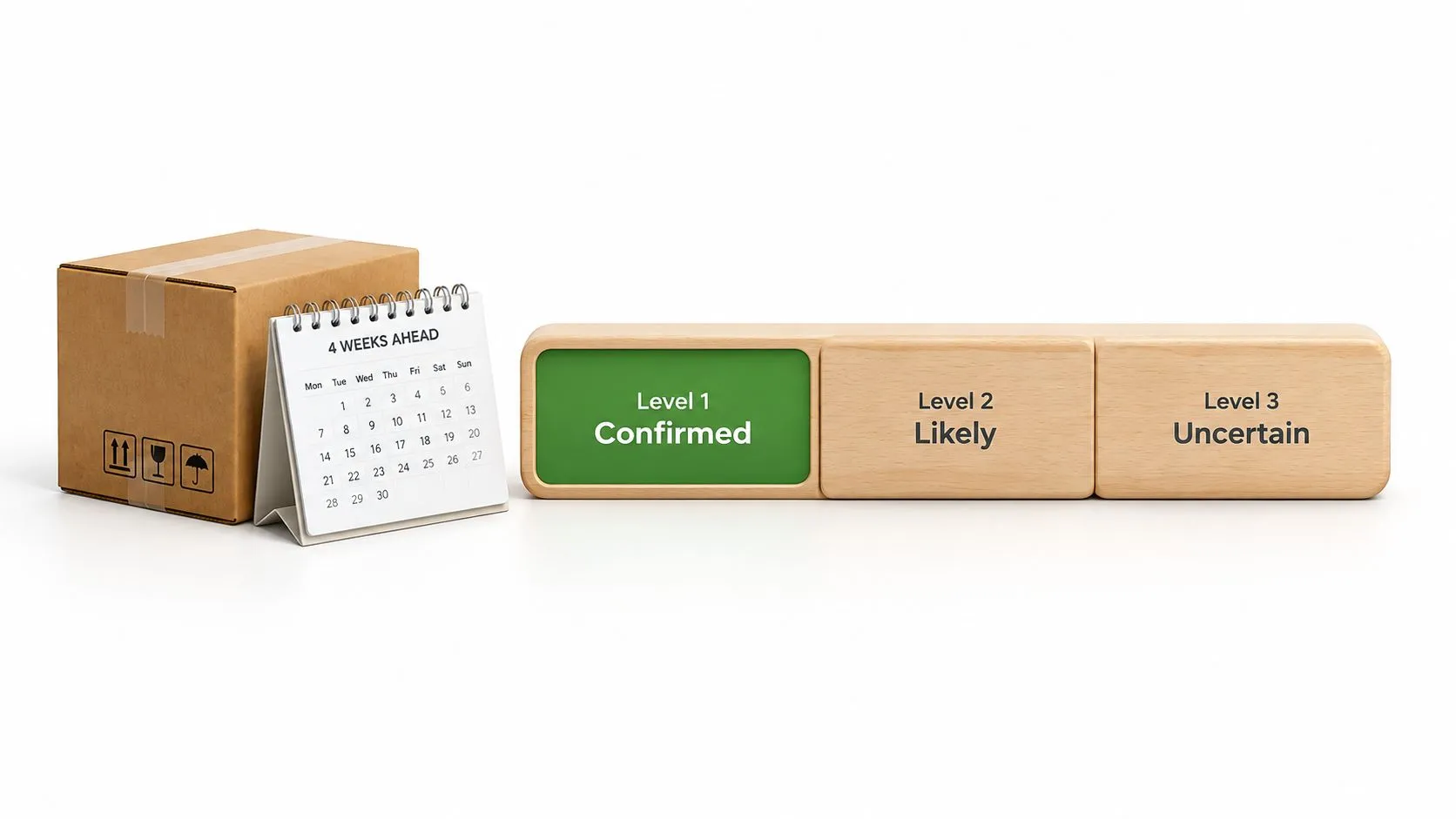
A [Zoho Inventory guide to backorders](https://www.zoho.com/inventory/academy/order-fulfillment/what-is-backorder.html) draws the line that most shop pages blur. A backorder normally means the seller expects future supply. It does not prove inventory is reserved, that the supplier confirmed a delivery date, or that the order cannot be canceled. An estimated restock date is not a firm fulfillment commitment.
| Confidence level | What the seller has | What the buyer should expect |
| --- | --- | --- |
| 1. Confirmed inbound stock | Purchase order placed; units in transit or tracked | Date is close to firm; cancellation is usually still possible until shipping |
| 2. Estimated replenishment | Supplier restock window given; no shipment tracked | Date is a target; delays of days or weeks are common |
| 3. Uncertain or no supplier commitment | Seller hopes for more units; no purchase order confirmed | Treat as a waitlist; the order may not be filled |
### What each level is worth
**Level 1, confirmed inbound stock**, is the only date close to firm. The seller has a purchase order, and the units are in transit or carry a supplier tracking reference. You can still cancel until it ships, but the box is real.
**Level 2, estimated replenishment**, is a target. The supplier named a restock window, and nothing is tracked yet. A date can slip by days or weeks without anyone having lied on day one. Wording like "arriving soon" usually sits here.
**Level 3, uncertain or no supplier commitment**, is a hope. There may be no purchase order at all. "No restock date" is the tell. Treat that order like a waitlist, because it may never be filled.
Scarce goods, imported goods, and marketplace sales where payment is taken before supply is confirmed should be read as Level 2 or lower until the seller shows a purchase order. A backorder is only as firm as the purchase order behind it.
## Confirm a Backorder Before You Pay
If the seller can answer the first three questions below in writing, treat the backorder as a Level 1 or Level 2 promise and pay. If not, treat it as a waitlist and wait for stock.
1. **Purchase order or a hope.** Ask whether a confirmed purchase order exists, or only a wish to restock.
2. **Current ship date.** Ask for today's estimated ship date, and whether it moved in the past month.
3. **Missed-date rule.** Ask what happens if that date passes, whether you get a notice, and whether a refund is offered.
4. **Cancellation.** Check whether you can cancel free of charge before the parcel ships.
5. **How you pay.** A checkout with buyer protection is safer than a bank transfer for a delayed order. The same habit applies to any delayed custom order, which is why bakers spell timing and remedies in [allergen terms for cake contracts](https://ovenbell.com/blog/cake-contract-template) before money changes hands.
6. **Your own deadline.** Note the date you would call the order failed, and set a reminder. A clear view of [order management activities](https://ruit.es/en/blog/order-management-activities/) shows why that date belongs on the order, not only in your head.
## What Backorders Do to Stock, Cash and Delivery Times
Each accepted backorder is an open obligation. The seller owes a shipment, and a refund route if that shipment fails. Those promises stack in the warehouse as a backlog long after the sale looked finished on the dashboard.
Cash often arrives at checkout, while the cost of the goods waits until restock. That timing helps cash flow when the supplier is reliable. It turns into a hole when the inbound date slips and refunds start leaving the account. The honest ship date is built from the parts below, not from a round number that sounds tidy.
| Step | Example time | What it covers |
| --- | --- | --- |
| Supplier restock lead time | 3 weeks | Time until the supplier can produce or ship new units |
| Inbound transit | 5 days | Carrier time from supplier to your warehouse |
| Receiving and packing | 2 days | Check-in, quality check and packing |
| Safety buffer | 4 days | Covers carrier and customs delays |
| Quoted ship date | About 4 weeks | Sum of the steps above, rounded up |
### Why the sum is the floor
In this example, three weeks plus five days, two days, and a four-day buffer already fill about four weeks. That sum is the earliest honest date. The date you publish should sit at or above it, never under it. Shaving the buffer to win the click is how a "4 weeks" badge becomes a six-week argument.
A missed date costs more than the sale it saved. Cancellations, refunds, and lost trust pile up, and a late date usually draws more support messages than an out-of-stock badge would have. People who have waited on a sofa already know the pattern described in [why furniture orders take so long](https://www.suburbanfurniture.com/why-is-my-furniture-taking-so-long/). Fix the lead-time breakdown before you decide to accept backorders at all, and keep the inbound cost visible in your [inventory accounting](https://ruit.es/en/blog/what-is-inventory-accounting/) so early cash is not mistaken for profit.
## When Sellers Should Accept Backorders
A backorder keeps the sale and the revenue. It also turns demand you would have lost into an open fulfillment obligation, and those obligations can become a later shipment backlog. Zero units on hand is not the deciding fact. You can have an empty shelf either way. The question is whether replenishment is credible enough to justify taking payment.
[Huboo's guide to ecommerce backorders](https://huboo.com/ecommerce/backorders/) puts the trade-off plainly. Preserving the sale is only half the story. Poor date accuracy raises support work, cancellations, refunds, and damage to trust. Backorders are not automatically better than a stockout.
| Factor | Accept backorder when | Show out of stock when |
| --- | --- | --- |
| Supply repeatability | Identical units reorder reliably | Each unit is unique or sourced one at a time |
| Supplier confirmation | Purchase order placed with a date | Restock is only a hope |
| Maximum acceptable delay | Delay can be stated in writing and kept | Delay is open-ended |
| Payment timing | Payment can be refunded or held until shipping | Payment is taken with no firm date |
| Overselling protection | Stock and status sync across all channels | Listings are updated by hand |
| Cancellation handling | Cancellation and refund take one step | Refunds need manual work |
For professional resellers, most second-hand stock is unique and bought one piece at a time. Calling that a backorder is misleading unless another identical unit is genuinely expected. A waitlist, a sourcing request, or an unavailable status is the accurate label. Backorders can lift conversion and cash flow when the six rows above are true. They do the opposite when the date is a guess.
> If you could not write the delay and the cancellation terms in the product description today, do not accept the order.
## How to Manage Backorders Without Overselling
A status the supply cannot back is where most broken promises start. The steps below keep the public date inside what you can document.
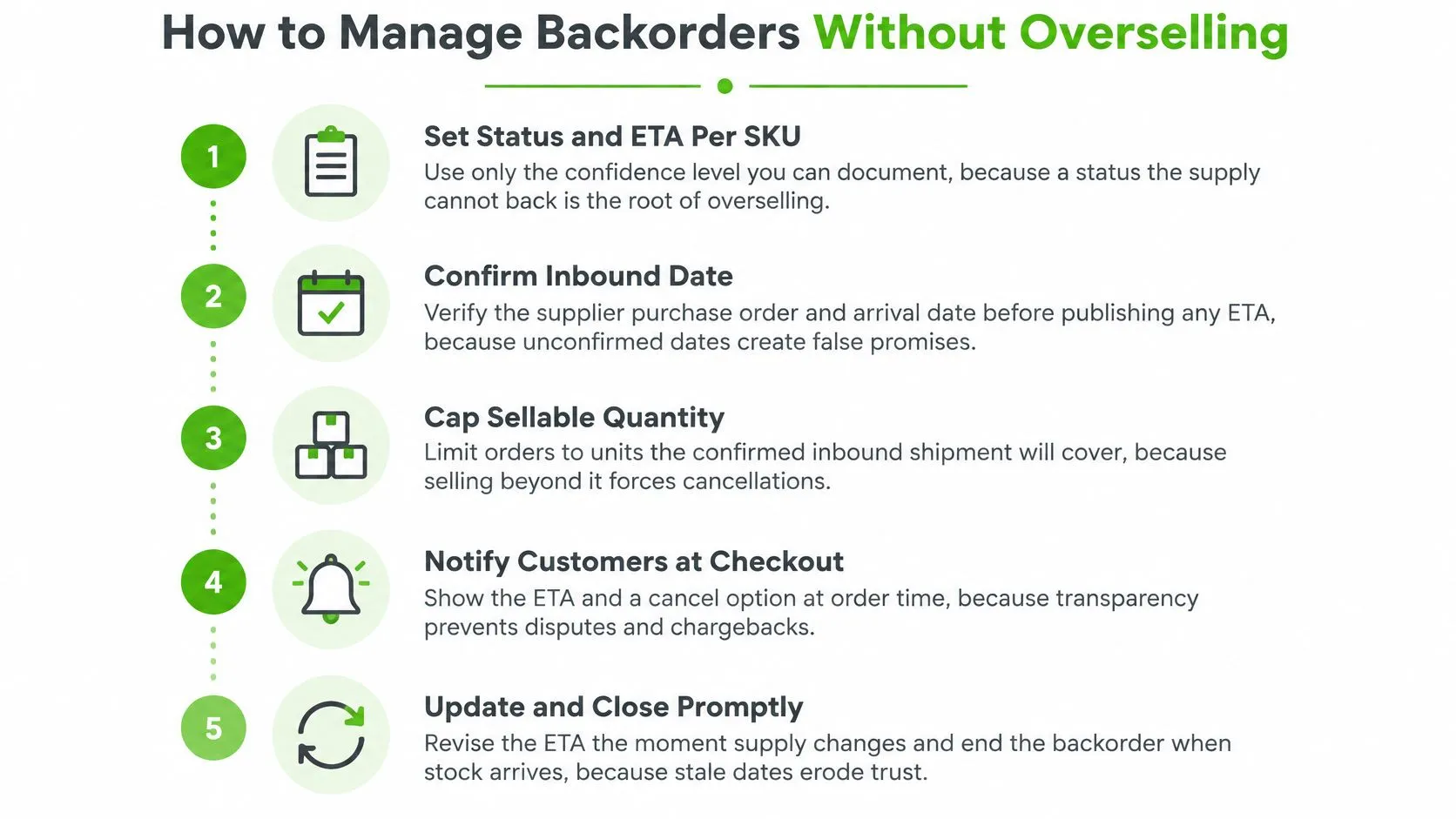
1. **Set a status and an ETA per SKU.** Use only the confidence level you can document. A hopeful badge on a SKU with no purchase order is the root failure, not a wording problem.
2. **Quote the ship date from the lead-time parts.** Add supplier time, transit, receiving, and the buffer. Publish that sum, not a shorter date chosen to look competitive.
3. **Lock stock across every channel.** A sale on one marketplace has to remove the item everywhere. Overselling happens when listings are updated by hand. Platforms that sync stock in real time and delist a sold item automatically close that gap, which is the point of [multi-channel inventory management](https://ruit.es/en/blog/inventory-management-multi-channel/).
4. **Publish the delay and the cancellation terms** in the listing and again in the order confirmation, so the buyer sees both before paying.
5. **Log each open backorder** with its supplier reference, expected date, and customer name. A shared log beats a memory.
6. **Allocate inbound units oldest first**, then ship inside the window you already stated.
7. **If the date slips, write before the old date passes.** Offer cancellation with a refund, and change the listing the same day.
The short walkthrough below shows the same sequence as a flow, from the status you can prove through to closing the order when stock lands.
Spreadsheet tracking is the first thing that fails as volume grows. Rows get skipped, two channels sell the last unit, and the apology email goes out after the buyer has already asked where the parcel is.
## Frequently Asked Questions
### What does back order mean?
A back order is an order a seller accepts for an item that is out of stock now, to be shipped once new units arrive. The ship date is an estimate, not a guarantee.
### What is the difference between a backorder and a pre-order?
A backorder sells a product that already exists but is out of stock today, and its date is an estimate. A pre-order sells a product that has not been released yet, on a date the seller sets at release.
### Is a backorder ship date guaranteed?
No. An estimated restock date is not a firm fulfillment commitment. Only confirmed inbound stock, with a purchase order placed and units in transit, gives a date close to firm.
### Can I cancel a backorder?
Only if the listing allows it before shipping. Check the cancellation terms before you pay, and ask the seller what happens if the estimated date passes.
### Should second-hand resellers accept backorders?
Usually not. Most second-hand stock is unique and bought one piece at a time, so a backorder is misleading unless another identical unit is genuinely expected. A waitlist or an unavailable status is the accurate label.
---
If you resell across several marketplaces, the hard part of a backorder is keeping one stock figure honest everywhere you sell. Ruit syncs inventory, pulls a sold listing off the other channels, and keeps orders in one place so you are not promising a unit you no longer hold. See how that works at [Ruit](https://ruit.es/en/).