# Cycle Count in Inventory: A Practical How-To Guide
Master cycle count in inventory with this practical guide. Learn scheduling, KPIs, common pitfalls, and how automation platforms streamline the process.
_Published: 2026-10-16 · Updated: 2026-10-16 · Source: https://ruit.es/en/blog/cycle-count-in-inventory/_
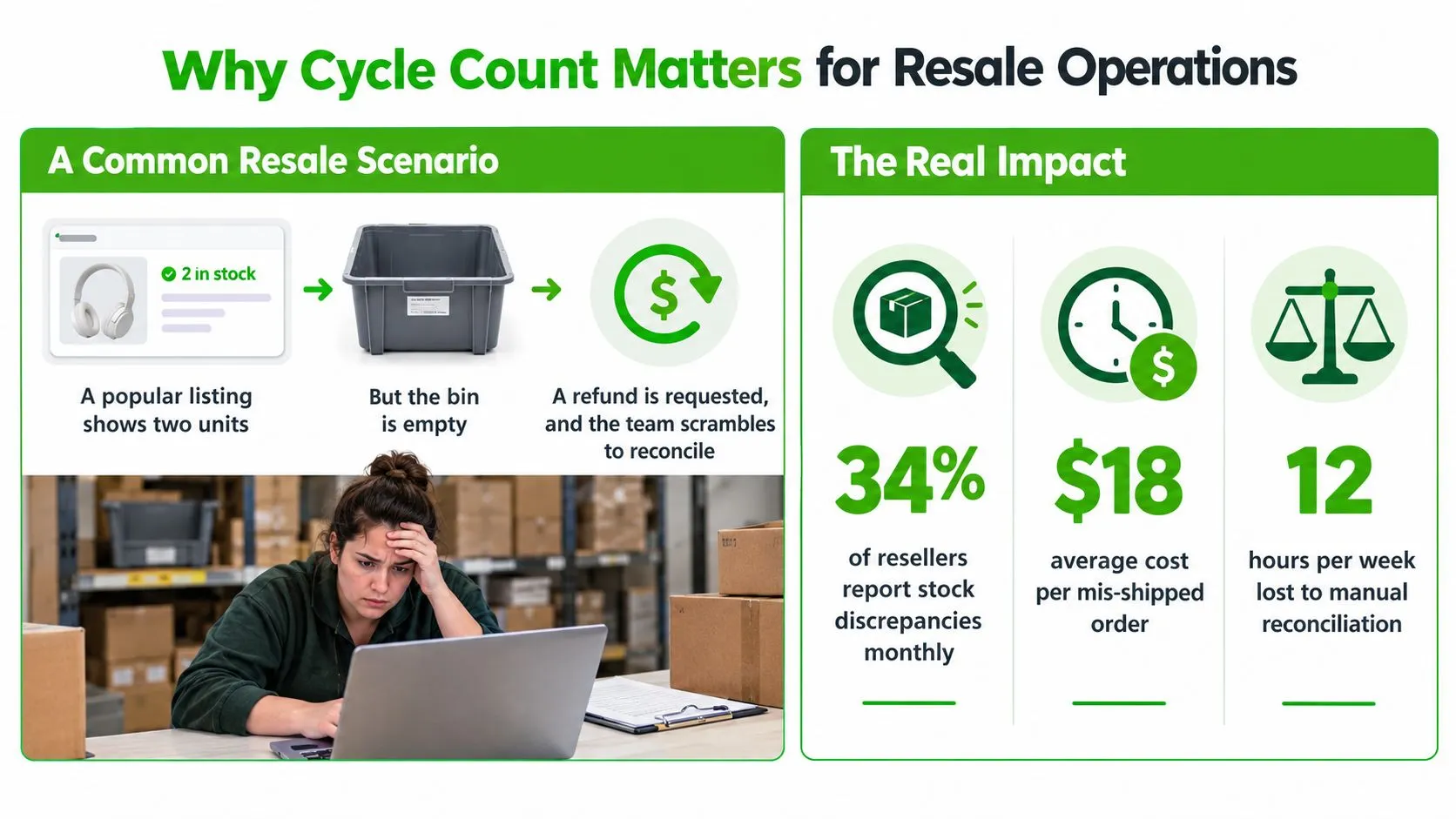
A cycle count problem usually shows up as a customer service problem first. A listing says there are two units available, the picker gets to the bin and finds nothing, someone checks Vinted, eBay, or the web store to see whether the item sold somewhere else, and now the team is issuing a refund instead of shipping an order. In second-hand resale, that kind of mismatch hurts more because many items can't be reordered.
That's why **cycle count in inventory** isn't just a warehouse routine. In a resale business, it's the operating control that keeps listings honest, pricing usable, accounting cleaner, and buyers from seeing stock that no longer exists. The generic advice built for standardized retail SKUs only gets you part of the way. When your stock is unique, graded, bundled, staged for photography, or live on several marketplaces at once, the actual job is reconciliation of **identity, state, and quantity**.
## Table of Contents
- [Why Cycle Count Matters for Resale Operations](#why-cycle-count-matters-for-resale-operations)
- [What breaks in second-hand stock](#what-breaks-in-second-hand-stock)
- [Cycle Counting vs Full Physical Inventory](#cycle-counting-vs-full-physical-inventory)
- [Where cycle counting wins](#where-cycle-counting-wins)
- [Where full counts still matter](#where-full-counts-still-matter)
- [Designing Your Schedule and SKU Priorities](#designing-your-schedule-and-sku-priorities)
- [Build classes around risk, not tradition](#build-classes-around-risk-not-tradition)
- [Sample ABC Frequency Matrix](#sample-abc-frequency-matrix)
- [Add random sampling to catch hidden process errors](#add-random-sampling-to-catch-hidden-process-errors)
- [Running a Count Step by Step](#running-a-count-step-by-step)
- [The operating sequence that works](#the-operating-sequence-that-works)
- [What to verify beyond quantity](#what-to-verify-beyond-quantity)
- [Root causes worth naming explicitly](#root-causes-worth-naming-explicitly)
- [When Automation and Platforms Pay Off](#when-automation-and-platforms-pay-off)
- [Why retail results don't map cleanly to resale](#why-retail-results-dont-map-cleanly-to-resale)
- [Use a break-even lens](#use-a-break-even-lens)
- [KPIs That Measure Accuracy](#kpis-that-measure-accuracy)
- [KPI one, binary record accuracy](#kpi-one-binary-record-accuracy)
- [KPI two, error severity](#kpi-two-error-severity)
- [Variance codes that lead to action](#variance-codes-that-lead-to-action)
- [Set thresholds, then manage to them](#set-thresholds-then-manage-to-them)
- [Your 30-Day Cycle Count Starter Plan](#your-30-day-cycle-count-starter-plan)
- [Week-by-week rollout](#week-by-week-rollout)
- [The short checklist](#the-short-checklist)
- [Frequently Asked Questions](#frequently-asked-questions)
## Why Cycle Count Matters for Resale Operations
The common failure mode is simple. Your system says an item is available, the shelf says otherwise, and the marketplace doesn't care why. It only sees a late shipment, a cancellation, or a refund request. In a resale operation, one bad record can spread through listings, order workflows, and financial records faster than teams expect.
A large empirical retail study showed just how normal record error is. Researchers examined **nearly 370,000 inventory records across 37 stores** and found that **65% of records were inaccurate** when compared with physical inventory. They also found that **26.4% of the variation** in inaccuracy occurred between product categories, while only **2.7%** occurred between stores, which matters because it suggests the way items are handled often matters more than location alone. The same study linked inventory-auditing practices with lower inaccuracy and found its model explained **67.6%** of the variation across stores and **69.0%** across product categories, according to the [Operations Management Science study on inventory record inaccuracy](https://ideas.repec.org/a/inm/ormnsc/v54y2008i4p627-641.html).
### What breaks in second-hand stock
Second-hand sellers are more exposed than standardized retailers because the record often needs to describe more than quantity.
- **Unique identity matters:** A vintage jacket in size M with one flaw is not interchangeable with the same brand in a different condition.
- **Channel exposure matters:** The same unit may be listed on Wallapop, Vinted, eBay, and a web store at the same time.
- **Process state matters:** An item can be received, staged for photos, reserved for an order, in returns inspection, or unsellable after damage.
That's why I treat counting as a control loop, not a headcount exercise for bins. If the wrong condition grade or listing ID is attached to the right quantity, your records are still wrong.
> Count what you can sell, not just what you can see.
Good merchandising decisions depend on accurate stock as much as good listings do. If you want a useful retail-side view of assortment and planning logic, [how merchandise planning drives sales](https://sprello.ai/blog/what-is-merchandise-planning-in-retail) is worth reading alongside counting discipline. The accounting side matters too, especially when corrections hit margins and cost records, which is why teams dealing with resale stock often need cleaner links between [inventory management and accounting](https://ruit.es/en/blog/inventory-management-and-accounting/).
## Cycle Counting vs Full Physical Inventory
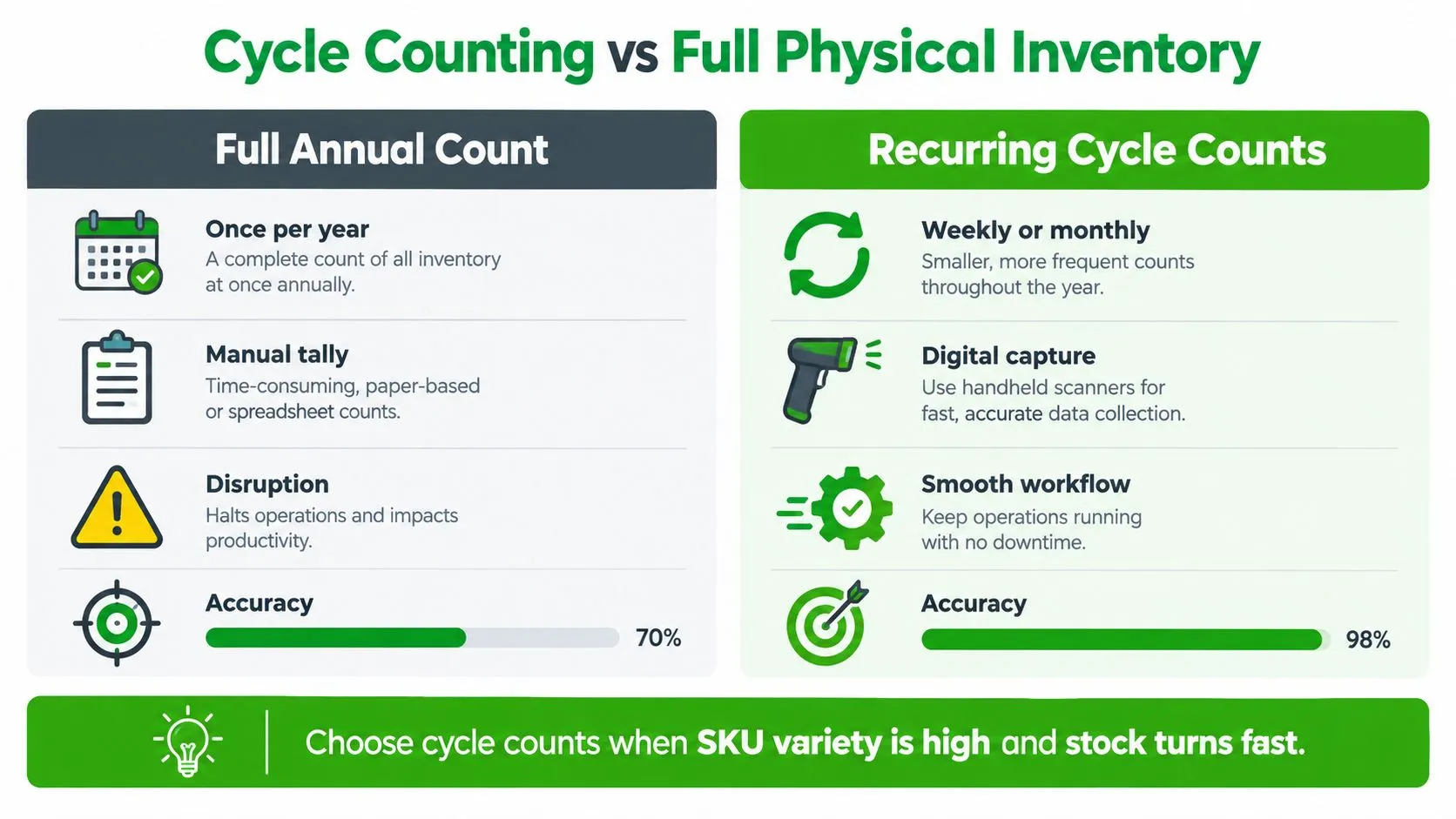
A full physical inventory gives you a big snapshot. A cycle count gives you a working control system. Those are not the same thing.
Full counts still have a place. They're useful for year-end controls, audits, ownership changes, or resetting a messy operation. But in a resale business, a wall-to-wall count ages almost immediately because items are received, listed, moved, sold, returned, and regraded constantly. If your catalog includes one-off products, the record can drift again the moment the count ends.
### Where cycle counting wins
Applied and academic work consistently frames cycle counting as a recurring alternative to relying only on annual physical inventory, with **ABC-based policies** that focus effort on the items that matter most. One documented policy counted **Group I items 12 times per year**, **Group II items 6 times per year**, and **Group III items about 1.2 times per year**, concentrating verification where value or risk was highest, as described in the [Georgia Southern review of cycle counting methods](https://digitalcommons.georgiasouthern.edu/cgi/viewcontent.cgi?article=1006&context=pmhr_2010).
That structure fits resale operations well because risk is uneven. A fast-moving pair of branded sneakers deserves more attention than a dormant low-value household item, even if both occupy one shelf slot.
| Approach | Best use | Main strength | Main weakness in resale |
|---|---|---|---|
| **Full physical inventory** | Financial reset, audit point, takeover cleanup | Comprehensive snapshot | High disruption, errors start accumulating again quickly |
| **Cycle counting** | Ongoing control of active stock | Finds mismatches closer to when they happen | Needs discipline and root-cause follow-up |
| **Blended policy** | Most growing resale teams | Stable baseline plus ongoing control | Requires clear ownership |
### Where full counts still matter
A recurring cycle count program doesn't replace every full audit. It reduces how often you need to rely on one. For a small reseller, that often means using cycle counting as the primary operating method and reserving occasional full counts for legal, accounting, or major process-reset moments.
> In second-hand inventory, the question isn't only “How many units are here?” It's “Is this the exact sellable item the system believes it is?”
## Designing Your Schedule and SKU Priorities
A count schedule earns its place when it directs limited labor toward the stock most likely to create a costly mistake. In resale, rank inventory by **financial exposure, sales velocity, and handling complexity**, not by unit count alone. A unique item sold through several channels can create more risk than a shelf of interchangeable units.
Use ABC classification to set the baseline, then add random checks. ABC directs routine effort toward known risk. Random sampling tests the parts of the catalog that your normal priorities may overlook, including neglected locations and inconsistent item states.
### Build classes around risk, not tradition
For second-hand inventory, an A item is not merely expensive. It may be difficult to replace, frequently transacted, or prone to errors that affect listings, reservations, and customer promises.
A practical classification looks like this:
- **A class:** Unique collectibles, premium electronics, designer apparel, and stock with active demand or limited replacement options.
- **B class:** Steady sellers with moderate exposure, repeatable enough to manage but still important to channel availability.
- **C class:** Low-value, slow-moving, or dormant stock where a small mismatch creates little immediate risk.
Set the calendar around those differences. If item identity is still inconsistent, improve the identifiers before increasing count frequency. A clear internal code can distinguish condition, bundle contents, and one-off units. This [guide to creating a SKU](https://ruit.es/en/blog/how-to-create-a-sku/) is useful when a catalog combines graded, bundled, and unique stock.
### Sample ABC Frequency Matrix
| Class | Profile | Count Frequency | Example Items |
|---|---|---|---|
| **A** | High value, fast-moving, or hard to replace | Monthly or more often if transaction activity is high | Serialized smartphones, rare trainers, luxury bags |
| **B** | Moderate value and steady movement | Every two months or on a fixed recurring schedule | Branded apparel basics, mid-range refurbished accessories |
| **C** | Low value, slow-moving, operationally low risk | Infrequent periodic counts | Dormant homewares, older media, clearance bundles |
ABC scheduling alone leaves blind spots. Set a fixed random sample for each cycle, large enough to expose process errors in neglected zones, but small enough to keep counting faster than a full audit. Keep the rule stable so results remain comparable from cycle to cycle.
### Add random sampling to catch hidden process errors
Random counts reveal problems that a value-based schedule may miss. A forgotten staging shelf, duplicate marketplace listing, or returns pileup can remain invisible until it affects a sale.
Draw samples across:
- **Neglected zones:** Photography tables, returns cages, and overflow shelving
- **Risky states:** Reserved items, pending payments, and delisted but not shelved stock
- **Control gaps:** Duplicate marketplace listings, incorrect variants, and wrong condition grades
Treat each sampled item as an identity-and-state check. Confirm that the physical unit matches the record, location, condition, listing status, and channel availability. If random counts reveal a repeated pattern, correct the handoff or system rule before adding more counting work. Frequency can detect symptoms, but process changes remove the cause.
## Running a Count Step by Step
A count only works if it holds up on a crowded Monday, with returns piling up, picks moving, and one-off items changing hands fast. In resale inventory, the job is not just to match a quantity. It is to verify **identity, condition, location, listing state, and saleability** for the exact unit in front of you.
### The operating sequence that works
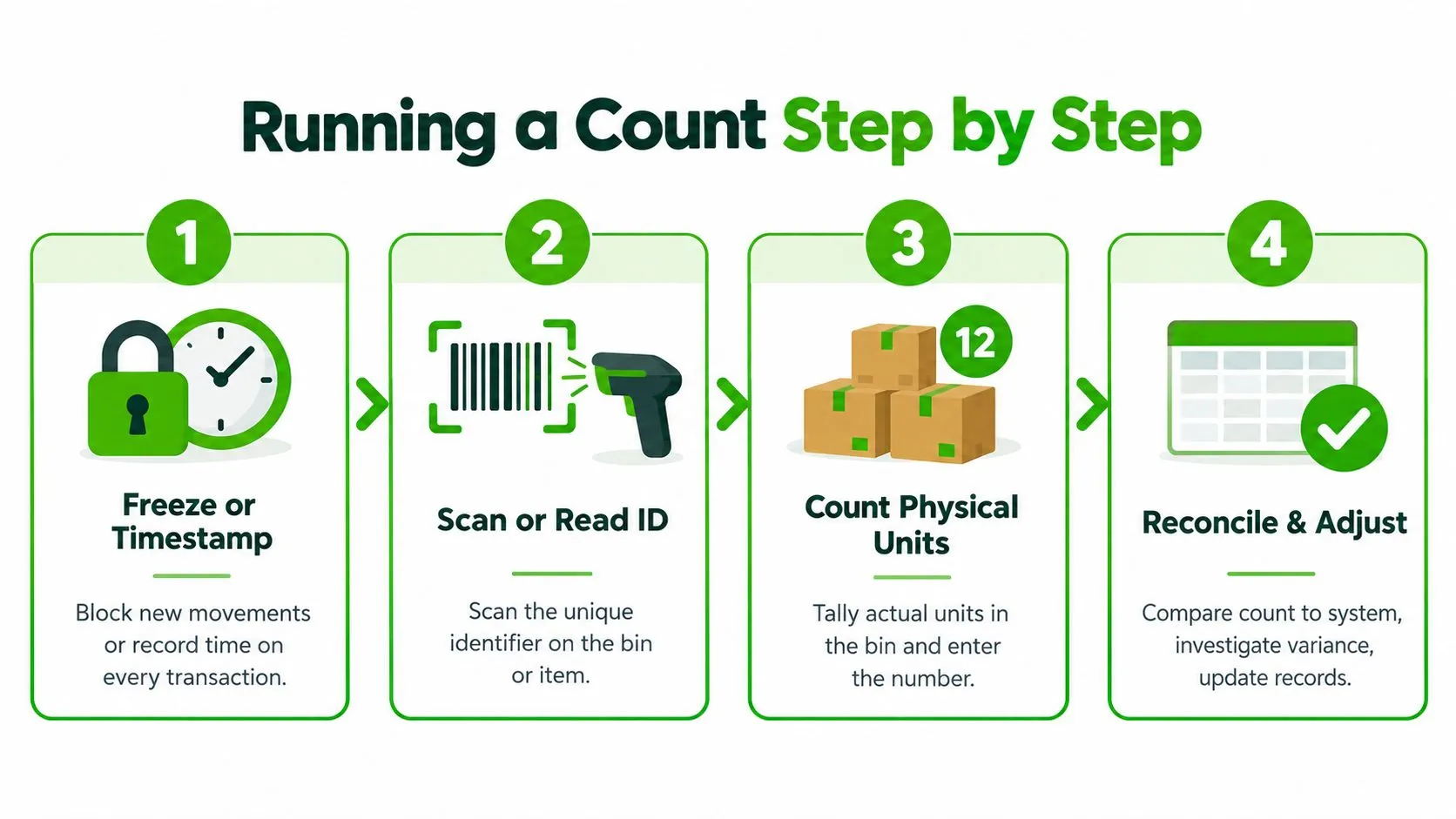
Use the same sequence every time.
1. **Freeze or timestamp movements**
Do not count through active movement. Pause transactions in the counted zone, or timestamp the moves so the team can reconcile against one clear moment.
2. **Scan or read the unique ID**
In resale, that may be a barcode label, serial number, listing ID, or internal item code. The point is to verify the exact unit, not just the shelf tag.
3. **Count the physical item or units**
Check the item in hand against the record. For one-off products, confirm variant, bundle completeness, accessories, and visible condition.
4. **Compare, investigate, then adjust**
Record the absolute variance, review the transaction trail, identify the most likely root cause, and approve the adjustment only after that review.
A short walkthrough helps teams settle into the rhythm.
### What to verify beyond quantity
Generic warehouse guidance often stops at “count the SKU.” That misses the point for mixed second-hand stock. I would include these control fields in every count record:
- **Item identity:** Serial number, unique SKU, or listing identifier
- **Condition state:** New with tags, refurbished grade, flaw noted, incomplete set
- **Location:** Bin, rail, shelf, returns area, staging area, photo station
- **Marketplace status:** Live, reserved, sold, draft, delisted, pending return
- **Bundle and variant integrity:** Charger included, left and right shoe paired, correct colorway and size
> **Practical rule:** If the item can be sold incorrectly because of the record, that field belongs in the count.
For discrepancy handling, I would keep unique, high-value items at a **0-1%** tolerance and only relax that where the labor cost is easier to justify than the stock risk. Repeated variance on the same item should be escalated instead of patched over with another adjustment.
### Root causes worth naming explicitly
When a variance appears, do not file it under “inventory error.” That label hides the process failure.
Common causes in multi-channel second-hand stock include:
- **Receiving error**, the item arrived but was never booked correctly
- **Duplicate listing**, one unit was exposed twice across channels
- **Unrecorded sale**, the order happened but stock did not update
- **Return mismatch**, the item came back in a different state than expected
- **Relocation error**, the unit moved to photography or overflow without a system update
- **Condition or variant mismatch**, the quantity exists but the sellable identity is wrong
Repeated errors on the same item class usually mean the count team is not the problem. The upstream workflow is.
## When Automation and Platforms Pay Off
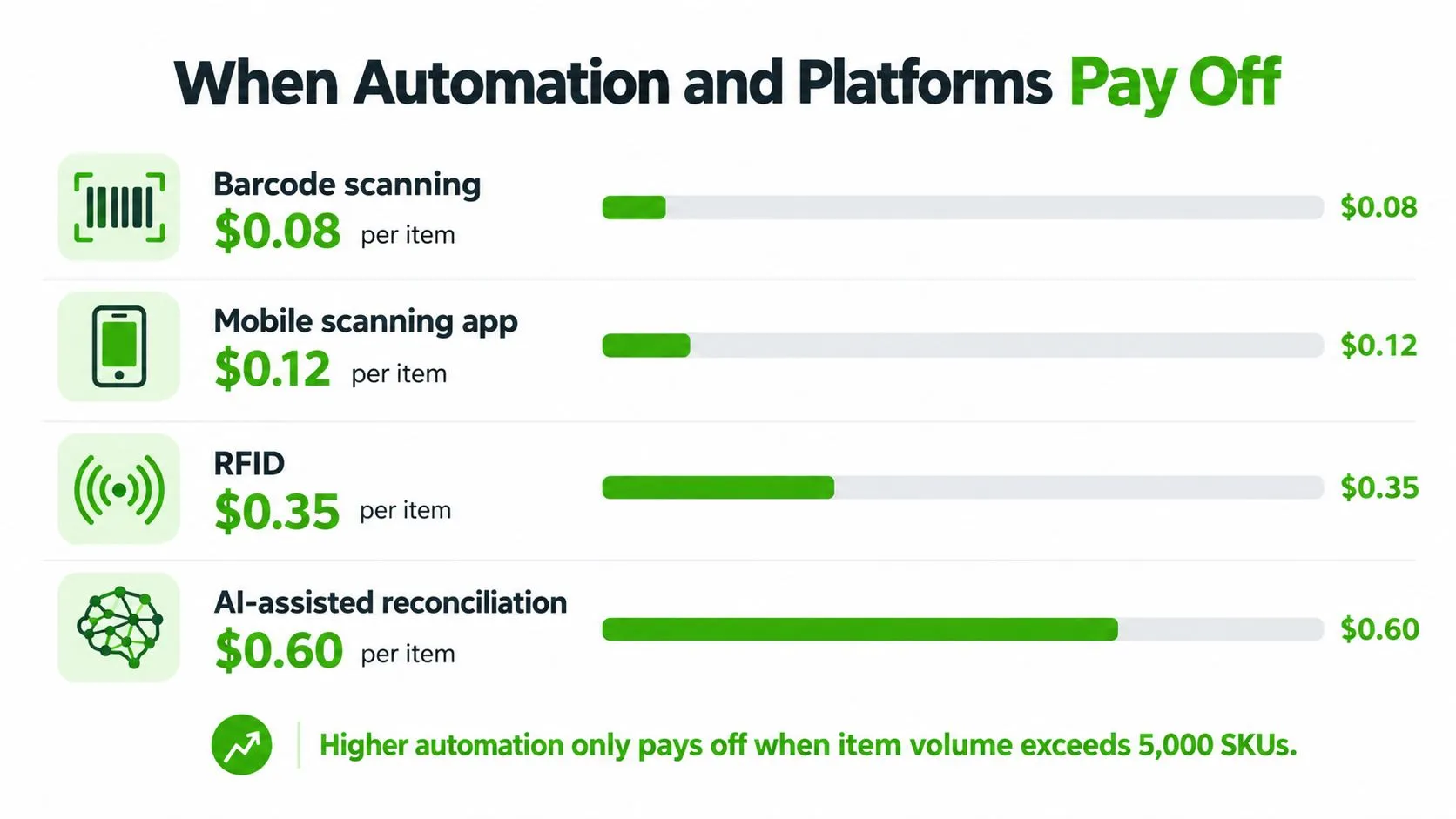
There's a lazy story in inventory tech that says more automation is always better. It isn't. The right question is whether the tool lowers the **total cost per verified sellable item**, not whether it sounds advanced.
For standardized retail, RFID can be a clear win. A reported Auburn University and GS1 US comparison found inventory accuracy improved from **63% with barcodes to 95% with RFID**, and cycle-count time fell **96%**, but those results came from retail environments and shouldn't be assumed to transfer directly to mixed-condition resale inventory, as summarized in [Levata's review of RFID inventory management evidence](https://www.levata.com/news/rfid-inventory-management-explained).
### Why retail results don't map cleanly to resale
A resale item often requires visual verification at the moment of count. You're not just asking whether the tag is present. You're checking whether the exact item, in the expected condition, with the correct accessories, is still sellable and attached to the right listing.
That changes the economics:
| Tool | Strong fit | Weak fit |
|---|---|---|
| **Manual count** | Very low-density stock, tiny catalog, owner-operated workflow | Hard to scale, easy to miss state changes |
| **Barcode or QR labels** | Strong baseline for unique item IDs and shelving discipline | Still relies on people to verify condition correctly |
| **Mobile scanning app** | Best balance when each item needs visual confirmation | Less useful if storage is highly automated |
| **RFID** | High volume, repeatable retail items, rapid bulk verification | Awkward when each piece is unique, irregular, or condition-graded |
| **AI-assisted reconciliation** | Helpful for data cleanup, listing matching, anomaly review | Weak if the physical process underneath is sloppy |
### Use a break-even lens
Before buying hardware or chasing AI workflows, map the hidden costs:
- **Setup costs:** Labels, readers, printers, software, integrations
- **Exception handling:** Recounts, unreadable tags, duplicate records, returns
- **Training burden:** Can new staff execute it without improvising
- **Operational gain:** Fewer oversells, faster listing, cleaner reconciliation, better labor use
For many second-hand businesses, **mobile barcode scanning** beats RFID because the team already has to touch the item and inspect it. If you want a practical view of the business case behind scanning, this article on [barcode system ROI for e-commerce](https://hello.quikly.com/blog/barcode-inventory-management-system) is a useful companion read. And if your bottleneck sits in cross-channel updates rather than counting speed alone, broader [ecommerce automation software](https://ruit.es/en/blog/ecommerce-automation-software/) decisions often matter more than adding another counting device.
## KPIs That Measure Accuracy
A count can look clean on paper and still leave the operation unstable. That usually happens when teams track only the share of exact matches and ignore how bad the misses are when they do happen. For resale stock, especially unique and condition-graded items moving across channels, you need one KPI that shows how often records are right and another that shows how costly the errors are.
Start with the basic definition. Inventory accuracy is the share of checked records that match the physical item and its recorded state. In one benchmarking study, a best-in-class result of **99.946%** was reported in an environment that combined cycle counting with RFID-supported storage and picking, plus system enforcement and tracking, as documented in the [warehouse benchmarking study from the Information Technology Research Institute](https://bpb-us-e1.wpmucdn.com/wordpressua.uark.edu/dist/7/795/files/2016/08/ierc_2001c_oldham.pdf). That figure is a useful target for ambition, not a plug-and-play result for a resale operation where identity, condition, and channel status all matter at once.
### KPI one, binary record accuracy
This is the simplest measure, and it still belongs in the dashboard.
**Binary record accuracy** asks one question. Did the checked record match, yes or no? The strength of this KPI is that supervisors, pickers, and sorters can all understand it quickly, and you can trend it by class, location, or operator without a lot of explanation.
Use it to compare:
- **By inventory class:** A, B, and C items
- **By location type:** active picking bins, staging, returns, overflow
- **By channel exposure:** listed everywhere, listed on one channel, awaiting listing
That makes it easy to spot process breakpoints. If staging shelves consistently underperform formal storage, the issue is usually the handoff, not the count itself.
### KPI two, error severity
A simple pass or fail view hides expensive misses. Ten exact matches do not offset one serious mistake on a high-value unique item. That is why a stronger setup pairs binary accuracy with a severity metric such as **mean absolute percentage error**, the approach recommended in the Penn State analysis of inventory record accuracy measurement.
Severity answers a different operational question. It does not ask only whether records are right. It asks how much damage a miss creates when the record is wrong.
> A count program looks healthy only when exact-match rates improve and large variances become rarer.
For second-hand businesses, I also separate severity into two views:
- **SKU accuracy:** Did the exact item record match?
- **Quantity-weighted accuracy:** Did the volume exposure stay close enough to avoid selling problems?
That distinction matters because a one-off watch and a pile of low-value media items do not carry the same risk. A small miss on the watch can block a sale, trigger a support issue, or force manual repair work. The media pile may be noisy, but it is usually less dangerous.
### Variance codes that lead to action
Every discrepancy needs a cause code. Without that, the KPI dashboard turns into a scoreboard with no diagnosis.
Use codes that point to the first workflow change worth trying:
| Variance cause | First fix to try |
|---|---|
| **Receiving error** | Tighten intake checks so the item identity, condition, and quantity are confirmed before stock hits active storage |
| **Duplicate listing** | Require a one-item-one-record rule before publication, then block reuse of the same identity across channels |
| **Unrecorded sale** | Reconcile order sync and manual sales posting at the end of each shift |
| **Return** | Separate return intake from normal receiving and force a state check before restock |
| **Relocation** | Make every move carry a location update at the point of movement |
| **Damage** | Add a condition check before restocking or repricing |
| **Shrinkage** | Review access controls and investigate missing items in the last known location |
| **Condition or variant mismatch** | Force a final visual match on grade, size, color, accessory set, or bundle contents before listing |
This matters more than it first appears. If duplicate listings dominate, counting faster will not fix the problem. If returns are driving the errors, the fix belongs in reverse logistics and grading, not in the count room.
### Set thresholds, then manage to them
A cycle count program gets serious when you manage to an explicit threshold instead of celebrating completed counts. Start with a representative sample. Then calculate your baseline for binary accuracy and your severity metric. From there, tighten tolerance for unique and high-value items, and only allow looser tolerance where the unit economics justify it.
The useful habits are operational, not ceremonial:
- **Review repeated variances first:** The same mismatch on the same item or process matters more than isolated noise.
- **Prioritize active-risk stock daily:** Items with active orders, recent marketplace movement, or strong sales velocity should get first attention.
- **Count dormant stock periodically:** Slow movers still matter, but they do not deserve the same labor every day.
The result is a KPI set that changes behavior. Teams stop arguing about whether the count was completed and start asking whether the stock record is trustworthy enough to sell from.
## Your 30-Day Cycle Count Starter Plan
Don't start with the whole building. Start with the stock that can hurt you fastest.
### Week-by-week rollout
**Days 1 to 7**
Choose one controlled area and define your first A-class cohort. Pick items that are high value, fast-moving, unique, or currently exposed on multiple channels. Clean the identifiers first so each record points to one real item.
**Days 8 to 14**
Run the first count using a frozen or timestamped window. Record every variance with a cause code, not just an adjustment note. If the same issue appears more than once, inspect the workflow that created it.
**Days 15 to 21**
Review the results and change one operating rule. That might be stricter location discipline for photography tables, better return intake, or a rule that every duplicate listing check happens before publication.
**Days 22 to 30**
Schedule the next count immediately. Keep A items on the shortest cadence, add a small random sample outside the class, and create a standing review for repeated variances.
### The short checklist
- **Pick one zone:** Don't spread effort across the whole operation.
- **Choose one priority class:** Start where record error creates direct selling risk.
- **Use cause codes:** Every mismatch should teach you something.
- **Escalate repeats:** Don't normalize the same variance every week.
- **Keep tolerances sensible:** Tight for unique or high-value items, looser only where the economics allow it.
The teams that get value from cycle count in inventory don't treat it as a ritual. They use it to find where reality and the system diverge, then they repair the process that created the gap.
---
If you run second-hand stock across marketplaces, [Ruit](https://ruit.es/en/) gives you one operating system for sourcing, inventory, multichannel listings, stock sync, orders, accounting, and analytics.
That matters for cycle counting because cleaner identifiers, real-time delisting, unified stock updates, and one source of truth reduce the exact data errors that counts keep uncovering.
## Frequently Asked Questions
### What is a cycle count in inventory?
A cycle count checks a small part of your stock on a recurring schedule instead of counting everything at once. In resale, each count verifies the identity, condition, location, listing state and quantity of the exact unit, so records stay accurate between full counts.
### How is cycle counting different from a full physical inventory?
A full physical inventory gives one comprehensive snapshot, useful for year-end controls, audits or resetting a messy operation, but it ages quickly when items are received, listed, sold and returned every day. Cycle counting is an ongoing control that finds mismatches closer to when they happen.
### How often should each ABC class be counted?
Count A items, the high-value, fast-moving or hard-to-replace stock, monthly or more often. Count B items every two months or on a fixed recurring schedule, and C items in infrequent periodic counts. Add a small random sample each cycle to catch the errors the schedule misses.
### Which KPIs show whether cycle counting works?
Track binary record accuracy, the share of checked records that match, together with an error severity metric such as mean absolute percentage error. The first shows how often records are right; the second shows how costly the misses are.
### Is RFID worth it for second-hand stock?
Not always. RFID suits high-volume, repeatable retail items. When each piece is unique or condition-graded, mobile barcode scanning is often the better fit, because the team already has to handle and inspect the item.