# How to Get Discounted Shipping Rates as a Reseller
Learn how to access discounted shipping rates for your resale business with practical methods for carriers, marketplaces, and multichannel tools.
_Published: 2026-10-17 · Updated: 2026-10-17 · Source: https://ruit.es/en/blog/discounted-shipping-rates/_
A reseller can have listings moving across Vinted, eBay, and Wallapop, steady orders, and still wonder where the margin went. Shipping is often the culprit: the label price seems reasonable until fuel, residential delivery, dimensional weight, and other charges land on the invoice. A discounted rate can look like a win and still cost more per parcel than another option.
The useful measure isn't the headline discount. It's the **all-in cost per parcel**, matched to what you sell, where you ship, and how your carrier bills. Treat discounted shipping rates as an operating system of choices, from marketplace labels and postal pricing to carrier contracts and packaging, rather than a single deal to negotiate.
## Table of Contents
- [Why Shipping Costs Eat Into Reseller Margins](#why-shipping-costs-eat-into-reseller-margins)
- [Where Discounted Shipping Rates Come From](#where-discounted-shipping-rates-come-from)
- [The Accessorial Charges That Reverse Headline Discounts](#the-accessorial-charges-that-reverse-headline-discounts)
- [Matching Discount Mechanisms to Your Monthly Volume](#matching-discount-mechanisms-to-your-monthly-volume)
- [Comparing Carrier Programs, Marketplaces, and Aggregators](#comparing-carrier-programs-marketplaces-and-aggregators)
- [Dimensional Weight, Packaging, and the Hidden Volume Lever](#dimensional-weight-packaging-and-the-hidden-volume-lever)
- [Audit the parcel before the carrier reclassifies it](#audit-the-parcel-before-the-carrier-reclassifies-it)
- [Negotiate from shipment data, not a headline](#negotiate-from-shipment-data-not-a-headline)
- [Your 30-Day Discounted Shipping Setup Plan](#your-30-day-discounted-shipping-setup-plan)
- [Frequently Asked Questions](#frequently-asked-questions)
## Why Shipping Costs Eat Into Reseller Margins
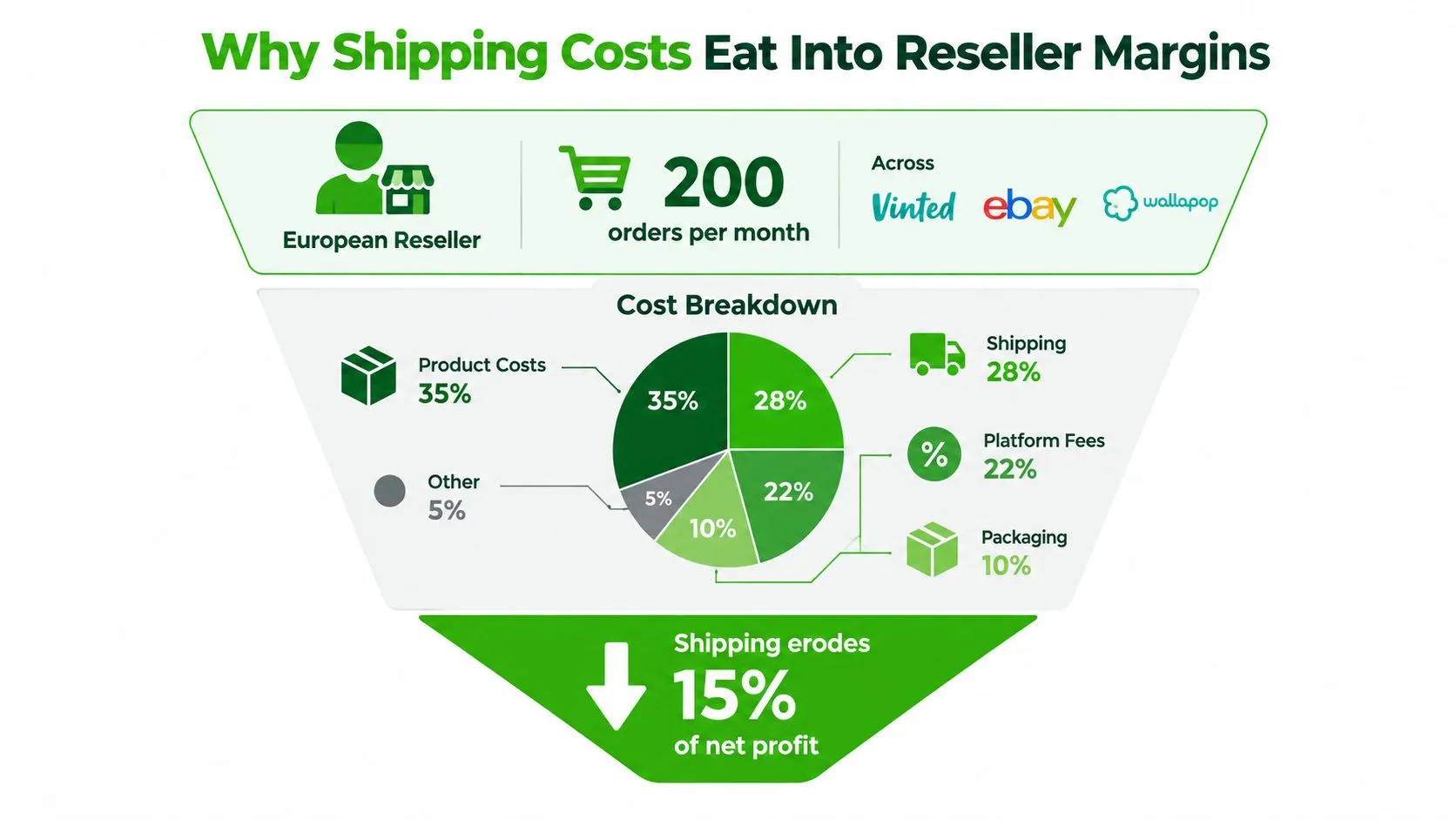
At 200 orders a month across Vinted, eBay, and Wallapop, a reseller may find that shipping has become the second-largest cost after sourcing. That's a practical warning, not a universal cost breakdown: the actual share depends on product prices, parcel sizes, destinations, and who pays for delivery. The problem is easy to miss when each order is assessed on its own. A few extra charges on a single label look small, but repeated across a busy operation, they narrow the contribution margin available to cover labor and overhead.
A published discount percentage won't tell you whether a carrier is affordable for your actual parcels. One option may be strong on small domestic orders and poor on bulky goods or remote destinations. Another may show a higher base rate but come out cheaper after surcharges. Before changing providers, pull a sample of invoices and compare the total charge by parcel type, service, and destination.
> **Practical rule:** Compare what you pay per shipment, not the discount printed beside the base rate.
Shipping also connects to decisions made elsewhere in the business. A seller who offers free delivery needs to know how shipping changes the delivered price and what that does to the margin on each listing. For a useful companion on that choice, see this guide to [setting up free shipping on eBay](https://ruit.es/en/blog/how-to-put-free-shipping-on-ebay/). Sellers who handle devices or other goods sent in for service may also need a reliable way to track inbound and outbound parcels; [mail-in repair tracking](https://benchkey.com/mail-in) can help clarify that workflow.
The right setup is a combination of decisions: which label source to use, when a direct account makes sense, what packaging fits each item, and how to check charges after delivery. Shipping economics aren't solved by one contract. They improve when sellers measure the whole parcel journey and adjust the parts that repeatedly erode margin.
## Where Discounted Shipping Rates Come From
A second-hand seller buying labels through a marketplace may already have access to discounted shipping rates without a carrier contract. The saving comes from the purchasing channel. Postal commercial pricing is available through approved channels; marketplaces provide platform-arranged rates; aggregators offer services through one account. Direct carrier agreements tie pricing to the shipper's volume and commitments. These routes carry different obligations, even when their headline discounts look similar.
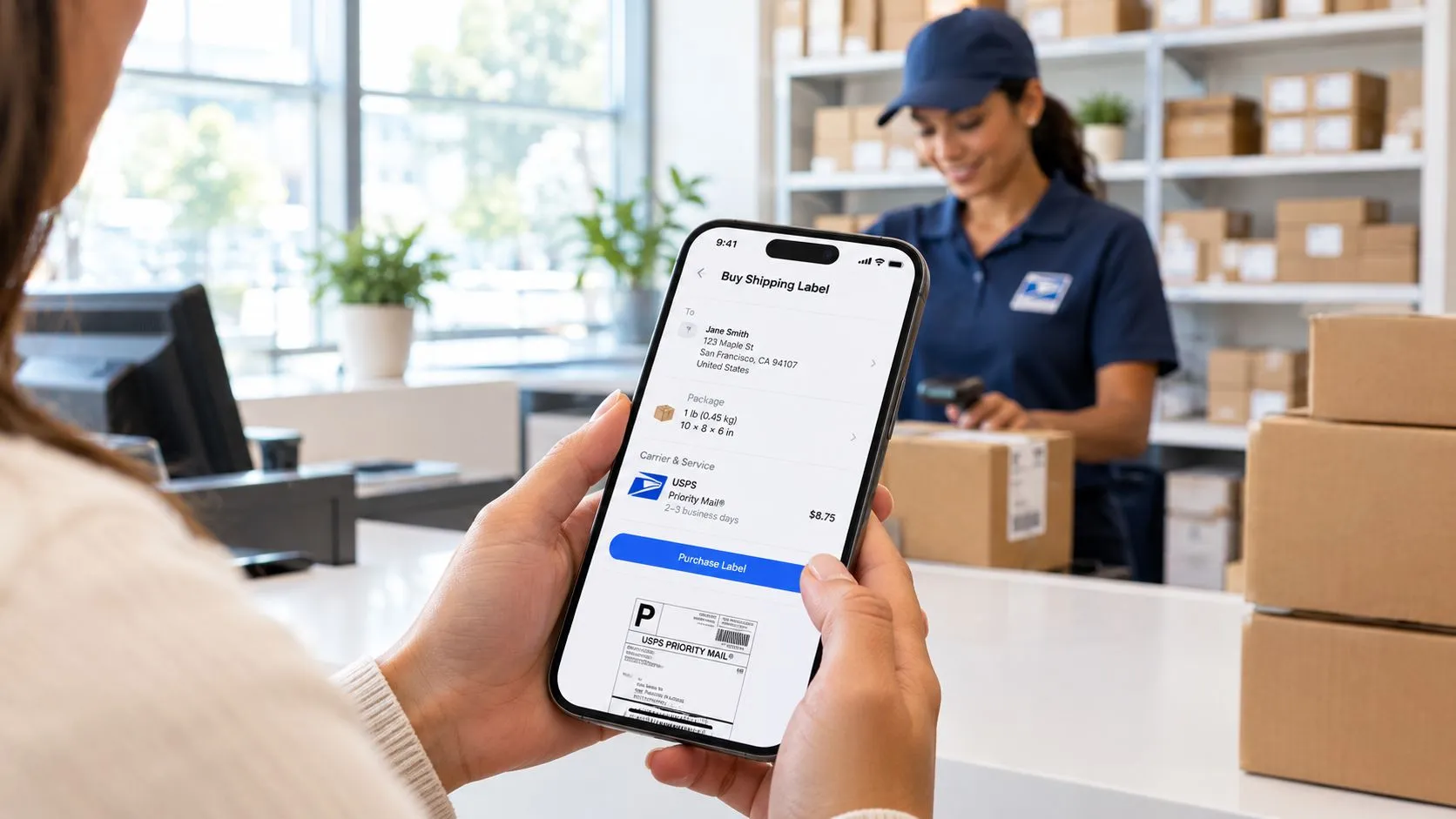
The USPS example illustrates commercial pricing. USPS combined Commercial Base and Commercial Plus into a single framework in January 2019, broadening access through approved online shipping channels; one published comparison lists a Priority Mail Express flat-rate envelope at **$33.46 with commercial pricing versus $38.25 at the post office**, saving **$4.79, or approximately 12.5%** ([shipping-cost calculations and pricing context](https://www.shipbob.com/ecommerce-shipping/calculate-shipping-costs/)). Treat that as a service-specific comparison, with no assumption that the same reduction applies across your parcels.
Access and control are separate decisions.
For a European reseller, the USPS example explains the mechanism, but local service terms determine the saving. Marketplace labels reduce setup work, though carrier choice and invoice visibility may be limited. Aggregators make service comparison easier, provided quotes account for your parcel dimensions and applicable charges. Direct contracts offer room to negotiate, alongside commitments, minimum charges and volume bands that need checking against actual monthly shipments.
Use monthly volume to assess whether those commitments are sustainable. At lower volumes, accessible platform pricing may avoid a commitment you cannot meet. As shipments become more predictable, compare a direct offer against the landed cost per parcel through your existing channel, including surcharges, dimensional weight and minimums.
Occasional shipments beyond parcel limits need a separate pricing comparison. Peak Transport's [2026 LTL shipping rate guide](https://www.peaktransport.co/blog/less-than-truckload-shipping-rates) provides context for less-than-truckload pricing. Keep those movements separate when evaluating parcel discounts so an unsuitable transport model does not distort the comparison.
## The Accessorial Charges That Reverse Headline Discounts
A carrier invoice can include far more than the transportation rate. Fuel, residential delivery, remote-area service, address corrections, peak fees, and dimensional-weight adjustments can all change the final bill. Industry analyses estimate that surcharges can make up **35% to 50% of the final invoice**; in one example, a **20% discount on the base transportation rate translated into only about 10% to 12% savings on total shipping spend** ([analysis of business shipping costs and surcharges](https://www.cahoot.ai/how-do-businesses-ship-so-cheap/)). A discount can be real and still deliver much less savings than its headline suggests.
Fuel surcharges are especially easy to overlook because they may vary over time and apply as a percentage of transportation charges. Residential and remote-area fees add costs tied to the destination, while address-correction charges can appear when entered details don't match carrier records. Dimensional-weight adjustments can raise a parcel's billable weight after the carrier measures it, and additional-handling or peak charges can further widen the gap between the quote and the final invoice.
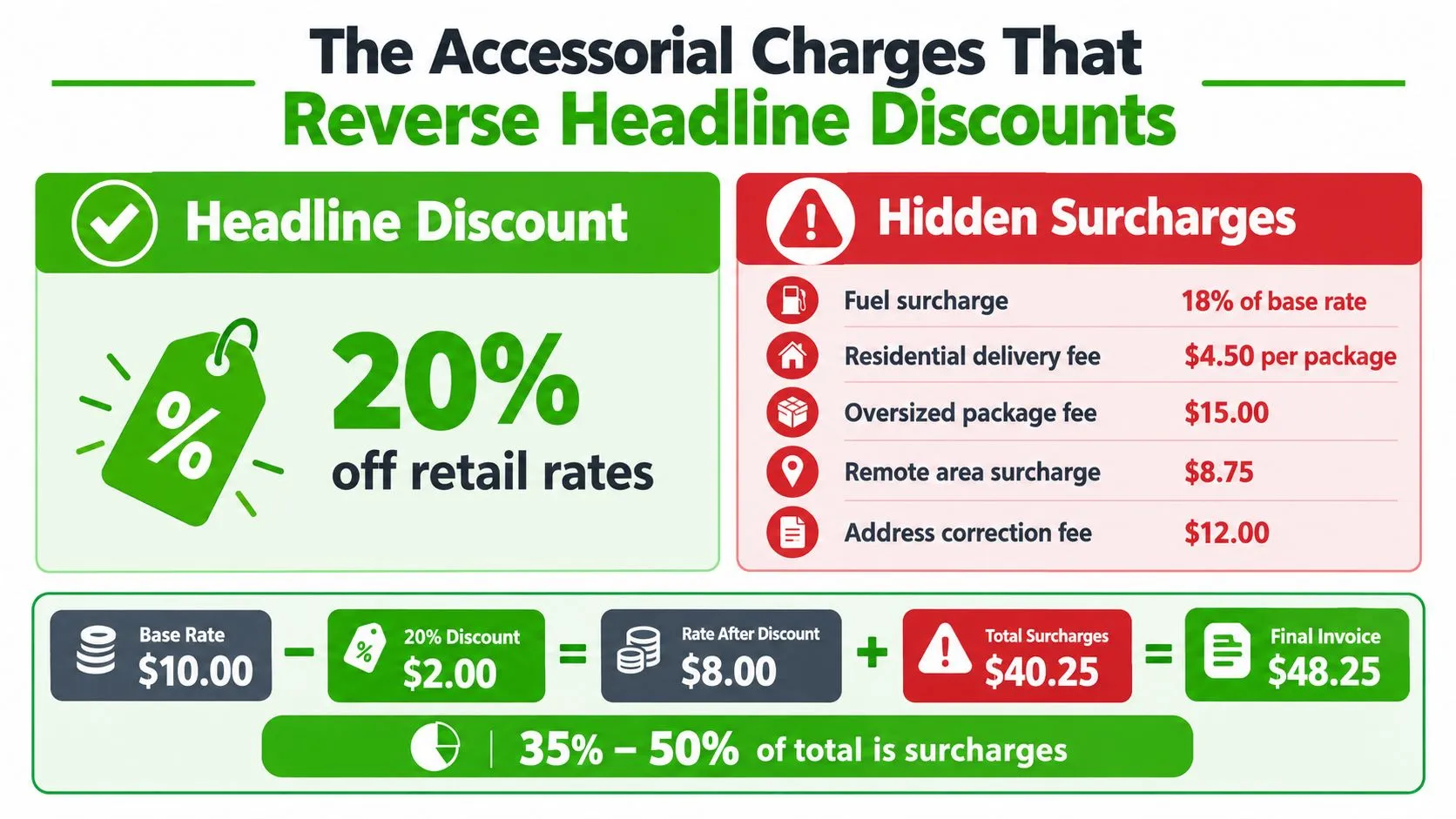
A useful invoice review compares each charge, not just each carrier's starting price. One provider might offer a lower transportation rate but apply a fee to a parcel type or delivery location that occurs often in your orders. Another may have a higher base rate but fewer relevant extras. Don't assume that either is cheaper for every destination or package profile. Check the actual billed charge against the original label details and note recurring differences.
Recent 2025 reporting cited in the shipping-surcharge overview describes international fuel surcharges averaging roughly **30%**, residential delivery charges of approximately **$5 to $7 per parcel in some markets**, and remote-area fees beginning near **$14**. The same overview describes FedEx's 2025 changes as including an average rate increase of about **5.9%**, residential surcharges above **$7.50**, and additional-handling increases of approximately **26% to 28%** ([shipping surcharges in ecommerce](https://www.freightamigo.com/en/blog/ecommerce-logistics/navigating-shipping-surcharges-a-comprehensive-guide-for-ecommerce-businesses/)). These are reported examples, not charges that apply identically to every account, service, or destination.
Use the invoice to answer a more useful question than “What's my discount?” Ask: **What's the landed cost per parcel for this service, package, destination, and season?** That comparison is where a cheaper-looking offer either proves itself or falls short.
## Matching Discount Mechanisms to Your Monthly Volume
A second-hand reseller shipping irregular batches needs different terms from one dispatching a steady stream of similar parcels. Monthly volume gives you a starting point, but consistency, package size, and destination mix determine whether a discount agreement pays off. Choose the mechanism that lowers landed cost per parcel without committing the business to spending it cannot sustain.
Start with accessible commercial pricing through postal or online channels, marketplace labels, or a multi-carrier tool. Build a shipment baseline before approaching carriers: record parcel dimensions, destinations, services, and final billed costs. For a European reseller with varied stock, separate compact clothing orders from bulky items when comparing offers. A blended average can hide an expensive parcel category.
One [business shipping rate analysis](https://www.cahoot.ai/how-do-businesses-ship-so-cheap/) estimates business-account pricing at **20% to 40% below consumer list rates**, with additional negotiated reductions of **5% to 15% off commercial base rates** around 10,000 parcels monthly and **20% to 30% off commercial base rates** around 100,000 parcels monthly. These are single-source estimates, not corroborated benchmarks or guaranteed offers. They do not establish eligibility thresholds or savings after surcharges.
The table is a practical decision framework, not a schedule of carrier contract tiers. Compare each route against your own billed parcel mix.
| Monthly volume | Mechanism to evaluate | What must improve | Main trade-off |
|---|---|---|---|
| Under 50 parcels | Marketplace labels, postal commercial pricing, aggregator rates, or pickup-point options | Landed cost against current retail pricing | Service restrictions or fees can offset the lower label price |
| 50-500 parcels | Keep comparing accessible channels; assess a carrier business account | Total cost for recurring parcel profiles | Minimum spend and cancellation terms may outweigh savings |
| 500-10,000 parcels | Test carrier negotiation alongside existing channels | Billed cost after dimensional weight, surcharges, and minimum charges | A base-rate discount may leave expensive extras unchanged |
| 100,000+ parcels | Evaluate volume-based carrier agreements | Savings across the actual shipment mix | Volume commitments can reduce flexibility when orders change |
Volume alone does not justify a contract.
Before accepting a direct offer, price the same representative shipments under both arrangements. Include any minimum-spend shortfall in the comparison. Check whether the business can maintain the commitment during quieter periods, rather than relying on peak-month dispatches.
> **Keep the sequence practical:** use accessible pricing first, establish a reliable shipment baseline, then negotiate when your data shows a carrier where it can compete.
Leaving retail pricing need not require a complex agreement. Use the best available mechanism at your current scale, and reassess when sustained volume or the parcel mix changes enough to affect the full bill.
## Comparing Carrier Programs, Marketplaces, and Aggregators
There isn't one best source for every label. Carrier-direct programs, marketplace labels, aggregators, and postal commercial pricing solve different problems. A direct relationship can be useful when a carrier handles a large, consistent share of the parcel mix. Marketplace labels keep fulfillment close to the sale, but may narrow service options. Aggregators make it easier to compare services in one place, while postal channels can work well for eligible parcels that fit their services.
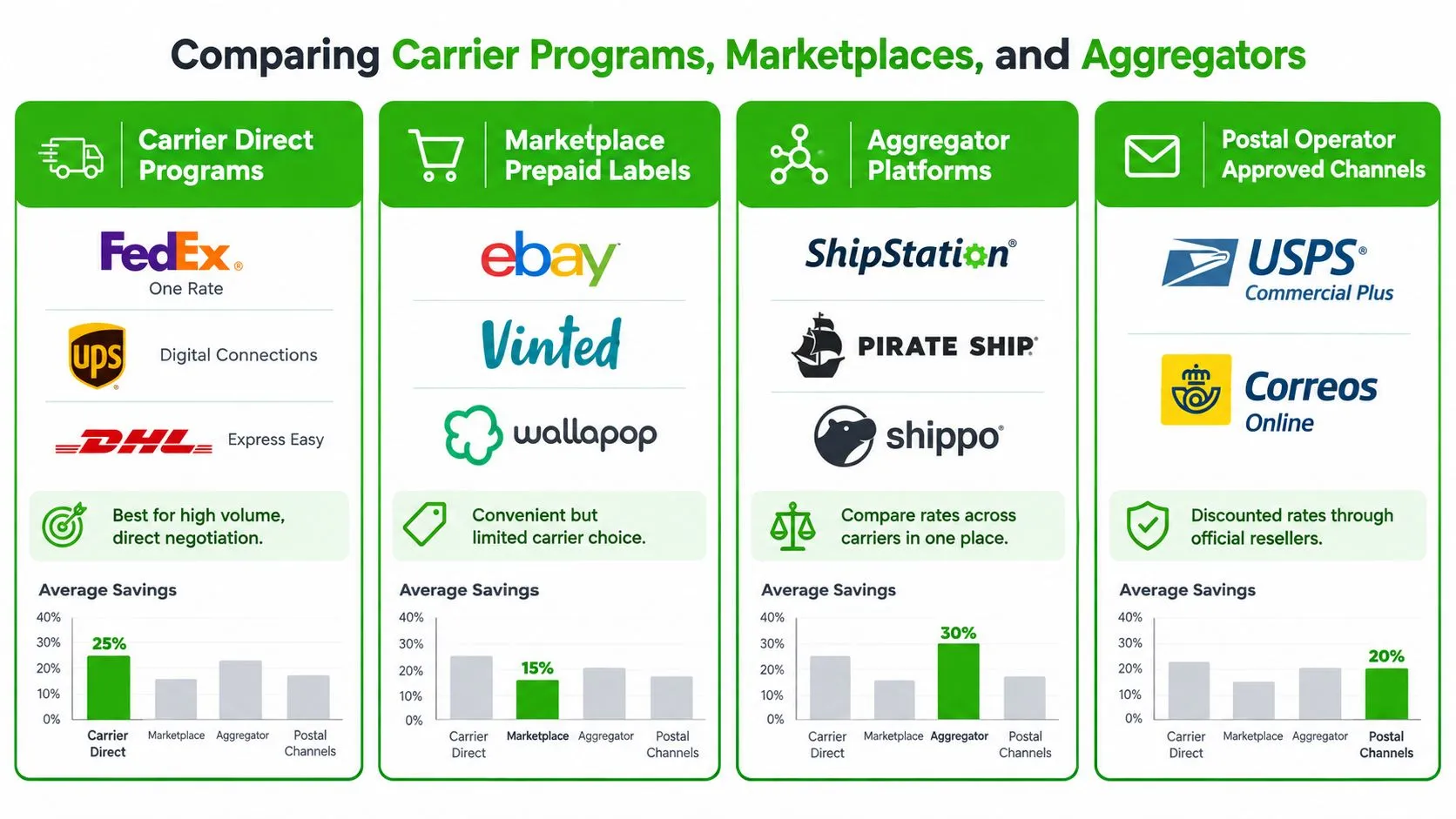
| Option | What it can do well | Trade-off to check |
|---|---|---|
| Carrier-direct programs | Put rates, billing, and service terms directly with the carrier; may suit steady volume | One carrier's strengths may not match every parcel or route |
| Marketplace prepaid labels | Keep label buying within platforms such as eBay or Vinted | Carrier choice, data access, and rate comparisons may be limited |
| Aggregators and multi-carrier tools | Present multiple services through one workflow and make rate comparison more convenient | Confirm whether quoted charges include relevant surcharges and how account pricing is structured |
| Postal commercial channels | Provide commercial pricing through approved online channels | Eligibility and value depend on service, format, destination, and parcel profile |
The most useful comparison is based on the same shipment details. Use the same dimensions, weight, destination, and service expectation when checking carrier-direct pricing against marketplace or aggregator options. If a quote leaves out a surcharge or uses different package details, it isn't a like-for-like comparison. A tool that displays rates is valuable only when the input data and final billing rules are trustworthy.
For resellers deciding between parcel networks, [this UPS-versus-USPS comparison](https://ruit.es/en/blog/is-ups-or-usps-cheaper/) can provide a starting point, but your own invoice history should determine the final choice. A workable setup often combines flexibility across carriers with direct negotiation where a carrier earns a substantial share of suitable shipments. Don't lock every order to a single label source just because its first quoted rate looks attractive. Keep whichever options win on **landed cost and service fit**, and reassess when your order mix changes.
## Dimensional Weight, Packaging, and the Hidden Volume Lever
Two parcels can weigh the same on a scale and cost very different amounts to ship. The difference is often the space each one occupies. For many European express services, dimensional weight is calculated as length × width × height in centimetres divided by **5,000**, though some ground contracts use another divisor; verify the rule for your own account before forecasting savings ([dimensional-weight and surcharge guidance](https://www.shippypro.com/blog/en/carrier-surcharges-in-2026-a-complete-guide)). Carriers generally bill using whichever is higher, dimensional weight or scale weight.
That matters to second-hand sellers because inventory rarely comes in one standard shape. A light coat can go in a mailer, while shoes may need a box and a bulky homeware item may take up far more space than its actual weight suggests. Applying an average weight across all products hides these differences and can lead to incorrect cost forecasts. Set packaging around product categories, then check whether the carrier's measurements agree with the dimensions recorded at label creation.
### Audit the parcel before the carrier reclassifies it
Start by measuring the **outer carton after sealing**, not an empty box or the item before packing. Compare the measurements and scale weight with the parcel details on the carrier invoice. A 30-day check can expose recurring remeasurement patterns, inconsistent data entry, or a particular packaging format that regularly triggers a higher billed weight. Investigate repeat exceptions rather than treating each one as an isolated charge.
Then test practical alternatives: right-sized mailers for flexible goods, adjustable-height boxes for items that don't need a tall carton, and less void fill where protection allows. Rank packaging by shipping cost and damage or return outcomes, not by dimensions alone. A smaller parcel that increases damage isn't an operational saving. For more context on how dimensional weight affects shipping charges, see these [shipping fee tips from PledgeBox](https://www.pledgebox.com/post/dimensional-weight-pricing). A clear pack-and-pick process also helps workers use the right materials consistently; this guide to [pick-and-pack operations](https://ruit.es/en/blog/pick-and-pack/) offers useful workflow context.
### Negotiate from shipment data, not a headline
Prepare your case before calling a carrier:
1. **Export invoices and segment shipments.** Use at least 12 months of invoices, broken down by carrier, service, destination zone, actual and dimensional weight, and surcharge type. This reveals which parcel profiles drive spend.
2. **Calculate effective cost by segment.** Divide total spend by parcels for each group and compare it with published tariffs and alternative proposals. Don't use the advertised discount as a substitute for your invoice total.
3. **Model contract mechanics.** Check minimum charges, fuel and residential surcharges, address-correction fees, peak fees, and the effect of missing volume thresholds. A base-rate concession can lose value when extras remain payable.
4. **Present your shipment mix.** Ask for pricing by service and zone, backed by the routes and package profiles you use. Avoid promising volume you can't reliably maintain.
5. **Negotiate accessorials separately.** Request written terms for fees, exemptions, thresholds, and tier-based repricing. Make sure the contract explains what happens if volume changes.
The KPI to anchor the conversation is **contribution margin per shipment after every carrier charge**. A monthly dashboard should show that figure by service and parcel profile, and flag the highest-cost 10% of parcels separately. The negotiation is easier when you can show exactly which shipments need better terms and why.
## Your 30-Day Discounted Shipping Setup Plan
Make this a routine rather than a one-off rate search. Start with the invoices and labels you already have, then work outward from the parcel profiles that cost the most. The point is to match a pricing mechanism to your real operation, not to collect the biggest advertised discount.
- **Days 1-7: Map current spend.** Export invoices, group shipments by carrier, service, destination, and parcel type, and identify the highest-cost 10% of parcels for separate review.
- **Days 8-14: Standardize packaging.** Create templates by product category, verify recorded dimensions after sealing, and track carrier remeasurements and billing corrections.
- **Days 15-21: Test available rate channels.** Compare eligible postal commercial pricing, marketplace labels, aggregators, and any business-account offer using the same shipment details. Replace options that consistently lose on all-in cost.
- **Days 22-30: Start a focused negotiation.** Take your shipment mix and invoice analysis to one carrier. Request service- and zone-specific terms, discuss accessorials separately, and get minimums and repricing rules in writing.
Review the numbers monthly while you're changing the setup, then revisit carrier mix, packaging, and surcharge trends at least **four times a year**. If a particular profile becomes expensive, investigate that group rather than assuming every label needs renegotiation. A new destination mix, a change in item sizes, or a fee adjustment can change which pricing channel performs best.
Discounted shipping works when the seller keeps measuring after the contract is signed. Track the margin left after the carrier's full charge, and let that result guide the next packaging or pricing decision.
## Frequently Asked Questions
### Where do discounted shipping rates come from?
They come from the channel you buy labels through: postal commercial pricing through approved online channels, marketplace labels, aggregators that offer several services through one account, or a direct carrier agreement tied to your volume. Each route carries different obligations, so compare them on landed cost per parcel rather than on the headline discount.
### Why does a shipping discount often save less than it promises?
Because the discount usually applies to the base transportation rate, while fuel, residential delivery, remote-area, address-correction and dimensional-weight charges stay on the invoice. Industry analyses estimate that surcharges can make up 35% to 50% of the final invoice, and in one example a 20% base-rate discount meant only about 10% to 12% savings on total shipping spend.
### When should a reseller negotiate directly with a carrier?
When your volume is steady enough to meet the commitments a direct offer brings. Build a shipment baseline first, with parcel dimensions, destinations, services and final billed costs, then price the same representative shipments under both arrangements, including any minimum-spend shortfall.
### How is dimensional weight calculated?
For many European express services, it is length × width × height in centimetres divided by 5,000, though some ground contracts use another divisor. Carriers generally bill whichever is higher, dimensional weight or scale weight, so measure the outer carton after sealing and check it against the invoice.
### How often should I review my shipping costs?
Review the numbers monthly while you are changing the setup, then revisit carrier mix, packaging and surcharge trends at least four times a year. If one parcel profile becomes expensive, investigate that group rather than renegotiating every label.
---
Ruit helps professional second-hand businesses manage sourcing, inventory, multichannel listings, orders, and analytics in one operational system. If you're working to protect margin while coordinating sales across marketplaces, [visit Ruit](https://ruit.es/en/) to see how it can bring more of that workflow together.