# Marketplace Management Software for Resellers
Learn how marketplace management software supports sourcing, listings, inventory, messaging, orders, accounting, analytics, and profitable reselling.
_Published: 2026-10-20 · Updated: 2026-10-20 · Source: https://ruit.es/en/blog/marketplace-management-software-en/_
A second-hand item sells while you're answering a buyer on another platform. The listing is still live elsewhere, so you rush to remove it. Later, you try to piece together the purchase cost, marketplace fees, shipping, and time spent handling the sale. Multichannel selling can bring more buyers, but disconnected tools make it harder to know whether the extra work is paying off.
Marketplace management software can connect those daily tasks, from sourcing and inventory to listings, orders, accounting, and performance analysis. The useful question isn't whether a system can publish your products to more channels. It's whether its shared data helps you make better decisions about capacity, costs, and profit per working hour.
## Table of Contents
- [Why Resellers Need Unified Operations](#why-resellers-need-unified-operations)
- [Understanding Marketplace Management Software](#understanding-marketplace-management-software)
- [Follow the data, not the feature names](#follow-the-data-not-the-feature-names)
- [Exploring Essential Management Capabilities](#exploring-essential-management-capabilities)
- [Start with the buying decision](#start-with-the-buying-decision)
- [Keep listings connected to stock](#keep-listings-connected-to-stock)
- [Connect the sale to the business result](#connect-the-sale-to-the-business-result)
- [Following Three Reseller Workflows](#following-three-reseller-workflows)
- [One unique item, several listings](#one-unique-item-several-listings)
- [A batch of goods, published on a schedule](#a-batch-of-goods-published-on-a-schedule)
- [Repeated questions, one order record](#repeated-questions-one-order-record)
- [Using AI With Clear Human Oversight](#using-ai-with-clear-human-oversight)
- [Set review rules before publishing](#set-review-rules-before-publishing)
- [Selecting and Implementing the Right System](#selecting-and-implementing-the-right-system)
- [Evaluate the real workflow](#evaluate-the-real-workflow)
- [Ruit Versus Basic Cross-Listing Tools](#ruit-versus-basic-cross-listing-tools)
- [Measuring Profitability and Return on Investment](#measuring-profitability-and-return-on-investment)
- [Frequently Asked Questions About Marketplace Management Software](#frequently-asked-questions-about-marketplace-management-software)
- [How is marketplace management software different from a cross-listing tool?](#how-is-marketplace-management-software-different-from-a-cross-listing-tool)
- [Does auto-delisting prevent every oversale?](#does-auto-delisting-prevent-every-oversale)
- [Can AI-generated listings be published without review?](#can-ai-generated-listings-be-published-without-review)
- [How do I measure whether the software is worth it?](#how-do-i-measure-whether-the-software-is-worth-it)
- [What should a vendor demonstration include?](#what-should-a-vendor-demonstration-include)
## Why Resellers Need Unified Operations
Marta sells used clothing and homewares across several marketplaces. A coat may appear on more than one platform, buyer questions arrive in separate inboxes, and orders have to be checked against a spreadsheet. When she updates a price or sells an item, she needs to remember which listings to change. At the end of the week, she rebuilds the sales record by comparing marketplace statements with her own notes.
That workflow creates opportunities and risks at the same time. More channels can help a one-off item find a buyer, but every extra channel adds updates, messages, and rules to remember. A delayed stock update can lead to an oversale; a forgotten fee can make a profitable-looking sale less attractive than it seemed.
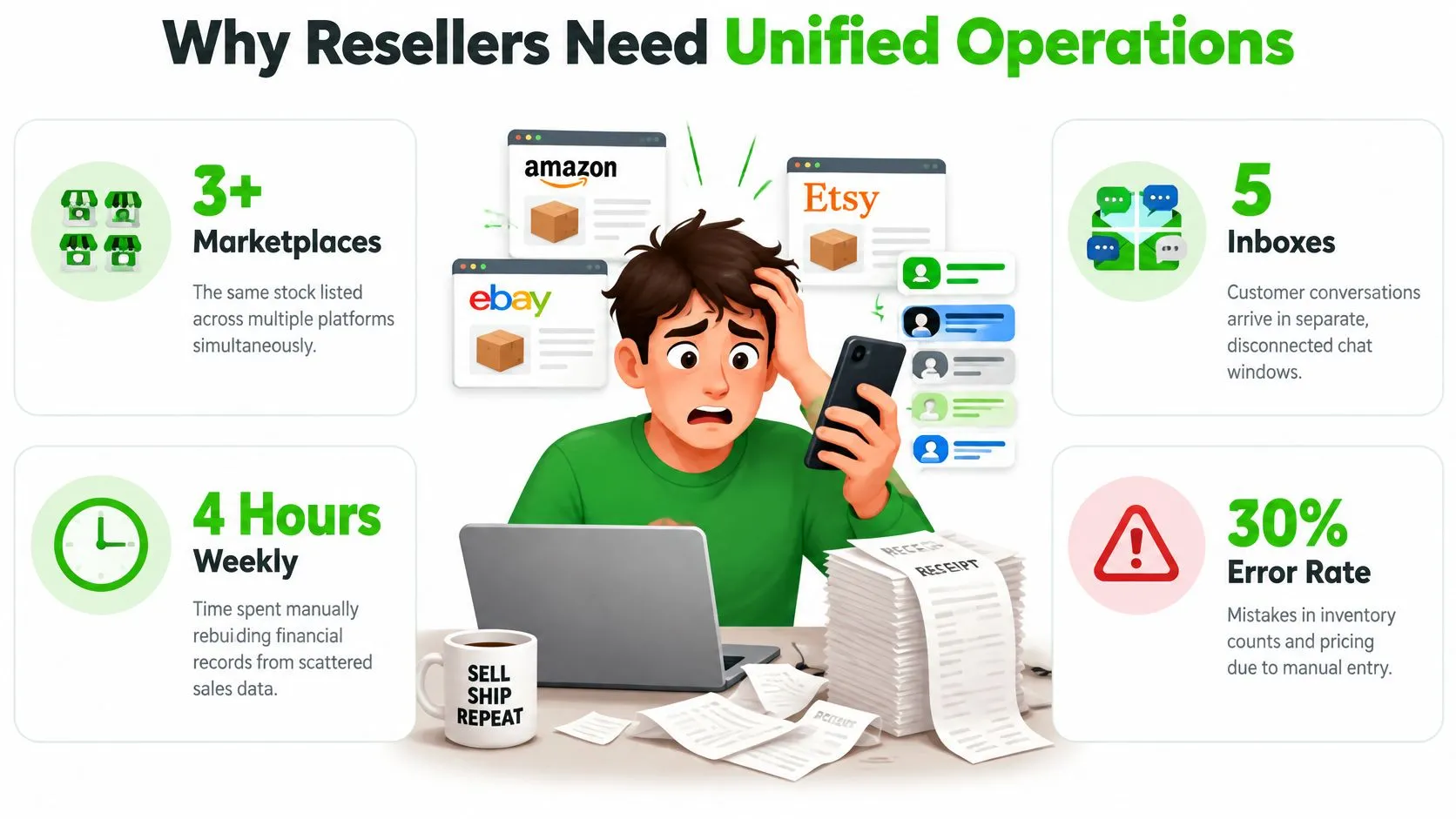
This isn't just a nuisance for sellers who have grown quickly. In research on the world's largest retailers, **56% sold through at least one online marketplace in 2023**, compared with **58% in 2022**. The same report puts third-party GMV for the **100 largest global online marketplaces at $996.4 billion in 2023**, with the broader marketplace economy reaching approximately **$3.5 trillion in GMV**. Those figures help explain why marketplace operations have become part of modern retail infrastructure, not merely a listing problem ([Digital Commerce 360's online marketplaces research](https://www.digitalcommerce360.com/product/online-marketplaces-report/)).
For Marta, a shared operational layer means a stock change can update connected listings, while orders and messages can be handled from a more consistent workspace. It doesn't remove the need to inspect an item, pack it, or resolve a difficult customer issue. It can, however, make the work and its results easier to track. Teams with delivery operations to coordinate may also find [proof of delivery software for 1PL teams](https://routelink.app/blog/subcontractor-management-software/) useful as a separate resource for documenting handoffs.
The practical goal is to judge each channel by the work and margin it contributes, not just by the sales it brings. That means looking beyond listing speed to the hours, errors, fees, and customer-service load behind each sale.
## Understanding Marketplace Management Software
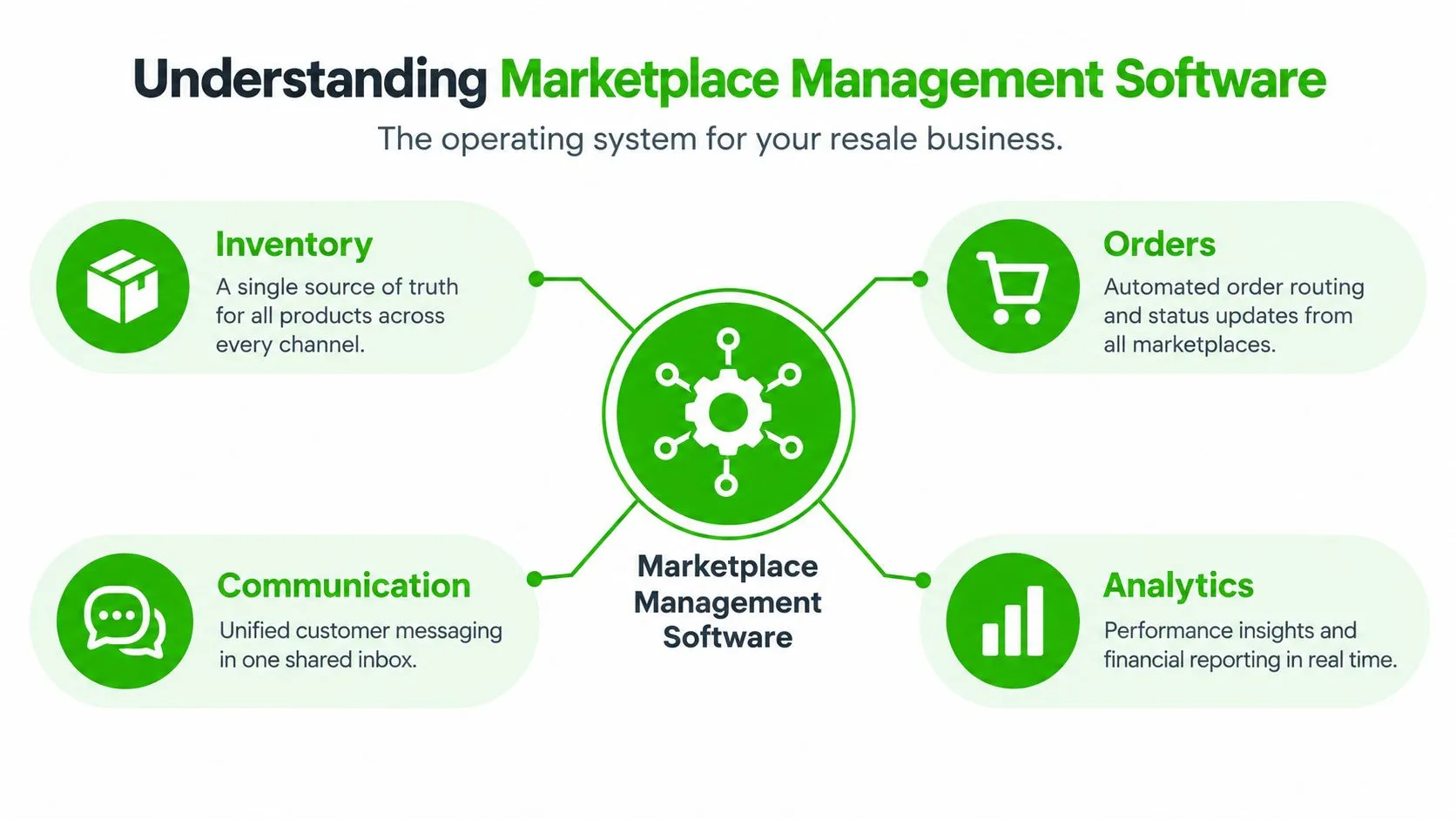
Think of marketplace management software as an **operating system for a resale business**. A computer operating system helps different applications work with shared resources. A business system can play a similar role by keeping product, stock, price, order, and customer information connected as work moves between sales channels.
A basic cross-listing tool often solves one important problem: it helps distribute a listing to multiple marketplaces. That can save repeated typing, but it doesn't necessarily connect the listing to sourcing costs, inventory age, customer conversations, accounting, or channel-level performance. Publishing a product is one action in the resale cycle, not the whole cycle.
### Follow the data, not the feature names
A fuller system may connect sourcing, product details, listings, stock, prices, customer messages, orders, accounting, and analytics. The important distinction is whether information travels between those stages. If the sale is recorded in one place but purchase cost lives in a separate spreadsheet, the software may help with activity without showing the economic result.
Capability depth varies. One product may synchronize quantities and listings, while another may also support bulk publishing, unified messaging, order workflows, exports, and reporting. Ask what data each feature reads and updates. A button labelled “analytics” doesn't necessarily mean a report can connect purchase cost and labor to realized margin.
A broader software-market estimate valued multichannel ecommerce software at **$9.5 billion in 2024** and projected **$25.2 billion by 2033**, a forecast CAGR of **12.5%**. A related estimate put the multichannel order-management market at **$3.2 billion in 2024**, with a projected **12.7% CAGR from 2024 through 2030**. These are estimates for differently defined categories, but both point to continued investment in systems that coordinate digital commerce work ([eDesk's overview of multichannel ecommerce software](https://www.edesk.com/blog/multi-channel-support-software-ecommerce/)).
For a reseller, the operating-system analogy is useful because it shifts the evaluation from “Can I list on this marketplace?” to “What does this system connect, and what decisions can I make with the result?” The answer should reflect the actual resale lifecycle, not just the most visible screen.
## Exploring Essential Management Capabilities
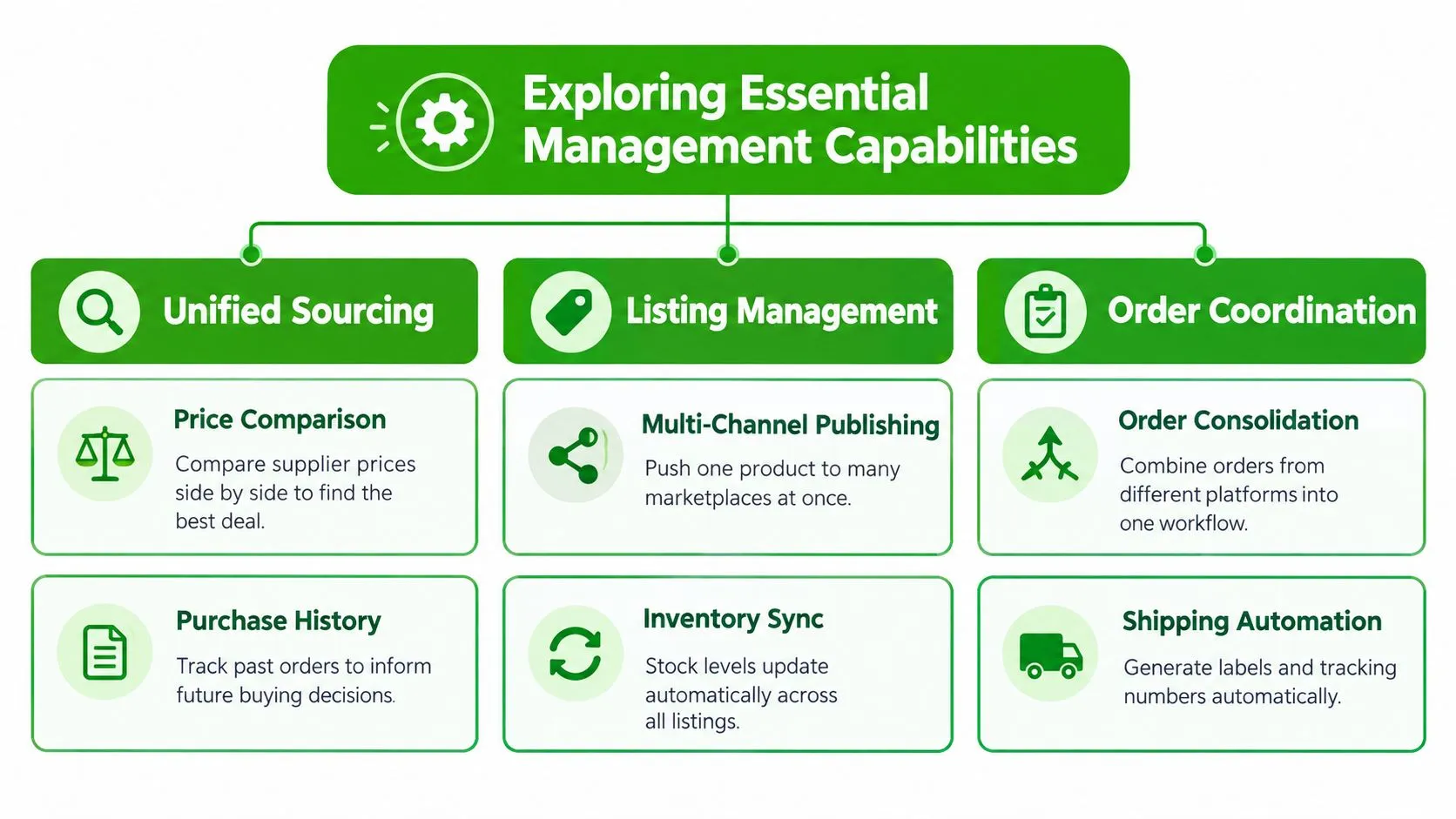
A useful system supports decisions at each point in the work, rather than presenting a long menu of features. For a second-hand seller, that starts before an item enters the catalog and continues after the sale.
### Start with the buying decision
**Sourcing tools** can bring marketplace searches, price comparisons, and purchase history into one process. A reseller considering a used camera, for example, can compare the asking price with their own records and decide whether the likely margin justifies inspection, cleaning, and listing time. A price comparison is only a signal: condition, provenance, fees, and the likelihood of a sale still need human judgment.
### Keep listings connected to stock
Once an item is acquired, **inventory import and merging** can prevent a seller from recreating records already held by connected marketplaces. Multichannel publishing, bulk uploads, and scheduling help distribute catalog work. A seller might prepare a group of listings at once and schedule publication rather than interrupting other tasks each time a product is ready.
Stock and price synchronization then reduce repeated updates. **Auto-delisting after a sale** can lower the chance that the same unique item remains available elsewhere, while scheduled relisting can bring an older listing back into view. These features depend on reliable channel connections and clear rules for which record controls the item's availability.
For small businesses reviewing the basics of stock control, [Orange Box Self Storage's inventory management guidance](https://orangebox-selfstorage.co.uk/inventory-management-for-small-businesses/) offers context on why accurate records matter beyond marketplace listings. Resellers can also compare approaches to [multichannel inventory management](https://ruit.es/en/blog/inventory-management-multi-channel/) when assessing how one stock record should relate to several sales channels.
### Connect the sale to the business result
**Unified messaging** helps a team see buyer conversations alongside relevant listings and orders. **Order handling** brings sales into a shared workflow, but sellers should check what the system automates, such as status updates or shipping steps, and what still requires manual action.
Accounting calculations and exports help carry transaction data into bookkeeping. Analytics can then draw on sourcing, prices, sales, and other available records to show where work and returns are concentrated. A feature is only useful if the underlying fields are complete and consistently maintained.
Ask vendors to demonstrate the complete flow with a real example: record an item's cost, publish it, change its availability, handle a sale, and inspect the resulting report. For a closer look at the operational stages, watch the product walkthrough below.
A system may also offer mobile access, team permissions, or AI-assisted analysis. These are most valuable when they fit the way the business works, not because they appear on a feature list.
## Following Three Reseller Workflows
### One unique item, several listings
A vintage furniture reseller finds a chair at a local sale. They record its purchase cost and condition in inventory, then create a product record with photographs, measurements, and notes about wear. From there, they adapt the presentation for relevant marketplaces, since each channel can have different buyer expectations and listing requirements.
If the chair sells on one platform, connected stock controls can help remove or mark its other listings unavailable. The seller still needs to confirm that the item is correctly described and ready for collection or shipping. The benefit is less duplicated entry and a clearer route from sourcing record to completed order.

### A batch of goods, published on a schedule
A clothing reseller has a set of inspected garments ready to list. Instead of creating each listing separately on every marketplace and their own ecommerce store, they prepare the core product information once, then adjust details where a channel needs different wording, pricing, or shipping information.
Bulk publishing can reduce repetitive work, while scheduled publication spreads listings across a chosen schedule. If prices change, synchronization may apply the update across connected listings, subject to the seller's rules. The reseller should still check images, sizes, condition notes, and any platform-specific fields before publication.
### Repeated questions, one order record
A buyer asks whether a lamp has a particular fitting, then follows up about delivery. With a unified inbox, the seller can see the conversation in a shared workspace rather than searching several chat windows. A response suggestion may help draft a reply, but the seller should verify the product detail before sending it.
When the buyer places an order, the seller can follow its status and record the sale for accounting. Analytics can then help compare the result with the item's purchase cost and the work involved. The system connects these steps; it doesn't make every product, price, or customer-service decision for the reseller.
Across all three workflows, the same catalog record can support more than one channel without forcing identical presentation everywhere. The seller still chooses the right description, price, and fulfillment approach for each audience.
## Using AI With Clear Human Oversight
AI can draft a title, suggest a description, remove an image background, propose a reply, or surface patterns in sales data. Those tasks may save time, but **faster output isn't the same as trustworthy output**, especially when an item's history and condition matter to the buyer.
A tool could mistake a scratch for a harmless mark, imply that an item is authentic without supporting evidence, or recommend a price based on incomplete comparisons. Image editing can also alter details a buyer needs to assess. If a reseller publishes generated claims without checking them, automation can make inaccurate information easier to distribute.
Trust is part of the operating process, not an optional layer. In the EU policy context, the Digital Services Act establishes platform-safety and transparency expectations, while obligations under the AI Act roll out through 2025 and 2026. Separately, **27% of surveyed European consumers identified non-trustworthy online sellers as having the biggest personal impact among the issues assessed**. The Council of the EU's document provides context for the consumer concern ([EU Council document on online consumer issues](https://data.consilium.europa.eu/doc/document/ST-6047-2025-INIT/en/pdf)).
### Set review rules before publishing
Before relying on AI-assisted workflows, ask:
- **What evidence supports the output?** Condition grades and authenticity signals should be traceable to product records, images, or a seller's inspection.
- **Which decisions need approval?** Require a person to review claims about condition, provenance, authenticity, and safety before they reach a customer.
- **Can the team see what changed?** Check whether the system keeps a useful history of generated content and human edits.
- **How does it handle uncertainty?** A suggestion should make missing information visible rather than present a guess as fact.
- **What happens to customer and product data?** Review privacy controls and access permissions, and establish when a conversation should be escalated to a person.
Use AI for drafting where errors are easy to catch. Keep accountable people involved when an automated decision could mislead a buyer or change the seller's responsibility.
## Selecting and Implementing the Right System
Start with the work your team performs. Record the marketplaces and owned stores you use, how your catalog changes, who handles messages and orders, and which accounting or ecommerce systems need to connect. A small reseller with unique items may need different controls from a team processing frequent bulk listings.
### Evaluate the real workflow
Ask shortlisted vendors to demonstrate your own process, not just a polished dashboard. Test sourcing records, listing creation, inventory and price updates, messages, orders, exports, and analytics with representative products. Check mobile access, integrations, user permissions, support, and whether the team can retrieve its data in a usable format.
A practical evaluation checklist:
- **Channel fit:** Confirm that the system supports the marketplaces and stores you use, including the operations you expect on each.
- **Data quality:** Check how it handles condition, cost, photographs, product details, and duplicates.
- **Synchronization rules:** Find out what happens after a sale, a price change, or a failed connection.
- **Team access:** Set permissions according to who can edit, approve, or publish information.
- **Support and exports:** Ask how you'll get help and what information you can take out of the system.
- **Success measures:** Decide what you'll track before rollout, including repetitive work, listing completion, errors, and margin visibility.
Before moving data, clean product records and decide which system owns each field. Then test a small, representative group of products across selected channels. Give someone clear responsibility for reviewing listings and resolving exceptions, such as a stock update that doesn't reach a marketplace.
Keep the first rollout focused. Once the process is stable, add channels or automation that address a known bottleneck. For a broader view of how connected workflows can reduce repeated manual tasks, see this guide to [ecommerce automation software](https://ruit.es/en/blog/ecommerce-automation-software/).
## Ruit Versus Basic Cross-Listing Tools
A basic cross-listing tool may be enough if your main problem is copying listings between a few channels. An end-to-end system is designed to connect more of the operating cycle, so it can support decisions about costs and work as well as publication.
| Operational need | Basic cross-listing | End-to-end marketplace management |
|---|---|---|
| Listing distribution | Publishes or copies listings across supported channels | Connects publishing with product and inventory records |
| Sourcing | Often outside the main workflow | May connect purchase information, price comparisons, and inventory intake |
| Inventory control | May sync availability | Can link stock changes to listings and sale records |
| Messaging | May not include a shared inbox | Can bring channel conversations into a common workflow |
| Orders | May provide limited order visibility | Can connect orders with fulfillment and accounting workflows |
| Accounting | Often handled elsewhere | Can support calculations and data exports |
| Analytics | May focus on listing activity | Can connect available data across stages of the resale cycle |
| Team operations | May offer limited shared controls | May include team access, roles, or permissions |
| Cross-cycle visibility | Usually centered on listings | Can connect sourcing through sale records and analysis |
Ruit is designed for professional second-hand sellers in Europe. Its stated capabilities include sourcing tools, inventory import and merging, multichannel publishing, stock and price synchronization, auto-delisting, unified messaging, order handling, accounting calculations and exports, and analytics. It also offers web and mobile access. The exact channel, integration, and workflow fit should be confirmed against a seller's own requirements.
A simpler tool can still be the sensible choice when the business needs listing distribution and already manages stock, messages, and accounting effectively elsewhere. Choose based on whether connecting the wider workflow would improve visibility enough to justify the added system and implementation work.
## Measuring Profitability and Return on Investment
Before adopting software, write down how the current operation performs. Track time spent on repetitive updates, time to complete a listing, synchronization errors, and response handling. Record sales and fees by channel, along with purchase cost, labor allocation, returns, and contribution margin where your data supports it.
Then calculate **profit per working hour** using a consistent method. Start with the revenue from a channel or workflow, subtract attributable costs such as purchase cost, marketplace fees, shipping, and returns, then divide the resulting contribution by the working hours assigned to that activity. Decide how you'll allocate shared tasks, such as photography or bookkeeping, and use the same approach when comparing periods or channels.
That calculation prevents a common mistake: treating every additional sale as profitable growth. A channel may add revenue while also demanding more listing work, customer service, or returns handling. Software time saved matters only if the business can use that capacity productively, reduce costs, or make better operating decisions.
For a refresher on the cost side, the [Aroma Warehouse cost guide](https://www.aromawarehouse.com/post/how-to-calculate-product-costs) can help organize product-cost thinking. You can also use a structured [sales analysis report example](https://ruit.es/en/blog/sales-analysis-report-example/) to consider which measures belong in a recurring review.
Reassess the system against a practical checklist: Does it fit your channels and catalog? Are product and customer data handled responsibly? Can the team use it consistently on mobile and desktop? Do integrations, support, and exports meet operational needs? Are the measures you chose showing a meaningful change in errors, workload, or margin visibility?
The right system isn't the one with the longest feature list. It's the one that helps your business make better decisions across the resale cycle.
## Frequently Asked Questions About Marketplace Management Software
### How is marketplace management software different from a cross-listing tool?
A basic cross-listing tool mainly helps distribute a listing to multiple marketplaces. Marketplace management software is designed to connect that listing with sourcing costs, stock, customer messages, orders, and accounting, so you can judge a sale by its result rather than by its publication alone.
### Does auto-delisting prevent every oversale?
No. Auto-delisting after a sale can lower the chance that the same unique item remains available elsewhere, but it depends on reliable channel connections and clear rules for which record controls the item's availability. Give someone responsibility for exceptions, such as a stock update that doesn't reach a marketplace.
### Can AI-generated listings be published without review?
They shouldn't be. Use AI for drafting where errors are easy to catch, and require a person to review claims about condition, provenance, authenticity, and safety before they reach a customer.
### How do I measure whether the software is worth it?
Write down how the current operation performs before adopting it: time spent on repetitive updates, time to complete a listing, synchronization errors, and sales and fees by channel. Then compare **profit per working hour** across periods, using the same method each time.
### What should a vendor demonstration include?
Your own process, not just a polished dashboard. Ask the vendor to record an item's cost, publish it, change its availability, handle a sale, and inspect the resulting report with representative products.
---
Ruit brings sourcing, inventory, multichannel listings, messaging, orders, accounting, and analytics into one workspace for professional second-hand sellers. Explore how its connected workflows could fit your operation by visiting [Ruit](https://ruit.es/en/).