# Order of Accounting Cycle: A Complete Guide for Resellers
Master the order of accounting cycle for your resale business. Learn why sequence matters, how to track inventory, and what to automate.
_Published: 2026-10-11 · Updated: 2026-10-11 · Source: https://ruit.es/en/blog/order-of-accounting-cycle/_
The order of the accounting cycle is a control sequence where each step depends on the previous one, typically starting with transaction analysis and journalizing, then posting to the ledger, preparing trial balances, recording adjusting entries, producing financial statements, and closing temporary accounts. A post-closing trial balance then confirms that the ledger remains balanced after closing.
You can understand the sequence more easily if you picture a normal resale week. You buy stock, photograph it, list it on several marketplaces, sell an item, pay for shipping, receive a payout after fees, and perhaps deal with a refund later. The money may arrive in a different amount and on a different date from the sale, but your profit report still needs to connect every event to the right item and period.
That's where the **order of accounting cycle** earns its place. It turns scattered operational activity into a traceable path from source document to reported profit. For a professional reseller, the process isn't about producing neat paperwork for its own sake. It's about knowing whether a sale made money after the item cost, marketplace fees, shipping, refunds, and other selling costs.
## Table of Contents
- [Why Order Matters in Resale Accounting](#why-order-matters-in-resale-accounting)
- [The sequence protects the story behind the number](#the-sequence-protects-the-story-behind-the-number)
- [Daily capture is different from period-end reporting](#daily-capture-is-different-from-period-end-reporting)
- [The Classic Accounting Cycle Steps](#the-classic-accounting-cycle-steps)
- [How Each Step Controls the Next](#how-each-step-controls-the-next)
- [What breaks when the sequence is ignored](#what-breaks-when-the-sequence-is-ignored)
- [Mapping the Cycle to Resale Operations](#mapping-the-cycle-to-resale-operations)
- [A practical event-driven order](#a-practical-event-driven-order)
- [Automation, Governance, and Human Review](#automation-governance-and-human-review)
- [Where people still need to decide](#where-people-still-need-to-decide)
- [Seasonal Close Checklist for Resellers](#seasonal-close-checklist-for-resellers)
- [Before calculating profit](#before-calculating-profit)
- [Before closing the period](#before-closing-the-period)
- [Next Steps for Building an Audit-Ready Workflow](#next-steps-for-building-an-audit-ready-workflow)
- [Frequently Asked Questions](#frequently-asked-questions)
## Why Order Matters in Resale Accounting
A second-hand reseller buys five pairs of sneakers for resale and lists them on Wallapop, Vinted, and eBay. One pair sells on Vinted, another sells on eBay, and the platform payouts arrive after commissions and shipping deductions. Then a buyer requests a refund, while a marketplace fee appears in the bank activity later than the original order.
Without a defined sequence, it's easy to count the gross customer payment as revenue, forget the inventory cost, enter the marketplace fee twice, or treat the payout as a second sale. The dashboard may look active, but the reported margin becomes a guess.

### The sequence protects the story behind the number
The accounting cycle starts with evidence. An order confirmation, purchase receipt, shipping record, fee statement, refund notice, and bank payout each tell part of the story. You analyze those documents first, record the transaction in a journal, and then organize the result in the ledger.
That order gives every figure a place and a reason. The ledger can then show inventory, revenue, fees, shipping, refunds, cash, and other accounts separately instead of blending them into one marketplace total. A practical introduction to the asset side of the process is [inventory accounting for resale businesses](https://ruit.es/en/blog/what-is-inventory-accounting/), especially when unsold stock remains part of the business rather than an expense.
> **Reseller rule:** A payout is evidence that money moved. It isn't automatically evidence of the correct revenue, inventory cost, or profit.
### Daily capture is different from period-end reporting
The first activities happen continuously as business events occur. You collect documents, analyze transactions, journalize them, and post them to the relevant accounts. Period-end work comes later, when you prepare trial balances, record adjustments, produce statements, and close temporary accounts.
That separation matters because a seller shouldn't wait until the end of the period to reconstruct every marketplace event from a bank statement. At the same time, daily imports shouldn't be treated as final reporting until the team has checked duplicates, missing payouts, returns, inventory identity, and account classification.
The cycle therefore acts as a **control mechanism**, not a bureaucratic ritual. It keeps operational activity moving while creating deliberate checkpoints before profit becomes an official figure.
## The Classic Accounting Cycle Steps
The traditional sequence can feel abstract until you compare it with assembling a bicycle. You wouldn't tighten the final brake cables before fitting the wheels, and you wouldn't test the finished bike before connecting the parts. Accounting works in the same way. Each stage uses information created by the stage before it.
1. **Analyze transactions.** Start with source documents and determine what took place. A purchase, sale, refund, fee, payout, or shipping charge may affect different accounts, even when the marketplace displays them together.
2. **Journalize the transaction.** Record the event in chronological form using equal debits and credits. Double-entry bookkeeping requires every transaction to affect at least two accounts through corresponding entries.
3. **Post to the general ledger.** Move the journal information into account categories such as inventory, revenue, cash, fees, refunds, and expenses. The journal shows the sequence of events, while the ledger shows the accumulated position of each account.
4. **Prepare the unadjusted trial balance.** List the ledger balances and check whether total debits equal total credits. This is a mathematical control before period-end adjustments.
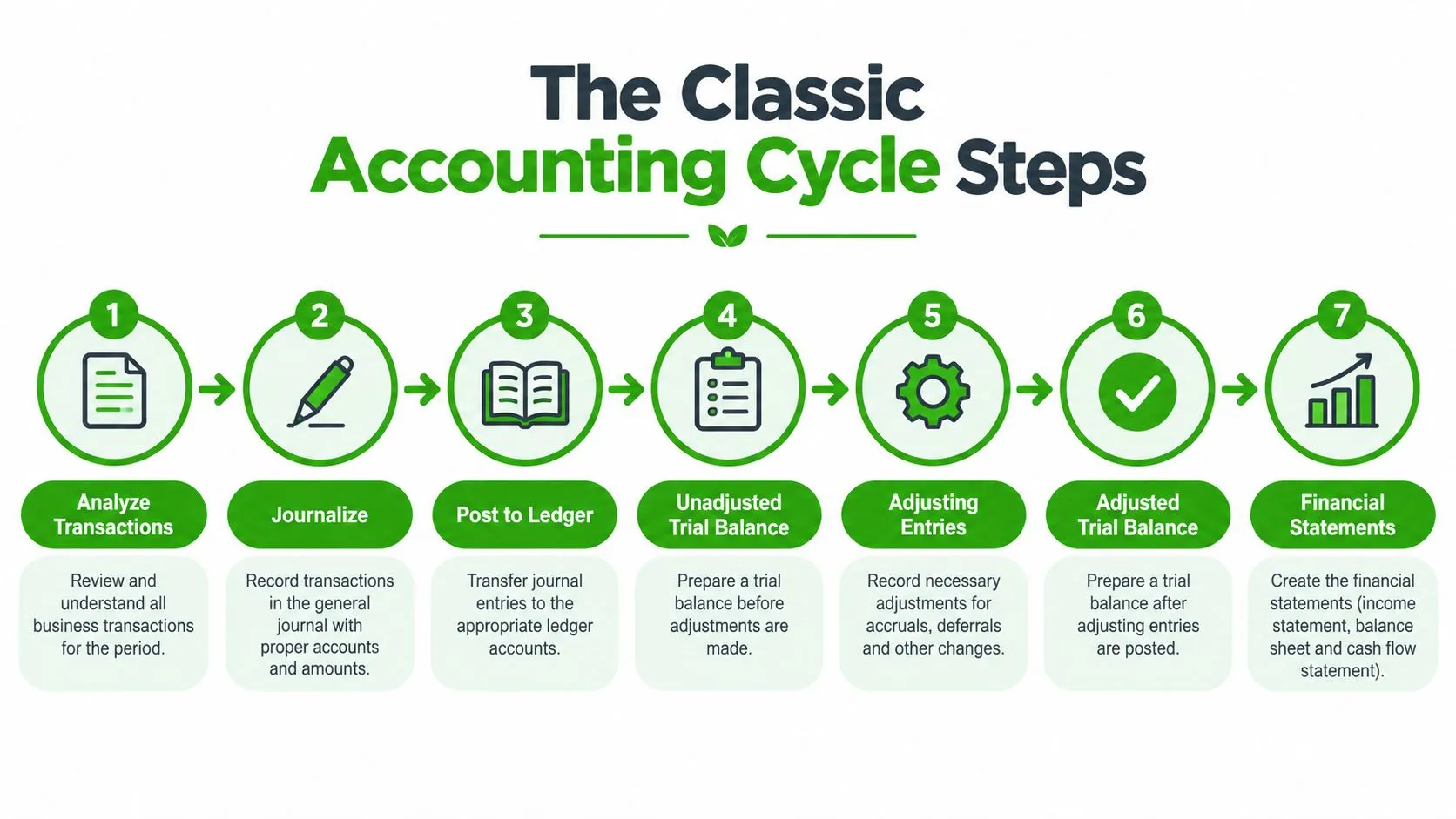
5. **Record adjusting entries.** Add entries needed to place income, expenses, inventory, accruals, returns, and other items in the correct reporting period. These entries are based on the preliminary records and the review of outstanding events.
6. **Prepare the adjusted trial balance.** Recheck the accounts after adjustments. The adjusted balances become the formal foundation for the financial statements.
7. **Prepare financial statements and close temporary accounts.** Produce the reports from the adjusted figures, then close temporary revenue and expense accounts. A post-closing trial balance confirms that the ledger remains balanced after closing.
A commonly taught six-step version combines some of these activities into a shorter summary: analyze transactions, journalize, post to the general ledger, prepare a trial balance, prepare financial statements, and prepare a post-closing trial balance. The count changes by framework, but the information flow doesn't.
The method rests on a long-established double-entry foundation. The earliest undisputed European example is associated with Genoa's treasury accounts in **1340**, while Luca Pacioli's **1494** publication in Venice provided the first widely recognized printed description of the method, including a memoriale, journal, and ledger. The [Library of Congress history of early accounting](https://guides.loc.gov/history-of-accounting/practice/early-history) places those milestones in the development of the system.
For a visual walkthrough of the sequence, this accounting-cycle explanation can help reinforce the relationship between recording, checking, adjusting, and reporting:
## How Each Step Controls the Next
The order matters because each stage answers a different question.
The transaction analysis asks, “What happened, and which accounts changed?” The journal then creates the first formal record. Posting transforms those chronological entries into account balances, so the ledger can answer, “How much inventory, revenue, cash, or expense has accumulated?”
The trial balance uses those ledger balances to test the arithmetic. If the debit and credit totals don't agree, something in the recording or posting process needs attention before reporting continues.
That check has limits. An unadjusted trial balance can balance even when a transaction was omitted, an amount was entered in the wrong account on both sides, or two errors offset each other. It confirms mathematical equality, not complete and correct bookkeeping.
### What breaks when the sequence is ignored
Preparing statements before adjustments can understate an expense that belongs to the period or leave inventory and returns in the wrong position. Posting directly from a bank payout without a journal record can hide how the payout relates to an order, fee, refund, or outstanding balance.
The [OpenStax explanation of the initial accounting-cycle steps](https://openstax.org/books/principles-financial-accounting/pages/3-3-define-and-describe-the-initial-steps-in-the-accounting-cycle) makes the dependency clear: journal entries feed the ledger, ledger balances feed the trial balance, and adjusted balances support financial statements.
For resellers, margin distortion often starts with a small classification shortcut. If a purchase is treated as an immediate expense instead of inventory, current profit can look lower before the sale and higher later. If the marketplace payout is treated as revenue rather than a settlement of an order, the business may record the same commercial event twice.
> A balanced trial balance tells you the arithmetic works. It doesn't tell you that the business captured every sale, assigned every item to the right cost basis, or classified every fee correctly.
Daily bookkeeping and period-end verification should therefore have separate responsibilities. Capture and post activity as it happens, then pause at the close to reconcile source documents, investigate exceptions, apply adjustments, and only then prepare statements.
## Mapping the Cycle to Resale Operations
A resale business needs one extra question before it can apply the textbook sequence: **has the item sold yet?**
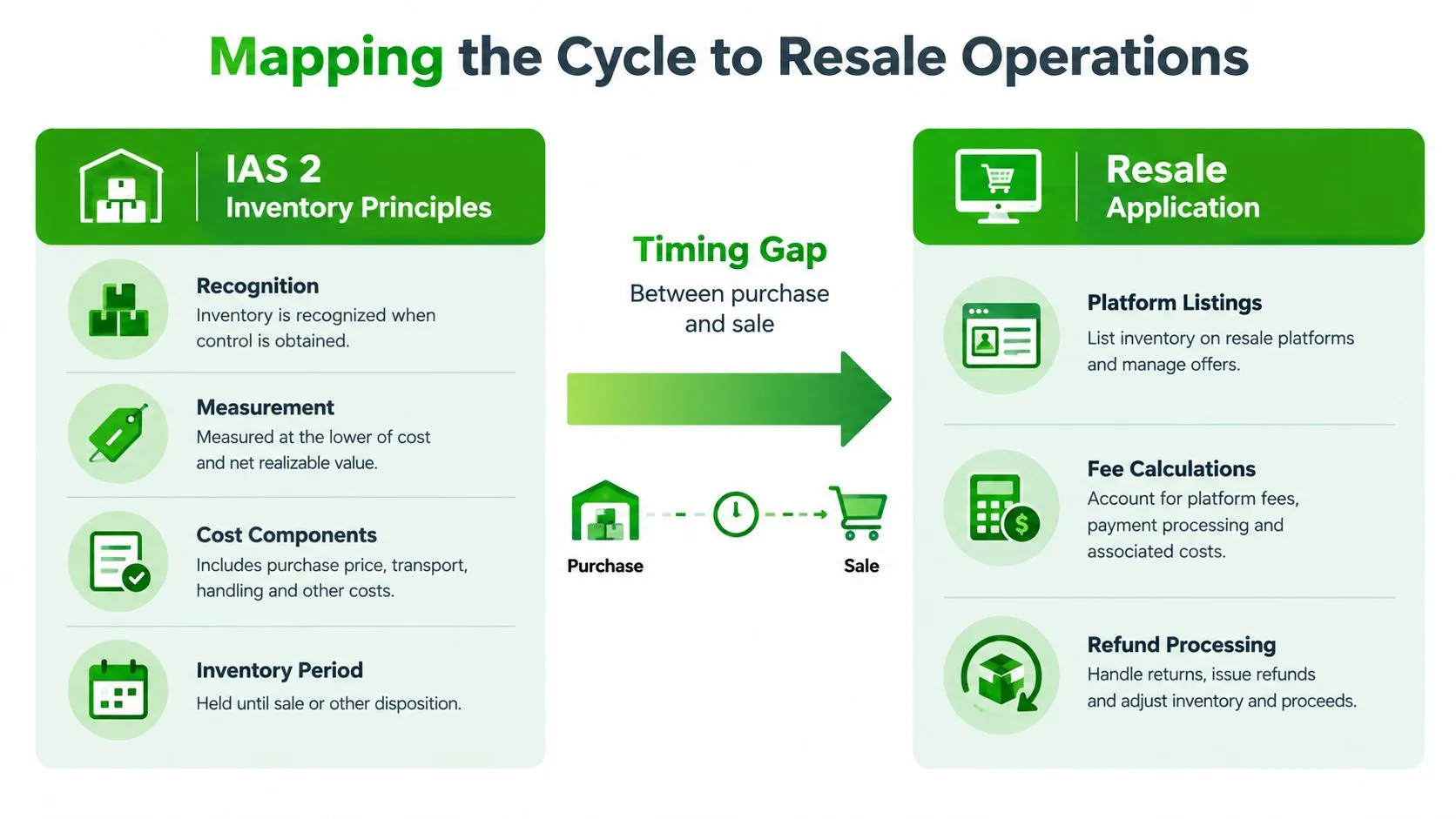
Under [IAS 2 inventory guidance](https://www.ifrs.org/issued-standards/list-of-standards/ias-2-inventories/), inventory cost remains an asset until the related sale occurs. At the sale, its carrying amount is recognized as an expense in the same period as the related revenue. That timing is the bridge between purchasing stock and measuring gross profit.
Suppose you source a jacket, upload it to several channels, and keep it unsold for part of the period. The cash payment for acquisition doesn't by itself turn the jacket into cost of goods sold. The item remains inventory at its appropriate cost basis until the sale event requires the related cost release.
### A practical event-driven order
For a multichannel order, use this operational sequence:
- **Reconcile sold units and payouts first.** Match each sold SKU to its order, marketplace settlement, payment record, and transaction date. A gross customer receipt and a later net payout are related events, not automatically separate revenue events.
- **Release the inventory cost second.** Identify the item's acquisition cost and move the correct carrying amount from inventory to cost of goods sold when the sale is recognized.
- **Post fees and selling costs third.** Record marketplace commissions, payment fees, shipping costs, and other selling expenses separately according to the applicable accounting framework.
- **Review exceptions at period end.** Check refunds, damaged goods, accrued expenses, taxes, and inventory write-downs before preparing the adjusted trial balance.
This decision rule handles the Vinted scenario where an item sells today but the fee appears in a settlement later. The sale, inventory release, fee, and payout may have different operational timestamps, yet the ledger should preserve their relationship.
Revenue splits and net settlements create a similar problem for businesses using multiple parties or channels. A practical resource on [how handles revenue splits](https://www.creem.io/blog/revenue-splits-without-spreadsheets) can help clarify the difference between gross activity, retained amounts, and amounts owed to others.
Ruit's [order-management activities](https://ruit.es/en/blog/order-management-activities/) also illustrate why operational order data needs to remain connected to inventory and settlement records. The aim isn't to force every marketplace into the same timing rule. It's to retain enough item-level and event-level detail for the accountant to apply the right treatment.
VAT and cross-border tax treatment need particular care because rules can vary by jurisdiction. Record the relevant tax information with the transaction and send uncertain cases to a qualified adviser rather than allowing a dashboard or marketplace payout to decide the accounting treatment by default.
## Automation, Governance, and Human Review
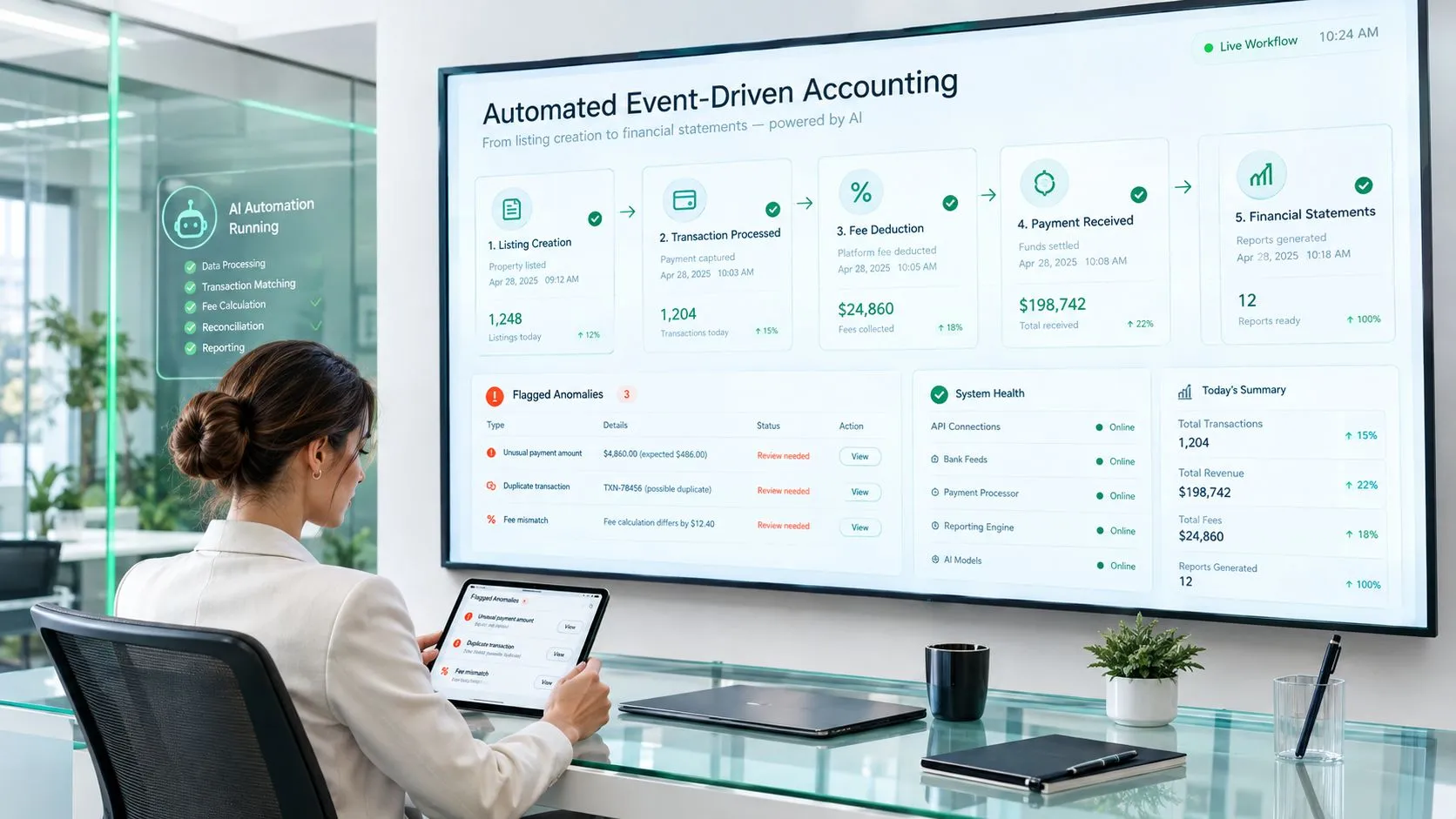
Automation changes how the accounting cycle is performed, but it doesn't remove the cycle's control points. A system may import orders, synchronize stock, delist an item after a sale, calculate a platform fee, or create a draft ledger entry. Someone still needs to decide whether the event is complete, correctly matched, and appropriate for posting.
That distinction is **mechanical sequencing versus control sequencing**. Mechanical sequencing describes what software can do automatically. Control sequencing describes where the business requires validation, approval, reconciliation, or an exception decision.
A 2025 Intuit QuickBooks survey reported that **95% of surveyed accounting firms adopted automation technology during the prior year**, with accounts payable, accounts receivable, and transaction processing among leading use cases. The [survey announcement](https://investors.intuit.com/news-events/press-releases/detail/1263/accountants-embrace-ai-and-strategic-advisory-services-to-fuel-growth-yet-continue-to-face-tech-and-talent-barriers-according-to-2025-intuit-quickbooks-survey) supports a useful conclusion for resellers: adoption can be widespread while accounting responsibility remains.
### Where people still need to decide
A professional resale workflow should define who reviews:
- **Duplicate-sale alerts:** One SKU listed on several channels must not remain available after a confirmed sale.
- **Payout variances:** The order total, fee statement, shipping deduction, refund, and bank receipt should reconcile or produce an exception.
- **Inventory-cost mismatches:** The system shouldn't release an estimated cost when the item's acquisition record is missing or ambiguous.
- **Tax treatment:** Cross-border VAT and related classifications require rules appropriate to the transaction and jurisdiction.
- **Period-end exceptions:** Unresolved returns, damaged goods, accrued fees, and write-downs need an explicit decision before closing.
A hybrid workflow works better than either full manual entry or blind automation. Capture transactions continuously, review exceptions daily, reconcile channels and bank settlements regularly, then conduct a documented period-end review before statements are finalized.
> **Control principle:** Automation can move a task earlier in the process, but it shouldn't move accountability out of the process.
Ruit can be considered alongside accounting software and workflow tools as one operational option. It connects multichannel inventory, listings, orders, fees, refunds, payouts, and accounting exports so teams can review structured transaction data before using it for formal reporting. Its role is to reduce disconnected operational records, not to replace professional accounting judgment. A broader overview of [ecommerce automation software](https://ruit.es/en/blog/ecommerce-automation-software/) provides context for that type of workflow.
## Seasonal Close Checklist for Resellers
A seasonal close should follow the evidence, not the order in which money happened to reach the bank. Start with source records, then reconcile commercial activity, then calculate margin, then adjust and close.
### Before calculating profit
- **Verify source documents:** Collect purchase receipts, order records, marketplace statements, shipping confirmations, refund notices, and bank activity. Link each document to the relevant SKU or transaction.
- **Confirm sold units:** Match sold items across Wallapop, Vinted, eBay, WooCommerce, or other channels. Resolve duplicate listings, cancellations, and orders that changed status.
- **Reconcile payouts:** Compare gross order activity with platform fees, shipping deductions, refunds, taxes, and the net amount received. Keep an unexplained difference open as an exception rather than forcing the ledger to match.
- **Check inventory identity:** Confirm that each sold item has an acquisition record and an appropriate cost basis. Separate unsold stock from units that should be released to cost of goods sold.
### Before closing the period
- **Post inventory cost:** Release the carrying amount for items sold during the period and retain unsold items as inventory, subject to the applicable framework.
- **Record selling costs:** Post marketplace commissions, payment fees, shipping expenses, and other costs separately so channel performance isn't hidden inside one net payout.
- **Review returns and damage:** Identify refunded orders, returned stock, damaged goods, and items that need a write-down. Record the required adjustments before producing the final reports.
- **Check VAT and cross-border issues:** Review the tax treatment for relevant jurisdictions and escalate uncertain classifications to a qualified tax adviser.
- **Accrue outstanding amounts:** Capture fees, shipping costs, or other expenses incurred during the period but not yet settled or invoiced, when the applicable accounting basis requires it.
- **Prepare the statements:** Use the adjusted trial balance as the input for the financial statements, then post closing entries and prepare the post-closing trial balance.
Payment timing can complicate the final reconciliation, especially when a platform settles after the commercial event. A reference on [DTC payment dates for brands](https://platformdtc.com/blog/dtc-payment-dates) can help teams think more carefully about payment schedules, settlement timing, and cash visibility.
Don't close with unresolved high-value exceptions hidden in a suspense account. Assign each exception an owner, supporting evidence, and a decision date so the next period starts with a clean explanation.
## Next Steps for Building an Audit-Ready Workflow
Build the workflow around the item, not just the payout. Each SKU should connect its acquisition record, listing history, sale event, marketplace fees, shipping, refunds, inventory release, and settlement information. That structure gives an accountant a clear route from the reported number back to the underlying event.
Start with document hygiene. Store source records consistently, use stable transaction identifiers, and record dates that distinguish purchase, sale, shipment, refund, fee, and payout events. Then define reconciliation routines for marketplaces, payment processors, bank accounts, inventory locations, and tax jurisdictions.
Set approval rules for exceptions before the business reaches a busy season. A missing acquisition cost, duplicate order, unexplained payout variance, or unusual refund shouldn't disappear into an automated import. The system can flag it, but a named person should decide how it is resolved.
Review inventory costs periodically and connect operational dashboards to formal accounting data only after verification. That preserves the speed of multichannel operations without presenting unadjusted marketplace activity as final profit. For a broader preparation reference, you can [prepare for your audit with this checklist](https://www.bookkeepingandaccountinginc.com/audit-readiness-checklist/).
The traditional order remains the backbone. The modern adaptation adds continuous event capture, item-level reconciliation, and human review at the points where marketplace timing creates ambiguity.
---
Ruit connects sourcing, inventory, multichannel listings, orders, fees, refunds, payouts, accounting exports, and analytics in one workflow for professional second-hand sellers.
Visit [Ruit](https://ruit.es/en/) to see how a unified operational record can help you move from marketplace activity to more reliable, audit-ready profit reporting.
## Frequently Asked Questions
### What is the correct order of the accounting cycle?
Analyze transactions, journalize them, post to the general ledger, prepare the unadjusted trial balance, record adjusting entries, prepare the adjusted trial balance, then prepare financial statements and close temporary accounts. A post-closing trial balance confirms that the ledger still balances after closing.
### Why does the order matter for a resale business?
Each step uses information created by the step before it. Skipping the sequence makes it easy to count a gross customer payment as revenue, forget the inventory cost, enter a marketplace fee twice, or treat a payout as a second sale.
### When does inventory cost become cost of goods sold?
Under IAS 2, inventory stays an asset until the related sale occurs. At the sale, its carrying amount is recognized as an expense in the same period as the related revenue, so an unsold item remains inventory even after you have paid for it.
### Is a marketplace payout the same as revenue?
No. A payout is evidence that money moved. The sale, the fees, any refund, and the payout are related events with different timestamps, and the ledger should record each one and preserve their relationship.
### Does a balanced trial balance mean the books are correct?
No. It confirms that total debits equal total credits. A trial balance can still balance when a transaction was omitted, an amount was posted to the wrong account on both sides, or two errors offset each other.