Is UPS or USPS Cheaper: 2026 Reseller Guide


Table of Contents
- Table of Contents
- The Real Cost of Shipping for Resellers
- Base Rate Breakdown for Lightweight and Midweight Parcels
- Finding the Weight and Zone Crossover Point
- Hidden Surcharges and Peak Season Pricing Traps
- Unlocking Commercial Pricing and Business Discounts
- Matching Your Inventory Mix to the Right Carrier
- Automating Carrier Selection in Your Daily Workflow
- Frequently Asked Questions
USPS is generally cheaper for lightweight parcels under 5 lb, while UPS becomes more cost-effective for heavier shipments over 10 lb and long-distance zones. For a 1 lb package traveling to Zone 1, USPS retail pricing is $11.00, compared with $11.99 for UPS, so USPS is the cheaper starting point.
You’re packing a freshly sold vintage jacket, checking the weight, and staring at two labels that look almost identical. One carrier seems cheaper until a residential fee appears. The other looks affordable until dimensional weight or a holiday surcharge changes the total. For a reseller, that small difference comes straight out of the item’s profit.
The practical question goes beyond just “is UPS or USPS cheaper?” It’s where does the cost crossover happen for this package, destination, address, and season? A single-carrier habit leaks margin because the cheapest option changes as weight and distance rise. This guide gives you a working framework for choosing the right label, protecting free-shipping offers, and setting up a repeatable process for every order.
Table of Contents
- The Real Cost of Shipping for Resellers
- Base Rate Breakdown for Lightweight and Midweight Parcels
- Finding the Weight and Zone Crossover Point
- Hidden Surcharges and Peak Season Pricing Traps
- Unlocking Commercial Pricing and Business Discounts
- Matching Your Inventory Mix to the Right Carrier
- Automating Carrier Selection in Your Daily Workflow
- Frequently Asked Questions
The Real Cost of Shipping for Resellers
A reseller’s shipping decision often happens under time pressure. The order is paid, the buyer expects movement, and the package is already on the packing table. Choosing the familiar carrier feels efficient, but familiar doesn’t mean profitable.
For lightweight clothing, accessories, books, and compact used goods, USPS usually has the advantage. The verified comparison shows that a 1 lb Zone 1 package costs $11.00 at USPS retail and $11.99 at UPS retail, with USPS about 8.3% cheaper on that lane. Commercial pricing widens the difference, with USPS at $9.04 compared with $11.99 for UPS, making USPS about 24.5% cheaper in that comparison (Pitney Bowes 2026 USPS rate overview).
That doesn’t make USPS the automatic answer. Once packages become heavier or travel through long-haul zones, UPS can become more competitive. Published comparisons show the crossover depends on both weight and zone, with UPS taking the lead in some 10 lb and 20 lb comparisons, particularly across selected zones (GoShippo’s carrier comparison).
Why one default carrier costs you money
A reseller shipping a 12 oz scarf and a 15 lb coffee machine shouldn’t use the same rule. The scarf benefits from USPS’s lightweight pricing structure. The coffee machine may be better suited to UPS Ground, especially when distance, packaging dimensions, and commercial pricing are factored in.
The same problem appears when sellers advertise free shipping. Before you enable that option, review how to put free shipping on eBay and calculate the carrier cost against your actual item margin, not an average estimate.
Practical rule: Build a carrier policy around package profiles, not loyalty to USPS or UPS.
The cost crossover point should become part of your operating routine. Record actual billed weights, dimensions, destinations, and final label costs. If your business is expanding into other markets, resources such as scaling with AU freight services can also help you think beyond individual labels and plan fulfillment capacity around the destinations you serve.
Base Rate Breakdown for Lightweight and Midweight Parcels
Base rates give you the first useful answer, especially for the shipment sizes common in secondhand ecommerce. USPS has a clear advantage on many lightweight parcels, but midweight results require a lane-by-lane check.
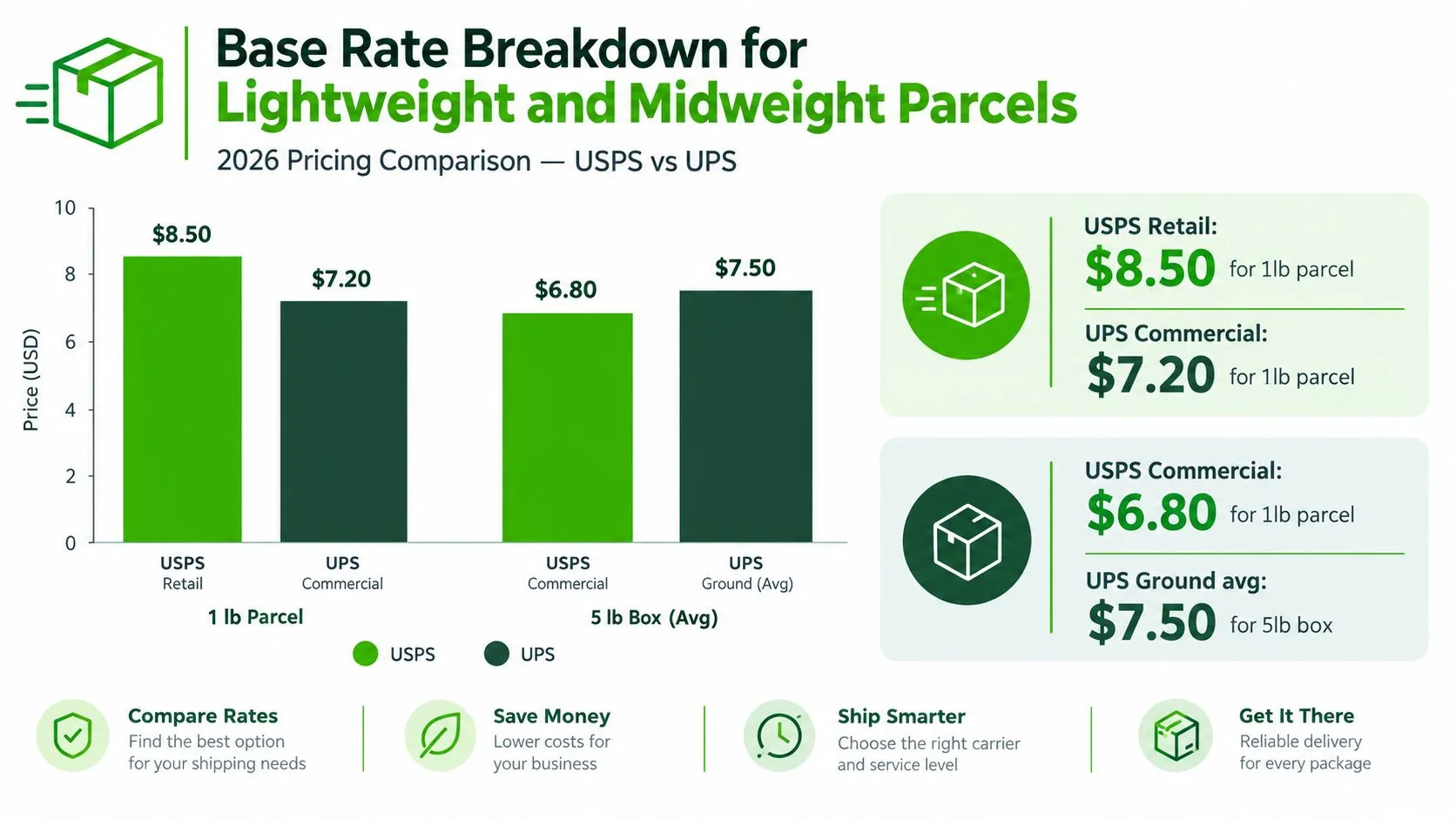
For a 1 lb package going to Zone 1, USPS retail pricing is $11.00, while UPS retail pricing is $11.99. USPS is therefore about 8.3% cheaper at retail on that comparison. At commercial pricing, USPS is listed at $9.04, against $11.99 for UPS, a gap of about 24.5% (Pitney Bowes 2026 rate comparison).
That commercial difference matters because many resellers unknowingly compare a discounted USPS label against a UPS Store price, or vice versa. You need to compare like with like. Retail-to-retail is one view, while commercial-to-commercial is the view that better reflects a professional operation.
The 5 lb benchmark
USPS also wins in several published comparisons for a 5 lb domestic parcel. One New York to Los Angeles benchmark lists USPS Ground Advantage at $22.75, compared with $25.98 for UPS Ground (Easyship’s UPS and USPS price comparison).
The result is important, but don’t treat it as a universal 5 lb rule. The same weight can produce a different winner when the package travels to another zone, uses different dimensions, or receives different commercial discounts. A small 5 lb box may favor USPS, while a larger box with a higher dimensional billable weight can shift the economics toward UPS.
| Shipment profile | Starting recommendation | Why |
|---|---|---|
| Lightweight parcel under 5 lb | Check USPS first | USPS is usually cheaper in this range |
| 1 lb Zone 1 parcel | USPS | The cited retail comparison is $11.00 versus $11.99 for UPS |
| 5 lb compact domestic parcel | USPS often wins | Published comparisons show USPS at $22.75 versus UPS at $25.98 on one lane |
| Heavy parcel over 10 lb | Check UPS first | UPS becomes more competitive as weight rises |
| Long-distance shipment | Compare both | Zone-based pricing can reverse the result |
For sellers handling letters, inserts, or very small accessories, understanding how much first-class postage costs can help separate ordinary mail decisions from parcel decisions. Don’t use a parcel-rate assumption for every item in your catalog.
The baseline recommendation is straightforward. Start with USPS for compact, lightweight inventory, but never lock in the choice before checking the destination zone and package dimensions.
Finding the Weight and Zone Crossover Point
Weight alone doesn’t determine the cheapest label. Distance changes the equation, because UPS and USPS apply different pricing structures across domestic zones.
A 10 lb parcel traveling a short distance may still favor USPS in some comparisons. The same 10 lb parcel traveling farther can favor UPS, especially when UPS’s ground network becomes more efficient relative to USPS pricing. Expert comparisons show USPS is often cheaper for light parcels under roughly 2 to 5 lb, while UPS becomes more competitive as weight and distance increase. Some rate tables show UPS winning at 10 lb in selected zones and at 20 lb across multiple zones (GoShippo rate comparison).
Read the crossover as a matrix
Use the table below as a decision screen, not a substitute for a live quote.
| Package weight | Short distance, Zones 1 to 3 | Long distance, Zones 4 to 8 |
|---|---|---|
| Under 2 lb | USPS usually preferred | USPS usually preferred, compare residential and dimensions |
| 2 to 5 lb | USPS often preferred | Compare both, USPS may still win for compact parcels |
| 5 to 10 lb | Compare both carefully | UPS becomes increasingly competitive |
| Over 10 lb | UPS may compete strongly | Check UPS first, especially for dense commercial shipments |
The right way to use this matrix is to create shipping clusters. Group your historical orders by weight band, destination zone, package type, and address class. Then compare the actual all-in label cost for each cluster.
Dimensions can erase a weight advantage
A large box filled with lightweight clothing may be charged according to dimensional weight rather than the physical scale weight. That means a package that feels light can still price like a heavier shipment. Record the box dimensions before you decide that USPS is cheaper because the scale shows a low number.
The crossover belongs to the box, not the product.
For each recurring package type, save a preferred box size and a carrier rule. If a 10 lb product fits in a compact carton, USPS may remain competitive. If the same product needs an oversized box, UPS may offer the better total cost. Use real quotes from your shipping platform and update the rule when packaging changes.
Hidden Surcharges and Peak Season Pricing Traps
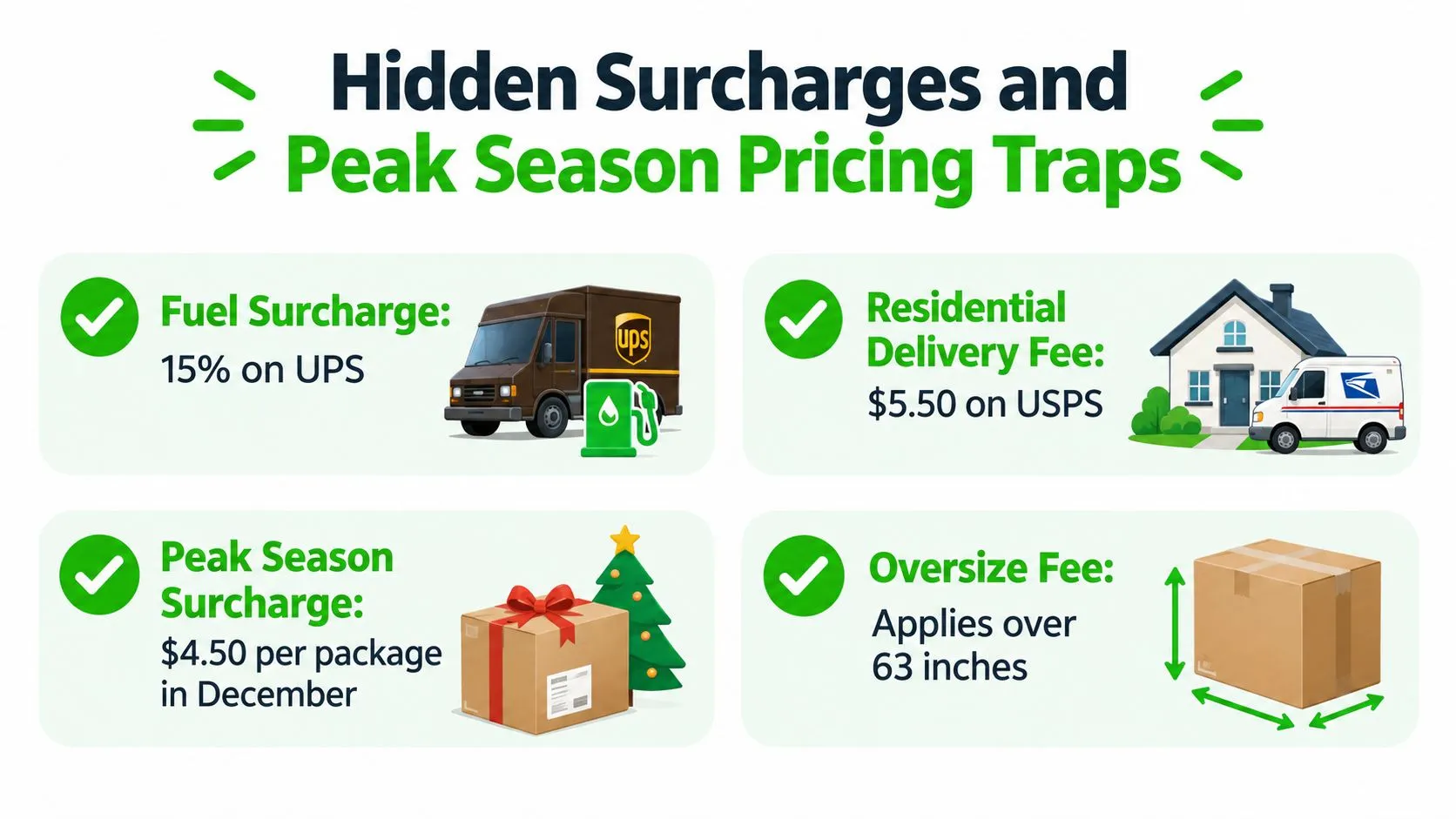
Published base rates can create false confidence. Your margin is affected by the final billed amount, and that amount may include residential handling, fuel, address corrections, dimensional adjustments, or peak-period charges.
These fees don’t affect every shipment equally. UPS can become less attractive on residential orders when its additional charges are included, while USPS’s price advantage can narrow during a seasonal adjustment. The correct comparison is always the final label cost for the exact service and destination.
Peak pricing changes the Q4 answer
USPS introduced a major holiday-season pricing adjustment for 2026 that began October 4, 2026 and ran through January 17, 2027. For Zones 1 to 4, the surcharge increased by $0.50 for parcels weighing 0 to 3 lb, $0.80 for parcels weighing 4 to 10 lb, $1.25 for parcels weighing 11 to 25 lb, and $3.90 for parcels weighing 26 to 70 lb and oversized parcels (USPS announcement for the 2026 holiday season).
Those adjustments can change your carrier policy during the busiest selling period. A product that supports free shipping during ordinary weeks may need a price adjustment, a packaging change, or a different service during the holiday window.
Build surcharge checks into your calendar
Use a recurring review before peak volume arrives:
- Audit seasonal dates: Mark the effective period in your shipping calendar before listing holiday inventory.
- Reprice free-shipping listings: Add the expected surcharge to your margin calculation instead of absorbing it blindly.
- Review heavy SKUs: The largest temporary increase applies to heavier and oversized parcels, so inspect those listings first.
- Compare service alternatives: A different carrier may be cheaper for a particular weight and zone during peak periods.
A holiday rate change is not an administrative detail. It can turn a thin-margin sale into a loss, particularly when the item’s selling price leaves little room for delivery costs.
Use the following video as an additional visual reference for thinking about shipping fees and carrier selection.
Unlocking Commercial Pricing and Business Discounts
Retail pricing is where many resellers make the wrong comparison. If you ship regularly, your goal should be to access commercial rates on both carriers and compare those rates consistently.
The 1 lb comparison illustrates why. USPS is listed at $9.04 under commercial pricing, compared with $11.99 for UPS in the cited comparison. That difference is large enough to influence whether you offer free shipping, charge the buyer separately, or remove a low-margin SKU from your catalog (Pitney Bowes pricing overview).
Move from counter pricing to account pricing
Start with a dedicated business account for each carrier. Keep your billing information, return address, packaging details, and shipping history organized so you can evaluate rates without mixing personal and business transactions.
Then use a multi-carrier shipping platform that displays available USPS and UPS services together. The purpose isn’t just convenience. It gives you a consistent comparison screen and can expose commercial or aggregated rates that aren’t visible when you buy labels at a retail counter.
Negotiate from shipment data
When your volume becomes meaningful, don’t ask for a discount based on a general promise to ship more. Bring a report showing:
- Weight distribution, including the share of parcels below 5 lb and above 10 lb.
- Zone distribution, showing whether your orders stay local or travel long distances.
- Address mix, separating residential and commercial destinations.
- Package dimensions, especially boxes that may trigger dimensional pricing.
- Current spend, separated by carrier and service.
This information helps you negotiate against your actual weaknesses. If UPS is competitive for your heavier shipments but expensive for residential orders, ask for terms that address the charges affecting that segment. If USPS wins on light parcels but loses during peak pricing, model that seasonal exposure before committing volume.
Discounts only improve margins when they match the shipments you actually send.
Review rates by package profile rather than accepting one average discount as proof that a carrier is cheaper. A strong commercial rate on heavy cartons won’t fix an operation that mainly ships lightweight residential parcels.
Matching Your Inventory Mix to the Right Carrier
Your catalog should influence your carrier mix. A vintage clothing seller, a refurbished electronics reseller, and a home-goods dealer face different weight, dimension, and risk patterns.
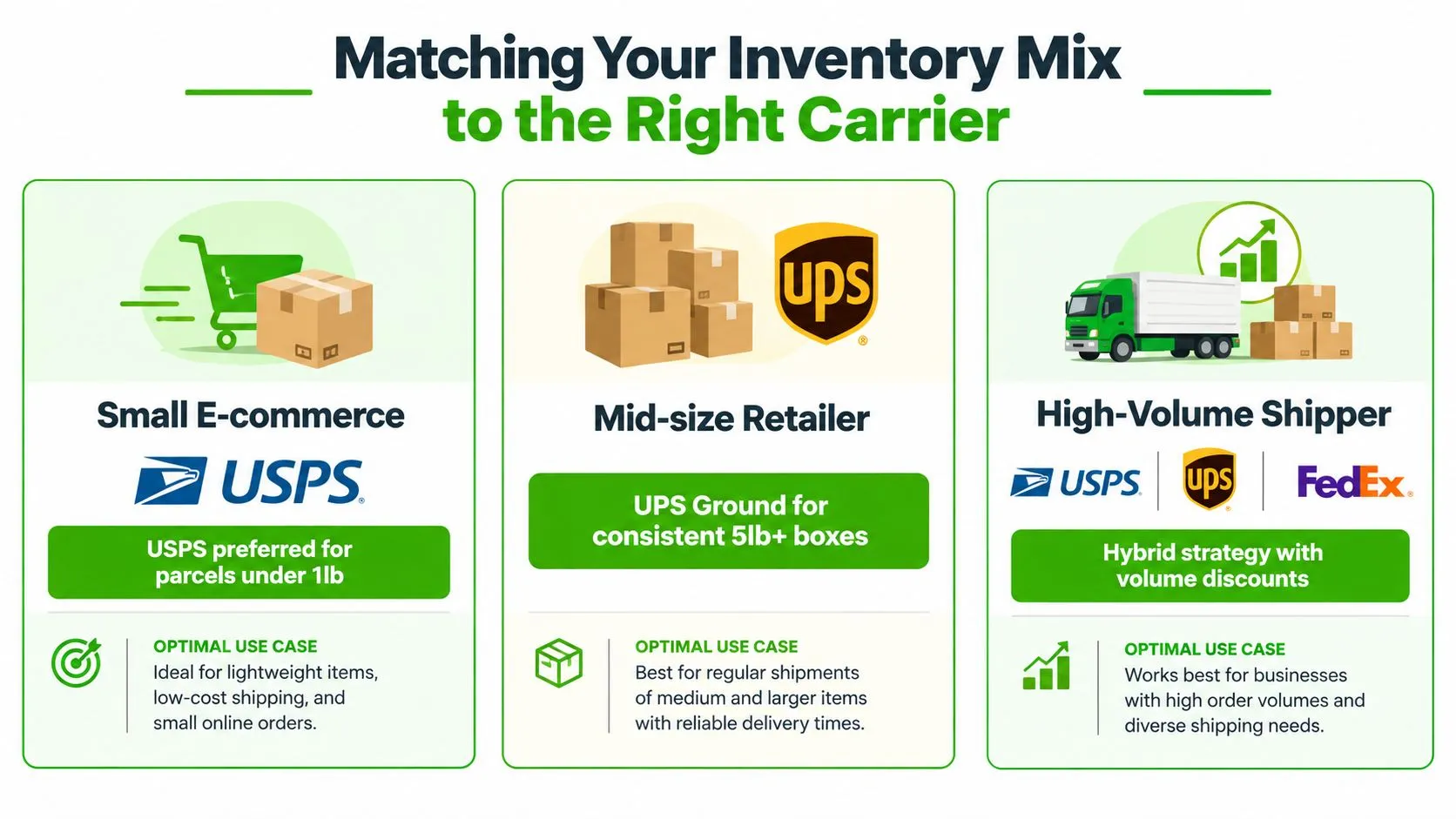
USPS is the default starting point for compact lightweight inventory. UPS deserves more attention as boxes become heavier, travel farther, or require more structured ground-network handling. A hybrid policy usually protects margins better than choosing one carrier for every order.
Match the product to the parcel profile
| Inventory type | First carrier to check | Operating reason |
|---|---|---|
| Vintage clothing and accessories | USPS | Items are often compact and lightweight |
| Small collectibles | USPS | Lower lightweight pricing can protect thin margins |
| Heavy electronics | UPS | Heavier parcels and tracking requirements may justify comparison |
| Small dense goods | USPS commercial options | Compact packaging can preserve the lightweight advantage |
| Bulky home goods | UPS | Weight and dimensions make long-distance ground pricing more important |
For a 5 lb domestic parcel, USPS Ground Advantage is cheaper than UPS Ground in several published comparisons. One benchmark lists $22.75 for USPS versus $25.98 for UPS on a New York to Los Angeles shipment, while another comparison places USPS at $9 to $12 and UPS Ground as the higher-cost ground option for a typical 5 lb Zone 5 shipment (Easyship’s published comparison).
That evidence supports a useful reseller rule: don’t switch every 5 lb order to UPS automatically. Check whether the box is compact enough for USPS’s lower base rate to outweigh UPS’s zone and surcharge exposure.
If your inventory is spread across eBay and other marketplaces, review your shipping options on eBay before standardizing calculated or seller-paid shipping. The listing method affects how much control you retain over the final carrier choice.
A hybrid setup works best when rules are explicit. USPS can handle lightweight parcels and qualifying destinations, while UPS receives heavier or long-distance packages when the live rate is lower.
Automating Carrier Selection in Your Daily Workflow
Manual comparison fails as order volume grows. You either spend too much time checking labels or default to the carrier you used yesterday, even when today’s package belongs to a different cost category.
Set up carrier selection as a series of rules:
- Capture accurate product data. Store weight, packed dimensions, preferred box, and handling requirements with each SKU.
- Create package profiles. Use names such as “small apparel mailer,” “compact 5 lb carton,” and “heavy electronics box.”
- Connect both carriers. Make USPS and UPS rates available in the same shipping workflow.
- Define service constraints. Decide whether the order needs ordinary ground delivery, faster delivery, signature handling, or a particular destination capability.
- Compare total label cost. Include available surcharges, dimensional pricing, and seasonal adjustments rather than comparing base rates alone.
- Log the result. Save the selected carrier and final billed cost so you can refine the rule from actual orders.
Use exceptions instead of manual decisions
Your system should select the lowest-cost service that meets the order’s requirements, then send unusual shipments to review. Useful exception triggers include oversized packaging, heavy parcels, high-value goods, rural destinations, and any order affected by a temporary peak adjustment.
Review the rules on a fixed schedule. Compare expected cost with actual label spend, then adjust box profiles or carrier preferences when the data shows a persistent gap. Packaging changes deserve the same attention as negotiated rates because a smaller carton can move an order across the carrier crossover.
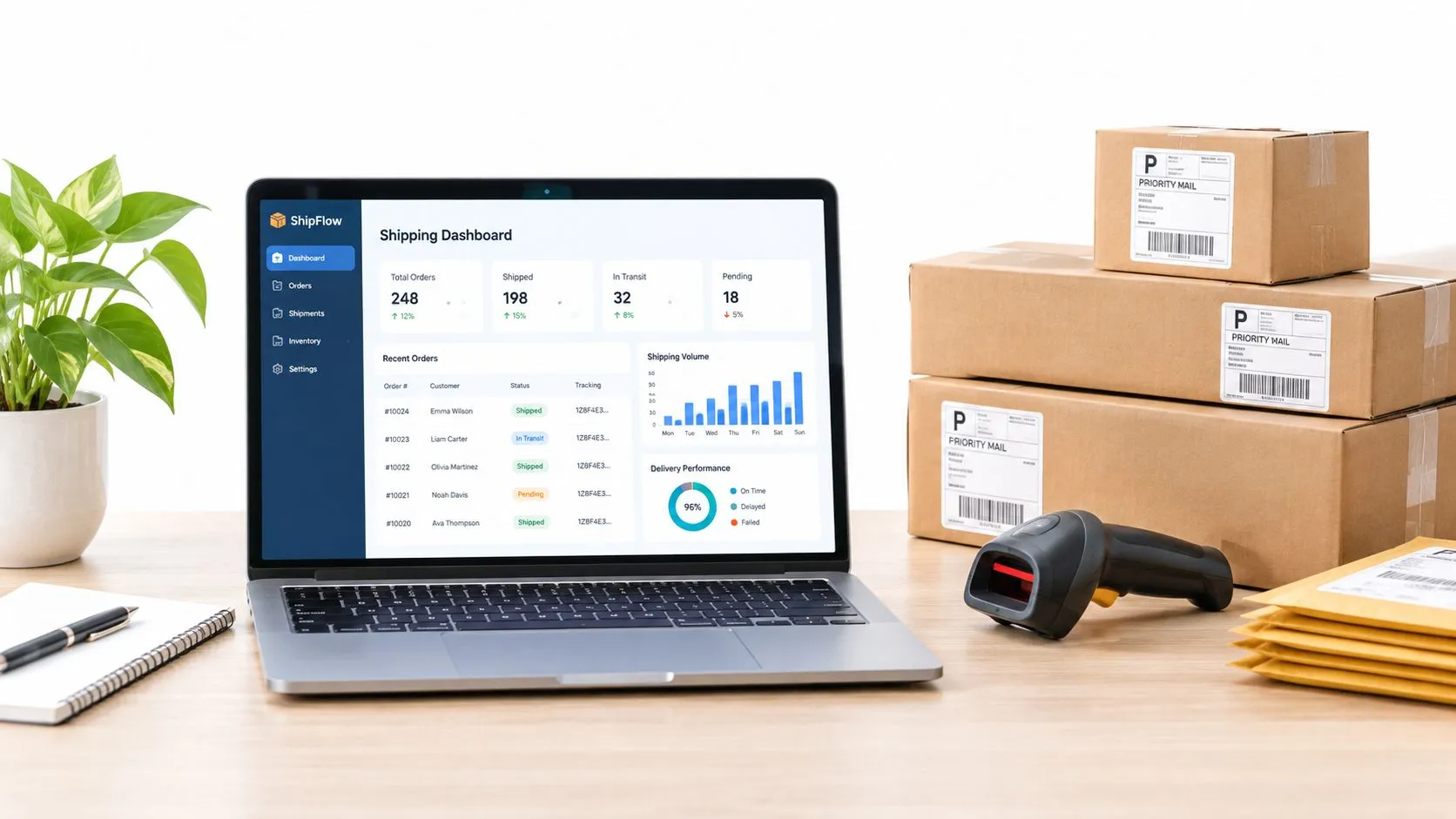
Ruit can centralize inventory, listings, orders, accounting, and analytics for professional secondhand sellers, helping you keep the shipment data connected to the wider operating workflow. Visit Ruit to evaluate whether its marketplace and inventory tools fit your business, then use your actual package profiles to build a carrier policy that protects margin on every order.
Frequently Asked Questions
Is USPS or UPS cheaper for a 1 lb package?
USPS is the cheaper starting point. For a 1 lb package going to Zone 1, USPS retail pricing is $11.00 and UPS retail pricing is $11.99. At commercial pricing, USPS is listed at $9.04 against $11.99 for UPS.
When does UPS become the cheaper carrier?
UPS becomes more competitive as weight and distance increase. Some rate tables show UPS winning at 10 lb in selected zones and at 20 lb across multiple zones. For heavy parcels over 10 lb, check UPS first.
Why can a light package cost more than expected?
A large box may be charged by dimensional weight rather than scale weight. Residential handling, fuel, address corrections and peak-period charges can also raise the final label cost. Compare the final billed amount, not the base rate.
How do holiday surcharges change the choice?
USPS applied a temporary holiday adjustment from October 4, 2026 through January 17, 2027. The largest increases apply to heavier and oversized parcels. Review free-shipping listings and heavy SKUs before peak volume arrives.