Amazon Suspending Accounts: Causes and Fixes


Table of Contents
- Table of Contents
- The Reality of Amazon Account Suspensions
- Common Policy Violations and Performance Triggers
- How Amazon Detects Risk Beyond Explicit Violations
- The Appeal Process and Recovery Odds by Suspension Type
- Building a Bulletproof Account Health Strategy
- Managing Multi-Channel Risk Beyond Amazon
- Proactive Monitoring and Next Steps
- Frequently Asked Questions
Amazon suspensions reached 14% of seller accounts in Q1 2025, up from 11% in 2024, according to recent Amazon compliance data. That figure changes the operating question. The issue isn’t whether a seller is honest or experienced. It’s whether the business can prove, quickly and consistently, that its sourcing, listings, customer service, fulfilment, and account relationships are safe under an enforcement system that increasingly evaluates patterns rather than isolated mistakes.
Amazon suspending accounts is therefore an operational risk, not just a punishment for obvious bad actors. A suspension can remove selling privileges, cancel listings, suspend the account, and affect payments under Amazon’s seller policies. The practical response is to build an evidence-ready operation before Amazon asks you to explain one.
Table of Contents
- The Reality of Amazon Account Suspensions
- Common Policy Violations and Performance Triggers
- How Amazon Detects Risk Beyond Explicit Violations
- The Appeal Process and Recovery Odds by Suspension Type
- Building a Bulletproof Account Health Strategy
- Managing Multi-Channel Risk Beyond Amazon
- Proactive Monitoring and Next Steps
- Frequently Asked Questions
The Reality of Amazon Account Suspensions
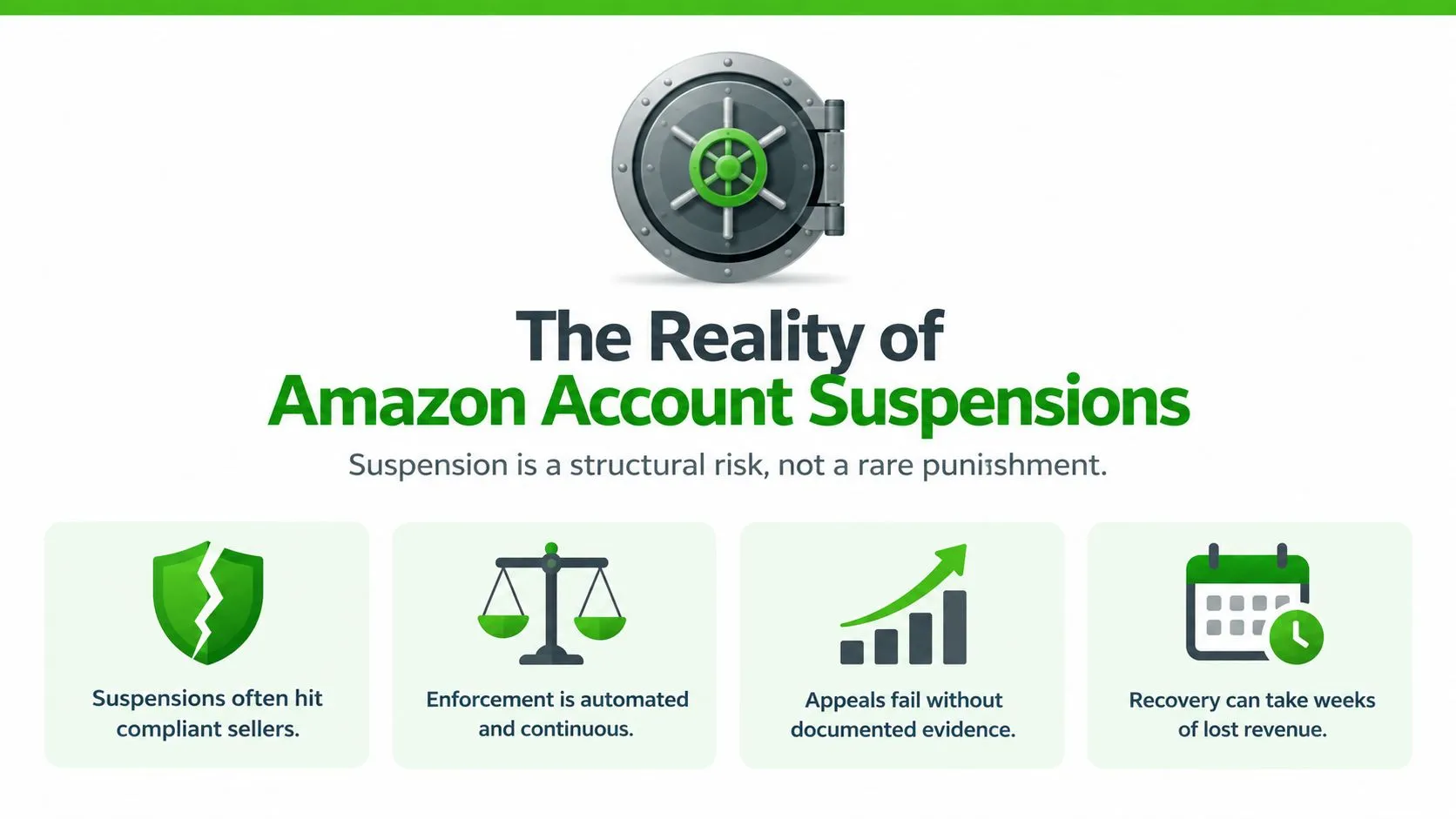
The seller base has already felt the impact. The same compliance summary reports that 35% of sellers had experienced an account suspension, while active sellers declined from 2.4 million in 2021 to 1.65 million by the end of 2025. Those figures don’t prove that enforcement alone caused the decline, but they do show how account governance and seller attrition have become structural marketplace issues.
Amazon’s rules give it broad enforcement options. Listing cancellation, account suspension, forfeiture of payments, and removal of selling privileges are all formal outcomes when a seller violates policy. Amazon also brought merchants worldwide under a 30-day notice framework before permanent removal after a widely cited 2019 policy change, marking a move toward a more standardized enforcement timeline.
Why compliant businesses still get caught
A professional seller can follow visible performance metrics and still receive an enforcement notice because Amazon reviews more than sales results. Supplier evidence, product authenticity, intellectual property complaints, account relationships, verification records, listing edits, and operational behaviour can all influence the outcome.
That creates a dangerous gap between what the seller believes is compliant and what Amazon can verify from its internal records. A clean dashboard is useful, but it’s not a complete defence. If the business can’t connect a product to a credible supplier, explain a sudden change in account behaviour, or separate its operation from another seller, good intentions won’t carry much weight.
Practical rule: Treat your Amazon account like a regulated operating licence. Store the evidence needed to defend it before an automated review begins.
The useful preparation isn’t another generic template. Sellers who need help structuring a response can review guidance on how to craft a winning Amazon Plan of Action, but the document should be built around the actual trigger and supporting proof. A polished explanation without invoices, ownership records, process changes, or measurable controls usually remains an assertion.
Common Policy Violations and Performance Triggers
Amazon’s enforcement categories are broad, but the operational causes are usually traceable. The most damaging patterns include inauthentic or counterfeit complaints, policy violations, review manipulation, intellectual property infringement, and persistent performance failures. Recent compliance data attributes 28% of reported suspension cases to inauthentic or counterfeit complaints, 22% to policy violations, 18% to review manipulation, and 15% to IP infringement in the cited industry report.
Those categories require different controls. An authenticity complaint points toward sourcing and chain-of-custody evidence. An IP complaint requires listing governance, brand review, and a process for removing disputed content. Review manipulation involves staff and agency conduct, while performance failures usually expose weaknesses in fulfilment, inventory accuracy, customer support, or carrier management.
The numbers that require daily attention
Amazon UK publishes concrete standards that are useful benchmarks for sellers operating in other markets. Order Defect Rate must stay below 1%, Late Shipment Rate below 4%, and Valid Tracking Rate above 95%, as stated in Amazon UK’s seller account health guidance.
| Metric | Target Threshold | Primary Risk Factor |
|---|---|---|
| Order Defect Rate | Below 1% | Negative feedback, claims, or chargebacks |
| Late Shipment Rate | Below 4% | Dispatch delays and inaccurate handling times |
| Valid Tracking Rate | Above 95% | Missing, invalid, or late tracking data |
These aren’t vanity indicators. They’re warning signals about the reliability of the operating system behind the account. If inventory is stored across locations, the listing quantity must reflect what can ship. If staff mark orders dispatched before the carrier scans them, tracking quality deteriorates even when the parcel eventually arrives.
Inauthenticity complaints need a sourcing audit. Keep supplier invoices, purchase orders, payment records, business registration details, and correspondence in a folder connected to each SKU or batch. The documents should identify the supplier clearly and match the product, quantities, dates, and business entity shown in Seller Central.
IP complaints need listing control. Don’t let inexperienced staff copy brand language, logos, images, or compatibility claims without review. Product titles and descriptions should reflect what you can substantiate, not what a competitor happens to claim.
Review manipulation needs a zero-tolerance workflow. Incentivised reviews, coordinated requests, scripted buyer interactions, and attempts to influence negative feedback can turn a customer-service process into a policy problem. Train every employee and external agency that handles buyer communications.
Metric failures are symptoms
A late-shipment warning often begins with an inventory mismatch, a warehouse cut-off problem, or a carrier collection failure. Fixing the percentage without fixing the cause only postpones the next incident. Use order-level root-cause analysis, then change the process that produced the failure.
How Amazon Detects Risk Beyond Explicit Violations
Good visible metrics don’t guarantee safety. Amazon can suspend an account when it suspects fraudulent, deceptive, illegal, or otherwise harmful activity, and its Account Health Rating guidance states that certain violations can trigger immediate deactivation regardless of the score. Repeat violations can also create deactivation risk after five infringement-related violations or two restricted-products violations within 180 days, according to Amazon’s Account Health Rating policy.

The shift from rules to risk signals
The difficult cases don’t always present a single obvious breach. Recent practitioner guidance describes Amazon using AI-detected behavioural signals and account-linking data that may not map neatly to one public policy page. A seller may see acceptable order metrics while Amazon investigates a related account, identity inconsistency, unusual login or operational patterns, or behaviour it interprets as circumvention.
That’s why “fix the metric” is sometimes the wrong response. If the notice concerns a related account or behavioural risk, the seller needs to explain the business structure and prove separation. Relevant evidence may include ownership documents, business addresses, user-access records, device and operational explanations, supplier relationships, and a clear account history. Send only authentic, consistent records. Altered or contradictory documents can create a more serious trust problem.
When Amazon’s concern is probabilistic, your appeal must make the business explainable.
A related account is also not the same as a duplicate listing. If multiple people, companies, brands, or warehouses operate within the same organisation, document who owns each account, which entity receives payments, who has access, and why any shared service provider or location exists. The goal isn’t to overwhelm the reviewer. It’s to remove unanswered questions.
Verification processes deserve the same discipline. Keep contact details, identity records, payment information, and business registration data aligned across systems. For sellers managing phone-based verification or one-time passwords, a controlled LineVerifier verification service may help organise verification workflows, but it can’t substitute for accurate ownership and compliance records.
The appeal flow may require acknowledging a violation, completing a questionnaire or quiz, and uploading supporting documents through Account Health. If the notice doesn’t identify the precise problem, don’t invent a confession. State what you can verify, identify the evidence you’re providing, and address each risk signal in plain language.
The Appeal Process and Recovery Odds by Suspension Type
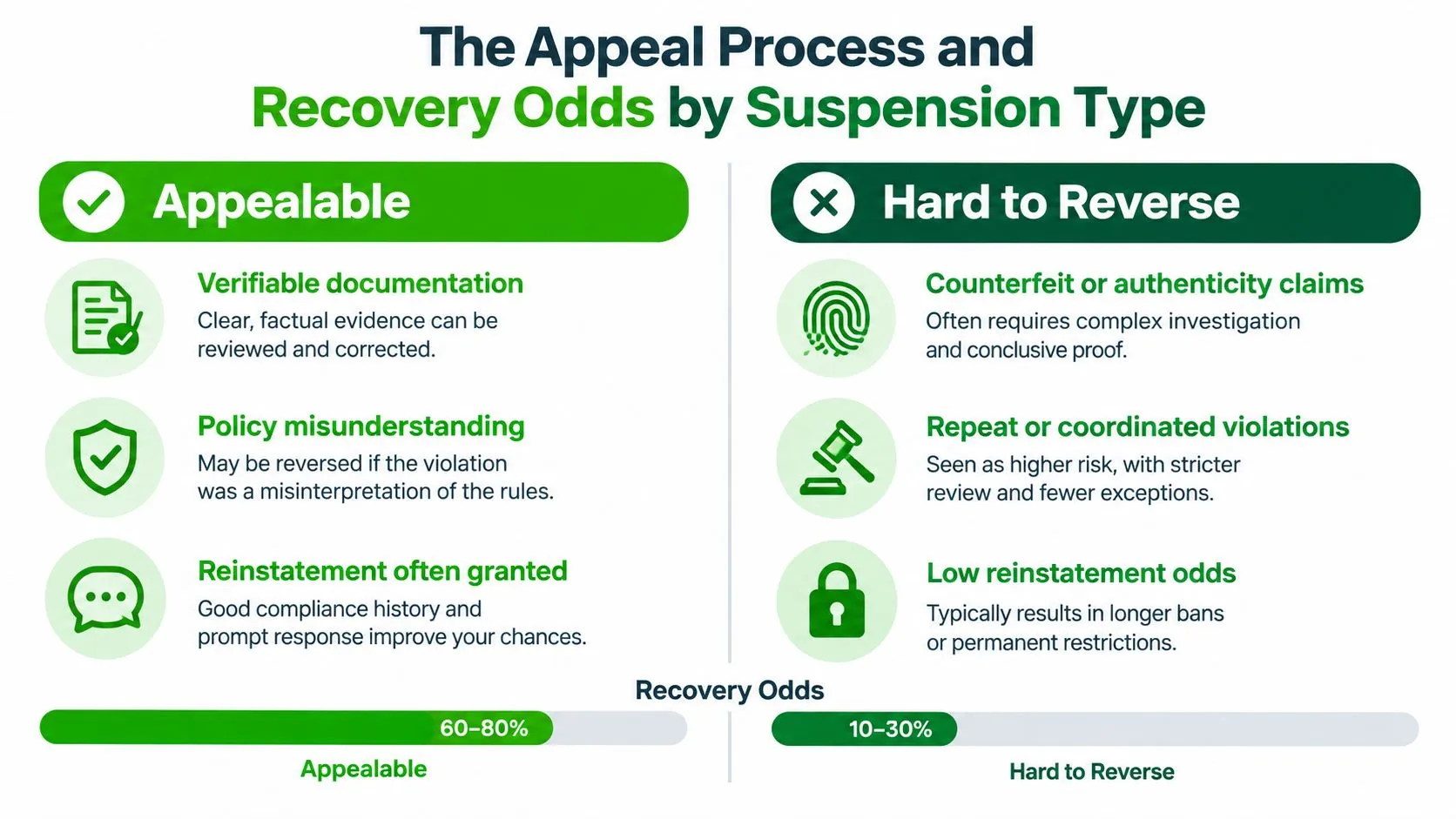
A Plan of Action isn’t a universal key. The best first appeal depends on the suspension class, and aggregated appeal data shows a sharp difference between categories. The cited dataset estimates 12% first-appeal success overall, with linked-account cases at around 8%, IP complaints around 12%, and late-shipment or metrics cases around 24% (aggregated appeal data).
Those figures aren’t a promise for an individual account. They’re a warning against treating every case as equally recoverable. A metrics suspension may respond to transaction-level analysis and fulfilment changes. A linked-account case may require proof about ownership, access, entities, and operational separation. An IP complaint can depend on rights, authorisation, product provenance, and the complainant’s position.
Match the evidence to the allegation
For a late-shipment or metric-based suspension, build the appeal around specific orders and corrective controls. Show what caused the failures, which inventory or carrier process changed, and how staff will detect a repeat. Generic promises about “better customer service” don’t answer the operational question.
For an IP complaint, identify the affected listings and establish the seller’s position with relevant authorisation, invoices, brand correspondence, or listing changes. Don’t argue that other sellers do the same thing. Amazon reviews your account, not the behaviour of unrelated sellers.
For a linked-account case, explain every legitimate relationship. Include company ownership, account purpose, user access, service providers, addresses, payment relationships, and the controls that prevent accidental cross-account activity. If the seller can’t explain the link, a polished POA won’t resolve it.
Amazon’s formal policy history also matters. The 30-day notice framework applies to permanent removal in the policy context cited earlier, but not every enforcement situation waits for a long notice period. Amazon can suspend immediately when it sees severe risk or harmful conduct. Read the exact notification, check Account Health, complete any requested quiz or questionnaire, and upload only documents that directly support the response.
What usually fails
Repeatedly submitting the same paragraph with minor wording changes rarely creates new evidence. Emotional explanations, accusations against competitors, unsupported claims of innocence, and large unlabelled document bundles make the reviewer’s job harder.
The first appeal should be treated as a high-stakes compliance submission. Write the root cause, corrective action, and prevention plan only when they are backed by records. If the evidence doesn’t support a conclusion, investigate before submitting.
Building a Bulletproof Account Health Strategy
Prevention starts with a simple principle: every sale should be explainable from purchase to delivery. That means the business can identify where the unit came from, why the listing is accurate, who handled the buyer communication, when the order was dispatched, and which record proves each step.
Build an evidence trail at SKU level
Store sourcing records against the product or batch, not in a general inbox. A useful file structure includes:
- Supplier identity: Keep invoices, purchase orders, payment evidence, and supplier contact details together.
- Product provenance: Record SKU, model, condition, serial information where relevant, and the related purchase batch.
- Listing approval: Save the product research, images, claims, brand language, and any authorisation used before publication.
- Customer resolution: Retain buyer messages, refunds, replacements, and the reason for each decision.
- Dispatch proof: Connect the order to the carrier handover and tracking event.
For second-hand and mixed-inventory businesses, the evidence challenge is greater because stock can vary unit by unit. Photograph condition and identifiers before listing, and prevent staff from reusing a description that doesn’t match the actual item.
Put controls around the failure points
Review Account Health weekly, but monitor operational data more frequently. A weekly review should identify trend changes before Amazon does. Compare cancellations, defects, dispatch timing, tracking validity, refunds, and buyer complaints by warehouse, employee, supplier, and product category.
Use a warning workflow that assigns an owner and deadline. A policy notice should trigger a same-day evidence review, not a reminder to “keep an eye on it.” Staff should know who can pause a listing, quarantine questionable inventory, correct a handling time, or escalate a buyer complaint.
Evidence beats reassurance: A reviewer can act on a dated invoice, order record, and documented process change. “We take compliance seriously” is not a corrective action.
Inventory synchronisation is part of account protection. Overselling creates cancellations, late shipments, and buyer complaints, especially when the same unit appears on Amazon and another marketplace. Keep the operational records and access controls documented in this account documentation resource so the business can show who changed what and when.
Train staff on restricted products, brand claims, buyer messaging, and account access. The strongest policy manual is useless if a contractor can create listings without review or answer complaints with an improvised promise.
Managing Multi-Channel Risk Beyond Amazon
Amazon can be a major channel, but it shouldn’t be the only channel carrying the business. A suspension removes more than listings. It can interrupt customer access, fulfilment routines, working capital, and the team’s daily operating rhythm while the review continues.
Diversification doesn’t eliminate compliance risk. It gives the business another route to sell existing stock and maintain customer relationships while one channel is unavailable. Suitable channels may include eBay, Vinted, Wallapop, an independent WooCommerce or PrestaShop store, and other marketplaces that match the inventory and target buyer.
Centralise the controls, not just the listings
Cross-posting alone can increase risk if inventory remains fragmented. A sale on one channel must reduce availability everywhere else, or the business creates the exact cancellation and fulfilment problems that damage account health.
A central operating system should synchronise:
- Inventory status: One available quantity for each item, including reserved and sold stock.
- Prices and condition: Consistent information with channel-specific adjustments where required.
- Orders: A single queue showing payment, fulfilment, returns, and exceptions.
- Messages: Buyer conversations assigned to the right team member.
- Analytics: Revenue, costs, stock age, and margin by channel.
The value is operational resilience, not just convenience. A professional reseller can shift attention toward another channel without recreating every listing or losing track of stock. The business also gets a more honest view of performance because sales, returns, and inventory are measured across the full operation.
This guide to multi-channel inventory management covers the controls needed to avoid overselling and keep stock aligned. The same discipline supports Amazon compliance because accurate inventory and reliable dispatch reduce the operational signals that lead to complaints.
Diversification should be deliberate. Choose channels based on product fit, fees, buyer expectations, shipping capabilities, and the team’s ability to answer messages. More channels without central control create more failure points. Fewer channels with synchronised inventory and clear ownership usually produce a stronger defence.
Proactive Monitoring and Next Steps
Run a short daily check on open buyer issues, unshipped orders, inventory mismatches, tracking events, account notifications, and listings that require review. Escalate any authenticity, IP, restricted-product, or verification message immediately, and preserve the original notice before anyone edits the related listing.
Once a week, review Account Health alongside operational records. Look for the cause behind every movement, such as one supplier generating complaints, one warehouse missing carrier collections, or one employee publishing unverified claims. A practical analytics dashboard reference can help teams decide which views belong in that recurring review.
Keep a suspension file even when the account is healthy. It should contain current supplier evidence, entity and ownership records, account-access information, listing approvals, customer-resolution history, and fulfilment controls. If Amazon opens a review, you’ll be assembling an explanation from an organised record instead of reconstructing the business under pressure.
The operating standard is straightforward: monitor the signals, preserve the proof, and reduce dependence on one channel. Sellers who do that can respond to visible policy notices and investigate less obvious behavioural flags with facts rather than assumptions.
Ruit centralizes inventory, listings, orders, buyer messages, and analytics across Amazon, eBay, Vinted, Wallapop, WooCommerce, and PrestaShop, helping professional resellers reduce overselling and keep operations explainable. Visit Ruit to see how a unified system can protect your account health and keep revenue moving when one marketplace becomes unavailable.
Frequently Asked Questions
Why does Amazon suspend seller accounts?
The most damaging patterns are inauthentic or counterfeit complaints, policy violations, review manipulation, intellectual property infringement and persistent performance failures. Amazon can also act on behavioural signals and related accounts, even when order metrics look healthy.
Which account health metrics should sellers watch?
Amazon UK publishes three benchmarks. Order Defect Rate must stay below 1%, Late Shipment Rate below 4% and Valid Tracking Rate above 95%. Treat a metric failure as a symptom and fix the process that produced it.
What are the odds of winning a first appeal?
The cited appeal data estimates 12% first-appeal success overall. Linked-account cases sit at around 8%, IP complaints around 12% and late-shipment or metrics cases around 24%. These figures are not a promise for an individual account.
What should a Plan of Action include?
Evidence that matches the allegation. Write the root cause, corrective action and prevention plan only when records back them. Invoices, ownership records and documented process changes carry more weight than a polished explanation.