Etsy vs eBay Selling: Side-by-Side Comparison for 2026


Table of Contents
- Table of Contents
- Why Etsy vs eBay Selling Matters for Resellers
- Marketplace Scales and Buyer Audiences
- Fee Structures and What They Mean for Inventory Turnover
- Listing Workflows and Multichannel Publishing Realities
- Best Categories and Use Cases for Second-Hand Goods
- When to Choose Etsy, eBay, or Both Together
- How to Test Your Platform Fit Before Scaling Inventory
- Frequently asked questions
You’ve got a storage area full of mixed inventory, a few handmade or vintage pieces that could command a premium, and a growing list of items waiting to be photographed. The obvious question is whether Etsy or eBay will generate more sales. The more useful question is which marketplace will let you source, list, price, ship, and renew that inventory without slowly eroding your margin.
Etsy and eBay reward different operating models. Etsy suits creative, curated, and vintage-led catalogs, while eBay gives resellers more room for used goods, branded products, parts, collectibles, and mixed-condition stock. For professional sellers, Etsy vs eBay selling is less a popularity contest than a decision about inventory turnover, buyer intent, and the cost of keeping every SKU active.
Table of Contents
- Why Etsy vs eBay Selling Matters for Resellers
- Marketplace Scales and Buyer Audiences
- Fee Structures and What They Mean for Inventory Turnover
- Listing Workflows and Multichannel Publishing Realities
- Best Categories and Use Cases for Second-Hand Goods
- When to Choose Etsy, eBay, or Both Together
- How to Test Your Platform Fit Before Scaling Inventory
- Frequently asked questions
Why Etsy vs eBay Selling Matters for Resellers
A reseller can make a good margin on an item and still lose money through slow listing work, repeated renewals, stock errors, and unplanned customer service. That’s why the platform decision changes daily operations, not just the checkout fee.
Suppose you’ve bought a varied batch of stock. A handmade ceramic piece may need styled photography, a story-led description, and a price that reflects its individuality. A used camera lens needs model identification, mount details, condition notes, compatible equipment, and a competitive price. Both items can be sold online, but they need different listings and attract different buyers.
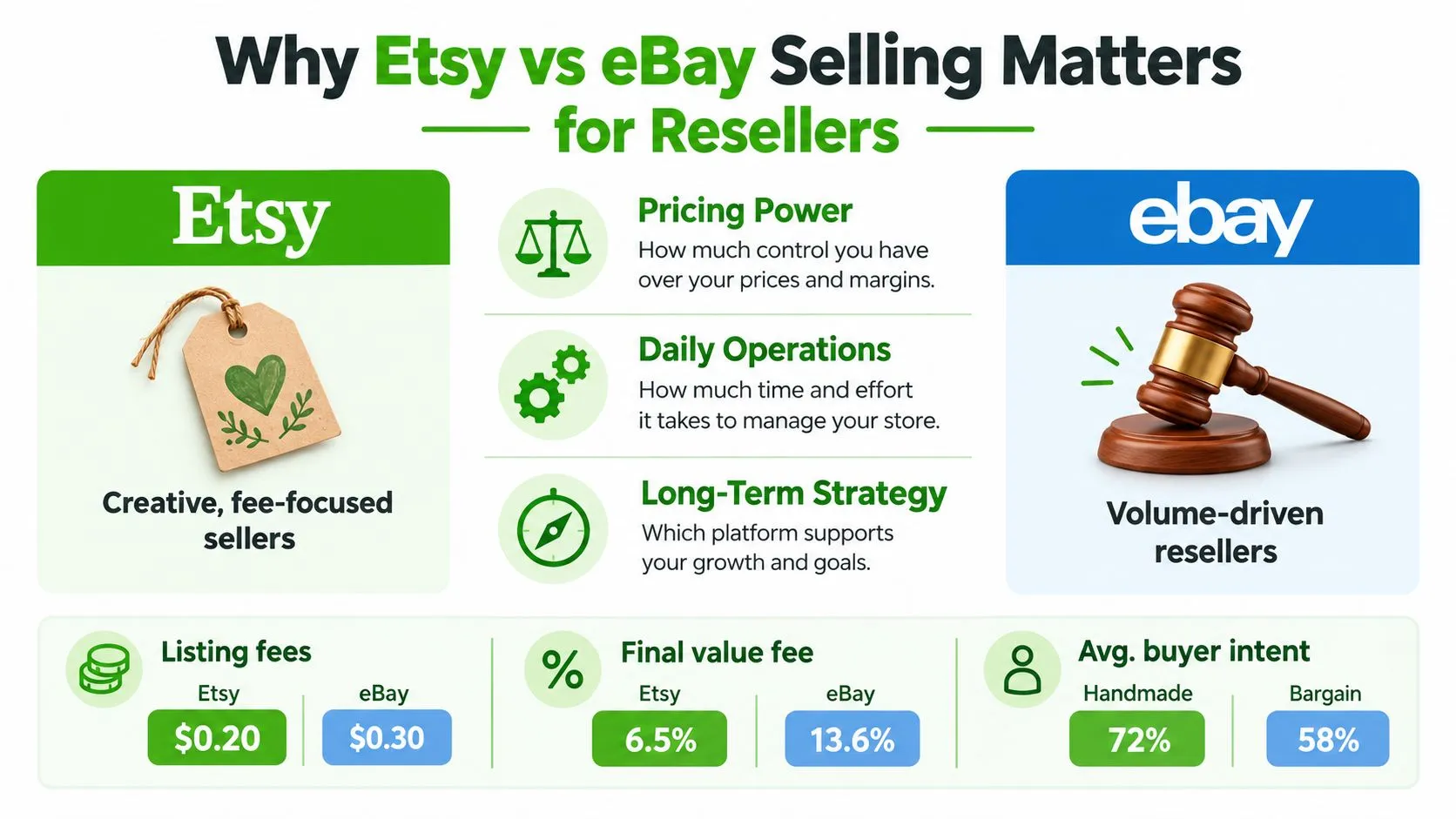
Etsy’s marketplace is concentrated around handmade, vintage, and craft-oriented commerce. eBay is broader and more general-purpose, which makes it more naturally suited to resale and mixed catalogs. Etsy’s own 2024 seller census found that 89% of sellers were businesses of one, 97% operated from home, and 59% sold their goods for the first time on Etsy (Etsy Seller Census). Those figures help explain why Etsy often feels approachable to small creative businesses, while eBay’s breadth supports more operationally complex resale models.
The hidden cost is workflow
A small catalog can absorb manual work. You can write each description carefully, check every variation, and remove a sold item from another channel without much disruption. A large second-hand catalog can’t rely on that process for long. Each extra SKU creates another photography task, inventory record, price decision, message thread, and fulfillment risk.
The platform also shapes pricing power. Etsy buyers often accept a premium for originality, curation, or customization. eBay buyers frequently compare brand, model, condition, completeness, and price. That doesn’t mean one audience is better. It means your item must be presented according to the reason buyers use that marketplace.
Practical rule: Choose the channel that matches how buyers identify value in your inventory, then calculate fees against realistic turnover.
For resellers, the decision usually comes down to three operational questions:
- Can the item legally and naturally belong on the platform?
- How much listing and maintenance work does each SKU require?
- Will the inventory sell quickly enough to justify the channel’s fee cadence?
Those questions are more useful than asking which marketplace is just cheaper. A curated Etsy catalog may outperform a broader eBay catalog on margin per item, while eBay may move mixed second-hand stock with less category friction. The right choice starts with catalog fit, then moves to operational fit and expected turnover.
Marketplace Scales and Buyer Audiences
A reseller with mixed inventory may list a vintage textile, a used phone, and a replacement part in the same week. Those items need different buyers and different listing work. Marketplace scale matters, but the useful comparison is whether the audience can find, understand, and buy each SKU at a workable pace.
Etsy reported 5.6 million active sellers and 86.5 million active buyers at the end of 2025, while eBay reported 136 million active buyers worldwide on a trailing 12-month basis in 2026 and roughly 20 million sellers across more than 190 markets (marketplace comparison data). eBay therefore offers broader reach across product types. Etsy concentrates demand around creative, distinctive, and curated goods, which can give a well-matched listing more relevance.
Buyer intent changes listing strategy
eBay shoppers often arrive with a specific task. They may search by brand, model number, part reference, size, condition, or compatibility. Listings need accurate item specifics, clear condition grading, useful fit information, and photographs that resolve questions before a buyer sends a message.
Etsy shoppers are more likely to browse by style, occasion, material, craft, or uniqueness. The first image must communicate visual appeal quickly, while the description explains why the item is distinctive. For handmade or customized products, variations and production details can matter as much as technical specifications.
| Buyer environment | Etsy | eBay |
|---|---|---|
| Marketplace character | Curated and creative | Broad and general-purpose |
| Common discovery behavior | Style, craft, uniqueness, gift intent | Brand, model, condition, value, rarity |
| Stronger catalog fit | Handmade, vintage, custom goods, craft supplies | Used goods, branded resale, parts, collectibles, mixed inventory |
| Listing emphasis | Visual presentation and product story | Searchable specifications and condition accuracy |
| Operational implication | Fewer categories, stronger product curation | More catalog breadth and more variation in fulfillment |
Etsy reported $10.4607 billion in gross merchandise sales for 2025, while eBay reported $11.1 billion in revenue for full-year 2025. These measures cover different parts of each business, so they should not be treated as a direct marketplace performance comparison.
Match demand elasticity to stock
A broad eBay audience helps when inventory spans brands, conditions, and price points. Buyers may search for one specific component or accept a used alternative because it solves an immediate need. That makes eBay relevant for replacement parts, second-hand electronics, collectibles, and mixed resale stock.
Etsy can work better when the catalog has a clear aesthetic or creative identity. Coherent vintage clothing, artisan materials, and original designs give shoppers a reason to recognize the shop rather than judge every SKU as an isolated listing.
For a practical view of what sells the most on eBay, compare marketplace demand patterns with your own sourcing history. A reseller operating an end-to-end workflow should track which SKUs justify photography, item specifics, pricing updates, storage, and fulfillment effort on each platform. The larger audience is useful only when it produces sufficient sell-through for that operational load.
Fee Structures and What They Mean for Inventory Turnover
A reseller with hundreds of SKUs can lose margin before a single order arrives. The relevant question is how often each listing costs money before it sells, and whether that expense fits the item’s expected turnover.
Etsy charges a $0.20 listing fee, and the listing renews every four months. It also applies a 6.5% transaction fee to the total sale price, including shipping, plus payment processing that is typically 3% + $0.25 per transaction in the United States (Etsy and eBay fee comparison).
eBay gives sellers 250 free listings per month on a basic account. After that allowance, most additional listings cost about $0.35, while completed sales usually incur fees around 13.25% to 13.6%, plus roughly $0.30 per order, depending on category (eBay selling fees).
Listing cadence matters more than it first appears
Etsy’s lower listing charge can suit products with strong margins and a reasonable chance of selling within the renewal period. A slow SKU still creates recurring catalog expense, however. Multiply that charge across dormant inventory, and the cost becomes part of storage and merchandising overhead.
eBay places more of its cost after conversion. Within the free listing allowance, that can make a broad catalog easier to carry when demand is uncertain. The completed-sale fee may be higher in many categories, so the cheaper option depends on sell-through, selling price, and time listed.
The useful comparison is not “Which fee is lower?” It is “Which fee arrives before the sale, and which fee arrives after it?”
For each SKU, record four inputs:
- Expected selling price, including any shipping amount that enters the fee calculation.
- Expected sell-through, based on your inventory history.
- Listing duration, including renewals or relisting work.
- Category-specific selling costs, especially on eBay.
A low-value item with uncertain demand can lose margin through repeated Etsy renewals, even if its transaction percentage is lower. A fast-moving eBay item may absorb a larger final-value fee because it spends less time waiting for a buyer. A high-margin handmade product may suit Etsy when buyer intent supports the price and the listing needs little maintenance.
Shipping changes the calculation. If delivery is advertised as free, include postage and packing in the product price before comparing net proceeds. A practical guide to putting free shipping on eBay helps assess the customer-facing offer while keeping shipping inside the margin calculation. For a multi-SKU operation, review these costs by inventory batch and platform, then shift publishing effort toward listings that turn quickly enough to cover their full carrying cost.
Listing Workflows and Multichannel Publishing Realities
The first operational difference appears before a buyer arrives. Etsy listings need a strong visual hook, a clear explanation of the product’s character, and accurate options for size, color, personalization, or material. eBay listings need a searchable title, complete item specifics, honest condition notes, and photographs that document wear, accessories, labels, and serial details where appropriate.

A good workflow starts with one inventory record, not a marketplace listing. Record the acquisition cost, item identifier, location, condition, included accessories, target price, and lowest acceptable price before publishing. That information becomes the source for channel-specific copy instead of forcing you to rebuild the product record every time.
Build one product record, then adapt it
For Etsy, concentrate on:
- Opening photography: Show the item in a setting that communicates scale, texture, and use.
- Descriptive language: Explain materials, process, customization, and the reason a buyer might choose it.
- Variations: Make size, color, and personalization options easy to understand.
- Processing expectations: State what happens after purchase, especially for made-to-order goods.
For eBay, prioritize:
- Search fields: Put the brand, model, product type, and key specification where buyers will find them.
- Condition evidence: Photograph scratches, marks, missing parts, packaging, and testing results.
- Compatibility: Include model references and exclusions for parts or accessories.
- Price flexibility: Decide whether fixed price, Best Offer, or auction logic suits the item.
Product video can support trust when it demonstrates texture, function, movement, or condition. Before recording, review the practical guidance on Etsy video requirements for brands, particularly if you’re producing consistent media for a branded or repeatable catalog.
A multichannel workflow adds another problem: the same item can sell on one platform while remaining visible on another. Manual removal works for a few listings, but it becomes fragile as the catalog grows. You also need a repeatable process for price changes, relisting, photo updates, and scheduled publishing.
Reduce duplicate work without flattening channel differences
Crosslisting shouldn’t mean copying one generic description everywhere. It should mean maintaining one accurate inventory record and generating platform-appropriate versions from it. A tool such as Ruit can centralize inventory, publish listings across connected marketplaces, synchronize stock and prices, automatically delist sold items, and schedule relisting or publication from a shared dashboard. Sellers comparing what crosslisting means in practice should assess whether a tool handles only publication or also the inventory and order consequences that follow.
Use the video below as a workflow reference for organizing a repeatable selling process:
The goal isn’t to make Etsy and eBay listings identical. The goal is to avoid photographing the same item twice, retyping the same facts, or discovering a stock conflict after payment. Keep the product data centralized, then preserve the buyer expectations that make each marketplace work.
Best Categories and Use Cases for Second-Hand Goods
Second-hand inventory performs best when the marketplace matches the way buyers evaluate it. A vintage jacket can sell through visual appeal, era, fabric, and styling. A replacement car part usually sells through reference numbers, compatibility, condition, and availability. Putting both into the same listing framework creates unnecessary work and weakens buyer confidence.
Etsy can suit vintage goods that meet its marketplace requirements, craft supplies, handmade products, and creative items with a strong visual or personal angle. Etsy’s vintage category is generally associated with items 20 or more years old, while eBay supports a much broader mix of new, used, refurbished, collectible, and parts inventory (Etsy and eBay seller comparison).
Category Fit by Platform
| Category | Better Fit | Why It Fits |
|---|---|---|
| Handmade ceramics and original craftwork | Etsy | Buyers can evaluate uniqueness, materials, and maker-led presentation |
| Vintage clothing with a clear era or style | Etsy or eBay | Etsy supports curated vintage intent, while eBay adds broader brand and size searches |
| Craft supplies and creative materials | Etsy | The product aligns with project-led browsing and craft purchasing |
| Branded shoes and apparel | eBay | Buyers often search by brand, model, size, condition, and price |
| Electronics and accessories | eBay | Technical specifications, compatibility, and condition drive the purchase |
| Replacement parts | eBay | Model numbers and fitment information support focused search demand |
| Collectibles and mixed-condition stock | eBay | Buyers compare rarity, completeness, grading, and market price |
| Custom or personalized goods | Etsy | The purchase depends on design, personalization, and presentation |
Resellers should also check whether the business model itself fits the marketplace. A broad wholesale or liquidation catalog may work operationally on eBay but face restrictions on Etsy if the products aren’t made, designed, handpicked, or sourced within the platform’s rules. Category eligibility should come before photography and listing investment.
A product’s resale value doesn’t override a marketplace’s catalog rules.
For eBay, condition variation can be an advantage if you document it precisely. Open-box, used, refurbished, incomplete, and parts-only items can each attract a different buyer, but only when the listing makes the differences unmistakable. On Etsy, a more curated assortment often matters because the shop experience contributes to the buyer’s perception of quality and relevance.
The practical decision is simple. Send items to Etsy when their value is rooted in creativity, curation, or personal expression. Send them to eBay when buyers are likely to search for a known product, compare alternatives, solve a repair need, or buy from a broad used-goods catalog.
When to Choose Etsy, eBay, or Both Together
A single-platform strategy makes sense when your inventory has one dominant identity and your team needs to protect focus. An Etsy shop built around handmade jewelry, personalized gifts, or curated vintage can benefit from consistent photography, language, and customer expectations. An eBay operation built around electronics, parts, branded apparel, or mixed second-hand stock can standardize condition grading and searchable item data.
The case for using both platforms becomes stronger when your sourcing mix naturally divides. Put creative and vintage-led products where the buyer intent is strongest, while sending brand-driven and model-driven resale stock to eBay. Don’t duplicate every SKU automatically. Duplicate only when the expected incremental reach justifies the extra photography, message handling, shipping setup, and stock-control risk.
Use a channel split that reflects the inventory
A practical split might look like this:
- Etsy-led catalog: Handmade pieces, custom products, craft supplies, and carefully curated vintage.
- eBay-led catalog: Electronics, replacement parts, branded goods, collectibles, and variable-condition stock.
- Selective overlap: Items such as vintage apparel or print-on-demand products that can be described effectively for both audiences.
- Single-channel exceptions: Low-margin products where duplicated maintenance costs more than the additional sales opportunity.
The biggest mistake is treating multichannel selling as free distribution. Every additional channel adds listing adaptation, buyer communication, returns handling, fee reconciliation, and the possibility of overselling. If one item sells on Etsy while an eBay listing remains live, a manual process can create cancellation work and damage buyer trust.
A unified seller stack reduces that risk when it connects inventory, listings, orders, and stock status rather than only copying descriptions. The right setup should let you import or merge existing inventory, publish channel-specific listings, update prices, remove sold items, and review performance by marketplace. Ruit is one option that combines multichannel publishing with inventory synchronization, automatic delisting, scheduled publication, order management, messaging, and analytics in a shared system.
Decide whether the extra channel earns its place
Track profit per hour, not only revenue per order. A second channel deserves attention when it adds profitable sell-through without requiring a second complete operating routine. If your team spends more time reconciling duplicate listings than preparing saleable inventory, consolidation may produce a better result.
For sellers building an Etsy jewelry catalog, a resource on sourcing jewelry for Etsy shops can help connect product selection with the marketplace’s creative buying context. The same principle applies to resale more broadly: source with the intended channel in mind instead of buying first and trying to force every item into every marketplace.
Choose Etsy alone when curation and creative positioning drive the business. Choose eBay alone when breadth and resale liquidity matter most. Choose both when the inventory can be divided cleanly and your systems can keep the catalog accurate without adding disproportionate labor.
How to Test Your Platform Fit Before Scaling Inventory
Don’t move a full sourcing budget into a new channel before testing the operational reality. Select a controlled group of products that represents your actual catalog, including fast-moving items, slow stock, low-value units, and products with different condition or presentation requirements.
Run a clean comparison
- Create a consistent baseline. Record acquisition cost, preparation time, expected price, packing materials, shipping cost, and the minimum acceptable net amount for each item.
- Publish channel-appropriate listings. Use Etsy’s visual and creative framing where appropriate, and eBay’s model, brand, condition, and specification structure for resale items.
- Track time as carefully as money. Log photography, listing creation, edits, buyer messages, packing, returns, and stock corrections.
- Calculate realized margin. Subtract marketplace fees, payment processing, shipping, packaging, discounts, and preparation costs from the final proceeds.
- Review turnover quality. Compare not only whether an item sold, but how long it occupied storage, how much attention it required, and whether the buyer created additional service work.
Your inventory system should also record location and status. A practical inventory management guide for small businesses can help establish the controls needed before you publish the same SKU across multiple channels.
After the test, keep the platform that produces the strongest combination of net margin, sell-through, and profit per hour for each category. Consolidate where the extra channel adds maintenance without enough demand, and expand selectively where channel-specific buyer intent improves the result.
Ruit can help professional resellers centralize inventory, publish adapted listings across channels, synchronize stock, delist sold items, and review sales and operational data from one workflow. If you’re ready to compare Etsy and eBay with less duplicate work, visit Ruit and evaluate how its multichannel tools fit your catalog.
Frequently asked questions
Is Etsy or eBay better for second-hand goods?
It depends on how buyers judge the value of your stock. Etsy suits handmade, vintage and creative items that sell on originality and curation, while eBay suits used goods, branded resale, parts and collectibles that buyers find by brand, model and condition.
Which platform has lower fees?
Neither in every case. Etsy charges before the sale through listing fees and renewals, while eBay places more of its cost after the sale, so the cheaper option depends on sell-through, selling price and time listed.
Should I list every item on both Etsy and eBay?
No. Duplicate an item only when the extra reach justifies the additional photography, buyer messages, shipping setup and stock-control risk, and remove sold items from the other channel quickly to avoid overselling.