Competitive Pricing Intelligence for Resellers

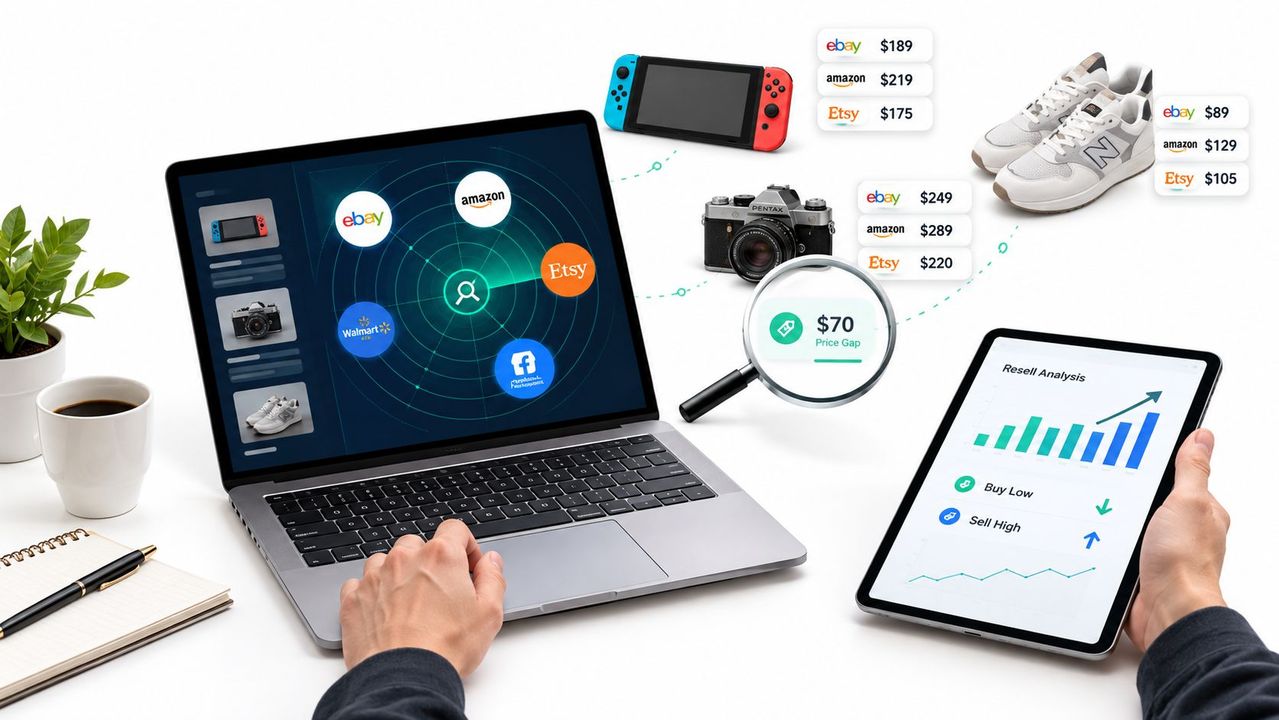
Table of Contents
- Table of Contents
- The Pricing Problem Every Professional Reseller Hits Sooner or Later
- What Competitive Pricing Intelligence Actually Means
- How a Pricing Intelligence Loop Works in Practice
- The Metrics That Actually Drive Repricing Decisions
- Manual Tracking, Alerts, and Automated Repricing Compared
- Tactics That Turn Competitor Data into Margin
- Why Identity Resolution Matters More Than Scraping Speed
- Putting It All Together for Resellers
- Frequently Asked Questions
You bought a sealed 2003 Game Boy Advance game after driving two hours to source it. Because you weren’t sure how much demand remained, you listed it on Wallapop below the comparable offers. A faster-moving reseller undercut your listing by €4 and sold the same afternoon. You made a sale, but you left the scarce inventory premium, sourcing time, and negotiating room on the table.
That pattern is common in professional second-hand selling. Buyers can see comparable listings, but they can’t see your fuel, labor, sourcing risk, or the hours spent testing and photographing the item. If your price is wrong, those costs vanish inside an apparently healthy margin.
Competitive pricing intelligence reconnects those invisible operating costs with the visible market. It helps you identify the right competing listings, interpret their condition and channel, and choose a price that supports profit per hour, not just a quick sale.
Table of Contents
- The Pricing Problem Every Professional Reseller Hits Sooner or Later
- What Competitive Pricing Intelligence Actually Means
- How a Pricing Intelligence Loop Works in Practice
- The Metrics That Actually Drive Repricing Decisions
- Manual Tracking, Alerts, and Automated Repricing Compared
- Tactics That Turn Competitor Data into Margin
- Why Identity Resolution Matters More Than Scraping Speed
- Putting It All Together for Resellers
- Frequently Asked Questions
The Pricing Problem Every Professional Reseller Hits Sooner or Later
A second-hand listing rarely has one obvious market price. It has a collection of signals. One seller may offer a boxed, tested console with its original accessories. Another may list the same model without a charger, with scratches, or with an uncertain battery. A third may have copied a manufacturer description and never inspected the item properly.
If you compare only the headline prices, you can make either mistake. You may underprice a scarce, complete item because a damaged example appears cheaper. Or you may overprice an incomplete product because a premium listing looks like a direct equivalent.
Why sourcing effort disappears from the listing
Your costs don’t appear in the buyer’s search results. A customer sees the title, photos, condition, shipping terms, and asking price. They don’t see the time you spent searching several marketplaces, the risk of buying untested stock, or the work required to clean and prepare it.
That creates a dangerous habit: pricing from intuition after sourcing, then checking a few competitors only when an item fails to sell. By then, you may have already trained yourself to accept a weak price. The listing gets attention, the buyer negotiates, and you blame demand when the issue was poor benchmarking.
The history of retail helps explain why price visibility matters. Fixed price tags spread through department stores in the 1830s and in 1858, when Le Bon Marché and Macy’s helped normalize non-negotiated prices in modern retail. Before that, bargaining was the norm. Airlines and hotels later applied yield and surge management, but mainly with historical demand data. Internet marketplaces added live competitor prices, inventory signals, and visible consumer behavior to the pricing decision, creating the foundation for today’s intelligence workflows. This history and the projected role of Amazon and eBay in retail are outlined by Empower.
Practical rule: Before changing a price, ask whether the comparison reflects the same item, the same condition, the same completeness, and the same selling channel.
The operating question
The useful question isn’t, “What are other sellers asking?” It’s, “What price gives this exact item a realistic chance of selling while paying me properly for the work involved?”
That requires more than a browser tab and a spreadsheet. You need a repeatable way to collect comparable offers, remove misleading matches, account for channel differences, and connect the result to inventory age and labor. Competitive pricing intelligence is the workflow that does this. It turns scattered market observations into a decision you can explain and repeat.
What Competitive Pricing Intelligence Actually Means
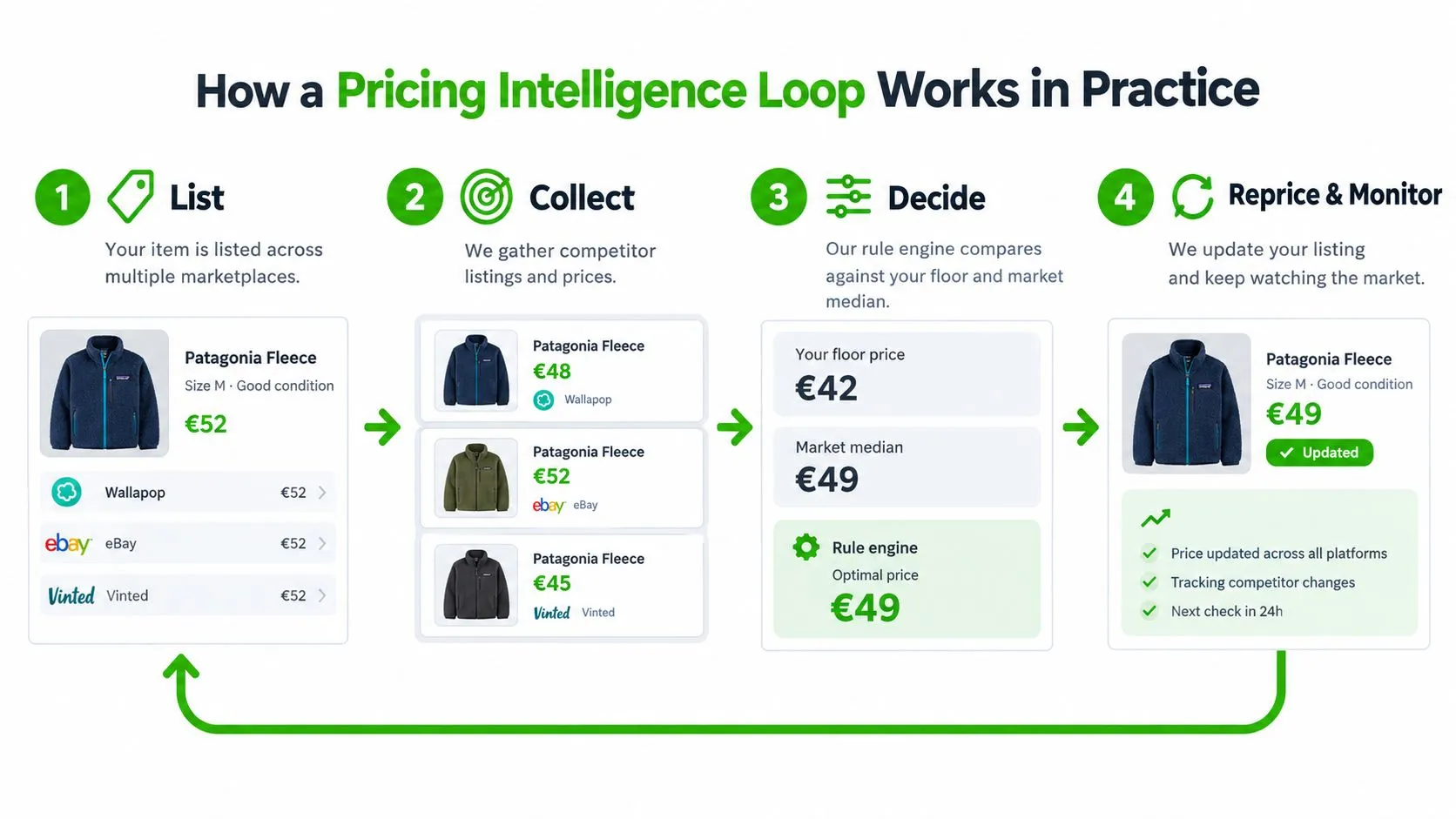
Think of competitive pricing intelligence as a price radar for your resale operation. The radar scans Wallapop, Vinted, eBay, Milanuncios, and other relevant channels, then plots listings that might compete with the item you carry.
The important word is “might.” A radar signal isn’t automatically a valid target. A sealed video game, a loose cartridge, and a reproduction cartridge may share similar titles but belong to different pricing groups. A Patagonia fleece in excellent condition and the same model with heavy pilling shouldn’t be treated as interchangeable. The system must collect, normalize, and interpret the offers before it recommends an action.
Monitoring versus intelligence
Basic competitor tracking tells you that a seller changed a price. Competitive pricing intelligence asks what changed, whether the listing is genuinely comparable, and what response makes commercial sense.
A useful workflow typically performs four jobs:
- Collect: Capture competitor prices, availability, condition details, seller information, and channel context.
- Match: Connect each offer to the correct product, variant, size, bundle, and condition.
- Interpret: Separate a meaningful market movement from an outlier, stale listing, promotion, or damaged item.
- Act: Recommend or apply a price within your floor, ceiling, stock, and margin rules.
This distinction matters more in second-hand resale than in standardized retail. A new product with a shared barcode often has a stable identity. A used item may be unique because of its wear, accessories, edition, repair history, or packaging. The system needs to understand those differences before it treats a competitor’s price as evidence.
Why normalization earns its place
Raw data creates false confidence. If one marketplace displays shipping separately, another includes it, and a third shows a seller discount only at checkout, the visible prices aren’t directly comparable. Bundles, accessories, regional availability, and platform fees can distort the apparent market position.
That’s why a useful platform should put every comparable offer into a common structure. The technical advantage isn’t merely collecting more pages. One benchmark vendor reports catalog-scale matching with refresh intervals as fast as every 10 seconds, while another large-scale solution scans more than 35,000 websites and marketplaces for real-time benchmarks. These capabilities and their trade-offs are discussed in the pricing intelligence rankings.
For resellers, the practical lesson is simple: fresh wrong matches are still wrong. Resources such as analysis workflows with Evoproxy can help teams think through the collection process, but the commercial value comes from turning collected data into accurate, condition-aware decisions.
How a Pricing Intelligence Loop Works in Practice
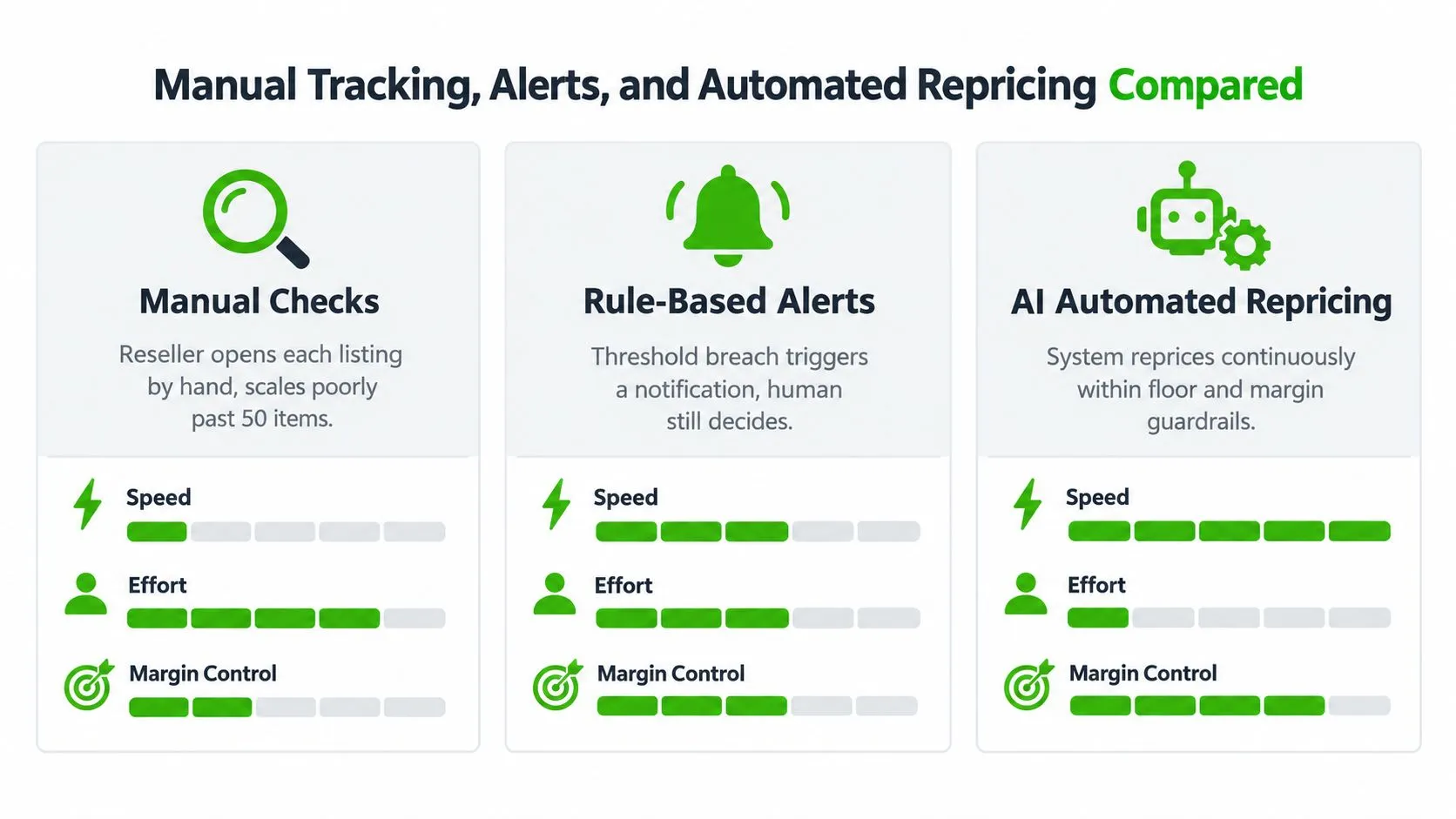
Take a Patagonia fleece listed across Wallapop, eBay, and Vinted. The seller has described the size, color, fabric, condition, and measurements, then published the item through several channels. The first stage is capture. A collection layer gathers relevant competitor listings and records the price, channel, stock status, description, photos, and any visible condition signals.
The second stage is normalization. The system removes duplicates, separates sizes and colors, and excludes offers that don’t belong in the same comparison set. A fleece with severe pilling, a bundle containing multiple garments, or a listing missing key measurements shouldn’t influence the target price for a clean, complete example.
From market noise to a decision
The third stage is interpretation. A pricing engine can compare the depth of the valid market, identify outliers, examine the difference between asking and sold prices where that history is available, and flag changes that deserve attention. It doesn’t need to assume that the lowest offer is the correct target. That listing may be damaged, poorly photographed, or priced to clear stock immediately.
The final stage is action. The seller may receive a recommended price, or the system may reprice the listing automatically within defined guardrails. Those guardrails can include a minimum acceptable price, a maximum price for the channel, an inventory-age rule, and a requirement for human approval when the match confidence is low.
The loop improves after each outcome
The workflow doesn’t end when the seller changes the price. A sale, relisting, delisting, buyer message, or expired offer adds context to the next decision. Over time, the seller can distinguish channels that produce quick conversions from channels that deliver better net proceeds, while recognizing that a graded collectible needs more supervision than a common fleece.
The routine that once consumed an evening of spreadsheet checks becomes a daily operating process. Automation handles repetitive comparisons, but human checkpoints remain essential for one-off items, unusual editions, uncertain authenticity, and condition descriptions that the data can’t confidently interpret.
A practical internal guide to eBay price tracking can help frame this workflow around marketplace monitoring rather than isolated price edits. The key is to make every action traceable. When a listing moves, the seller should know which comparable set triggered the change and which rule allowed it.
The Metrics That Actually Drive Repricing Decisions
Raw margin can deceive a reseller. An item with a strong margin may require repeated messages, careful packing, photography, testing, and relisting. Another item may produce a smaller margin but sell quickly with little support. The useful unit is profit per hour worked, supported by metrics that describe both demand and effort.
Start with category-specific sell-through behavior and days to sale. A slow-moving vintage camera may justify a higher initial price and a longer holding period than a common pair of sneakers. A fast-moving item may reward a price that protects position without chasing every competitor downward.
Elasticity changes the rule
Price elasticity measures how demand responds when price changes. McKinsey describes dynamic-pricing systems that combine an elasticity module with time-series methods and large-scale analytics while accounting for seasonality, cannibalization, and competitive moves. Independent e-commerce research reports aggregate demand elasticity at -1.34, with variation from -1.72 in electronics to -0.89 in fashion. McKinsey discusses the elasticity module and the cited research variation.
You shouldn’t transfer those category findings mechanically to every used listing. Their value is directional. They show why a single “match the lowest competitor” rule can destroy margin in one category while doing little for demand in another.
Track these measures together:
- Sold price: The closest market evidence for what buyers accepted, when reliable transaction data exists.
- Asking price: A useful position signal, but not proof that the item will sell at that amount.
- Days to sale: The time between publication and conversion, interpreted by channel and condition.
- Sell-through rate: The share of comparable inventory that converts within a defined observation period.
- Net contribution: The amount remaining after fees, shipping support, acquisition cost, and preparation work.
- Profit per hour: Net contribution divided by sourcing, preparation, listing, support, and fulfillment time.
A median of relevant sold prices is usually more reliable than an average of list prices because extreme offers distort averages. If sold data is limited, use the asking-price distribution cautiously and label it as an expectation rather than a proven result.
| Metric | What It Measures | Decision Value for Resellers |
|---|---|---|
| Total competitor count | How many visible offers exist | Often vanity data unless the count is filtered for true matches |
| Lowest asking price | The cheapest visible offer | Useful for risk checks, dangerous as an automatic target |
| Median comparable price | The center of a cleaned comparison set | Stronger anchor for initial positioning |
| Days to sale | How quickly comparable items convert | Helps choose between holding margin and accelerating turnover |
| Net contribution | Money left after direct selling costs | Protects against attractive but unprofitable sales |
| Profit per hour | Return on operational time | Best north-star measure for professional resale workflows |
Your pricing process also needs a link between research and listing execution. A guide to finding a selling price can help sellers combine comparable sales, fees, costs, and floor pricing instead of copying a single visible offer.
Tooling costs belong in the same calculation. Before adopting any external workflow, review the cost of plans and compare the recurring expense with the hours and margin the process could realistically recover. A system that produces more alerts but doesn’t improve profit per hour is adding activity, not value.
Manual Tracking, Alerts, and Automated Repricing Compared
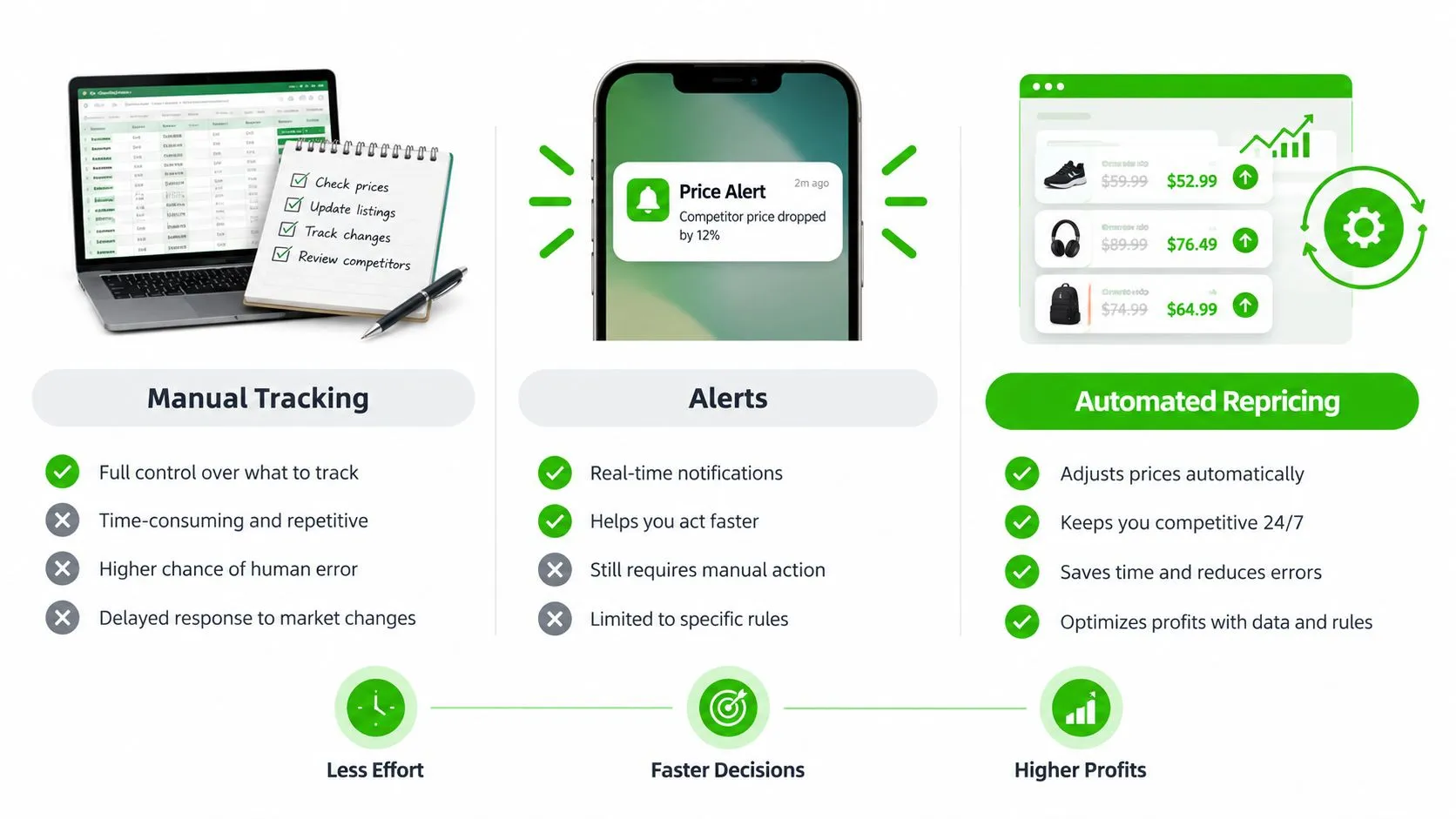
A reseller usually moves through three operating tiers. Manual checks work while the catalog is small and the products are unusual. Rule-based alerts provide scale without surrendering every decision to software. Automated repricing becomes useful when the comparison set is reliable and the rules are mature enough to control downside.
Consider a batch of used iPhones listed across Wallapop and eBay. The seller must distinguish storage capacity, color, battery health, cosmetic grade, carrier status, included accessories, and repair history. A cheaper phone with a degraded battery isn’t a valid benchmark for a clean, non-carrier-locked device.
Three tiers, three failure modes
Manual checks give the seller the richest context. They can inspect photos, read descriptions, and notice details that structured data misses. The cost is inconsistency. The seller may check high-priority listings carefully while ignoring the long tail, and yesterday’s spreadsheet can become stale after a competitor changes availability.
Rule-based alerts are more dependable for clear events. A notification can fire when a matched offer crosses a threshold, when a comparable seller goes out of stock, or when your listing falls outside a defined price corridor. The reseller still decides whether the signal is valid. That human step is valuable when product condition varies, but it remains a bottleneck if every alert requires investigation.
AI-assisted automated repricing can make changes directly, but only within guardrails. It suits repeatable products with strong identity signals and stable rules. It becomes risky when the system confuses storage variants, treats a cracked screen as a normal condition, or responds to a one-off listing.
Choosing the right tier
Don’t choose automation because it sounds advanced. Choose it when the expected reduction in manual work and pricing errors exceeds its cost, and when you can explain what happens at the boundaries.
A seller with rare collectibles may keep manual approval for every change. A seller with many similar phones may automate only the listings with complete specifications and verified condition fields. Most professional operations benefit from a hybrid: automated monitoring for the catalog, alerts for ambiguous cases, and automatic repricing only where the seller has proven the match and floor rules.
The practical guidance in pricing used items for resale fits this progression. Build the decision process first. Automate the repeatable parts second.
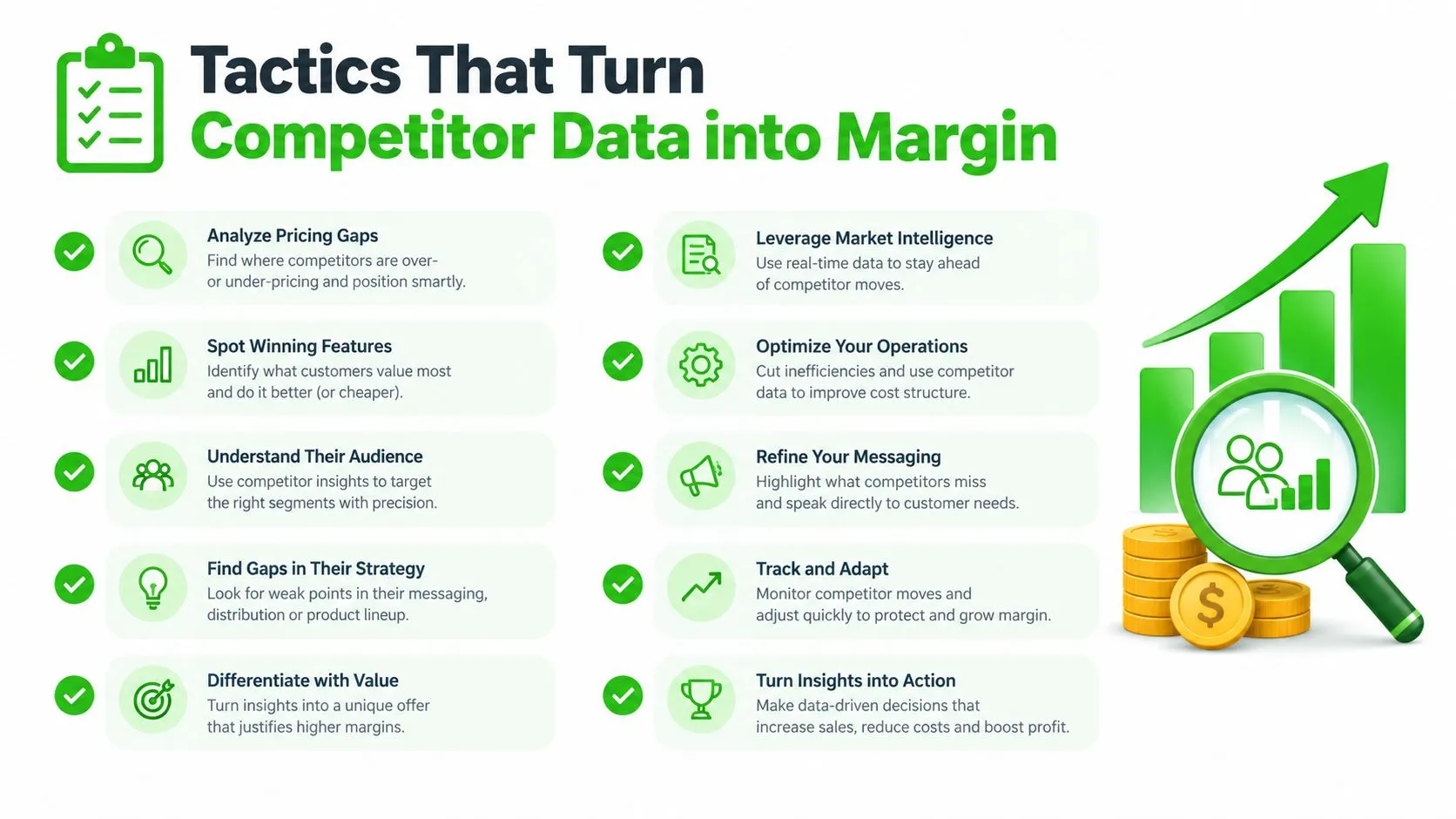
Tactics That Turn Competitor Data into Margin
A dashboard full of competitor prices doesn’t create profit by itself. The operating advantage appears when each signal leads to a controlled action that respects item identity, labor, channel economics, and inventory priorities.
Start with thresholds, not automatic matching
Set a floor that reflects acquisition cost, fees, preparation time, and the minimum return you require for the work. Set a ceiling when scarcity, condition, or channel demand supports a premium. Then define what happens between those boundaries.
For example, a competitor price drop shouldn’t automatically trigger a matching move. The system might require several valid comparable offers, a change that persists beyond a short-lived anomaly, or evidence that your listing has lost its market position. This approach protects you from discounting just because one seller wants a quick exit.
Use different rules for different inventory groups:
- Fast-moving standard items: Allow smaller, frequent adjustments when the match confidence is high.
- Rare or hard-to-source stock: Preserve room for scarcity and require human approval before reducing price.
- Condition-sensitive goods: Compare only against listings with equivalent grading and completeness.
- Aged inventory: Combine price movement with relisting, improved photos, and a clearer title.
Make identity resolution a first-class task
Record the fields that make the item commercially distinct. For a used iPhone, that may include storage, carrier status, battery health, repair history, and accessories. For a collectible game, it can include region, language, box, manual, authenticity, and cartridge condition.
A match should carry a confidence level and a reason. If the system matched by model name but couldn’t verify the storage capacity, the seller should see that limitation before approving a repricing action.
Audit every move: A useful price change should answer three questions, which competitors influenced it, what condition evidence did the system use, and which floor or ceiling rule permitted it?
Explainability also makes training easier. When a seller overrides a recommendation, the reason can become a future rule. The system learns that a sealed edition deserves different treatment from a loose copy, or that a local marketplace attracts buyers willing to pay more for collection pickup.
Connect repricing to relisting
Price is only one part of marketplace performance. A stale title, weak first photo, missing measurements, or poor category placement can make a fair price look expensive. Send repricing outputs into the relisting workflow so the seller can review the entire offer instead of changing the number in isolation.
Sequence the rollout. Begin with the top 20% of SKUs, a prioritization approach discussed in the context of pricing intelligence operations, and validate matches, floors, overrides, and outcomes there before expanding. Keep a change log, review false matches, and inspect whether lower prices improve profit per hour.
Why Identity Resolution Matters More Than Scraping Speed
Fast scraping fills a dashboard quickly, but speed can’t repair a bad match. In second-hand resale, the critical question is whether the competing offer is the same product in a comparable condition, with the same variant, accessories, and completeness.
A system can refresh constantly and still recommend the wrong price if it compares a boxed collector’s edition with a loose copy, or a working phone with a damaged one. Recent industry coverage describes the shift from “more data” toward cleaner product matches, with particular concern around variant-level precision, GTIN and UPC mismatches, title-based matching, and explainability. The 2026 discussion of pricing intelligence tools examines this data-trust problem.
The seller should see why a recommendation changed: which comparable listings were included, how their conditions were scored, and which floor or ceiling rule applied. That audit trail lets you override an incorrect identity in seconds instead of discovering the mistake after the payout.
Collection still matters, especially when listings change quickly. A practical Stella Proxies web scraping guide can help teams think about reliable data gathering, but collection is only the input. Identity resolution is where the pricing decision becomes trustworthy.
Putting It All Together for Resellers
Competitive pricing intelligence earns its place when it raises profit per hour worked. That happens when the system finds the right comparable listings, reacts at a useful pace, respects margin floors, and explains every important action.
A sensible rollout starts with a clean catalog. Give each SKU a comparable set, define category-specific floors and ceilings, and automate only the repeatable inventory where condition and identity are clear. Keep human review for rare, high-value, graded, or one-off items. Review matched competitors regularly, remove stale identities, and measure margin per hour rather than margin per sale.
Your next move can be small. Audit five current listings, verify the comparable set for each one, separate asking prices from credible sold evidence, and record the time required to prepare and sell each item. Use that baseline to decide whether the next improvement should be better matching, faster alerts, stronger listing content, or controlled repricing.
For professional sellers, Ruit brings inventory, multichannel listings, price comparison, synchronization, relisting, orders, and analytics into one workflow, with pricing decisions connected to the wider operation. Visit Ruit to review how a centralized system could help you turn competitor signals into faster, more explainable pricing decisions and better profit per hour.
Frequently Asked Questions
What is competitive pricing intelligence?
It is a workflow that collects competitor offers, matches them to the right product and condition, interprets the market and then recommends or applies a price. Basic tracking tells you that a price changed. Pricing intelligence asks whether the listing is truly comparable and what response makes sense.
Should I match the lowest competitor price?
Not automatically. The lowest offer may be damaged, poorly photographed or priced to clear stock. Set a floor and a ceiling first, and require several valid comparable offers before you lower a price.
Which metric matters most for resellers?
Profit per hour worked. It divides net contribution by the time spent on sourcing, preparation, listing, support and fulfillment. A median of relevant sold prices is usually a stronger anchor than an average of list prices.
When does automated repricing make sense?
When the comparison set is reliable and the rules are mature. It suits repeatable products with strong identity signals. Keep human review for rare, high-value, graded or one-off items.