How to Start a Resell Business the Smart Way


Table of Contents
- Table of Contents
- Why Most Resellers Stall Before They Start
- Setting Up the Business the Right Way
- Sourcing Inventory That Actually Sells
- Intake, Prep, and Listing Workflow
- Selling Across Multiple Marketplaces
- Pricing, Messaging, and Daily Operations
- Accounting, KPIs, and Scaling the Operation
- Frequently Asked Questions
Most advice on how to start a resell business begins with “pick a niche and list on a marketplace.” That’s incomplete advice. Listing is the easy part. The difficult work is finding inventory with enough margin, processing it quickly, keeping stock accurate across channels, and knowing whether each sale paid you for the hours involved.
The opportunity is real. The global secondhand and resale apparel market was estimated at $256 billion in 2025, with broader analyses placing resale at roughly 10% of total apparel spend (Statista). But a large market won’t rescue a disorganized operation. Treat reselling as an operating system, not a pile of listings, and your decisions about sourcing, tools, pricing, and growth become much clearer.
Table of Contents
- Why Most Resellers Stall Before They Start
- Setting Up the Business the Right Way
- Sourcing Inventory That Actually Sells
- Intake, Prep, and Listing Workflow
- Selling Across Multiple Marketplaces
- Pricing, Messaging, and Daily Operations
- Accounting, KPIs, and Scaling the Operation
- Frequently Asked Questions
Why Most Resellers Stall Before They Start
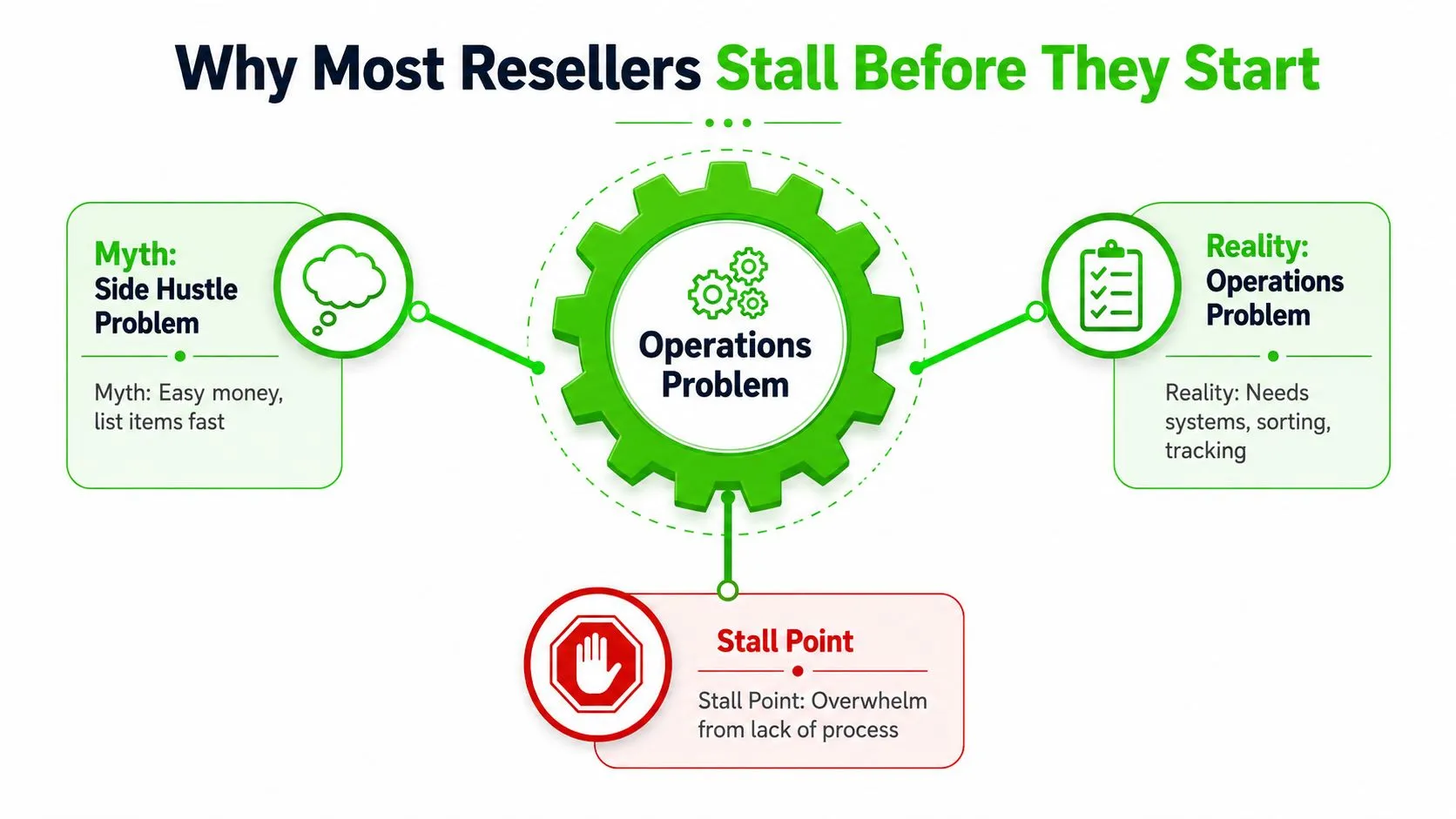
The “buy a batch, take photos, post on Vinted or eBay, and wait for money” model sounds simple because it ignores everything between purchase and profit. You still need to inspect every item, record its cost, clean or repair it, photograph defects, write accurate copy, store it, answer questions, ship it, handle returns, and remove it from every other sales channel after purchase.
That workload is why reselling behaves more like logistics than casual retail. Independent coverage describes secondhand selling as unpredictable and labor-intensive because sellers often handle sourcing, photography, listing, shipping, and cleaning themselves (Shopify’s resale business guide). A seller can generate revenue and still lose money if each item absorbs too much time or if fees and shipping consume the apparent margin.
Revenue is a distracting first metric
Hobbyists ask, “How much did I sell?” Operators ask, “What did I keep, and how long did it take?” That difference changes what you buy. A high-priced item isn’t automatically attractive if authentication, cleaning, photography, customer messages, and return risk consume the afternoon. A modest item can be excellent inventory when it moves quickly through a repeatable process.
Track profit per hour from the beginning. Subtract purchase cost, marketplace fees, packaging, shipping subsidies, refunds, and direct processing costs. Then divide the result by the time spent sourcing, preparing, listing, messaging, and fulfilling. You don’t need perfect accounting on day one, but you do need an honest estimate.
Operator mindset: Every item must earn both a margin and a place in your workflow.
Four problems stop most new sellers:
- Weak sourcing: They buy what looks cheap instead of what has proven demand and workable costs.
- No intake system: Inventory arrives faster than it gets graded, photographed, and listed.
- Single-channel dependence: One marketplace controls visibility, customer access, and policy risk.
- Blind numbers: Gross sales hide fees, dead stock, returns, and unpaid labor.
If you need a practical framework for the wider decisions involved in a start a business with small investment, use it to think beyond the first purchase. The right shift is simple: stop asking whether an item might sell and start asking whether you can source, process, price, and rotate that item repeatedly.
Setting Up the Business the Right Way
Choose your structure before inventory arrives. In the UK, a sole trader setup is usually simpler to administer, while a limited company creates a separate legal entity and can provide limited liability in appropriate circumstances. Neither structure automatically makes a resell business profitable, and tax treatment depends on your circumstances, so get advice from an accountant before committing to a structure for liability or tax reasons.
A sole trader may suit someone testing a narrow range from home. You trade under your own name or a registered business name, keep records, report trading income through the relevant tax process, and remain personally responsible for business obligations. A limited company can make more sense when you’re entering supplier agreements, bringing in another owner, employing staff, or building a brand that should exist separately from you.
| Factor | Sole Trader | Limited Company |
|---|---|---|
| Setup and administration | Generally simpler | More formal administration |
| Legal identity | You and the business are closely connected | Company is a separate legal entity |
| Liability | Personal exposure can be greater | Limited liability may apply, subject to law and conduct |
| Supplier perception | Can look professional with good records | May help when dealing with formal suppliers |
| Best fit | Testing a focused resale operation | Building a larger operation or adding partners |
Separate the money immediately
Open a dedicated business bank account, even if you’re starting alone. Mixing personal supermarket spending with stock purchases makes your real cost of goods difficult to reconstruct and turns tax preparation into detective work. Use bookkeeping categories such as inventory purchases, marketplace fees, postage, packaging, equipment, software, repairs, refunds, and professional services.
Keep invoices, supplier messages, receipts, payout reports, and evidence of refunds. Ask an accountant how VAT, income tax or corporation tax, allowable expenses, and marketplace reporting apply to your situation. The rules can change by jurisdiction and business structure, so a clear UK business setup guide can help you prepare better questions for professional advice.
Make the customer-facing basics credible
Decide whether your brand should be your personal name or a resale-focused name. Your own name works for a small curated shop and keeps branding simple. A distinct name is more useful if you want to sell vintage clothing, refurbished electronics, books, or collectibles under a consistent identity.
Insurance deserves attention before you scale. Ask a broker about stock, public liability, product liability where relevant, business equipment, and goods held away from home. Secondhand products carry condition, authenticity, and safety considerations, so accurate descriptions and documented inspections matter as much as a polished logo.
Sourcing Inventory That Actually Sells
Sourcing determines your ceiling. Beginners often choose a channel because it feels exciting, then discover that the inventory is inconsistent, the preparation takes too long, or the items have weak demand. Pick sources based on repeatability, condition control, acquisition cost, and the amount of labor each unit requires.
| Channel | Typical Margin | Time per Unit | Best Use Case |
|---|---|---|---|
| Thrift and charity shops | Variable, often strongest on selective finds | Moderate | Apparel, books, small collectibles |
| Garage and estate sales | Variable, with room for negotiation | High per buying trip | Distinctive single-item flips |
| Liquidation pallets | Unpredictable until inspected | High | Operators who can absorb batch risk |
| Supplier closeouts and wholesale | More predictable after testing | Lower once established | Repeatable products and known SKUs |
| Online arbitrage | Depends on price gaps and competition | Moderate | Sellers without local sourcing access |
| Retail arbitrage | Depends on clearance availability | Moderate to high | Opportunistic, fast-moving stock |
Treat margin ranges as working estimates, not promises. The same purchase price can produce a strong return in one category and a loss in another because demand, defect rates, fees, shipping, and processing time differ.
Validate before committing cash
Before putting more than $100 into a category, check 30-day sold comparisons across at least two marketplaces. This rule is deliberately conservative. Look at actual sold prices, condition differences, time-to-sale signals, shipping requirements, and the number of competing listings. Don’t build a buying decision around an unsold asking price.
Vintage denim shows why category knowledge matters. A pair may look attractive because the brand is recognizable, but waist and inseam measurements, fabric condition, fading, repairs, and current style demand can determine whether it becomes a quick sale or sits in storage. Learn more about the category’s wider sustainability context with this guide to slow fashion for retailers.
Used electronics require a different risk model. Test charging, ports, screens, batteries, connectivity, serial information, accessories, and account locks. A device that appears cheap can become expensive after testing, data wiping, missing components, and a return. Your buying ceiling must include those tasks, not just the sticker price.
For bulk buying, document every unit as it arrives and calculate the usable inventory rate. Guidance on buying bulk and reselling is useful because batch economics depend on what can be listed and sold, not the number of items inside the box.
Intake, Prep, and Listing Workflow
Unboxing should look like a production line. Create one fixed station with sorting bins, a digital scale, a label printer, cleaning supplies, a neutral photography backdrop, and a spreadsheet or inventory application. Log every item within 24 hours of arrival, including purchase cost, source, category, condition grade, storage location, and a provisional price.
If an item enters your home without an assigned record, it becomes invisible inventory. Invisible inventory can’t be priced accurately, found quickly, or removed from other marketplaces after a sale.
Use one path from purchase to listing
Run each item through the same sequence:
- Inspect and authenticate: Check labels, serial information, construction, missing parts, safety concerns, and signs of counterfeit goods.
- Grade the condition: Use consistent terms and record every notable flaw. Photograph defects rather than burying them in vague wording.
- Clean and repair: Remove dust, lint, stickers, and surface marks. Only perform repairs you can complete reliably.
- Measure and weigh: Record dimensions, garment measurements, package weight, and any shipping constraints.
- Photograph for decisions: Use consistent lighting and capture front, back, labels, details, and defects.
- List from a template: Build category templates with title structure, measurements, condition language, shipping settings, and return information.
- Store by SKU: Put the item in a labeled location that another person could find without asking you.
A SKU should identify the item, not merely the category. The SKU creation guide can help you design a naming convention that works across shelves, spreadsheets, and marketplaces.
Measure the work, not just the outcome
Create queue buckets for ready, listed, sold, and ship. Don’t let prepared stock sit between stations. Record the minutes spent on intake, prep, photography, listing, and fulfillment. That time becomes your true cycle time per item, and it reveals which categories look profitable only because you aren’t valuing your labor.
Reusable templates reduce decisions and improve consistency, but don’t let templates produce inaccurate descriptions. Buyers care about measurements, compatibility, condition, and defects. Your copy should use the phrases customers search for, while remaining precise enough to prevent avoidable returns.
A simple workflow is often enough at the start. Add automation only when the manual process is stable and you know which delay you’re trying to remove.
Selling Across Multiple Marketplaces
One marketplace can keep you busy. Several can build a business, but only if you control the inventory and understand the fee stack. Choose channels by category fit and net margin, not by the size of their audience.
eBay remains a logical home for collectibles, parts, specialist goods, and products that need detailed search discovery. Poshmark and Depop suit different parts of the apparel market, while Mercari and Facebook Marketplace can work for local or bulky goods where shipping removes the margin. Your own WooCommerce or PrestaShop store can strengthen brand control, but it also creates responsibility for traffic, customer service, payments, and technical upkeep.
| Marketplace | Listing Fee | Final Value Fee | Payment Fee | Best-Fit Category | Avg Sell-Through |
|---|---|---|---|---|---|
| eBay | Check current seller terms | Check current seller terms | Check current seller terms | Collectibles, parts, specialist goods | Track your own results |
| Poshmark | Check current seller terms | Check current seller terms | Check current seller terms | Apparel and accessories | Track your own results |
| Depop | Check current seller terms | Check current seller terms | Check current seller terms | Fashion and style-led apparel | Track your own results |
| Mercari | Check current seller terms | Check current seller terms | Check current seller terms | Small goods and general resale | Track your own results |
| Facebook Marketplace | Check current seller terms | Check current seller terms | Check current seller terms | Local and bulky goods | Track your own results |
Fees and policies change, so don’t copy a static fee chart into your pricing model. Pull the current charges from each marketplace, then calculate the amount left after the item cost, fees, shipping label, packaging, discounts, refunds, and any paid promotion.
Cross-list only with stock control
Manual cross-listing creates duplicate work and makes overselling more likely. Overselling leads to canceled orders, disappointed buyers, and possible marketplace penalties. A central inventory record should show the SKU, channel, listing URL, asking price, minimum price, storage location, and status.
Use each channel as a controlled test. Put comparable slow-moving items in different venues, then compare net profit, time to sale, message volume, returns, and shipping effort. Don’t pay for promotion on a channel until you know that the resulting sale can carry the additional cost.
The central question isn’t “Where can I list this?” It’s “Which channel gives this item the best risk-adjusted profit per hour?” A practical explanation of what crosslisting means can help you understand the operating implications before adding more platforms.
Pricing, Messaging, and Daily Operations
Pricing should respond to evidence, not mood. Start with a floor price that protects your contribution margin after every direct cost. Set an initial asking price from sold comparisons, then define what happens if the item receives attention but no purchase, attracts no attention, or competes with newly listed stock.
A rule-based repricing system beats random discounts. Define review points by listing age, watcher activity, comparable prices, and condition. The exact timing depends on your category and channel, but the rule must be written before you feel pressure to clear space. Otherwise you’ll keep weak inventory at an emotional price or discount good inventory unnecessarily.
Protect the margin with guardrails
Calculate the lowest acceptable price before accepting offers. Include:
- Acquisition cost: What you paid for the item, allocated freight, and any batch costs.
- Marketplace deductions: Listing, final value, payment processing, advertising, and currency charges where applicable.
- Fulfillment: Packaging, postage, labels, local delivery, and handling.
- Risk allowance: Expected returns, missing components, repairs, and authentication work.
- Labor: Your recorded time, multiplied by the hourly value you use for decisions.
A buyer’s offer isn’t good because it converts stock into cash. If the sale consumes significant labor and leaves little contribution after costs, move the item through a different channel or bundle it with related stock.
Make communication repeatable
Write saved responses for the questions you receive most often: measurements, flaws, bundle pricing, shipping, compatibility, and returns. Reply in scheduled blocks, such as morning listing work, a midday price review, and evening messages and dispatch. This prevents notifications from fragmenting every other task.
AI can draft titles, descriptions, translations, and replies. Review every output before publishing or sending. Automated language can invent condition details, omit a defect, or promise a delivery outcome you can’t control. Trust comes from accurate specifics, not polished filler.
Track response speed, dispatch time, return reasons, and message volume each week. These operational indicators help explain why visibility or conversion changes, and they show whether you need better templates, a different category, or another person on the workflow.
Accounting, KPIs, and Scaling the Operation
A resale dashboard should answer operational questions, not decorate a spreadsheet. Track profit per hour, sell-through rate, return rate, cost of goods sold relative to revenue, and aged inventory. The purpose is to decide what to buy again, what to reprice, what to liquidate, and which task deserves automation.
Keep a separate business account and reconcile marketplace payouts against order-level records. Track sales-tax or VAT obligations according to the jurisdictions where you operate, and ask your accountant about vendor reporting thresholds, equipment treatment, and the records required for your structure. A simple chart of accounts should separate inventory purchases, sales revenue, marketplace fees, postage, packaging, repairs, software, equipment, contractors, refunds, and owner transactions.
Don’t scale because you’re bored with manual work. Scale when a constraint is measurable.
| Stage | Team | Tools | Key KPIs | Upgrade Trigger |
|---|---|---|---|---|
| Early operation | Solo | Spreadsheet, one channel, basic bookkeeping | Profit per hour, listing backlog, aged inventory | Repeated backlog or rising support time |
| Developing operation | Founder plus part-time prep help | Second channel, repricing tool, structured inventory file | Net margin by channel, processing time, return reasons | Prep work consumes regular weekly capacity |
| Established operation | Founder, assistant, or VA | Inventory management, unified messaging, accounting exports | Sell-through, stock accuracy, labor cost, cash tied in stock | Manual sync and reporting create preventable errors |
| Larger operation | Defined team roles | Warehouse process, integrations, advanced analytics | Contribution by category, channel, and labor hour | Space, staff, and software are supported by unit economics |
Add systems in the right order
Begin with one channel and a spreadsheet. Prove that your sourcing rules and listing workflow produce acceptable profit per hour before paying for complex software. Add a prep assistant when preparation becomes the bottleneck, not when you want the business to look bigger.
Add a second channel when the first channel has repeatable listings and accurate stock. Add repricing when manual reviews consume useful selling time. Introduce inventory software when duplicate listings, stock errors, or channel reconciliation create measurable losses. Add a VA for messages only after your saved responses and escalation rules are clear.
A professional platform such as Ruit can centralize sourcing research, inventory imports, marketplace publishing, stock and price synchronization, messaging, and orders across connected channels. That kind of system is relevant when the business has outgrown scattered spreadsheets and separate marketplace workflows, but it won’t fix poor buying decisions or weak unit economics.
The broader market supports taking the model seriously. The secondhand-product market was estimated at about $475.19 billion in 2025 and projected to reach $854.57 billion by 2030, a 12.4% compound annual growth rate, according to The Business Research Company. The same source reports 15% year-over-year growth in 2025, which makes channel reach and stock rotation important, but growth alone doesn’t guarantee profit.
The business wins when every stage connects: a reliable source feeds a disciplined intake line, accurate records feed multiple channels, pricing protects contribution, and the dashboard tells you where labor and cash are trapped. Build that system before you quit your job, or build it now if your side hustle already has enough volume to expose the cracks.
Frequently Asked Questions
How much should I spend before I trust a new category?
Set a deliberately conservative ceiling and buy the evidence before the stock. Before putting more than $100 into a category, check 30-day sold comparisons across at least two marketplaces: actual sold prices, condition differences, time-to-sale signals, shipping requirements, and how many listings you would be competing with. An unsold asking price tells you what a seller hopes to get, not what the category pays.
How quickly should I log new inventory?
Within 24 hours of arrival, recording purchase cost, source, category, condition grade, storage location, and a provisional price. An item that enters your home without a record becomes invisible inventory: you cannot price it accurately, find it quickly, or remove it from other marketplaces once it sells. Everything after intake depends on that record, because grading, cleaning, measurement, photography, listing, and storage by SKU all write back to it.
When should I start selling on more than one marketplace?
Add the second channel once the first one produces repeatable listings and accurate stock, not before. Manual cross-listing duplicates the work and makes overselling more likely, and overselling means canceled orders, disappointed buyers, and possible marketplace penalties. What makes a second channel safe is a central inventory record holding the SKU, channel, listing URL, asking price, minimum price, storage location, and status. Choose the channel by category fit and net margin rather than by audience size.
How do I decide the lowest price I will accept?
Calculate the floor before any offer arrives, and build it from five costs: acquisition, marketplace deductions, fulfillment, a risk allowance covering returns and repairs, and your recorded labor at the hourly value you use for decisions. An offer is not good merely because it turns stock into cash. If the sale would consume significant labor and leave little contribution after those costs, move the item through a different channel or bundle it with related stock.
Which numbers should a new reseller track?
Profit per hour comes first: what you keep after purchase cost, marketplace fees, packaging, shipping subsidies, refunds, and direct processing costs, divided by the hours spent sourcing, preparing, listing, messaging, and fulfilling. Around it, track sell-through rate, return rate, cost of goods sold against revenue, and aged inventory, because those are the figures that decide what to buy again, what to reprice, and what to liquidate. Keep a separate business bank account and reconcile marketplace payouts against order-level records, so the numbers describe the business instead of your personal spending.
Ruit gives professional resellers one place to manage sourcing, inventory, multichannel listings, stock synchronization, messages, and orders. Visit Ruit to see whether its operating system fits the volume, channels, and profit-per-hour targets you’re building toward.