What Is Inventory Accounting and Why It Matters


Table of Contents
- Table of Contents
- Inventory Accounting in the Life of a Reseller
- The Core Concepts Behind Inventory Accounting
- Comparing the Main Inventory Valuation Methods
- Perpetual vs Periodic Inventory Systems
- Shrinkage, Write-Downs and the Lower of Cost Rule
- A Worked Example Across Three Sales Channels
- Bookkeeping Best Practices for Multichannel Sellers
- Frequently Asked Questions
Inventory accounting is the system a business uses to value stock on hand, record cost of goods sold when items sell, and reconcile physical units with financial records. Under IFRS IAS 2, inventory is measured at the lower of cost and net realizable value. U.S. GAAP uses the same basis for every cost method other than LIFO and the retail inventory method, which keep a lower-of-cost-or-market approach.
You’ve bought a rail of secondhand jackets, photographed each one, and listed them on Wallapop, Vinted, and eBay. One sells overnight, another gets returned, and a third disappears from the shelf even though your spreadsheet still says it’s available. Meanwhile, you’re trying to work out whether your prices cover sourcing, cleaning, postage, platform fees, and tax.
That’s where inventory accounting becomes practical. It connects each physical item to a recorded cost, keeps unsold stock on the balance sheet, and moves the item’s cost into cost of goods sold, or COGS, when the sale happens. If those movements aren’t recorded consistently, your reported profit and your view of the business can both be wrong.
Table of Contents
- Inventory Accounting in the Life of a Reseller
- The Core Concepts Behind Inventory Accounting
- Comparing the Main Inventory Valuation Methods
- Perpetual vs Periodic Inventory Systems
- Shrinkage, Write-Downs and the Lower of Cost Rule
- A Worked Example Across Three Sales Channels
- Bookkeeping Best Practices for Multichannel Sellers
- Frequently Asked Questions
Inventory Accounting in the Life of a Reseller
A typical reseller’s month starts with buying stock, not with making a sale. You might source fifty secondhand jackets, bring them home, photograph the condition of each one, assign internal codes, and publish listings across several marketplaces. At that moment, the business owns inventory, even though no customer has paid yet.
The first bookkeeping action is to record each unit and its cost basis. That usually begins with the purchase price. Depending on your accounting rules and business model, related costs such as inbound transport, cleaning, or preparation may also need consideration. IRS guidance describes historical cost as potentially including direct materials, direct labor, indirect costs, purchasing, storage, handling, and allocable management costs under IRC 263A, while market value is based on current bid prices at the inventory date. IRS inventory valuation guidance explains the distinction in detail.
A missing receipt creates more than a documentation problem. If you forget the cost of one jacket, you may later record the sale as revenue without the correct COGS. That inflates the apparent margin, distorts the value of remaining stock, and leaves you reconstructing the transaction when preparing tax records.
The intake record is the foundation
Create one inventory record for every saleable unit. For a used-goods business, the record should normally include:
- SKU: A unique code that connects the physical item to its listing and ledger entry.
- Acquisition date: The date the item entered your business inventory.
- Cost basis: The amount paid and any cost you’ve decided to capitalize under your accounting policy.
- Condition and notes: Information that supports pricing, returns, and later write-down decisions.
- Channel status: Whether the unit is listed, reserved, sold, returned, or unavailable.
A practical SKU creation process helps you avoid treating the same jacket as separate stock when it appears on three platforms. The SKU should stay attached to the item as it moves from sourcing to photography, storage, listing, dispatch, and accounting.
Practical rule: If you can’t identify the item and its recorded cost before it sells, you won’t be able to explain its margin confidently after it sells.
Unit-level tracking supports decisions beyond compliance. It tells you whether a vintage denim jacket is profitable at its current price, whether a bundle was worth buying, and whether your next sourcing trip should focus on jackets, books, or accessories. Memory and rough estimates may work for occasional personal sales, but they become unreliable as soon as stock is spread across multiple channels.
The Core Concepts Behind Inventory Accounting
Inventory accounting rests on four connected ideas: inventory asset, cost of goods sold, gross margin, and ending inventory. Think of your stockroom as a wallet. Until an item sells, the money you spent on it remains stored in the form of goods. When the item sells, its cost leaves that wallet and becomes an expense matched against the sale.
Inventory is the value of goods held for resale. A secondhand leather bag you bought but haven’t sold is not normally recorded as an immediate expense just because cash left your bank account. It remains an asset until the business sells it, loses it, or determines that its recorded value is no longer recoverable.
COGS is the cost assigned to the units sold during the period. Gross margin is the difference between sales revenue and COGS, before operating costs such as rent, accounting software, advertising, or subscriptions. Ending inventory is the value of stock still held at the reporting date.
One sale, two accounting movements
Suppose your business sells a secondhand leather bag. The sale creates revenue, and the customer’s payment increases cash or a receivable. At the same time, the bag’s recorded cost leaves inventory and enters COGS.
The simplified entries are:
- Debit cash or accounts receivable, credit revenue: Records what the customer paid.
- Debit COGS, credit inventory: Removes the bag’s cost from the balance sheet and recognizes it as an expense.
The selling price and the item’s cost are different numbers. Marketplace fees, payment processing, and outbound shipping may reduce the net result, but they need to be classified consistently rather than deducted from the purchase cost.
Product costs and period costs
A useful test is to ask whether a cost helps bring a specific item into saleable inventory. The purchase price of a jacket is a product cost. Inbound transport may also be part of the cost basis, depending on the applicable accounting framework and your policy. By contrast, a monthly software subscription or general storage rent is usually a period cost, recognized as the business incurs it rather than attached to one jacket.
The central formula is:
Beginning inventory + purchases minus ending inventory = COGS
If you buy a bundle of seven books and sell all seven together, the bundle’s recorded cost moves into COGS at the sale. If you sell three books now and four later, only the cost assigned to the three sold books moves out of inventory. The remaining four stay as ending inventory.
For a deeper operational reference, keep these reference docs for inventory alongside your chart of accounts and reconciliation checklist.
Comparing the Main Inventory Valuation Methods
The valuation method determines which cost flows into COGS and which cost remains attached to ending inventory. Under IFRS IAS 2, businesses assign the cost of interchangeable inventory using FIFO or weighted average, and they should use the same cost formula for inventories with a similar nature and use. Items that are not ordinarily interchangeable require specific identification instead.
Used-goods resellers face an extra complication. A box of identical paperback books is treated differently from a one-off vintage watch because the books are interchangeable and the watch is not. For interchangeable stock, your method should match how you manage it, and you should apply it consistently.
Three methods in practice
FIFO, or first in, first out, assumes the earliest purchased or produced units are sold first. Imagine a stack of books. You place new purchases at the back and sell from the front. FIFO can fit goods that naturally move in purchase order, but it may not mirror the physical handling of unique secondhand items.
Weighted average blends the cost of comparable units into an average cost. It can be useful for bulk lots of interchangeable clothing or books when tracking every individual acquisition would consume more time than the information is worth. The trade-off is that the average can hide the margin of a particularly cheap or expensive unit.
Specific identification assigns the actual recorded cost to the exact item sold. It suits one-off vintage watches, designer bags, collectibles, and other pieces where each unit has a distinct identity and price. It requires disciplined SKU records because the accounting result depends on matching the sale to the correct item.
| Method | How It Values Units | Best Fit For | Main Limitation |
|---|---|---|---|
| FIFO | Assigns the earliest available costs to units sold first | Fast-moving goods with a clear intake sequence | May not reflect the economics of unique secondhand stock |
| Weighted average | Blends comparable unit costs into an average | Bulk lots of similar, interchangeable items | Can conceal the margin of individual units |
| Specific identification | Uses the actual cost of the exact item sold | One-off or highly distinctive pieces | Requires accurate unit-level records |
When input prices rise, the method can change the timing of COGS, ending inventory value, reported gross margin, and taxable profit. Don’t switch methods just because one period looks more attractive. For a broader discussion of LIFO and its restrictions, consult this LIFO tax savings guide for founders, then confirm the permitted treatment with your accountant and local rules.
For practical guidance on organizing stock in a shop or warehouse, see this resource on inventory for a store. As a shortcut, choose FIFO for goods that flow oldest-first and weighted average for comparable bulk stock. Under IAS 2, one-off pieces that are not ordinarily interchangeable require specific identification.
Perpetual vs Periodic Inventory Systems
The difference between perpetual and periodic inventory is the difference between updating your stock ledger as events happen and updating it after a count. A perpetual system records purchases, sales, returns, and adjustments continuously. A periodic system waits until the end of an accounting period, counts what remains, and calculates the adjustment.
For a seller using Wallapop, Vinted, and eBay, a spreadsheet-based periodic process can create operational gaps. You list one jacket on three platforms, sell it on eBay, and forget to remove the other listings. A second buyer pays on Vinted before you notice. The accounting problem is also a stock-control problem.
| Dimension | Perpetual | Periodic |
|---|---|---|
| Quantity visibility | Updated after recorded transactions | Updated after a physical count |
| COGS timing | Recognized when the sale is recorded | Calculated through an end-of-period adjustment |
| Channel control | Can support frequent synchronization | Relies on manual updates and review |
| Best fit | Active multichannel operations | Smaller or simpler inventories |
| Main risk | Incorrect integrations or entries | Stale records and difficult reconciliation |
Perpetual tracking gives you a clearer view of unit margin before you reprice an item. It also makes returns, cancellations, and stock transfers easier to investigate because each event has a place in the record. It doesn’t remove the need for physical counts. It gives the count a reference point so you can investigate differences instead of discovering them without context.
When the workflow needs to change
A hobbyist may cope with periodic counting while selling a small, stable range of items. The pressure rises when listings multiply, several people handle stock, or sales occur while the owner is away from the spreadsheet. At that point, the key question isn’t whether software sounds modern. It’s whether manual updates are creating oversells, stale COGS, or end-of-period work that takes longer than the selling activity itself.
Reorder decisions also depend on clean stock information. A guide to setting reorder points for expenses can help separate purchasing decisions from the broader accounting process. For secondhand sellers, the equivalent may be a sourcing threshold rather than a repeat order, but the principle remains the same: base the decision on usable records, not an optimistic spreadsheet balance.
Shrinkage, Write-Downs and the Lower of Cost Rule
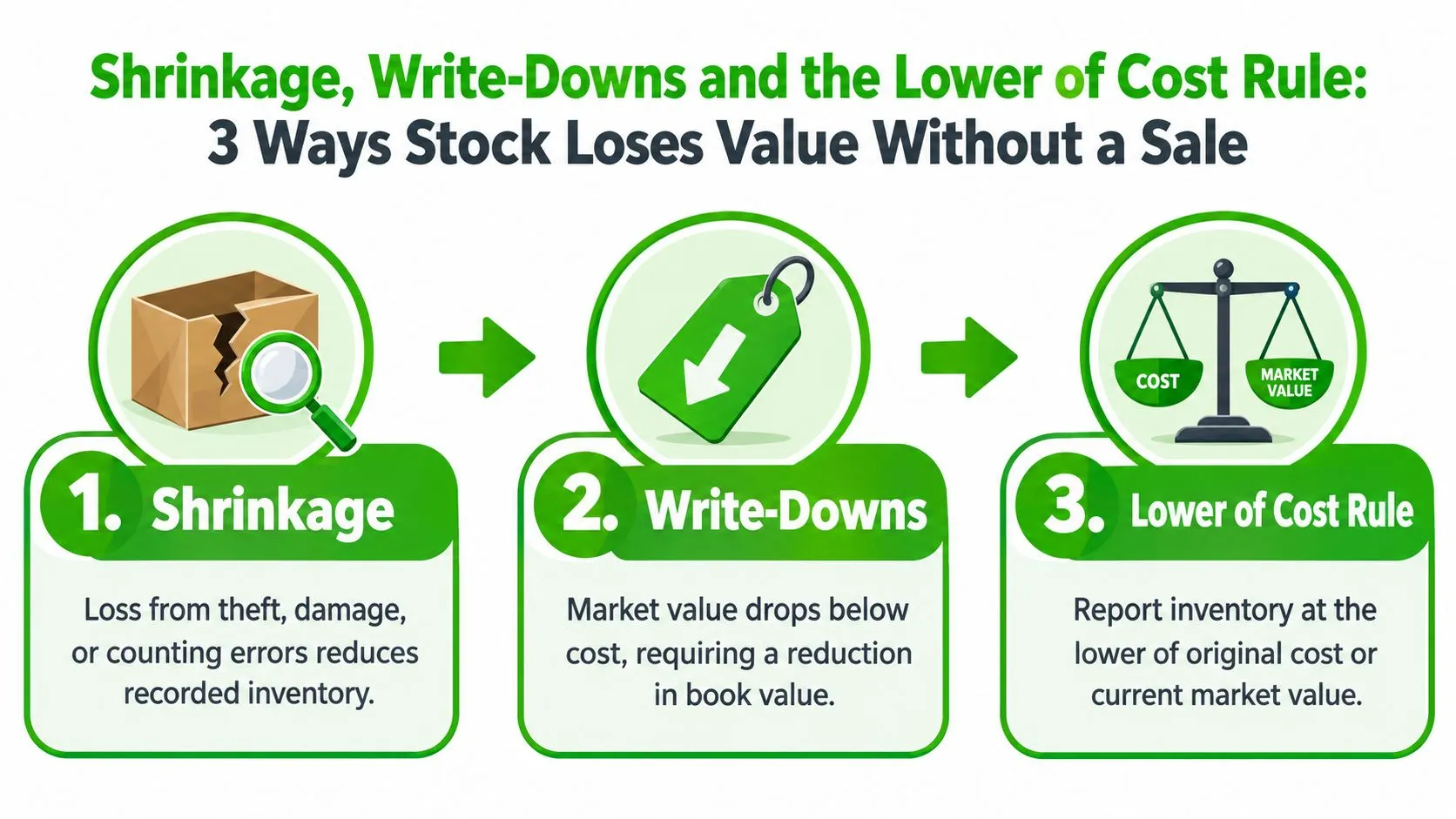
Stock can lose value without a customer buying it. A handbag may be damaged, a jacket may disappear, or an item’s realistic selling price may fall below its recorded cost. These events require different decisions because shrinkage, write-downs, and valuation rules describe different problems.
Shrinkage is the gap between recorded inventory and the stock you can physically account for. It can result from loss, damage, theft, spoilage, or receiving errors. Under U.S. GAAP, businesses commonly record it through COGS or a separate shrinkage expense, while IRS retail guidance permits estimated shrinkage under a safe-harbor method based on historical ratios and sales. The appropriate treatment depends on your jurisdiction, records, and accounting policy.
Match the entry to the event
Suppose a stock count shows that two listed items are missing. You’d reduce inventory and recognize the loss through shrinkage expense or COGS, depending on your policy. The entry is conceptually:
- Debit shrinkage expense or COGS
- Credit inventory
Now consider a damaged handbag sourced for resale. If it’s no longer saleable, a write-off may remove its carrying value. If it can still sell at a reduced price, a write-down may reduce the book value to the amount expected to be recovered.
Under IFRS, IAS 2 requires inventory to be measured at the lower of cost and net realizable value, meaning the expected amount recoverable through sale after relevant completion and selling costs. U.S. GAAP uses the same basis for every cost method other than LIFO and the retail inventory method. Those keep a lower-of-cost-or-market concept, where inventory is compared with market or replacement value and recorded at the lower amount. The accounting standards update behind the current U.S. rule explains which methods it covers and why.
A consigned jacket that has sat unsold while comparable prices fall may need review even though it’s still physically present. The question is whether the recorded cost remains recoverable, not whether the item is still hanging on the rail.
Permanent loss or recoverable value
A shrinkage adjustment reflects stock that’s gone or unusable. A write-down reflects reduced recoverable value. Under IFRS, a prior write-down can be reversed when net realizable value recovers, subject to the applicable limit. That makes documentation important. Keep the reason, date, item reference, valuation basis, and approval for every adjustment so management reporting and financial statements tell the same story.
A Worked Example Across Three Sales Channels
Take one vintage leather jacket bought for €80. You list it on Vinted for €120, eBay for €135, and Wallapop for €110. The listing price isn’t the accounting result, because only one channel can ultimately complete the sale and the payout will be affected by fees, shipping, refunds, and payment processing.
At intake, record the jacket as inventory at its cost basis. Under a perpetual setup, the jacket remains in inventory while it’s listed. The three marketplace listings are not three units. They’re three offers for the same SKU.
After three weeks, the jacket sells on eBay. Record the eBay sale as revenue at the amount required by your accounting policy, then record the €80 COGS when the sale is recognized. The purchase cost has moved from the balance sheet to the income statement because the jacket has left your inventory.
Reconcile the sale rather than trusting the headline price
Run a short check as soon as the order is confirmed:
- Remove the other listings: Mark the Vinted and Wallapop offers unavailable so the same jacket can’t sell twice.
- Confirm dispatch: Match the SKU on the order, packing record, and shipping label.
- Reconcile the payout: Compare the expected sale proceeds with the marketplace settlement, fees, shipping charges, and payment deductions.
- Record the margin: Separate revenue, COGS, selling costs, and any tax treatment required in your jurisdiction.
- Close the inventory record: Change the unit status from listed to sold and retain the transaction evidence.
The common mistake is to record only the money that reaches your bank. That can conceal the gross sale, the marketplace fee, and the cost of fulfilment. Another error is to leave the jacket active on another platform, which creates a stock mismatch even though the accounting entry for the completed sale looks correct.
A weekly channel reconciliation catches these issues while the order history, payout statement, and physical movement are still easy to match. At quarter-end, you should be reviewing exceptions, not rebuilding every sale from scattered emails and platform exports.
Bookkeeping Best Practices for Multichannel Sellers
Good inventory bookkeeping is less about performing a complicated calculation and more about creating a repeatable operating rhythm. Record the cost when you source the item, preserve the evidence, and make the SKU the common language between your stockroom, listings, orders, and ledger.
Build the habit at sourcing
Photograph receipts as soon as you buy stock, especially when sourcing from markets, charity shops, auctions, or private sellers. Store the image with the acquisition record rather than leaving it in a phone camera roll. For lots, document how you allocated the total cost across the individual units.
Tag every SKU with enough information to make later review quick. Channel, condition grade, acquisition date, and storage location can help you find a missing item or explain why a listed price changed. The point isn’t to collect labels for their own sake. It’s to make every sale traceable from purchase to payout.
Review the channels on a schedule
Compare marketplace settlements with your ledger regularly. Check the item sold, gross proceeds, platform fees, shipping labels, payment processing, refunds, and the final payout. If you wait until tax preparation, a duplicate listing or unexplained deduction may be difficult to reconstruct.
A practical weekly review can include:
- Stock exceptions: Investigate units marked available online but absent from the shelf.
- Payout differences: Match platform statements to the sales and fee entries in your records.
- Returns: Confirm whether returned goods are saleable, damaged, or awaiting inspection.
- High-value counts: Physically verify valuable items and document any adjustment.
- Margin review: Compare actual unit results with your pricing policy and sourcing thresholds.
For a broader system approach, review inventory management software for e-commerce. The upgrade decision should follow the workflow. If manual work causes repeated oversells, delayed reconciliation, or unreliable unit margins, integrated inventory software becomes a control decision rather than a convenience purchase.
One option is Ruit, which centralizes inventory records and can synchronize stock across connected marketplaces, including removing availability after a sale. It also supports importing and merging existing marketplace inventory and SKU-based matching, which is relevant when a reseller already has listings spread across Wallapop, Vinted, eBay, or a web shop.
Frequently Asked Questions
Is inventory accounting legally required where I live?
The answer depends on your country, business status, legal form, accounting framework, and tax regime. Don’t decide based only on revenue or platform activity. Ask a local accountant whether your sales are treated as a hobby, private disposals, or a registered trading business, then keep inventory records from the point your activity becomes commercial.
What happens when a buyer returns an item?
Inspect the unit before putting it back into available stock. If it’s saleable, return it to inventory using the applicable cost basis and reverse or adjust the original sale and related fees. If it’s damaged or its recoverable value has changed, record that condition instead of automatically restoring the original listing value.
Do personal-item resales create tax obligations?
Selling an occasional personal possession and operating a resale business aren’t necessarily treated the same way. Keep acquisition records, sale records, platform statements, and evidence of whether items were bought for personal use or resale. A tax professional can apply the rules for your country and explain how marketplace reporting affects your filing.
How often should I count stock?
Use a cycle that reflects your risk. Count high-value or frequently handled items more often, investigate discrepancies when they appear, and complete a fuller physical reconciliation at a sensible reporting interval. A count is useful only when you compare it with the ledger, identify the cause of differences, and post documented adjustments.
The practical answer to what is inventory accounting is now clear: it’s the discipline that keeps each unit, cost, sale, and stock balance connected. Start with accurate intake records, choose a consistent valuation method, reconcile every channel, and ask for local professional advice where tax or reporting rules are uncertain.
Ruit gives professional secondhand sellers one place to manage sourcing, SKU-based inventory, multichannel listings, orders, and stock synchronization across marketplaces. Visit Ruit to see how you can connect the operational records behind your inventory with the sales and financial data they produce.