How to Create a SKU: A Guide for Resale Businesses

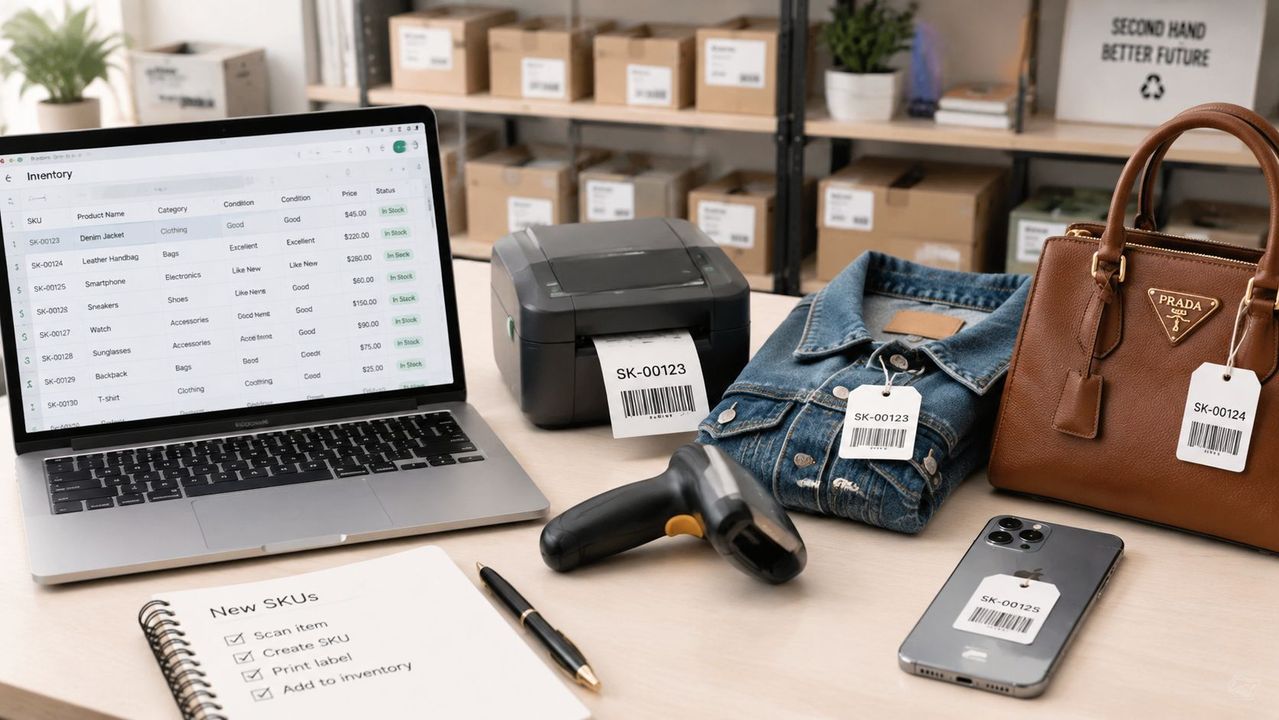
Table of Contents
You’ve bought a mixed lot, photographed half of it, and listed the rest across Vinted and eBay. A buyer asks whether the denim jacket is still available. You search through boxes, phone galleries, drafts, and messages, then discover two similar jackets with different flaws and only one has been listed. The sale isn’t difficult because the item is rare. It’s difficult because you can’t identify it quickly.
That’s the point where resale stops feeling like a hobby and starts behaving like an operation. A Stock Keeping Unit, or SKU, gives every sellable item a stable internal identity, so you can connect the physical item, its photos, listings, storage location, cost, and eventual sale. Learning how to create a SKU matters most when your stock isn’t uniform, because second-hand inventory rarely gives you identical units with predictable replenishment.
Table of Contents
- The Tipping Point from Resale Hobby to Business Chaos
- Why Generic SKU Advice Fails for Second-Hand Goods
- Designing Your Resale SKU Architecture
- Real-World SKU Examples for Resellers
- Implementing and Managing Your SKUs with Ruit
- Beyond the Code Your SKU as a Business Tool
The Tipping Point from Resale Hobby to Business Chaos
At first, memory is enough. You remember buying the black Nike hoodie, placing it in a tote, and uploading its photos to your phone. Then inventory accumulates. A vintage jacket is waiting for measurements, a refurbished phone needs a final test, and a bundle of trading cards has been split into several possible listings. A buyer purchases one item, but you’re not completely sure which box contains it.
That uncertainty creates work everywhere. You recheck photos, rewrite descriptions, inspect items that may already be sold, and guess whether a listing is still live. You may also price an item without knowing its acquisition cost or condition notes. None of these problems comes from a lack of effort. They come from giving one item several informal identities.
A SKU fixes the identity problem. It’s an internal reference assigned to one sellable item or variant, and it becomes the common key for your records. The label on the storage bin, the inventory row, the marketplace listing, and the sales record should all point to the same code.
What changes after you assign an identity
A useful resale SKU lets you answer practical questions without opening every box:
- What is this item? The code connects to the category, brand, model, and variant details.
- Where is it? The code points to a shelf, bin, rail, or storage zone.
- Which photos belong to it? The item record holds the correct image set and listing draft.
- What state is it in? Condition, testing status, defects, and refurbishment notes stay attached to the item.
- What happened after sale? The same reference can support order processing, accounting, and customer service.
A SKU won’t replace accurate photos, descriptions, or physical organization. It gives those activities a dependable anchor. Without that anchor, every new marketplace or storage location multiplies the chance of a mismatch.
Practical rule: If a team member can’t identify the exact item from the SKU record and retrieve it without asking you, the system isn’t finished.
Why Generic SKU Advice Fails for Second-Hand Goods
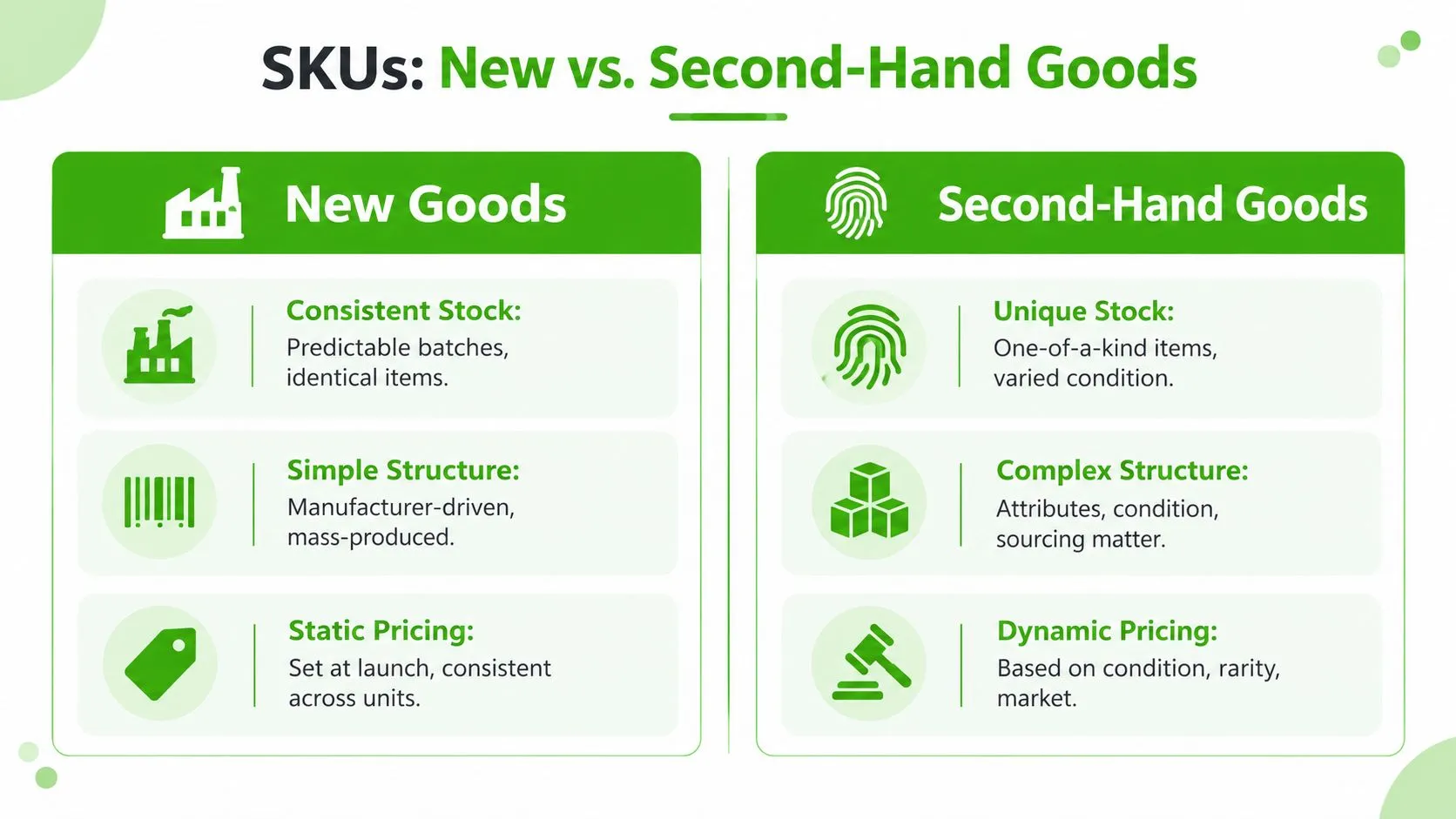
Retail SKU advice usually starts with predictable variants. A new T-shirt may have a fixed brand, model, color, and size, with identical units arriving from a supplier. That structure doesn’t describe a one-off Levi’s jacket with fading on one sleeve, a missing button, a particular photo set, and a sourcing record from a charity shop.
Second-hand inventory has unique states, not just standard variants. Two copies of the same iPhone model can differ in battery condition, cosmetic grade, included accessories, refurbishment status, and packaging. Two handbags with the same model name may have different wear, repairs, or authenticity documentation. A collectible can be technically the same release but still require a separate record because the item, photos, and condition are unique.
The practical guidance in this SKU creation guide for inventory management supports a restrained approach. Condition, grade, refurbishment state, and photo history matter operationally, but forcing every human-readable detail into the code makes it harder to scan, type, and scale. The SKU should identify the item. The inventory record should explain it.
Separate stable identity from changing information
Some fields help distinguish an item, but they shouldn’t become permanent parts of its SKU. A sourcing channel, acquisition date, supplier name, price, or manufacturing reference can change in meaning or become irrelevant after the item enters your operation. If you encode unstable data, a normal business change can make the original SKU misleading.
Keep these details as separate fields:
- Condition and grade: Store the full grading explanation, not just a short code.
- Source: Record the marketplace, shop, auction, trade-in, or private seller.
- Photo set: Link the images to the item record and update them when the item changes state.
- Refurbishment history: Note tests, replaced parts, repairs, and outstanding issues.
- Bundle status: Identify whether the item is sold alone, in a set, or as part of a changing bundle.
For professional sellers, the important question is not “Can a person understand this SKU?” It’s “Can the business keep using it after the item moves through sourcing, storage, listing, sale, return, and accounting?” A simple code with disciplined documentation usually survives that lifecycle better than a descriptive sentence compressed into characters.
You can also review broader inventory management practices when deciding which operational fields belong beside the SKU rather than inside it.
Designing Your Resale SKU Architecture
Start with the inventory record, not the code. Create a master table with one row for every sellable item or variant. A used Nintendo console, its controller bundle, and a separate replacement controller may look related, but they need separate rows if customers can buy them separately.
A fixed schema should move from broad to specific. A practical pattern is category, brand, model, variant, and unique identifier, such as category-brand-model-color-size. Guidance from Cin7 on modern SKU inventory management recommends a consistent structure, 3 to 5 segments, and a readable code length of about 8 to 12 characters. Treat that as a design target, not a reason to sacrifice uniqueness.
Choose the fields that distinguish your stock
For resale, begin with fields that help staff find, identify, and process the item:
- Category:
CLOfor clothing,ELECfor electronics, or another controlled code. - Type:
JKTfor jacket,PHfor phone,CONfor console. - Brand or model: Use a controlled abbreviation, such as LEVI for Levi’s or IP15 for iPhone 15.
- Variant: Include size, color, storage capacity, or edition only when it affects the sellable unit.
- Condition: Use a short controlled code, such as EXC, GOOD, or FAIR.
- Unique ID: Add a sequence or item identifier so near-identical units don’t collide.
You don’t need every field in every SKU. A one-of-a-kind jacket may need category, type, brand, condition, and unique ID. A tested phone may need model, storage, condition, and unique ID. The key is to decide the rule before the next purchase arrives.
Build a rulebook people can follow
Your rulebook should define accepted abbreviations, segment order, condition codes, and examples of valid and invalid codes. It should also reserve unused code blocks for future categories or brands, so expansion doesn’t force you to restructure existing records.
Avoid punctuation and special characters when your channels or spreadsheets may interpret them differently. Don’t start with leading zeros, and don’t change the ordering between marketplaces. A code such as CLO-LEVI-JKT-M-EXC-014 may be easy for a person to read, but a shorter internal format such as LEJME014 can be easier to import and type if your master record contains the full detail.
The important distinction is controlled structure versus overloaded meaning. Don’t encode the seller’s entire description into the SKU. Keep measurements, defect notes, provenance, photo history, and pricing in dedicated fields.
For a deeper look at connecting item references with scanning workflows, see this guide to inventory management with barcode scanning.
Real-World SKU Examples for Resellers
The best test is whether a SKU works on a busy receiving day. You should be able to create it quickly, recognize the item in your master table, and keep it unchanged when the listing moves between channels.
Vintage clothing
Suppose you receive a vintage Levi’s denim jacket in medium, with visible fading and a loose cuff button. A possible SKU is:
CLOLEJMED014
Read it as clothing, Levi’s jacket, medium, item 014. The condition isn’t fully encoded because “fading and loose cuff button” belongs in the condition field and listing description. If you use a controlled condition code, you might instead choose:
LEJMEDF014
Here, F could mean fair according to your internal rulebook. Don’t assume the buyer understands the letter without seeing the full condition explanation.
For clothing, size and measurements belong in the product record. A jacket marked medium can measure differently from another jacket marked medium, so the SKU shouldn’t pretend that the size label captures the whole fit.
Used electronics
A refurbished iPhone 15 with a specific storage capacity, cosmetic grade, and included accessories needs an item-level identity. For example:
IP15-128-G-022
The model and storage capacity identify the product type, G represents your controlled cosmetic grade, and 022 distinguishes this physical unit from another matching phone. Record the serial number, testing outcome, battery information, included cable, and repair history separately. Don’t place the serial number in the SKU if it’s long or likely to create import friction.
For consoles, a Nintendo Switch with two Joy-Con controllers and a dock is a different sellable unit from a console-only listing. Give the bundle its own record rather than changing the console’s SKU every time the accessories change.
Collectibles and accessories
A Luffy figurine can use a model or release code plus a unique sequence:
COLFIGLUF031
The record should hold the edition, box condition, paint flaws, authenticity notes, and photo set. For trading cards, use a set and card identifier where those details are stable, then add a unique sequence when condition or grading differs. One card with a crease and one near-mint card shouldn’t share a sellable record merely because the printed card number matches.
These examples show the same principle: the SKU points to the item, while the record carries the nuance.
Implementing and Managing Your SKUs with Ruit
A spreadsheet is a sensible starting point if it behaves like a controlled master table rather than a personal notes file. Create columns for SKU, item name, category, brand, model, condition, source, cost, storage location, listing status, photo reference, and sale details. Make the SKU mandatory, prevent accidental edits to existing codes, and keep a change log for corrections.
Start by entering new purchases consistently. Backfilling a large catalog all at once often creates rushed abbreviations and duplicate identities. Work through one category or storage area, compare physical items with photos, and mark uncertain records for review instead of guessing.
Test the workflow before scaling it
SKU design rules can look clear until someone has to receive a mixed purchase, create listings, move stock, and process a sale. A practical workflow described by Cleverence’s inventory SKU guidance is to train a small cohort, run the system for 2 to 4 weeks, and compare baseline and pilot metrics before a full rollout.
Useful checks include:
- Retrieval accuracy: Can staff locate the exact item from the record?
- Listing consistency: Does the same SKU remain attached across every sales channel?
- Duplicate prevention: Does an import update the existing item rather than create another?
- Margin visibility: Can you connect the sale to acquisition cost and selling expenses?
- Velocity decisions: Can you classify stock as fast, medium, slow, or very slow?
You can also group SKUs by gross-profit bands, count how many SKUs sit in each band, and compare that with the share of units sold in those bands. That reveals whether sales are concentrated in low-margin stock or aligned with the inventory you want to source.
Keep one identity across every channel
A multichannel seller has a harder requirement than a single-marketplace seller. The SKU must survive imports, edits, relisting, and stock updates between platforms. The cost of a broken SKU appears later, when systems fail to match listings or when a sold item remains active elsewhere. This lifecycle problem is highlighted in guidance on ecommerce SKU systems, which focuses on the operational consequences of codes that break during cross-platform synchronization.
Ruit can centralize inventory, listings, orders, and marketplace synchronization, with SKU-level records supporting product imports and matching. If you’re evaluating inventory tools more broadly, the PuppetVendors inventory software blog offers another useful perspective on managing stock in resale and consignment workflows.
For an existing catalog, document the import columns before uploading anything. Check the supported import structure first and decide which field remains the permanent matching key. Never change a SKU casually after listings and sales history depend on it. If an item is replaced by a materially different version, create a new identity and retain the old record as historical reference.
Beyond the Code Your SKU as a Business Tool
A SKU becomes valuable when it connects physical stock with decisions. Once every jacket, phone, console, and collectible has a stable identity, you can examine which categories sell quickly, which sourcing channels produce worthwhile stock, and which items consume time without producing an acceptable return.
That analysis only works if the underlying records are consistent. Keep acquisition cost, condition, listing date, sale price, fees, storage location, and outcome in separate fields. The SKU should remain stable while those values change through the item’s lifecycle.
Use the record to improve decisions
A practical review can answer questions such as:
- Sourcing: Which sources produce items that sell reliably at your target margin?
- Pricing: Which conditions or brands need different pricing rules?
- Storage: Which categories deserve the easiest-to-reach locations?
- Listing work: Which items require repeated editing or relisting?
- Inventory control: Which records have missing photos, unclear grades, or duplicate listings?
The same discipline supports broader guidance on managing inventory efficiently, especially around accurate records, organized storage, and repeatable processes. The objective isn’t to make every code clever. It’s to make every item traceable.
Create the rulebook before your next sourcing trip, assign SKUs as soon as items become sellable, and test retrieval with someone who didn’t create the record. A short, stable code backed by complete operational data will serve your resale business far longer than an elaborate code that only makes sense on the day you invent it.
Ruit centralizes SKU-based inventory, listings, orders, marketplace synchronization, and operational data for professional resale businesses. Visit Ruit to see how you can replace scattered spreadsheets and marketplace records with one workflow for managing unique second-hand items.