Not I the High Street: Reseller Guide


Table of Contents
- Table of Contents
- Understanding the Not On The High Street Marketplace
- The Real Economics and Fee Structure for Sellers
- Pros and Cons for Second-Hand and Vintage Resellers
- Seller Requirements and the Application Process
- Managing Unique Inventory Across Multiple Channels
- Building a Sustainable Multichannel Resale Strategy
- Frequently Asked Questions
You’ve found a one-off vintage piece with strong photographs, a realistic price, and exactly one item in stock. It’s already listed on eBay, Vinted, and your own store. Now you’re considering Not On The High Street, or searching for it as “not i the high street”, because the platform appears to offer a more affluent, gift-focused audience. The question isn’t whether the marketplace can generate attention. It’s whether that attention will produce enough net profit per item and per hour to justify another listing workflow.
For a professional second-hand reseller, Not On The High Street shouldn’t replace your existing channels. It should earn a carefully controlled place in your channel mix. The platform’s curation, fee structure, seasonal demand, and inventory requirements make it potentially valuable for distinctive, giftable stock, but inefficient for undifferentiated volume.
Table of Contents
- Understanding the Not On The High Street Marketplace
- The Real Economics and Fee Structure for Sellers
- Pros and Cons for Second-Hand and Vintage Resellers
- Seller Requirements and the Application Process
- Managing Unique Inventory Across Multiple Channels
- Building a Sustainable Multichannel Resale Strategy
Understanding the Not On The High Street Marketplace
The correct brand name is Not On The High Street. The search phrase “not i the high street” is a common typo, but the commercial question behind it is clear. Sellers want to know whether this curated UK marketplace can give unusual products more useful exposure than broad, open listing platforms.
Not On The High Street was founded in 2006 by Holly Tucker and Sophie Cornish. The business had already reached substantial scale less than a decade later, with The Guardian reporting annual sales of £83 million in 2014, while a later company and industry profile described gross sales of about £127 million for the same year. Those figures differ because they use different measures, but both indicate that the business had moved far beyond a small niche gift website by that point. The marketplace’s growth and 2014 sales figures are discussed in this business profile.
Its defining feature is curation. Unlike an open marketplace where sellers can generally upload products with limited editorial intervention, Not On The High Street positions itself around hand-selected partner brands and distinctive products. The customer experience is built around discovery, gifting, personalisation, and products that feel less interchangeable than standard retail stock.
That distinction matters for vintage sellers. eBay can capture a buyer searching for a specific maker, model, era, or part number. Vinted can work well for accessible fashion and quick-moving wardrobe items. Not On The High Street is more suitable when the item has an obvious story or gifting use, such as a distinctive homeware piece, an unusual accessory, a well-presented retro object, or an upcycled product with a clear point of view.
Curation changes the seller’s job
The platform says it’s home to over 5,000 small brands, more than 350,000 products, and over 4 million customers. It operates as a curated marketplace rather than a stock-holding retailer, with third-party sellers creating and fulfilling the products themselves. Not On The High Street describes its partner and customer model on its company page.
That architecture creates opportunity and pressure at the same time. The platform can expand its assortment without owning every item, while sellers retain responsibility for product quality, availability, presentation, packaging, and dispatch. Your advantage is access to a branded environment. Your risk is that your business must behave like a polished retail partner, not a casual seller uploading a quick listing between sourcing trips.
My view is straightforward: apply only if your stock has a coherent editorial identity. A random mixture of used garments, damaged décor, and miscellaneous finds will be harder to position than a tightly edited collection of, for example, mid-century homeware, vintage wedding accessories, or restored desk objects.
The Real Economics and Fee Structure for Sellers
The headline commission is only one part of the cost. Seller terms show a non-refundable joining fee, plus commission charged on the full transaction value, including delivery charges. That second point is particularly important because a seller can calculate commission on the item price while overlooking the amount taken from shipping revenue. The seller FAQ explains the joining fee and commission basis.
For a vintage reseller, the relevant calculation is not “sale price minus sourcing cost”. It’s the full contribution after every channel and handling cost:
- Sale proceeds: The amount paid by the customer for the item and delivery.
- Marketplace deductions: The joining cost allocated across expected orders and the commission applied to the transaction, including delivery.
- Physical preparation: Cleaning, testing, restoration, steaming, repairs, measurements, and packing.
- Fulfillment: Postage, protective materials, insurance where appropriate, and the time spent preparing the parcel.
- Risk allowance: Returns, damage, inaccurate condition assessment, and the possibility that a one-off item must be relisted elsewhere after a failed order.
The delivery commission changes the economics of heavy or awkward stock. A small vintage brooch may be inexpensive to pack and ship, so the delivery component has limited impact. A ceramic lamp, framed print, or substantial piece of furniture can be different. If the delivery charge is high, the commission applies to a larger transaction base, while packaging and damage risk also rise.
Practical rule: Calculate marketplace profitability from the complete transaction value, not from the product price alone.
Use a contribution margin, not a markup
A high markup can still produce a weak return if the listing takes too long to create and the item requires difficult fulfillment. This is especially true with second-hand goods because sourcing costs vary, condition is inconsistent, and every product may need individual photography and copy.
Before applying, build a worksheet for representative stock categories. Use actual product examples from your inventory rather than an optimistic average. Include the time needed to source, inspect, photograph, describe, list, store, pack, dispatch, and handle customer messages. Then allocate the joining fee across a conservative expected order volume. Don’t treat that fee as irrelevant just because it’s paid once. It still has to be recovered through profitable sales.
A useful pricing method is to separate market value, condition value, and channel cost. The used-item pricing guide from Ruit provides a practical framework for thinking about comparable prices and resale margins. Use that analysis before deciding whether an item belongs on a curated channel or should move through a faster, lower-friction outlet.
Marketplace Fee Comparison
| Marketplace Type | Joining Fee | Commission Base | Best For |
|---|---|---|---|
| Curated marketplace | Non-refundable joining fee may apply | Full transaction value, including delivery charges | Distinctive, giftable, well-presented products |
| Open resale marketplace | Varies by platform and seller category | Varies by platform and transaction type | Broad demand, testing products, and faster listing |
| Owned ecommerce store | Usually no marketplace joining fee | Payment, software, fulfillment, and marketing costs still apply | Repeat customers, brand control, and customer retention |
The comparison shows why Not On The High Street shouldn’t receive every item in your catalogue. It needs products with enough perceived value to absorb the platform’s costs and enough visual appeal to benefit from curation. If an item only works when you ignore packing time or shipping commission, it doesn’t work.
Pros and Cons for Second-Hand and Vintage Resellers
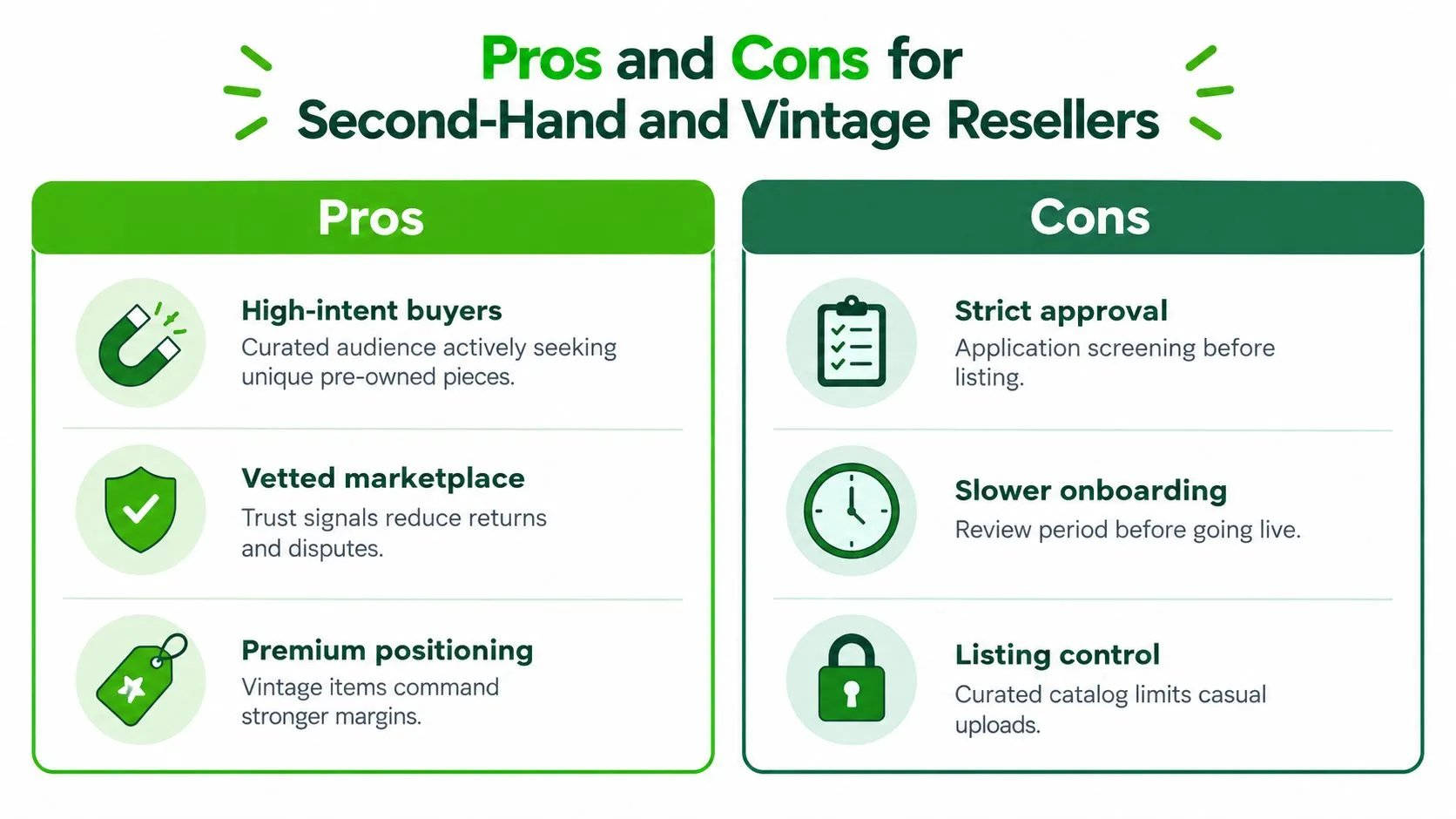
Not On The High Street offers a stronger fit for edited vintage collections than for general second-hand inventory. The platform’s customers are already browsing for products with personality, and the curated environment can help a carefully selected item appear more premium than it would in a crowded search feed.
That doesn’t mean every vintage product belongs there. A one-off item must satisfy two audiences. It has to appeal to the buyer, and it has to make sense within the platform’s wider presentation. A rare object with poor photography, uncertain measurements, or visible wear that isn’t explained clearly will create friction rather than trust.
Where the platform can work
Giftability is the strongest commercial advantage. Vintage stock often performs better when you frame it around the recipient and occasion rather than only its technical attributes. “Brass desk lamp” is functional. “A distinctive vintage desk lamp for a design-conscious home office” gives the buyer a reason to consider it as a gift or statement purchase.
The curated setting can also support premium positioning. Buyers may accept a stronger price for an item that has been selected, authenticated where relevant, cleaned, photographed properly, and described with confidence. That premium isn’t automatic. You earn it through presentation and reliable service.
A focused storefront can reinforce your expertise. A reseller specialising in vintage travel accessories, retro interiors, or collectible textiles has a clearer proposition than a shop containing unrelated finds. The guide to selling vintage online offers useful context for building that kind of specialist presentation across digital channels.
Where it creates friction
The platform’s seasonal profile is a serious operational constraint. A 2026 interview with the company’s chief executive reported that more than one third of annual turnover is generated in November and December. The same interview covered a partner dashboard that gives sellers access to metrics including sessions, views, and conversion rate. Retail Gazette reported on the platform’s gifting focus, seasonality, and seller tooling.
That concentration can create a misleading impression of success. A seller might receive strong peak-season demand but weak results during the rest of the year. You need to judge the channel across the full trading cycle, not by a festive sales spike.
The other drawback is operational. One-off items require individual photography, condition notes, measurements, storage locations, and stock control. If the platform expects a polished catalogue, every listing takes more care. That effort can be justified for high-margin hero pieces. It becomes wasteful for low-priced items that already sell quickly elsewhere.
My recommendation is to use a strict filter:
- List on the curated marketplace: Rare, visually distinctive, giftable items with enough margin to cover preparation and delivery complexity.
- Test cautiously: Seasonal pieces, fragile goods, or products where you’re unsure whether the audience will accept your pricing.
- Keep elsewhere: Common garments, low-value accessories, imperfect items, and stock that needs speed more than brand presentation.
Seller Requirements and the Application Process
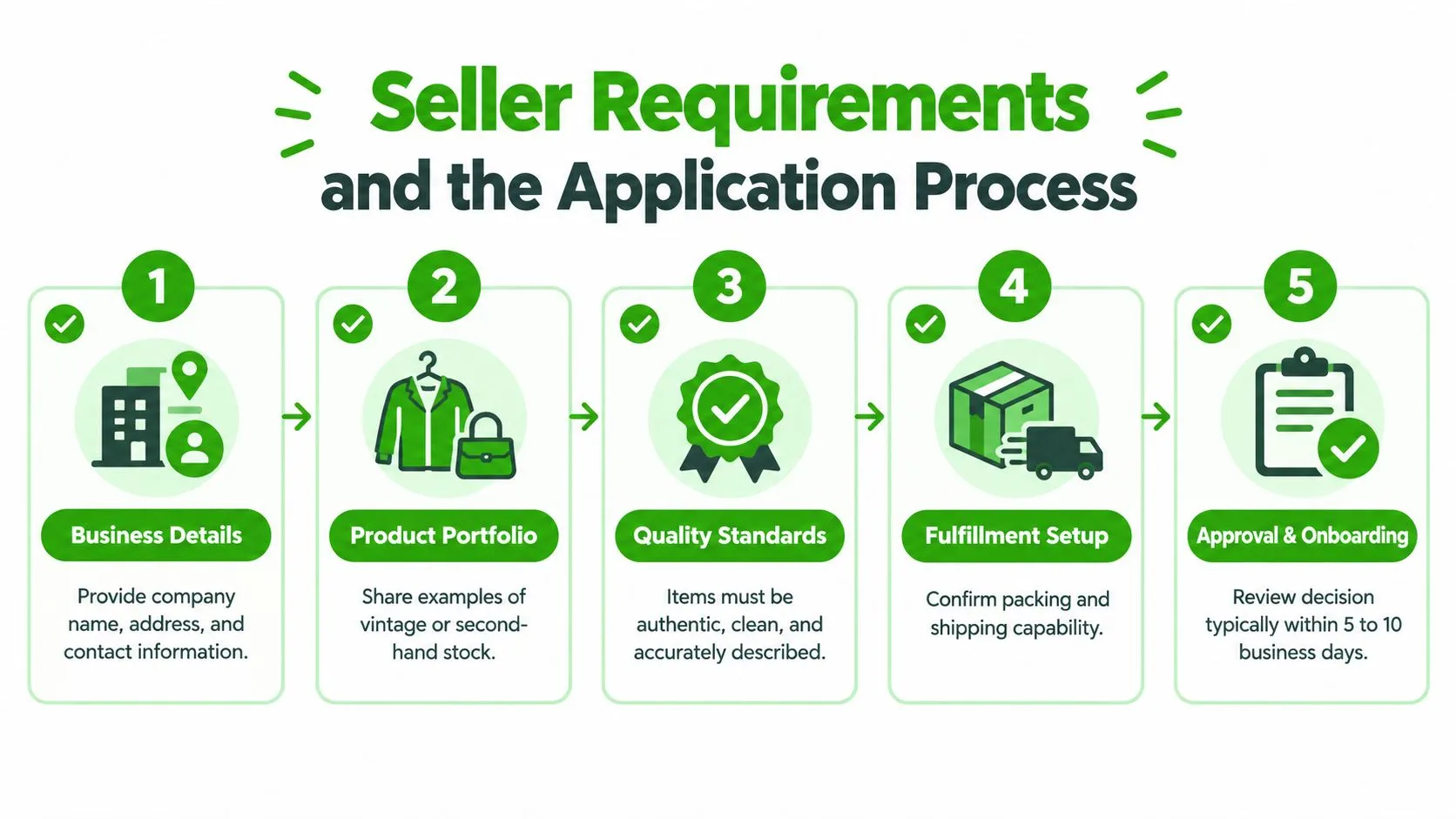
Treat the application as a retail partnership proposal, not a formality. An open marketplace can tolerate inconsistent product photography and informal descriptions because its catalogue is built around seller volume. A curated marketplace has to protect the customer experience, so your application should make your business look controlled, distinctive, and dependable.
Prepare the business information first
Start with accurate business details, contact information, dispatch arrangements, and a concise description of your niche. Don’t describe yourself as a general reseller if your strongest proposition is narrower. “We source interesting items” is weak. “We curate restored vintage lighting for characterful home interiors” gives the reviewer a recognisable category and customer.
Your product portfolio should show your best work, not merely your most expensive stock. Select examples that demonstrate:
- A clear point of view: Explain what makes your collection coherent.
- Consistent presentation: Use similar backgrounds, lighting, framing, and image quality.
- Honest condition reporting: State flaws, repairs, age-related wear, and missing parts without euphemisms.
- Useful specifications: Include dimensions, materials, provenance where known, care guidance, and practical limitations.
- Reliable fulfillment: Show that you can protect the item, dispatch it on time, and answer customer questions.
Make second-hand quality visible
Vintage sellers sometimes assume that “pre-owned” explains everything. It doesn’t. The buyer needs to understand what has been checked, what remains original, and what evidence supports your description.
For clothing, show labels, seams, fabric composition where known, measurements, and notable wear. For furniture or décor, photograph joints, surfaces, fittings, electrical components where relevant, and any restoration. For collectibles, separate confirmed facts from your interpretation. Don’t invent a date, designer, or provenance to make a listing sound more valuable.
Your sustainability angle can strengthen the application, but it shouldn’t replace commercial detail. Explain how your business extends product life, then show that you can maintain accurate stock, package safely, and provide consistent customer service. The marketplace needs a credible seller, not only a compelling philosophy.
Review the economics before you submit
The non-refundable joining fee means an application has a cost even before your first successful order. Recheck your candidate range, channel pricing, and fulfillment process before committing. If you can’t identify a group of products that can carry the fees while meeting the platform’s quality expectations, don’t apply yet.
Use the application process as a test of readiness. If producing a coherent portfolio feels difficult, your inventory may be too broad or your photography and documentation may need work. Fix that foundation first. A curated channel rewards discipline, and the same discipline will improve performance on your owned store and other marketplaces.
Managing Unique Inventory Across Multiple Channels
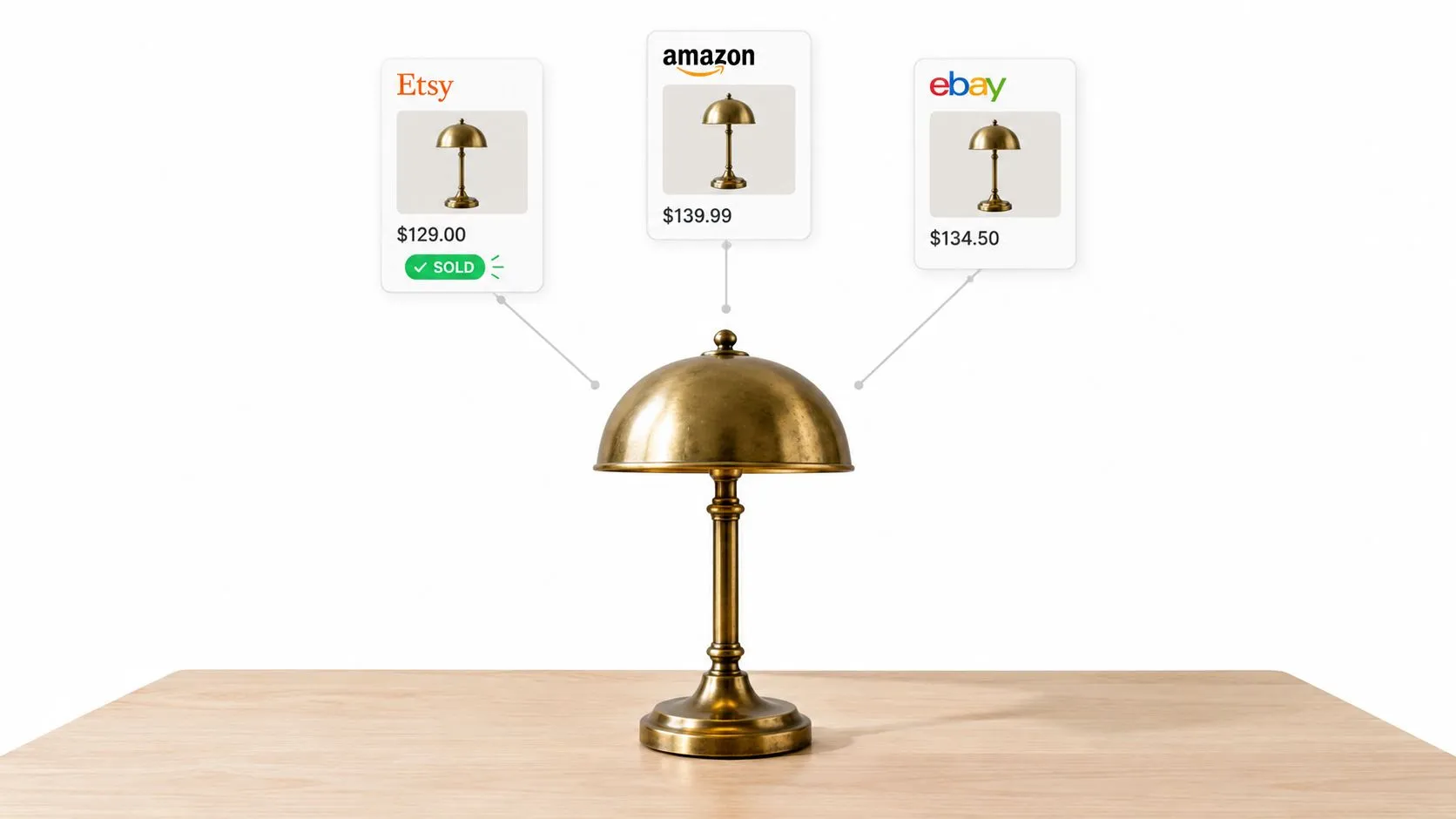
The greatest risk for a vintage reseller isn’t creating a listing. It’s selling the same one-off item twice.
A brass lamp can remain live on Not On The High Street, eBay, Vinted, and a WooCommerce store until one buyer pays. If the other channels don’t update quickly, you have to cancel an order, explain the mistake, refund the customer, and potentially damage marketplace performance. Manual spreadsheet updates don’t solve this reliably when several people list stock or when sales arrive through multiple channels.
Build one inventory record per physical item
Every unique product needs a stable SKU before it goes live. The SKU should connect the physical item to its photographs, condition notes, storage location, cost, asking price, and every published channel. Don’t create separate records for the same lamp because it appears in different storefronts.
A practical SKU structure can combine a category code, acquisition batch, and item identifier. The exact format matters less than consistency. The SKU creation guide from Ruit explains the role of a unique stock reference in resale operations.
Your central record should also distinguish between available, reserved, sold, returned, and unlisted. A customer message that says “I’ll take it” shouldn’t remove stock unless your process marks the item as reserved with an expiry rule. Otherwise, staff can lose track of inventory that is temporarily unavailable but not sold.
Automate delisting wherever possible
The safest workflow is event-based. When a sale is confirmed on one channel, the system changes the central stock status and removes or pauses the listing everywhere else. If a channel doesn’t support instant updates, create a manual exception queue and check it frequently during busy periods.
The critical controls are:
- Centralised stock: One master record owns the available quantity.
- Channel mapping: Each marketplace listing points back to that record.
- Automatic delisting: A completed sale triggers removal from connected channels.
- Exception alerts: Failed updates create a visible task rather than vanishing unnoticed.
- Photo and copy reuse: The source listing feeds each channel without creating duplicate inventory records.
- Audit history: Staff can see who changed the item status and when.
A multichannel tool is useful only if it matches your real operations. Test what happens after a sale, cancellation, return, price change, and temporary hold. Don’t evaluate a platform solely by how quickly it publishes a product. The important question is whether it prevents a second buyer from purchasing an item that no longer exists.
The video below provides additional context for thinking about multichannel resale workflows and operational control.
Building a Sustainable Multichannel Resale Strategy
Not On The High Street should sit at the premium end of your channel portfolio, not at its centre. Put your most distinctive and giftable items there, especially products that benefit from editorial presentation and can absorb the full cost of listing, delivery, packaging, and customer service.
Use open marketplaces for breadth and testing. Vinted, Wallapop, and eBay can provide useful outlets for products that are more price-sensitive, less gift-led, or too ordinary to justify a curated presentation. Your own WooCommerce or PrestaShop store gives you more control over merchandising and customer relationships, but it also requires you to create demand rather than relying on marketplace discovery.
A simple decision matrix keeps channel allocation practical:
| Stock characteristic | Primary channel decision |
|---|---|
| Rare, attractive, giftable, and high margin | Curated marketplace plus owned store |
| Broad demand and easy shipping | Open marketplace with efficient listing |
| Low margin or highly price-sensitive | Fastest, lowest-friction channel |
| Fragile, bulky, or difficult to describe | Channel with the clearest fulfillment economics |
| Strong repeat-buying potential | Owned store and direct customer retention |
Measure profit per hour
Revenue by channel is a poor management metric on its own. Record the time required to photograph, write, publish, answer messages, pack, dispatch, and resolve problems. Then compare the contribution margin after marketplace charges and fulfillment costs.
Seasonality also needs a deliberate plan. Build stock ahead of the gifting window, but don’t buy inventory solely because it might suit holiday demand. Use seller dashboard data such as sessions, views, and conversion rate to identify whether weak performance comes from insufficient exposure, poor presentation, or an unattractive price. The platform’s data can inform decisions, but it won’t rescue products with weak margins.
For a professional operation, Ruit can centralise inventory, publish products across connected channels, synchronise stock and prices, remove sold items from other marketplaces, and connect listing activity with orders and analytics. That makes it one operational option for sellers who need more than separate cross-listing screens.
For a broader way to assess channel roles, customer ownership, operational effort, and commercial fit, use Arlo Inc.’s channel strategy framework alongside your own margin data. The framework is more useful when you apply it to actual stock categories rather than treating every channel as equally valuable.
My final recommendation is selective. Join Not On The High Street when you have a recognisable collection, polished product assets, reliable fulfillment, and enough margin to withstand the full transaction cost. Delay the application if you’re still managing stock manually, listing low-value items, or relying on holiday demand to compensate for weak economics. A curated marketplace can improve the quality of your customer acquisition, but only a controlled multichannel system will protect the profit that follows.
If you’re losing time recreating listings and manually removing sold vintage items from multiple marketplaces, Ruit can centralise inventory, publish across sales channels, and synchronise stock for a professional resale workflow. Visit Ruit to evaluate whether its multichannel tools fit your current catalogue, team, and margin targets.
Frequently Asked Questions
Is Not On The High Street a good fit for second-hand resellers?
It suits edited vintage collections better than general second-hand inventory. List rare, visually distinctive, giftable items with enough margin to cover preparation and delivery, and keep common garments, low-value accessories and stock that needs speed on other channels.
How does Not On The High Street charge sellers?
Seller terms show a non-refundable joining fee, plus commission charged on the full transaction value, including delivery charges. Calculate marketplace profitability from the complete transaction value, not from the product price alone.
How do you avoid selling a one-off item twice across channels?
Give every unique item one inventory record with a stable SKU, and point each marketplace listing back to it. When a sale is confirmed on one channel, change the central stock status and remove or pause the listing everywhere else. Failed updates should create a visible task rather than vanish unnoticed.