Selling Vintage Online: A Practical Playbook for Resellers


Table of Contents
- Table of Contents
- Why Selling Vintage Online Is Now an Operating Business
- Sourcing Vintage Stock That Actually Sells
- Authentication and Condition Grading That Protects Margin
- Pricing Vintage for Sell-Through, Not Ego
- Photography and Listing Metadata That Win Search
- Choosing the Right Multichannel Mix for Vintage
- Shipping, Service and Scaling With Data
- Frequently Asked Questions
You’re probably looking at a rack, a storage rail, or a phone full of drafts and thinking the same thing most resellers eventually think: sales are coming in, but the cash still feels tight. That usually means the problem isn’t demand. It’s math.
Selling vintage online stops being casual the moment you have enough inventory to lose track of what you paid, where an item is listed, how long it’s been sitting, and whether the sale made money after fees, shipping, and returns. A piece can sell fast and still be a bad business decision. Another can sit for weeks and still be worth carrying if the margin justifies the wait.
The category is large enough now that discipline matters more than enthusiasm. Independent market reporting estimates the global recommerce market at US$210.7 billion in 2025, after 14.8% growth across 2020 to 2024, with a forecast of about US$310.5 billion by 2029 according to global recommerce market data from Research and Markets. That’s good news for vintage sellers. It also means more competition, tighter pricing, and less room for sloppy operations.
Table of Contents
- Why Selling Vintage Online Is Now an Operating Business
- Sourcing Vintage Stock That Actually Sells
- Authentication and Condition Grading That Protects Margin
- Pricing Vintage for Sell-Through, Not Ego
- Photography and Listing Metadata That Win Search
- Choosing the Right Multichannel Mix for Vintage
- Shipping, Service and Scaling With Data
- Frequently Asked Questions
Why Selling Vintage Online Is Now an Operating Business
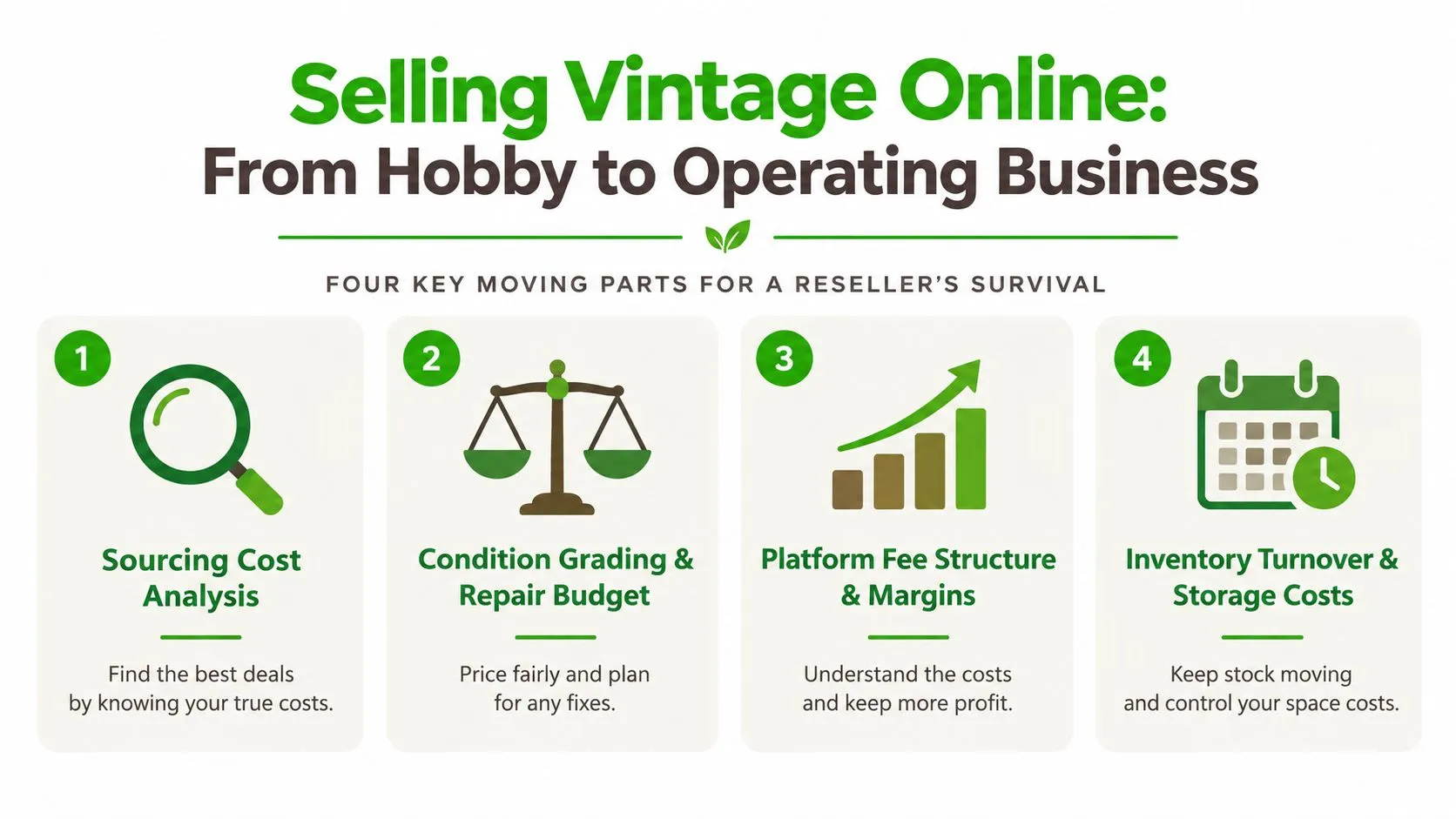
If you want this to last past the excitement phase, treat every item as inventory, not as a charming find with emotional value. That shift changes everything. You stop asking, “Could someone love this?” and start asking, “What’s my cost basis, expected sell-through, and net margin after work?”
What separates a business from a hobby
A hobby seller can get away with rough estimates. An operating business can’t. You need a minimum stack that keeps decisions consistent:
- Inventory control: one place to track SKU, cost, storage location, listing status, and sale channel.
- Comp checking: a repeatable method for checking sold prices before you buy and before you list.
- Shipping workflow: scale, label process, packaging standards, and a way to handle breakables without improvising.
- Category analytics: enough visibility to know which item types move, which tie up capital, and which create service headaches.
Most beginners focus on gross revenue because it feels like progress. It isn’t the right scorecard. What matters is net margin per hour worked. If an item takes too long to source, clean, measure, list, pack, and defend in messages, it can drain the business even if the sale price looks good.
Practical rule: If you can’t explain your margin before listing, you’re guessing, not operating.
The quiet margin traps
The biggest leaks usually don’t look dramatic.
Free shipping absorbed on bulky pieces can wipe out profit. Platform fees stack when you promote listings or accept lower offers just to move old stock. Overbuying on trend-led categories creates storage pressure and stale inventory. Small-ticket items are especially risky. Independent coverage notes that fixed per-order fees and buyer-side protection charges can make sub-$50 vintage materially less profitable, even while resale demand grows, in this MediaPost report on secondhand resale economics.
The fix is boring and effective. Give every piece a cost basis, a target margin, and a time limit. Once you do that, selling vintage online gets less emotional and much easier to scale.
Sourcing Vintage Stock That Actually Sells
Good sourcing isn’t about finding unusual things. It’s about finding inventory that will convert at a price band your workflow can support. Scarcity alone doesn’t pay the bills. Realized comps do.
The healthiest sourcing mix usually combines fast local buying, slower high-upside buying, and at least one channel that can refill inventory without spending half your week in a car.
Four sourcing channels with different economics
Some channels produce better headroom. Others save time. You need both.
| Sourcing channel comparison for vintage resellers | Typical Gross Margin | Inventory Risk | Time Per Unit |
|---|---|---|---|
| Thrift and charity shops | Moderate to high if bought selectively | Moderate | High |
| Estate sales and auctions | High on underpriced lots, uneven by category | High if bought in bulk without comp checks | Moderate to high |
| Wholesale lots and deadstock | Moderate, sometimes strong on consistent categories | High if quality is mixed | Low to moderate |
| Digital arbitrage from online marketplaces and clearance | Moderate | Moderate to high | Low per search, variable on fulfillment |
Thrift and charity shops are still useful, but they’re labor-heavy. Estate sales can produce excellent buys, especially when sellers want cleanouts, but mistakes get expensive fast. Wholesale and deadstock can smooth your listing pipeline if your category knowledge is strong. Digital arbitrage works best when you know exactly which labels, cuts, and eras you can flip repeatedly.
For the storage side of that mix, it helps to keep a formal process instead of relying on memory. Display Guru on inventory management is a useful reference because the physical organization side is where many sourcing gains get lost.
What to check before you buy
In person, the fastest useful checklist is usually this:
- Label construction: union labels, made-in tags, fabric tags, and logo styles often narrow era quickly.
- Hardware details: zipper makers, stamped snaps, buckle finish, and button backs can tell you more than a seller’s description.
- Fabric content: natural fibers, unusual blends, and heavier construction often convert better than generic synthetics unless you’re buying a trend-specific Y2K piece.
- Cut and silhouette: don’t buy only on age. Buy on shape that current buyers will wear.
- Condition reality: stains at seams, underarm wear, dry rot, and hidden repairs are where profit disappears.
Online sourcing needs the same discipline. Before committing to lots or bundles, check sold history first. One eBay benchmark estimated 562,001 vintage items sold in the last 30 days, worth $24.6M, with an average sold price of $43.77 and a 13.6% sell-through rate against 4,137,074 live listings, according to ZIK Analytics vintage sell-through data for eBay. That’s the reminder most sellers need. A huge number of items get listed. A much smaller share sells.
Buy on turnover plus margin. Never on the feeling that something “has to be worth more.”
A practical sourcing cadence is simple: one local hunt for singles, one lot-checking session for bulk opportunities, one comp review, and one cleanup pass on stale inventory so you don’t keep buying while old stock clogs your shelves.
Authentication and Condition Grading That Protects Margin
Authentication and condition grading are where you protect profit before the listing ever goes live. Most disputes start because the seller was vague, optimistic, or inconsistent. Buyers usually forgive age. They don’t forgive surprises.
Build a category-specific check routine
Designer leather, denim, outerwear, and accessories all need different checks. On bags and leather goods, inspect date codes, serial formatting, edge paint, stitching consistency, hardware engraving, and lining materials. On garments, zipper makers, stitch density, care tags, shoulder construction, and fabric hand often tell you whether a piece is period-correct or later reproduction.
Collectibles and small decorative objects need the same rigor in a different language. Check maker’s marks, signature placement, glaze wear, mold seams, screws, felt bases, and any paperwork that travels with the object. Provenance isn’t always available, but when you have it, photograph it.
Use one grading rubric every time
You don’t need a complicated system. You need one you can apply without drifting.
- Excellent vintage condition: minimal wear, no notable flaws beyond expected age.
- Very good vintage condition: light wear visible on close inspection, fully wearable or usable.
- Good vintage condition: visible wear or minor repairs, still functional and described clearly.
- Fair vintage condition: heavier wear, notable flaws, repair project, or display use only.
Then translate that grade into buyer-facing language. Spell out actual defects. Don’t hide behind “good for age.” State pilling, fading, missing buttons, pinholes, scuffs, crazing, or repairs plainly. Measurements matter more than tagged size, especially for older garments where sizing standards drift.
Clear condition language saves money twice. It lowers dispute risk, and it attracts the buyer who is comfortable with the item as it is.
Document like you expect a claim
Take clean, high-resolution photos of front, back, interior, label, maker marks, and every flaw. Save those images outside the marketplace too. Keep pack-out photos for expensive or easily disputed items. If you sell branded goods with higher fraud risk, third-party authentication can make sense for top-end pieces. For lower-priced stock, it’s often overkill unless authenticity is the entire value proposition.
The goal is simple. A buyer should never be able to say they weren’t shown the condition that mattered.
Pricing Vintage for Sell-Through, Not Ego
Most pricing mistakes come from identity, not arithmetic. Sellers remember the effort it took to find an item, the style appeal, or the story behind it, and then ask the market to pay for that emotion. Buyers don’t care how hard it was to source. They care whether the item is worth buying today.
Start with sold comps, not active listings
Active listings are ambition. Sold listings are evidence.
Use recent sold comps on the same platform where you’re listing whenever possible. Match by brand, era, material, size range, and condition. If a comp came from a seller with strong photography, detailed measurements, and a trusted history, give it more weight than a lazy listing with one blurry photo. A pristine ranch jacket and a faded one aren’t the same comp just because the label matches.
A simple pricing floor works well in practice:
- Cost of goods
- Cleaning or repair cost
- Platform and payment fees
- Shipping subsidy if you offer one
- Returns reserve
- Tax obligations
- Your target profit
Then compare that floor to market reality. If your required price sits above believable comps, don’t force the listing. Either your sourcing cost was too high, your category is too weak, or the item belongs on a different channel.
For a deeper breakdown of comp-based pricing logic, this guide to finding a selling price is a useful reference point.
Here’s the video version of the pricing mindset in action:
Price drops should follow a schedule
Random discounting trains you to panic. Use a rule.
- Hold price on rare, high-signal items with strong comps and low direct competition.
- Trim price in small steps on mid-tier stock that has attention but no conversion.
- Delist and relist stale inventory when the listing itself is the problem.
- Exit the item if the market keeps rejecting your ask and the capital is better used elsewhere.
Seasonality matters too. Outerwear, knitwear, and heavier leather usually need different timing than tees or lightweight dresses. Grail pieces justify patience. Bread-and-butter inventory usually doesn’t. Cash flow is better than theoretical upside.
Photography and Listing Metadata That Win Search
Strong listings don’t begin with clever copy. They begin with clear photos and searchable metadata. On crowded marketplaces, discoverability is often the difference between a fast sale and dead stock.
Build a repeatable photo setup
You don’t need an expensive studio. You need consistency. A neutral background, natural window light, a hanger or mannequin, and a phone with exposure control are enough for most clothing and small home goods.

The minimum shot list should be fixed across your catalog:
- Front view: clean and centered.
- Back view: buyers want shape and drape.
- Label or maker mark: essential for trust and search relevance.
- Flaw close-up: don’t bury wear.
- Context shot: worn, styled, or placed in a room if the category benefits from scale.
Keep white balance consistent across sessions. Mixed lighting makes a shop look messy and raises doubt about color accuracy. File naming also matters if you export listings across channels. A simple SKU-first naming system prevents confusion later.
Metadata is part of the sales work
Recent independent coverage says more specific tags perform better than generic listing language, including decade, fabric, silhouette, and condition descriptors, in this vintage listing trends article from Lost and Found Decor. The practical takeaway is straightforward. Generic titles waste search opportunities.
Put the primary keyword early. Use structured fields thoroughly: brand, decade, category, size, color, material, fit, and style notes buyers search. “Vintage leather jacket” is weak. “1990s brown leather bomber jacket mens oversized lined” is much stronger if it’s accurate.
If you want a cleaner photo-to-listing workflow, this article on sale by photo is relevant because the handoff from images to listing creation is where many sellers lose speed.
Better metadata doesn’t just help search. It also filters in the right buyer and reduces dumb questions.
Choosing the Right Multichannel Mix for Vintage
Most sellers don’t need more platforms. They need a better reason for using each one. Every channel attracts a different buyer behavior, tolerance for detail, and price expectation. If you list everything everywhere without rules, you create admin work faster than you create profit.
One industry summary reports that online resale is growing at an 18.5% CAGR and captures 52.0% of U.S. secondhand clothing transactions, while the U.S. secondhand market is estimated at US$61 billion in 2026, up 8.93% from 2025. The same summary also cites a forecast of US$78.8 billion by 2030 for the U.S. secondhand apparel market, according to Vox Booster’s secondhand statistics roundup. The important part for a reseller isn’t the headline growth. It’s that online channels now shape how price discovery works.
Match channel to inventory type
| Multichannel Vintage Mix: Fees, Audience, Vintage Fit | Effective Fees | Buyer Behavior | Vintage Fit |
|---|---|---|---|
| Wallapop | Lower-fee feel, varies by service use | Fast local decision-making, offer-driven | Strong for mid-market and quick turns |
| Vinted | Lower-fee feel for sellers, price-sensitive buyers | Browsing, bargain hunting, high velocity | Strong for everyday vintage apparel |
| eBay | Fee-heavy if you stack options | Search-led, comp-aware, global reach | Strong for broad vintage categories and price discovery |
| WooCommerce | Controlled by your own stack | Better for repeat customers and curated edits | Strong if you have a brand and traffic source |
| PrestaShop | Similar owned-channel logic | Works for structured catalog selling | Strong for sellers with operational discipline |
| Todocolección | Specialist marketplace dynamics | Collectible-focused and category-specific | Strong for Spanish-language collectibles and decor |
Wallapop and Vinted are often the speed channels. eBay is the comp engine and the broadest test of what buyers will pay. WooCommerce and PrestaShop make more sense when you’ve built repeat demand and want more control over merchandising. Todocolección fits certain collectible verticals far better than general marketplaces.
A useful channel split
A practical mix for many vintage businesses looks like this:
- Fast-turn inventory on high-traffic marketplaces
- Higher-consideration pieces on eBay
- Curated repeat-buyer stock on your own store
If you’re comparing social-led resale platforms and adjacent options, best alternatives to Depop is worth reviewing because it helps clarify where younger, style-led buyers shop versus where collectible buyers prefer to search.
For a broader view of platform selection, this roundup of best selling sites is useful when you’re deciding which channels deserve operational attention.
Don’t graduate an item to your own storefront just because you like it. Move it there when you already have the audience, the brand fit, and a reason to believe the buyer will come to you directly.
Shipping, Service and Scaling With Data
Shipping is where many vintage businesses discover whether they’re organized or improvising. A rushed pack-out, a vague return response, or a missing weight check can turn a good week into a pile of preventable losses.
Pack by category, not by mood
Different categories need different packaging rules. Ceramics and glassware need internal cushioning, movement control inside the box, and outer-box protection that assumes rough handling. Framed textiles need corner protection and moisture awareness. Electronics need power-state documentation, cable separation, and clear accessory photos before sealing.
Write the standard once and use it every time:
- Soft goods: folded consistently, sealed against moisture, labeled by SKU before bagging.
- Fragile items: photographed before boxing, cushioned in layers, then boxed with no internal rattle.
- High-risk items: insured when appropriate, with pack-out images saved to the order file.
- Multi-part orders: every component checked against the picking note before tape goes on.
That process matters even more because returns abuse is real. Retailer-side data shows return fraud rose from 10.4% of returns in 2022 to 13.7% in 2023, with fraudulent returns valued at $102 billion. The reported fraud mix included used merchandise at 48.8%, stolen goods at 44.2%, fraudulent payment at 37.2%, employee return fraud at 27.9%, and counterfeit receipts at 25.6%, according to Radial’s report on return fraud trends. For vintage sellers, that means condition photos, unique detail shots, weight confirmation, and tamper-evident packaging aren’t optional.
Photograph the item, the label, and the sealed package before handoff. Those three images solve a surprising number of disputes.
Service rules prevent margin leaks
Customer service gets expensive when every message becomes a custom project. Set response patterns by order value and issue type.
Low-value questions should get fast, standardized answers on measurements, shipping timing, and condition clarifications. Mid-value pieces deserve more personalized replies because extra confidence often closes the sale. High-value items need documentation-first communication. If a buyer asks about flaws, send the exact supporting images and restate the condition language plainly.
Partial refund requests need rules too. Don’t negotiate from memory. Refer back to listing photos, written condition notes, and pack-out evidence. If you allow returns, define what must be true for the return to be accepted and what counts as buyer remorse versus listing inaccuracy.
If your inbox volume is growing, operational guides on how to scale customer service with AI can be useful because consistency beats speed alone. Fast replies help, but accurate replies protect margin.
Track the business weekly
Most resellers know their sales total. Fewer know which categories are paying for the business. A weekly dashboard fixes that.
| Weekly Vintage Reseller Operations Dashboard | Definition | Target Range | Owner |
|---|---|---|---|
| COGS | What you paid for listed and sold inventory | Stable relative to category pricing | Founder or buyer |
| Sell-through rate | Share of listed inventory that actually sells | Rising in strong categories | Founder |
| Days-to-sale | Time from listing to completed sale | Shorter for bread-and-butter stock | Founder |
| Return rate | Share of orders that come back or get disputed | As low as possible through better grading | Operations |
| NPS | Buyer satisfaction signal from post-sale feedback | Consistently positive trend | Customer service |
| Channel margin | Net profit by marketplace after costs | Highest on disciplined channels | Founder or finance |
The point isn’t to create corporate theater. It’s to catch problems while they’re still small. If one channel generates lots of messages but weak net margin, cut volume there. If one category sells fast but creates service issues, adjust how you source or describe it. If your days-to-sale stretch, the issue might be pricing, photos, or overbuying.
Once volume rises, handoff becomes the test. Another person should be able to source, list, pack, and answer buyers using your documentation, not your intuition. That’s also where tools become useful. Systems that sync listings across channels, keep stock aligned, help with repricing, and surface sourcing signals reduce the daily manual work. One example is Ruit, which centralizes sourcing, inventory, multichannel listing, messaging, and orders for professional secondhand sellers.
A vintage business becomes easier to grow when every task has a rule, every item has a margin logic, and every channel earns its place.
Frequently Asked Questions
How do you price vintage items to sell?
Start from recent sold comps on the platform where you list, matched by brand, era, material, size and condition. Then check that the price covers your floor: cost of goods, repairs, fees, shipping, a returns reserve, taxes and your target profit.
Which platforms are best for selling vintage online?
Wallapop and Vinted suit fast-turn apparel, eBay works for broad categories and price discovery, and your own WooCommerce or PrestaShop store makes sense once you have repeat buyers.
How can you reduce disputes when selling vintage?
Grade condition with one rubric, photograph every flaw, and keep pack-out photos of the item, the label and the sealed package before handoff.
If you’re serious about selling vintage online as an operating business, Ruit gives you one system to manage sourcing, inventory, multichannel publishing, messages, and orders without stitching together separate tools. It’s built for professional secondhand sellers who want tighter control over sell-through, not just more listings.