7 Stuff to Resell for Profit in 2026


The best stuff to resell isn’t always the cheapest inventory. A low auction price can disappear after buyer premiums, VAT, freight, storage, inspection, repairs, returns, and the time needed to sell each item. Even a phone’s resale value depends on more than the model, as the factors for smartphone resale price make clear.
This roundup evaluates seven sourcing routes and resale categories using the complete equation: estimated resale value minus landed cost and operating effort. That means checking condition uncertainty, fees, freight, refurbishment, sales channels, seasonality, and the work required per item. Start with manageable lot sizes, confirm inspection and removal terms, and choose inventory that matches your skills, storage, geography, and buyer access. Once volume grows, Ruit can centralize sourcing, inventory, multichannel publishing, pricing, messaging, orders, accounting, and analytics for European resale businesses.
Table of Contents
- 1. Ruit
- 2. B-Stock Amazon Europe Liquidations
- 3. Liquidation.com
- 4. GovDeals
- 5. John Pye Auctions
- 6. Troostwijk Auctions
- 7. DirectLiquidation.com
- Top 7 Resale Sources Comparison
- Turn a Promising Lot Into a Repeatable Resale System
1. Ruit
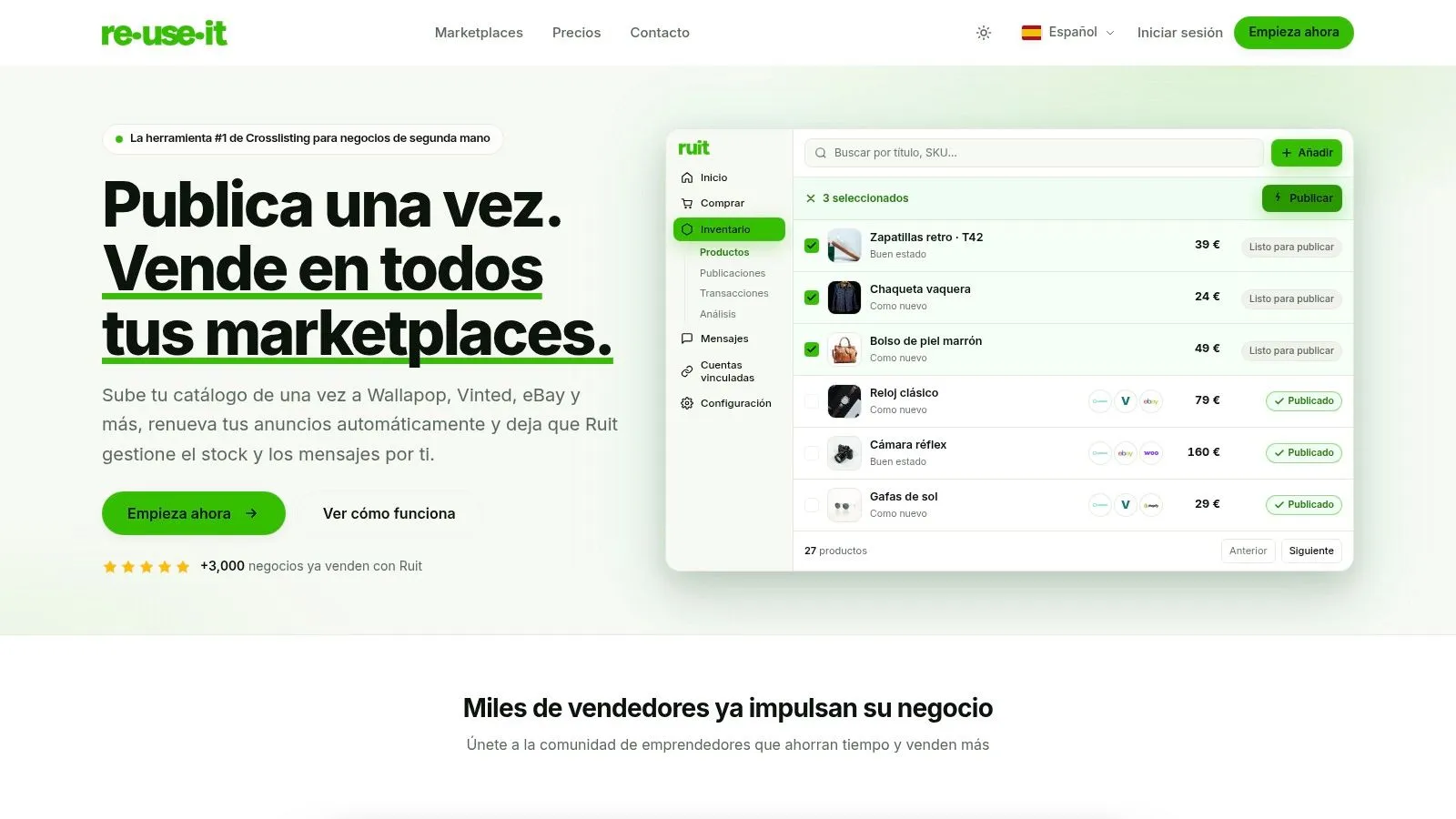
Ruit isn’t a liquidation marketplace or a category of inventory. It’s the operating layer that becomes valuable after you’ve found stuff to resell and need to turn purchases into a repeatable business. The platform brings sourcing, inventory, listings, prices, messages, orders, accounting, and analytics into one system, with access through the web, iOS, and Android.
For a professional reseller, that distinction matters. A crosslisting tool may distribute one listing across several marketplaces, but it doesn’t necessarily help you compare purchase opportunities, track landed costs, avoid duplicate sales, or understand which categories consume too much labor. Ruit connects the buying and selling sides, including unified marketplace search across platforms such as Wallapop, Vinted, eBay, and Todocolección, price comparison and history, opportunity alerts, and AI-assisted deal detection.
Where Ruit changes the resale equation
The strongest use case is operational complexity. You can import and merge existing inventory without recreating listings, publish in bulk or on a schedule, synchronize stock and prices, and automatically delist an item after it sells. AI can help generate titles and descriptions, edit photos, remove backgrounds, and suggest replies in a unified messaging inbox.
That reduces the hidden cost of inventory. A mixed lot may look attractive at purchase, but its real value depends on how quickly you can inspect, photograph, describe, publish, answer questions, and keep every channel accurate. Ruit’s analytics and accounting connect those activities to sales data, giving you a better basis for deciding whether a category is profitable after labor, not merely profitable before labor.
Practical rule: Treat software as part of landed operating cost. If a tool doesn’t help you process, sell, or measure inventory more efficiently, it hasn’t improved the resale equation.
Ruit is designed primarily for European professional sellers, so its marketplace coverage is more relevant to businesses operating in that region than to sellers focused elsewhere. Plans include Basic, Premium, and Enterprise options, with custom development, API, and ERP or CRM integrations available at the enterprise level. The website reports more than 3,000 active businesses and more than 1 million listings published, while user feedback highlights time savings, multichannel publishing, and support. Review the current monthly pricing and cancellation terms before subscribing, because access begins immediately and the service’s policy states that subscribing involves waiving the 14-day withdrawal period.
2. B-Stock Amazon Europe Liquidations
B-Stock’s Amazon Europe liquidation marketplace suits buyers who want retailer-direct supply without relying entirely on informal local sourcing. The channel offers customer returns, overstock, and damaged freight from European warehouses, with manifested lots spanning categories such as consumer electronics, home products, and toys.
A manifest improves your starting position because you can identify brands, quantities, and listed conditions before bidding. It doesn’t remove uncertainty. A returned item may still need testing, cleaning, missing-accessory checks, repackaging, or refurbishment, and the manifest can’t tell you how much labor each unit will consume.
Calculate the landed cost before bidding
The auction format creates a second risk. Buyer premiums and VAT apply, while shipping from different European locations can complicate freight planning. A lot that looks attractive at the hammer price may become unsuitable after transport, handling, storage, and disposal of unsellable units.
European geography can work in your favor if your customers are nearby and you can choose a freight lane that keeps delivery practical. It can work against you when a lot’s contents are scattered across locations or when bulky goods require special collection arrangements. Before bidding, estimate the cost per potentially sellable unit, not the cost per item listed on the manifest.
A manifest narrows uncertainty. It doesn’t convert returned inventory into tested inventory.
Amazon-related returns can be especially suitable for sellers with established channels for electronics, home goods, and toys. Those channels might include eBay, local marketplaces, or an owned store, but each requires different photography, descriptions, shipping policies, and customer support. See Ruit’s guide to Amazon returns pallets before treating a pallet as a straightforward bargain.
Best fit: European resellers with a VAT ID, testing capacity, storage, and enough category knowledge to separate quick listings from repair projects.
Main drawback: Auction fees, VAT, freight, and uncertain condition can erase the apparent discount before you make a sale.
3. Liquidation.com
Liquidation.com offers broad access to retail returns, shelf pulls, refurbished goods, and salvage inventory. Its selection includes general merchandise, apparel, tools, and electronics, with case, pallet, and truckload formats available from United States locations.
The platform’s breadth is useful when you’re still comparing categories. You may find smaller lots for testing, then move toward larger purchases if your inspection process and sales channels can handle them. The same breadth creates a valuation problem, because a mixed lot may contain items with very different demand, condition, shipping profiles, and listing effort.
Match lot size to your processing capacity
Manifests help you model the purchase, but they need careful interpretation. A listed product name isn’t enough. You need to distinguish new, returned, refurbished, salvage, incomplete, and untested units, then account for the likely work required to make each item saleable.
The buyer’s premium, taxes, and shipping are added to the auction outcome, so landed cost must be calculated before you bid. Freight can be particularly important for low-value or bulky goods. A broad lot may contain enough attractive products to justify the purchase, but only if the slower, damaged, or difficult-to-ship items don’t absorb your storage and labor budget.
Check the manifest: Identify which units have a clear sales channel and which depend on uncertain demand.
Separate condition risk: Model tested, incomplete, damaged, and salvage goods as different inventory classes.
Test a smaller lot: Use the first purchase to measure actual inspection time, sell-through, returns, and disposal effort.
A category that performs well for another buyer may not work for you. Your location, shipping rates, repair skills, and ability to create accurate listings determine the actual outcome. Ruit’s advice on buying in bulk and reselling is relevant here because scale only helps when your process can absorb it.
Best fit: U.S.-based or internationally experienced resellers who understand freight, manifests, and condition grading.
Main drawback: Selection is wide, but quality and profitability can vary sharply between sources and lots.
4. GovDeals
GovDeals is a better source for resellers who can evaluate equipment than for beginners searching for easy-to-ship consumer products. Government surplus can include vehicles, tools, IT equipment, furniture, laboratory gear, maintenance equipment, and other commercial assets.
The opportunity comes from specialization. A government agency may sell an item because it no longer fits its operational needs, not because the product has no secondary demand. A buyer who understands a specific tool, vehicle, machine, or component may value it more accurately than a general bidder.
Inspection and removal are part of the product
The platform’s biggest advantage is that inspection is often permitted. That gives you a chance to examine condition, identify missing parts, assess wear, and determine whether transport is practical. Use that access. Government surplus is generally sold as-is, where-is, so the buyer takes responsibility for testing, removal, compliance, and onward logistics.
An apparently low-priced asset can become expensive if it needs specialist loading, dismantling, storage, registration work, or refurbishment. Large equipment also narrows the customer pool and may require local collection. That can protect you from shipping risk, but it also means your resale channel must reach buyers who can collect or pay for transport.
If you can’t explain how you’ll inspect, remove, store, and sell an asset, you haven’t evaluated the lot yet.
GovDeals works particularly well for part-out strategies. An old machine, vehicle, or equipment bundle may be worth more as components than as a complete unit, but parting out increases handling, cataloging, photography, and customer-service work. You’ll need accurate model information and a realistic route for every major component.
Best fit: Technical resellers, mechanics, equipment dealers, and operators with workshop or storage access.
Main drawback: The buyer’s premium, removal requirements, and as-is terms make due diligence essential.
5. John Pye Auctions
John Pye Auctions provides a practical middle ground between blind pallet buying and direct one-to-one sourcing. The UK auctioneer handles retail returns, consumer electronics, homeware, vehicles, and trade stock through regular sales and physical salerooms.
The ability to view goods before bidding can materially improve decision quality. Photos and catalog descriptions help you shortlist lots, but viewing lets you check screens, ports, finishes, completeness, packaging, signs of use, and obvious damage. That’s especially important for electronics and homeware, where a small defect can change the item’s sales channel or make the listing uneconomical.
The fee structure changes the bid ceiling
John Pye commonly applies a 25% buyer’s premium plus 20% VAT where applicable, as stated in the supplied auction details. Those charges must be included before you decide the maximum bid. Collection deadlines and removal rules add another layer of cost, particularly when the purchase involves several lots or bulky items.
Auction terms also limit the protections buyers may expect from ordinary retail transactions. There may be no cooling-off period or ordinary return route, so the viewing process becomes part of your quality-control system. If you can’t attend, consider whether the photos and description provide enough evidence for the risk you’re taking.
A useful starting category is compact, recognizable inventory that can move through eBay or local marketplaces without specialist freight. Consumer electronics can offer strong demand, but only if you can test them and describe faults accurately. Homeware may be easier to inspect yet slower to ship or more vulnerable to breakage.
Read how to start a resell business before scaling from occasional auction purchases into a structured operation, and use top auctions for imports to broaden your sourcing research.
Best fit: UK resellers who can view, collect, test, and list inventory efficiently.
Main drawback: Premiums, VAT, collection deadlines, and restricted returns can quickly change the economics.
6. Troostwijk Auctions
Troostwijk Auctions targets a different type of reseller. Its pan-European sales focus on insolvency and bankruptcy stock, machinery, vehicles, restaurant equipment, retail fixtures, and other commercial assets rather than mainly consumer returns.
That makes it particularly interesting for category specialists. A restaurant closure might create a set of stainless-steel counters, commercial appliances, shelving, and small equipment. A fleet or industrial sale might offer vehicles, tools, or components that can be resold whole, refurbished, or separated into parts. The value comes from knowing what the asset is worth in a specific buyer market.
Technical knowledge creates the advantage
Troostwijk’s multilingual European footprint can help buyers search beyond their immediate area, but cross-border sourcing introduces practical questions. Check the asset’s location, loading arrangements, transport route, taxes, documentation, and removal deadline before bidding. A machine may have a strong resale audience, yet still be a poor purchase if dismantling and specialist freight consume the spread.
Commercial assets also require better descriptions than generic consumer goods. Buyers may need dimensions, serial numbers, voltage, operating hours, compatibility details, service history, or proof that the item functions. Missing information can reduce buyer confidence and increase questions, returns, or disputes.
Value the resale route first: Decide whether the item will go to a trade buyer, local business, specialist marketplace, or parts customer.
Price the handling: Include dismantling, loading, transport, temporary storage, testing, cleaning, and photography.
Protect against concentration: Don’t let one large purchase consume the capital and space needed for faster-moving stock.
Troostwijk’s long auction history and commercial focus can produce higher-value opportunities, but higher ticket prices don’t automatically mean better returns. The operating effort is often greater, and a single inaccurate valuation can tie up capital for longer than a small consumer lot.
Best fit: B2B resellers, equipment specialists, dealers, and businesses with technical or logistics capabilities.
Main drawback: Commercial assets demand expertise, and strict removal conditions can create costs before the item reaches your sales channel.
7. DirectLiquidation.com
DirectLiquidation.com offers retailer returns, overstock, refurbished goods, electronics, appliances, tools, and general merchandise through auctions and fixed-price purchases. Cases, pallets, and truckloads give buyers different entry points, so you can test a category without immediately committing to the largest available format.
The platform provides manifests and condition codes, which are useful for estimating how much of a lot may be saleable. Treat those details as a planning input rather than a guarantee. Your results still depend on whether items arrive complete, whether they power on, whether accessories are included, and whether the products have enough demand to justify individual listing work.
Choose inventory that survives freight
Large appliances and mixed merchandise can look attractive at the source but become difficult after shipping. Freight, taxes, buyer premiums, pickup requirements, storage, and special handling all affect landed cost. A product’s resale potential must also survive packaging and delivery damage risk, especially when your customer base is spread across regions.
Electronics and tools may offer clearer product identification and stronger buyer search behavior, but they often need testing. Appliances may produce larger individual sales while demanding more storage, local delivery coordination, and customer support. Fixed-price buying can reduce auction uncertainty, yet it doesn’t remove condition or logistics risk.
Use the platform’s buyer education and dispute processes, but don’t build a purchase model around recovering every problem through a dispute. The safer approach is to document the lot, photograph arrivals, inspect promptly, and classify inventory into list, repair, parts, return, and disposal paths.
Best fit: U.S.-based resellers seeking mixed lot sizes and a documented B2B buying process.
Main drawback: Buyer premiums, taxes, shipping, and variable lot quality can overwhelm the apparent wholesale discount.
Top 7 Resale Sources Comparison
| Platform | 🔄 Implementation complexity | ⚡ Resource requirements | 📊 Expected outcomes | 💡 Ideal use cases | ⭐ Key advantages |
|---|---|---|---|---|---|
| Ruit | Moderate-high: onboarding, integrations and workflow setup | Subscription cost, team devices, time for configuration | Measurable increase in profit/hour and reduced manual work | High‑volume EU second‑hand sellers and teams automating end‑to‑end ops | End‑to‑end multichannel automation with integrated AI and native EU marketplace integrations |
| B‑Stock (Amazon Europe Liquidations) | Low-moderate: account + auction participation procedures | VAT ID, bidding capital, freight management across EU sites | Steady pipeline of retailer returns; price discovery via timed auctions | EU resellers seeking retailer‑direct manifests and predictable sourcing | Retailer‑direct manifests, B2B gating reduces casual competition |
| Liquidation.com (Liquidity Services) | Low-moderate: online bidding and lot selection process | Working capital, shipping logistics, manifest review | Broad selection and steady deal flow; variable quality impacts margins | Buyers seeking wide category access and established US auction flow | Scale and variety with clear B2B processes and documented fees |
| GovDeals | Moderate: agency rules, inspection and removal requirements | Transport, inspection/repair capacity, compliance with agency terms | Potential high margins on vehicles/equipment; high variability | Resellers who can inspect, refurbish or part‑out government surplus | Often below‑market start prices and diverse non‑retail assets |
| John Pye Auctions | Moderate: online + physical viewing recommended; auction terms to follow | Travel/collection logistics, buyer’s premium and VAT where applicable | Lower blind‑buy risk due to viewing; frequent auction cadence | UK/EU resellers comfortable with public auctions and physical collection | Regular sales with physical viewing that reduce lot uncertainty |
| Troostwijk Auctions | High: technical valuation and removal for commercial assets | Heavy logistics, dismantling/loading costs, specialist knowledge | Access to high‑value commercial lots; higher average flip potential | B2B/industrial resellers, machinery and fleet specialists | Pan‑EU insolvency pipeline and long auction heritage |
| DirectLiquidation.com | Low-moderate: online lots with live and fixed‑price options | Capital, shipping/pickup arrangements, manifest due diligence | Variety of lot sizes enabling scalable purchasing strategies | US resellers seeking mixed lot sizes (cases → truckloads) | Manifests and condition codes plus flexible buying formats |
Frequently Asked Questions
What is the best stuff to resell for a beginner?
Start with one compact category you can inspect, test and describe accurately, such as consumer electronics or homeware bought in small lots. Use the first purchase to measure inspection time, sell-through and returns before you scale.
How do I calculate the maximum bid on a liquidation lot?
Start from the expected resale value and subtract the buyer’s premium, VAT, freight, storage, repairs, packaging and the likely share of unsellable units. Estimate the cost per potentially sellable unit, not the cost per item listed on the manifest.
Turn a Promising Lot Into a Repeatable Resale System
The best stuff to resell in 2026 will depend less on a universal product list than on your ability to complete the entire resale equation. Global second-hand product sales were estimated at $475.19 billion in 2025 and are projected to reach $535.03 billion in 2026, with the market forecast to reach $854.57 billion by 2030, according to The Business Research Company’s second-hand product market report. That expansion creates room for more professional sellers, but it also makes process quality more important as competition and inventory volume grow.
Start with one category you can inspect and describe accurately. Then calculate the maximum purchase price from the expected resale value, fees, freight, packaging, repair, storage, taxes, and likely defect rate. Reserve money and time for items that need testing or parts, and confirm the sales channel before you buy. A product that sells well locally may be awkward to ship, while a compact item may need strong photography and precise condition notes to compete online.
Seasonality belongs in the same calculation. Fashion, toys, outdoor equipment, household goods, and business assets can attract buyers at different points in the year, so record when listings receive views, offers, and sales rather than assuming demand is constant. Track actual sell-through, realized price, return frequency, defects, and minutes spent per item.
Scale only after several purchases validate your assumptions. The U.S. secondhand market was estimated at $61 billion in 2026, with resale representing $34 billion of that total, according to Capital One Shopping’s secondhand market statistics. That commercial scale supports serious resale businesses, but it doesn’t rescue a weak lot model.
For European sellers managing Wallapop, Vinted, eBay, WooCommerce, PrestaShop, Shopify, or Todocolección, Ruit can serve as the operational layer after sourcing due diligence is complete. It centralizes listings, stock, prices, messages, orders, accounting, and performance data, helping you see whether a category earns enough after the work required to sell it.
Ruit connects professional European resellers with unified sourcing, inventory control, multichannel publishing, price management, messaging, orders, accounting, and analytics. If you’re ready to measure the cost of every lot and manage growing stock across your sales channels, visit Ruit and see how the platform can support a more repeatable resale operation.