Best Time List eBay: 7 Data-Driven Strategies

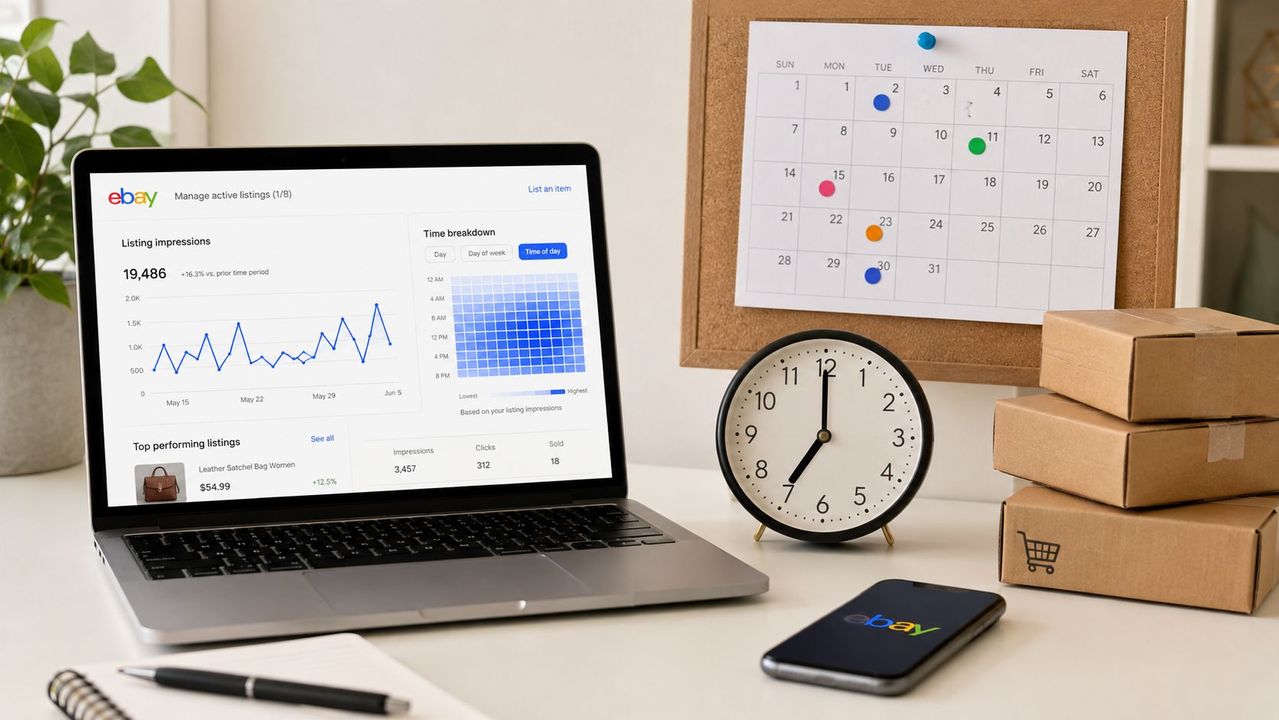
Table of Contents
- Table of Contents
- 1. Sunday Evening Listings
- 2. Thursday Through Saturday for Seven-Day Auctions
- 3. Mid-Week Listings
- 4. Time-Zone Optimization for European Markets
- 5. Programmed Refresh Listings
- 6. Post-Payday Listings
- 7. Category-Specific Timing Optimization
- 7-Point Comparison: Best Times to List on eBay
- Turn Timing Advice Into a Repeatable eBay Test
The best time list eBay advice gets repeated so often that it starts sounding universal, but it isn’t. A new fixed-price listing, an auction launch, an auction end time, and an inventory refresh all serve different goals, so a single clock window can’t optimize all four at once. eBay’s own marketplace research guidance says the better question is whether there are fewer competing listings when you publish, and it warns against over-trusting hour-by-hour timing because many products don’t have enough volume to judge every hour credibly eBay marketplace research guidance.
The seven timing systems below are starting hypotheses, not guarantees. Use them against your own audience with a simple measurement set, impressions, views, watchers, bids, conversion rate, final price, and time to sale. Professional sellers can also use Ruit to keep the test conditions consistent with scheduled and bulk publishing, auto-relist, and inventory synchronization, which matters more when you’re comparing timing rather than improvising it.
Table of Contents
- 1. Sunday Evening Listings
- 2. Thursday Through Saturday for Seven-Day Auctions
- 3. Mid-Week Listings
- 4. Time-Zone Optimization for European Markets
- 5. Programmed Refresh Listings
- 6. Post-Payday Listings
- 7. Category-Specific Timing Optimization
- 7-Point Comparison: Best Times to List on eBay
- Turn Timing Advice Into a Repeatable eBay Test
1. Sunday Evening Listings
A seller with broad-demand consumer inventory may see a listing sit all day, then attract attention after dinner on Sunday. That pattern makes Sunday evening a useful opening hypothesis, not a universal answer. Independent seller guides commonly identify roughly 18:00 to 22:00 CET as a practical browsing window. One analysis found 29% more impressions in the first 12 hours for listings created between 6 PM and 9 PM EST from Sunday to Wednesday, suggesting that early exposure deserves separate measurement Closo timing analysis.
For consumer inventory, Sunday evening can serve two different timing systems. It may be a starting window for fixed-price listings, or a launch point for auctions intended to gather attention during the week. Electronics resellers often report stronger late-evening engagement, while fashion buyers may browse after dinner rather than during working hours. These observations support a category test, not a blanket rule. Compare Sunday with other systems, including mid-week publishing, payday timing, and scheduled refreshes.
Why the first hours matter most
Early impressions and clicks can determine whether a new listing gains attention from active buyers. A listing published while its audience is asleep or working may receive fewer initial interactions, leaving less evidence that the timing helped.
Practical rule: Test Sunday evening with similar items uploaded at a consistent time, then compare impressions, views, watchers, and conversion rather than judging one sale.
Batching comparable products makes the test easier to read. Schedule them within the same window, record the first view and first watcher, and track time to sale alongside the final outcome. The result should be treated as a hypothesis about your category and audience, not proof that Sunday is the best hour.
For larger catalogs, Ruit can schedule listings in bulk. That reduces accidental variation in publication times, allowing sellers to compare timing systems across auctions and fixed-price inventory with cleaner conditions.
2. Thursday Through Saturday for Seven-Day Auctions
A seven-day auction that starts on Saturday evening can finish the following Saturday evening, while a Thursday launch can place the closing window near the following Thursday. The start time therefore matters because it determines which buyer browsing period receives the final bids. Seller observations and auction-timing guidance commonly favor late-evening closes, particularly 17:00 to 21:00 Pacific Time or roughly 18:00 to 21:00 EST, with Sunday night often treated as a strong target in major English-speaking markets auction timing guidance.
Use Thursday through Saturday starts when the auction needs several browsing cycles before closing. A Thursday launch can support a mid-week-to-weekend run, while a Saturday launch keeps the ending closer to the following weekend. The choice is a scheduling hypothesis, not a universal rule. Test it against Sunday launches, mid-week listings, fixed-price inventory, and the buying patterns of your category.
A longer auction creates more opportunities for watchers to return and compare similar items. That extra exposure can help vintage goods, collectibles, and niche electronics, where buyers may need time to assess condition or value. It can also delay payment for fast-moving commodity products, especially when demand is already strong and additional visibility adds little.
How to make auction timing measurable
Compare similar items with consistent categories, condition, starting prices, and shipping terms. Record final price, bid count, watcher activity, and whether bidding accelerates near the close. A weekend lift may indicate buyer behavior, stronger competition, or simple variation. Repeated tests are needed to separate those explanations.
Close auctions when your buyers are home, not when your calendar is convenient.
Time zones can change the result. A U.S.-focused closing window may miss evening buyers in the UK or Germany, while a European close may fall during working hours for American bidders. Treat the closing time as one variable within a broader system that includes buyer intent, category behavior, cash-flow needs, and recurring refresh schedules.
Ruit’s scheduled publishing and inventory workflow can keep start and end times consistent across repeated auction tests.
3. Mid-Week Listings
A niche office-equipment listing can gain more from a quieter category page than from Sunday’s larger shopping audience. The supplied eBay marketplace research guidance recommends comparing the current number of active items with the average daily volume of completed items from the recent month. This frames timing as a supply-and-demand check, rather than a fixed rule about the calendar.
Tuesday and Wednesday afternoons are testable starting points for specialized inventory. Fewer sellers may be posting in the same category at that moment, giving professional tools, workplace equipment, and replacement parts a less crowded path to search visibility. The potential benefit is exposure quality, not necessarily a larger total audience. Buyers who already know the specification may value a clear result more than a high-traffic browsing period.
When lower competition beats broad traffic
Sunday evening can bring broader traffic while also increasing listing congestion. A specialized B2B item, replacement component, or collectible may therefore perform better during the week, even if fewer shoppers are active. That outcome remains a hypothesis until the seller compares similar listings under consistent conditions.
- Office and workplace items: Weekday browsing may align with buyers searching for a specific task or business need.
- Professional tools: Reduced category congestion can make a specialized listing easier to notice.
- Collectibles with dedicated communities: A mid-week launch may reveal early watcher interest without the noise of a weekend surge.
Measure first views, watcher activity, conversion, and time to the first meaningful engagement. Compare those results with weekend listings that use similar condition, price, shipping, and item-specific settings. A faster initial view does not automatically mean a stronger sale, so evaluate visibility alongside final conversion and cash-flow timing.
Ruit can queue mid-week listings in batches, helping sellers keep Tuesday or Wednesday tests consistent across categories. Its role is operational: it reduces manual scheduling work while the seller tests whether lower competition, rather than a popular hour, explains the result.
4. Time-Zone Optimization for European Markets
A seller based in Madrid may publish for a Spanish evening and still miss buyers in Britain or Germany. European timing therefore depends on the audience attached to each listing, not only on the seller’s office clock. Supplied seller observations identify 18:00 to 20:00 CET as a possible overlap window for UK and continental evening traffic. Treat that range as a hypothesis to test, because buyer activity can differ by country, category, and format.
A single timestamp also produces different local experiences. The same listing may reach a UK shopper earlier than a continental buyer, while a German or French customer may encounter it at a more convenient evening hour. Auction listings add another consideration: the chosen launch time affects when the sale ends, whereas fixed-price listings can benefit from repeated exposure across several regional windows.
Use buyer location as the organizing variable. A fashion reseller could compare continental evening launches with UK-focused timing. A household-goods seller might test an earlier period that reaches commuters before dinner. Sellers with multi-region inventory can assign separate timing groups instead of forcing every item into one European schedule.
Start with a regional test
Keep the item, title, price, shipping terms, and format consistent. Rotate publication across two adjacent European evening windows, then compare first views, watchers, conversion, and time to the first meaningful engagement by buyer region. If the listing attracts attention but does not convert, the timing may be acceptable while the offer, delivery terms, or category competition needs examination.
Short tests can mislead when inventory or demand changes. Repeat the comparison with similar items and record the local time, target market, listing type, and outcome. A convenient seller timezone may reduce administrative effort, but buyer-aligned timing gives the test a clearer commercial purpose.
Ruit can support this process by keeping scheduled eBay publishing consistent across marketplaces. Its eBay publishing tools and bulk controls are useful for operationalizing regional comparisons at scale. The platform does not establish which timezone performs best. It helps sellers apply the same test design repeatedly, while their own category and audience data determine the schedule.
5. Programmed Refresh Listings
An older listing can remain available while losing attention. The practical question is not whether to refresh every item, but which inventory should re-enter the market, on what schedule, and with what comparison group. eBay’s Seller Hub research tools can help sellers examine what to sell, when to sell, and how to sell eBay Seller Hub research guidance. That information supports a test plan, but it does not establish one posting hour for every category.
A programmed refresh cycle suits stable stock that does not need constant repricing but may benefit from renewed exposure. Renewing an older listing can create a clear observation point: record its status before the refresh, then compare views, watchers, inquiries, and time to sale afterward. Any improvement remains a hypothesis until similar items receive comparable treatment.
The main trade-off is measurement quality. Refresh too many listings together and the resulting spike becomes difficult to interpret. Wait too long and slow-moving inventory may continue absorbing storage and attention without producing useful buyer signals.
Build a controlled refresh cycle
Start with a small inventory group rather than the entire catalog. Assign comparable items to different refresh windows, keep the offer and listing format stable, and record the local time, category, prior listing age, and outcome. This separates a timing effect from changes in price, demand, competition, or item quality.
- Refresh in waves: Divide older inventory into groups and publish each group at a different planned window.
- Change one variable: Keep the day consistent while testing time, or keep the time consistent while testing day.
- Measure the sales path: A quicker sale after renewal is useful evidence, but views and watchers show whether exposure improved before conversion.
- Review failed tests: Low response after a refresh may indicate a weak offer or crowded category rather than poor timing.
A recurring schedule works best when the same process is repeated with similar inventory. Ruit’s auto-relist and synchronized inventory tools can reduce manual work while preserving that consistency. Its renew-and-republish workflow can help sellers run repeated refresh tests at scale. Ruit operationalizes the schedule, while category and audience data determine whether the schedule deserves continuation.
6. Post-Payday Listings
Cash flow changes buyer intent. The supplied seller observations point to a post-payday window around the 25th to 27th of the month, when discretionary spending tends to feel easier because buyers have fresh purchasing power. That’s a useful hypothesis for items that sit above impulse-purchase territory, especially premium fashion, mid-range electronics, and hobby goods.
This isn’t a blanket rule for all inventory. If your buyers are price-sensitive or utility-driven, payday timing may matter less than competition and search relevance. But for items that benefit from a little extra spending confidence, the late-month window can be a meaningful test.
The advantage of this timing system is that it’s tied to buyer behavior, not just browsing behavior. A shopper who wants a new jacket, a console accessory, or a collectible may be more willing to commit late in the month than earlier when budgets are tighter. That makes the timing useful for margin-sensitive inventory.
Use the month as a schedule, not a guess
If you sell recurring categories, map them to the same monthly windows and compare them over several cycles. The goal is to see whether the late-month period affects views, watchers, or conversion more than the first half of the month.
If your audience buys after payday, your best listing time may be a date range, not a weekday.
That’s why this strategy works best when you already know which items are worth holding for a stronger sales window. It’s a cash-flow decision as much as a visibility decision. With Ruit, you can plan listings in advance so premium inventory lands in the month-end window consistently, instead of depending on someone remembering to post it at the right time.
7. Category-Specific Timing Optimization
Why should a drill, a sneaker, and a desk compete for the same posting hour? Their buyers have different routines, and category timing should reflect that difference. Consumer goods may attract evening browsing, while office furniture, tools, collectibles, and fashion can follow separate activity patterns. A contractor shopping for a drill is not behaving like a sneaker collector or a casual clothing buyer.
The useful unit is therefore the category, not a universal clock. Assign each category an initial window, then test whether that choice affects early views, watchers, conversion, or the need for a later refresh. Some products may fit broad consumer evenings. Others may perform better during weekday work hours or hobby-focused leisure periods. These are starting hypotheses, not fixed rules.
Build category rules from your own data
Begin with comparable listings in one category. Keep titles, pricing logic, condition, and presentation consistent while changing only the publication time. Compare which items gain attention quickly, which convert soon after exposure, and which benefit from a later refresh. This design separates timing effects from differences in listing quality.
- Office furniture and work items: Test daytime publishing when business buyers are active.
- Fashion and clothing: Test evening windows when browsing is more relaxed.
- Electronics and collectibles: Test weekend windows, when purchase intent may be stronger.
- Tools and DIY items: Test weekend mornings, when project-driven buyers may be planning work.
Category behavior also interacts with the listing format. Fixed-price inventory can be tested through recurring publication and refresh windows, while auctions require attention to the ending period and bidder availability. A category that receives evening traffic may still need a different auction close than a fixed-price listing. Compare formats separately rather than treating one result as proof for the other.
European sellers should also segment by buyer location. A schedule that fits one market may place a listing outside another market’s active hours. Cash-flow periods can add another layer, but category evidence should show whether that effect matters for the specific inventory.
If you sell across several categories, segmented scheduling is more informative than one convenient default. Ruit’s bulk publication tools and inventory organization can assign different timing rules to item types without rebuilding the workflow. Its category-focused guidance can help structure tests around products that may benefit from timing discipline Ruit category guidance.
7-Point Comparison: Best Times to List on eBay
| Strategy | Implementation Complexity 🔄 | Resources & Speed ⚡ | Expected Outcomes ⭐📊 | Ideal Use Cases 💡 | Key Advantages ⭐ |
|---|---|---|---|---|---|
| Sunday Evening Listings (18:00-22:00 CET) - Peak Buyer Activity | Medium 🔄, scheduling or automation recommended; simple to execute | Low ⚡, quick visibility boost; minimal setup | High ⭐⭐⭐ 📊, increased CTR, engagement, better auction closes | Fashion, electronics, auction-style listings; casual weekend buyers | Max visibility during peak traffic; stronger auction competition |
| Thursday-Saturday Listings for 7-Day Auction Duration - Extended Visibility Window | Medium‑High 🔄, requires planning of start/end days and relist logic | Moderate ⚡, longer sale cycle; more monitoring | High ⭐⭐⭐ 📊, extended exposure, improved price discovery over two weekends | Vintage, collectibles, niche electronics with moderate-high demand | Double-weekend exposure; higher final sale prices |
| Mid-Week Listings (Tue-Wed 14:00-16:00 CET) - Reduce Competition Strategy | Low‑Medium 🔄, simple scheduling; less time-sensitive | Low ⚡, slower traffic but low competition | Moderate ⭐⭐ 📊, better discoverability, improved margins per unit | B2B, wholesale, office equipment, specialized/professional items | Reduced price pressure; lower CPC and steadier bids |
| Time‑Zone Optimization for European Markets - Multi‑Regional Scheduling | High 🔄, multi-region planning and localization required | High ⚡, needs analytics, coordinated publishing across timezones | High ⭐⭐⭐ 📊, expanded audience and faster turnover across markets | Multi‑regional sellers (ES, UK, DE, FR, etc.), cross‑border electronics and fashion | Captures multiple peak windows; increases addressable buyer pool |
| Programmed Refresh Listings (Every 30 Days) - Algorithmic Visibility Maintenance | Medium‑High 🔄, automated refresh logic needed at scale | Moderate ⚡, automation required but maintains steady cadence | High ⭐⭐⭐ 📊, 30-45% impression lift; fewer stale listings | High‑volume resellers, vintage dealers, catalogs needing steady rotation | Maintains “freshness” in search; reduces need for paid promotion |
| Post‑Payday Listings (Around 25th-27th Monthly) - Cash‑Flow Buyer Strategy | Medium 🔄, monthly coordination with inventory and pricing | Low‑Moderate ⚡, short high-conversion window | High ⭐⭐⭐ 📊, 20-35% higher conversions; higher average transaction value | Mid‑range to premium items, designer fashion, mid-priced electronics | Targets buyers with disposable income; higher transaction values |
| Category‑Specific Timing Optimization - Data‑Driven Scheduling by Item Type | High 🔄, requires historical data, segmentation and testing | High ⚡, ongoing analysis and schedule management | Very High ⭐⭐⭐⭐ 📊, best ROI; category-tailored conversion improvements | Diverse inventories, seasonal items, sellers optimizing multiple categories | Maximizes ROI by aligning timing to category buyer behavior |
Turn Timing Advice Into a Repeatable eBay Test
The cleanest decision sequence is simple. Choose auction or fixed-price based on the item’s sales objective, assign an initial schedule from the matching timing system, and keep the timezone handling consistent from the first test to the last. Then compare matched items, not isolated wins, because one strong sale doesn’t prove the timing worked.
Record impressions, views, watchers, bids, conversion rate, final price, and time to sale for each test group. If you’re testing auctions, track the end time as carefully as the start time. If you’re testing fixed-price items, watch the first few hours after publication, because the supplied seller data shows that early visibility can matter a great deal Closo timing analysis.
Sunday evening is still a useful starting point for broad-demand inventory, especially consumer goods with leisure browsing behavior. But category, buyer location, competition, and auction duration can all change the best answer. eBay’s own guidance supports that more cautious view, because it emphasizes supply pressure and market research rather than a single universal clock eBay marketplace research guidance.
If you manage a larger catalog, Ruit can make the process easier to repeat. Bulk scheduling, auto-relisting, and synchronized inventory help you keep the timing test clean while your business keeps moving.
If you want to turn timing from a guess into a repeatable workflow, visit Ruit and review its scheduling and inventory tools for eBay sellers. It’s a practical way to test publication windows at scale without losing control of your stock, pricing, or cross-channel timing.