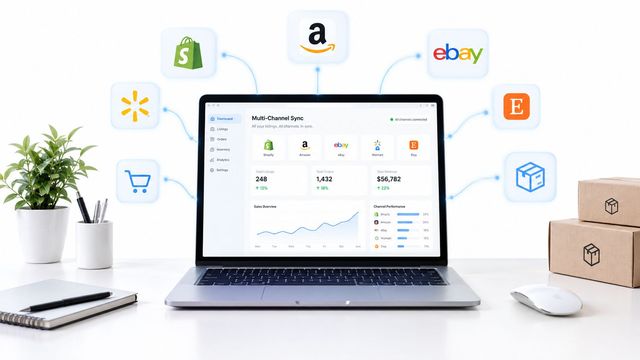
Keep WooCommerce and Your Marketplaces on the Same Stock Count


Table of Contents
- Table of Contents
- Why WooCommerce Stock Sync Breaks at Scale
- Choosing the Right Sync Approach for Your Business
- How Real-Time Synchronization Actually Works
- Setting Up WooCommerce Marketplace Integration
- The Overselling Problem and Sync Timing
- Troubleshooting Common Sync Failures
- Building a Reliable Multichannel Inventory System
- Frequently Asked Questions
You sell a one-off vintage jacket on WooCommerce, then notice the same jacket is still live on Vinted and Wallapop. Before you can remove either listing, another buyer checks out. The problem isn’t effort. It’s that three sales channels are making availability decisions from different stock states.
That scenario becomes harder with a catalog of unique items, frequent marketplace activity, POS sales, refunds, manual adjustments, and multiple team members. Stock synchronization for WooCommerce only works reliably when the business treats inventory as an operational system, not as a quantity copied between dashboards.
Table of Contents
- Why WooCommerce Stock Sync Breaks at Scale
- Choosing the Right Sync Approach for Your Business
- How Real-Time Synchronization Actually Works
- Setting Up WooCommerce Marketplace Integration
- The Overselling Problem and Sync Timing
- Troubleshooting Common Sync Failures
- Building a Reliable Multichannel Inventory System
Why WooCommerce Stock Sync Breaks at Scale
WooCommerce works well when one store controls the catalog and checkout. Its stock management handles product quantities inside that site, but the base platform wasn’t built as a complete multichannel synchronization layer. WordPress.com’s Inventory History documentation notes that WooCommerce doesn’t save a native log or history of product stock changes by default. Third-party tools exist partly because operators need an audit trail for every adjustment, including timestamps, old and new quantities, user IDs, and order IDs.
That distinction matters for professional resellers. A single WooCommerce order can reduce stock locally, while a marketplace sale, a POS transaction, or a manual edit changes the same SKU elsewhere. Without a controlled synchronization process, each channel can temporarily present its own version of availability.
The hidden cost of a local stock field
WooCommerce’s stock quantity is a field on a product or variation. It isn’t, by itself, a transaction ledger, reservation service, or conflict-resolution policy. If two systems write to that field without agreed authority, the last update can overwrite a valid change rather than incorporate it.
For unique second-hand inventory, the risk is especially sharp. You often have one physical item and several listings, so a delayed delist creates a direct fulfillment problem. The business must cancel an order, explain the failure to a buyer, and repair the listings manually.
A cloud-based order management workflow can help centralize orders, but order visibility alone won’t solve stock contention. The integration still needs consistent identifiers, event handling, and rules for what happens when two systems report different quantities.
Operational rule: If your team can’t answer which system owns a SKU, your synchronization setup isn’t governed yet.
Why scale exposes weak assumptions
Manual updates can appear acceptable while sales are slow. As catalog activity rises, the gaps become visible:
- One item, multiple listings: A sale on one channel doesn’t automatically remove every other listing.
- Shared edits: Staff, suppliers, POS systems, and integrations can all alter the same quantity.
- Missing history: Without logs, an unexplained stock change becomes a detective exercise.
- Unclear authority: A marketplace, WooCommerce, or ERP may each believe it has the final say.
The first architectural decision is therefore not which plugin to install. It’s whether WooCommerce should own inventory, receive inventory from another system, or act as one channel connected to a central stock service.
Choosing the Right Sync Approach for Your Business
A lightweight connector can be exactly right for two WooCommerce stores with a shared catalog. It can also be the wrong tool for a reseller operating WooCommerce, Vinted, Wallapop, eBay, a physical shop, and an accounting workflow. The deciding factor isn’t the feature list alone. It’s the number of systems that can create, sell, reserve, refund, or manually change stock.
Compare the operating models
| Solution Type | Best For | Channels Supported | Auto-Delist | Source of Truth Control |
|---|---|---|---|---|
| Dedicated sync plugin | Two WooCommerce installations or a focused store connection | Usually WooCommerce endpoints | Often limited to connected stores | Basic, usually one selected source |
| Middleware integration platform | Businesses connecting several independent systems | Depends on connectors and APIs | Available when supported by the workflow | Configurable, but requires careful conflict rules |
| Full-cycle operational system | Professional resellers managing sourcing, listings, orders, and inventory together | WooCommerce plus connected marketplaces and operational tools | Designed for channel-wide delisting where supported | Centralized governance across the workflow |
A dedicated plugin usually keeps the implementation narrow. That makes deployment simpler and reduces the surface area for failure. The trade-off is that quantity copying doesn’t automatically provide sourcing, listing management, unified messages, reservations, accounting, or marketplace-specific delist behavior.
Middleware gives you more freedom. You can route WooCommerce events into a POS, ERP, marketplace connector, or warehouse system. That flexibility comes with responsibility. Someone must define field mappings, retry behavior, ownership, and what happens when two updates arrive close together.
A full-cycle system such as Ruit is relevant when stock is part of a wider resale operation. Its stated workflow covers sourcing, inventory, multichannel publishing, automatic stock synchronization and auto-delist behavior, with WooCommerce included as a sales channel. The practical trade-off is that you’re adopting an operating layer rather than buying a narrowly scoped stock connector.
Match the tool to operational complexity
Use a focused plugin when WooCommerce is the main authority and the connection is simple. Choose middleware when your team already has an ERP or POS that must remain central. Consider a full-cycle platform when the main problem isn’t only quantity transfer, but the repeated work around listings, messages, orders, and channel-wide stock control.
Before choosing, document:
- Catalog structure: Are products standard items, variations, or mostly unique one-off listings?
- Channel count: How many destinations can sell the same physical stock?
- Write access: Which systems can reduce, reserve, restore, or manually edit inventory?
- Team workflow: Does one person manage stock, or do several operators make changes?
- Recovery needs: Can the tool replay missed events and show an audit trail?
The cheapest connector is rarely cheap if staff still reconcile orders manually. The right solution is the smallest architecture that reliably handles every system allowed to change availability.
How Real-Time Synchronization Actually Works
A sync process has two basic jobs. It must move a stock change quickly, and it must recover when that change fails, arrives twice, or reaches the wrong product. No single transport method handles both jobs perfectly.
Webhooks use a push model. When an order, refund, or stock adjustment occurs, the source system sends an event to the receiving system. That avoids waiting for the next scheduled check and suits fast-moving SKUs.
Polling uses a pull model. A service checks an API on a schedule and asks what changed. It adds delay, but it remains useful when a webhook is unavailable, misconfigured, dropped, or received before the downstream service is ready.
The production pattern is hybrid
An effective design uses webhooks for near-real-time changes and scheduled REST synchronization for reconciliation. Technical guidance on real-time inventory sync recommends this hybrid model because webhook delivery isn’t guaranteed, while polling can detect missed events.
The same source emphasizes several implementation details:
- Map every SKU consistently. A product ID in WooCommerce, a marketplace listing ID, and an internal stock record must resolve to the same physical item. Variations need their own reliable mapping.
- Prefer delta updates for events. A sale should decrement the authoritative quantity, rather than blindly overwrite it with a stale absolute value.
- Validate webhook signatures over HTTPS. The receiver needs to confirm that the event came from the expected source.
- Store event IDs. Retries are normal. Deduplication prevents one sale from decrementing stock more than once.
- Queue incoming events. A queue lets the system process bursts safely and keeps the webhook endpoint from becoming a fragile synchronous bottleneck.
- Make updates idempotent. Reprocessing the same event should leave the inventory in the same valid state, not create another decrement.
Speed isn’t the only measure
Industry guidance places serious multichannel propagation in the sub-second to sub-30-second range, with one source describing sub-5-second synchronization as a current standard and another noting sub-200-millisecond webhook delivery in well-architected systems. These aren’t promises every WooCommerce setup can meet. They’re useful benchmarks for evaluating whether a design is appropriate for high-velocity stock.
A fast webhook that overwrites the wrong quantity is still a bad sync. Reliability comes from combining delivery speed with identity, authority, ordering, deduplication, and reconciliation.
Setting Up WooCommerce Marketplace Integration
Start with governance, not credentials. Connecting APIs before deciding who owns stock creates a system that moves data quickly without knowing which data is correct.
1. Select the authoritative inventory system
Choose one system as the source of truth for sellable quantity. WooCommerce can fill that role for a simple operation. A central inventory service, POS, or ERP may be more appropriate when physical and online sales share stock.
Don’t allow every endpoint to behave as an equal master by default. If WooCommerce receives an update from a marketplace and then sends a competing update back, the integration can create loops or overwrite newer information.
2. Establish durable SKU mapping
Use one SKU for one inventory identity across the connected systems. For variations, map the variation rather than assuming the parent product is enough. Unique second-hand items need especially strict mapping because two visually similar listings may represent different physical goods.
Create a mapping exception queue. A missing SKU shouldn’t create a new product or leave a listing active with untracked stock.
3. Configure the transport and frequency
Enable webhooks wherever the channel supports them. Keep scheduled REST synchronization as a reconciliation path, not as the only protection against overselling. The correct schedule depends on velocity, channel behavior, and the cost of a stale listing.
A WooCommerce selling workflow should also account for refunds, cancellations, manual stock corrections, and returns. A sale isn’t the only event that changes availability.
4. Define safety behavior
Set rules for zero stock, low stock, and failed updates. Auto-delist should remove or deactivate the listing on other channels when the authoritative quantity reaches zero. A safety buffer can protect against uncertain marketplace timing, but it reduces the quantity you can expose for sale, so apply it deliberately by SKU group.
5. Test before expanding
Begin with a small SKU set that includes a simple product, a variation, a refund, and a manual adjustment. Confirm the full cycle:
- Sale event: The source records the sale and emits one event.
- Inventory change: The authoritative quantity changes once.
- Channel update: Connected listings receive the new availability.
- Failure handling: A rejected update enters a retry or exception queue.
- Audit trail: Logs show the old state, new state, event identity, and destination.
Enable detailed logs and alerts for negative stock, unusually large adjustments, unmapped SKUs, and repeated delivery failures. A sync that fails loudly is easier to fix than one that leaves stale listings online.
The Overselling Problem and Sync Timing
“Real-time” is often used to describe any automated process, including a job that runs every few minutes. That label isn’t operationally useful. The question is how long a sold item remains available elsewhere, and whether the system can reserve stock before concurrent checkouts complete.
A 2026 guide citing retailer research reports that 58% of retailers operate below 80% inventory accuracy, only 26% update online inventory every 30 minutes or less, and just 6% keep cancellations caused by inventory issues below 1%, as documented in SquareSync’s WooCommerce inventory synchronization guide. The same source reports that a 15-minute sync window can create a 34.4% chance of overselling on a given sync window.
Use velocity tiers instead of one universal setting
Fast-moving products deserve push-based updates, reservations, and strict conflict handling. Slower-moving items may tolerate scheduled reconciliation if a brief stale-availability window has little commercial impact. This isn’t an argument for accepting unreliable sync. It’s a way to allocate engineering effort where a delay creates the greatest exposure.
A seller with unique jackets may have low volume overall but high risk per SKU, because each item has no substitute. A shop with replenishable stock may tolerate a different policy, provided the available quantity and reorder process are trustworthy.
Concurrency can defeat a fast sync
Even instant propagation doesn’t prevent two checkouts from competing for the same last unit. WooCommerce has documented race-condition behavior in which overlapping checkouts or updates can produce negative inventory. WooCommerce synchronization performance guidance identifies concurrent write contention as a major scale failure mode and describes a production case where locking and improved inventory handling reduced checkout median latency from 1,240 milliseconds to 380 milliseconds and order error rates from 0.8% to 0.002%.
The architectural response includes row-level locking, asynchronous processing, stock reservations, and source-priority rules. A webhook should update the other channel quickly, but the checkout path must also protect the quantity while two buyers attempt to claim it.
Practical rule: Measure the exposure window for your fastest or least replaceable SKUs. Don’t buy “real-time” as a label. Verify event latency, reservation behavior, and recovery after failure.
Troubleshooting Common Sync Failures
Most sync incidents have recognizable symptoms. A listing remains active after a sale, WooCommerce shows a negative quantity, or a nightly comparison finds that two channels disagree. Treat each symptom as evidence of a specific failure class rather than repeatedly pressing “sync now.”
Negative stock points to contention
When two checkouts overlap, both processes may read the same available quantity before either writes the decrement. Row-level locking can serialize the critical update. Stock reservations can hold the item while payment completes, and asynchronous workers can process downstream channel changes without blocking the primary order path.
Check application logs for overlapping order timestamps, duplicate event IDs, and repeated writes to the same SKU. If the issue appears only during bursts, the problem is likely concurrency rather than a missing product mapping.
Stale channels point to delivery failure
A webhook can fail because the receiver rejects the payload, the signature check fails, the queue is unavailable, or the downstream API returns an error. Store delivery status, response details, retry count, and event ID. Then let scheduled reconciliation find anything the event path missed.
Don’t treat a successful webhook request as proof that the marketplace accepted the stock change. The receiving system needs its own confirmation and exception handling.
Conflicting quantities require authority
Manual edits, POS sales, refunds, and warehouse corrections can all touch one SKU. Define source priority before the incident occurs. For example, a central stock record may override a marketplace quantity, while a refund creates a new event that restores stock only after the return is approved.
WooCommerce troubleshooting documentation for unsynchronized stock can help teams structure an investigation, but the durable fix is governance: one owner, explicit write rights, and a reconciliation process.
Drift needs scheduled repair
Reconciliation should compare the authoritative quantity with every connected channel and record the difference before applying a correction. A 2025 technical discussion highlighted nightly reconciliation of WooCommerce _stock and _stock_status alongside strict one-source-of-truth governance as a stronger operating model for shared inventory.
Use batch-safe processing so a large correction doesn’t overwhelm APIs or cause another wave of conflicting writes. Alert on negative values, large adjustments, and repeated mismatches. The published scale case cited above shows why inventory architecture affects checkout reliability, not just catalog accuracy.
Building a Reliable Multichannel Inventory System
Reliable synchronization is an operating discipline. The technical stack matters, but the business needs rules that staff can follow when a sale, refund, manual edit, or integration failure changes the same SKU.
Set the framework in four parts:
- Authority: Name the single system that owns sellable quantity and document which systems may request changes.
- Identity: Map every product and variation to one stable SKU or inventory record.
- Velocity: Assign fast movers, scarce one-off items, and slower products to appropriate event and reconciliation policies.
- Control: Monitor webhook delivery, queue health, negative stock, unmapped items, and channel mismatches.
Run periodic reconciliation even when webhooks appear healthy. Keep an audit history for quantity changes, use reservations where concurrent checkout risk is material, and apply batch-safe updates during repair jobs. For multi-warehouse operations, define whether stock is pooled, allocated by location, or exposed through a central availability service.
Audit your current setup by tracing one SKU from purchase through listing, sale, delist, refund, and relist. Identify every system that can write to it, then remove unexplained write access. If your team needs stock synchronization plus sourcing, multichannel publishing, and messaging, evaluate whether a full-cycle platform fits better than a collection of disconnected plugins.
Frequently Asked Questions
Why does WooCommerce stock sync break only at scale?
Because a single store controls its own checkout, and nothing else does. WooCommerce handles quantities inside that site well; what it was never designed to arbitrate is two checkouts on different platforms competing for the same last unit.
Should synchronization use webhooks or scheduled polling?
Both, for different jobs. Webhooks carry the near-real-time changes; a scheduled pass reconciles what webhooks missed. A design with only one of them either reacts late or never notices a dropped event.
Can faster syncing eliminate overselling entirely?
No, and expecting that is the trap. Instant propagation shortens the window in which two buyers can reach the same unit, but it cannot close it. Beyond a point the remaining fix is governance, not timing.
Where should troubleshooting start when quantities disagree?
At the last event both systems agree on. Sales, refunds, cancellations and manual corrections each move stock, so the useful question is which of them the two sides recorded differently, not which number is right.
Ruit connects WooCommerce with other sales channels and supports automatic stock synchronization and auto-delist workflows for professional resale operations. Review the Ruit platform to see whether centralizing inventory governance and multichannel operations fits your catalog.