2nd Day Air: Costs, Cutoffs, and When to Use


Table of Contents
- Table of Contents
- A Late-Night Order That Changed How We Think About 2nd Day Air
- What 2nd Day Air Actually Means as a Service
- How FedEx, UPS, and USPS Label Their Second-Day Services
- What 2nd Day Air Costs for Resale Inventory
- Calculating the Delivery Date Step by Step
- Matching Shipping Speed to Order Value and Buyer Promise
- Tracking, Proof of Delivery, and Insurance for Higher-Value Parcels
- Common Misconceptions and a Quick Pre-Ship Checklist
- Frequently Asked Questions
A buyer pays for expedited shipping late on Thursday. You print the label that night, but the parcel isn’t picked up until Monday. The label says 2nd Day Air. The buyer sees a delivery estimate that sounds like Saturday. Those are two different clocks, and the gap between them can turn a routine resale order into a late-delivery complaint.
The service name describes transit after the carrier accepts the parcel. It doesn’t automatically mean the buyer will receive it two calendar days after checkout, or even two days after you create the label. To make a reliable promise, you need to know when the carrier takes possession, which days count, and what delivery window applies at the destination.
Table of Contents
- A Late-Night Order That Changed How We Think About 2nd Day Air
- What 2nd Day Air Actually Means as a Service
- How FedEx, UPS, and USPS Label Their Second-Day Services
- What 2nd Day Air Costs for Resale Inventory
- Calculating the Delivery Date Step by Step
- Matching Shipping Speed to Order Value and Buyer Promise
- Tracking, Proof of Delivery, and Insurance for Higher-Value Parcels
- Common Misconceptions and a Quick Pre-Ship Checklist
- Frequently Asked Questions
A Late-Night Order That Changed How We Think About 2nd Day Air
The order arrives at 9:40 p.m. Thursday. The buyer pays extra for 2nd day air because they need the item soon. At 10:05 p.m., you buy and print the label. The parcel is packed and ready, but your carrier pickup has already happened, and there’s no staffed drop-off available overnight.
The label exists. The carrier doesn’t have the parcel.
If you leave it for Monday pickup, the clock doesn’t start on Thursday night. The carrier begins transit after Monday acceptance, so the second business day would ordinarily be Wednesday, subject to the service commitment for that shipment. The buyer may have expected Saturday because they counted from checkout, not from handoff.
That difference matters to a resale business. A marketplace can judge your handling against the date shown to the buyer, while the carrier measures its transit commitment from acceptance. Printing a label doesn’t bridge those two systems. It records shipment details, but it can’t make the parcel move.
Operational rule: Promise from the date the carrier is expected to accept the package, not from the time the order is paid for or the label is printed.
The practical fix is to build the shipping clock into your workflow. Record the daily pickup cutoff, distinguish label creation from carrier acceptance, and calculate the delivery date using business days and the destination’s service window. Once those details are visible, “2nd day air” becomes easier to explain, price, and promise accurately.
What 2nd Day Air Actually Means as a Service
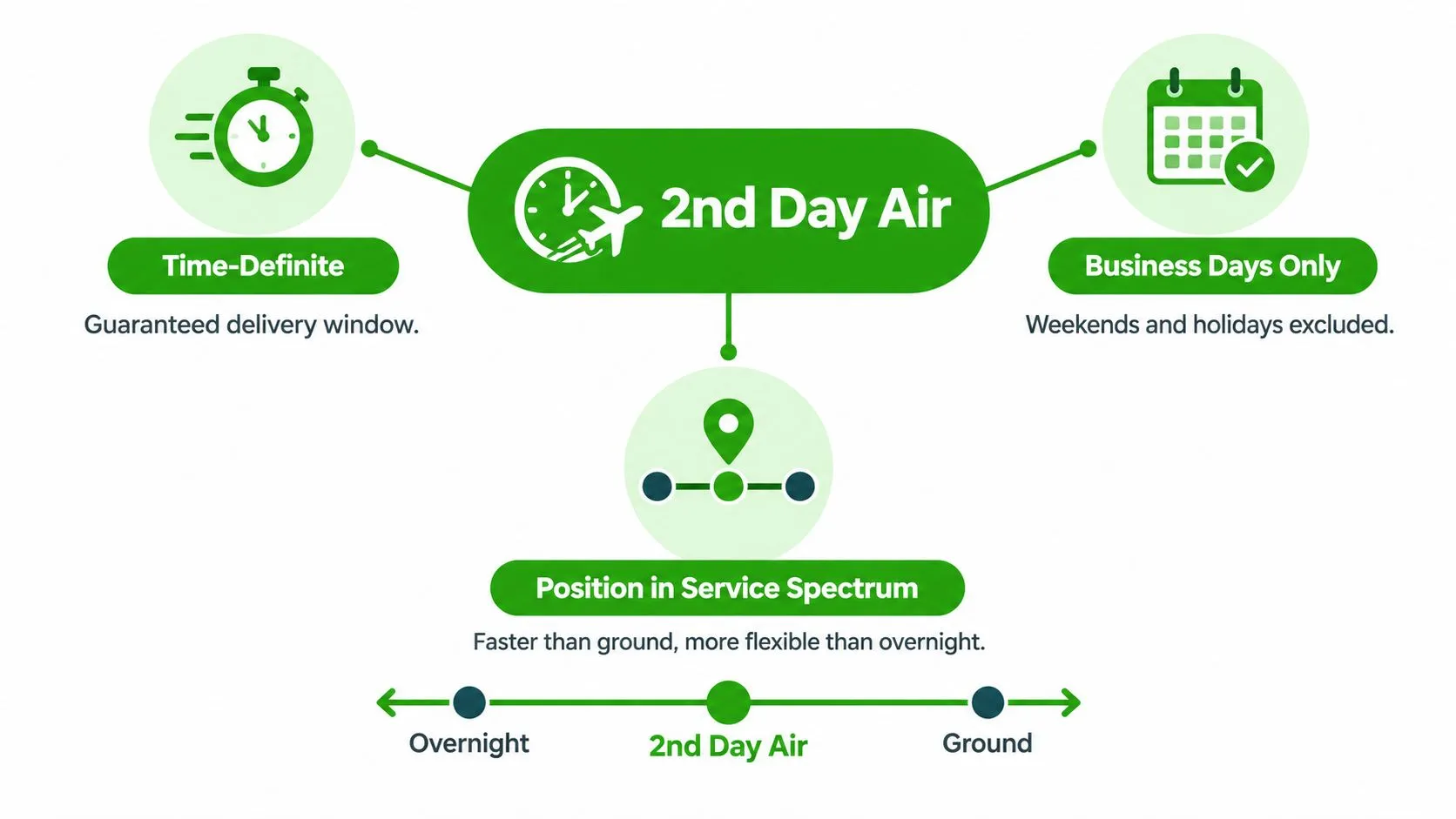
2nd day air is a time-definite air-express service designed to move a parcel within a stated business-day schedule. It sits between overnight service and slower ground transportation. Like a scheduled express train, the service follows a planned timetable, but the trip doesn’t begin just because you bought a ticket. The carrier needs to receive the parcel and put it into the network.
A useful starting point is the acceptance date. That’s when the carrier physically receives the package, not when you pay for postage or print a label. The carrier then counts the applicable business days according to that service’s rules. Weekends, holidays, destination coverage, and local delivery commitments can all affect the date a buyer should expect.
The category has a longer history than its name might suggest. FedEx opened its two-day E-2 service to all customers in 1982 after previously making it available only to a limited number of large customers as “filler freight.” The move helped establish two-day air as a scalable option between premium overnight and slower ground shipping; FedEx later introduced 2Day Freight alongside Overnight Freight in 1989, as recorded in its company history timeline.
The clock, in plain language
For a straightforward shipment, identify the carrier’s acceptance day, then count the service’s eligible business days. If a parcel is accepted on Monday and the service counts the next two business days as transit, the expected delivery day is Wednesday. If it misses Monday’s cutoff and is accepted Tuesday instead, that ordinary expectation shifts to Thursday.
That’s why “two days” can’t be read as “48 hours from checkout.” For guidance on how air movements fit into broader logistics decisions, see this overview of routing options for air cargo.
A service name also shouldn’t be treated as a complete customer promise. Before listing a delivery date, check:
- Acceptance: When will the carrier receive the parcel?
- Calendar: Which days count for the selected service?
- Destination: Does the carrier serve the buyer’s address with that commitment?
- Delivery window: Is the promise by a particular time, or by the end of the stated service day?
- Exceptions: Could a holiday, cutoff, or optional weekend service change the date?
How FedEx, UPS, and USPS Label Their Second-Day Services
Three carriers sell a two-day product under three different names, and each name hides a slightly different clock. A reseller comparing labels has to read the commit time, the weekend rule, and the weight ceiling for the actual destination, because two services that sound identical on a rate sheet can land a day apart in practice.
FedEx calls its version 2Day: delivery within two business days, generally by 5:00 p.m. to businesses and by 8:00 p.m. to residences. The faster sibling, 2Day A.M., generally arrives by 10:30 a.m. to businesses and noon to most residences. FedEx starts counting on the business day after acceptance, its standard schedule runs Monday through Friday, and Saturday handling depends on the destination and may cost extra. Its published limits cap a package at 150 lb, 119 inches in length, or 165 inches in length plus girth (FedEx 2-day shipping details).
UPS sells 2nd Day Air and 2nd Day Air A.M. The standard service generally delivers by the end of the second business day, and the A.M. version pulls that window into the morning. Saturday delivery is available for many destinations with a surcharge, and the published package ceiling is 150 lb.
| Carrier & service | Delivery-by time | Saturday option | Practical max weight |
|---|---|---|---|
| FedEx 2Day | Generally by 5:00 p.m. to businesses and 8:00 p.m. to residences | Available for some destinations, rules and charges apply | 150 lb |
| FedEx 2Day A.M. | Generally by 10:30 a.m. to businesses and noon to most residences | Check the destination and service details | 150 lb |
| UPS 2nd Day Air | Generally by end of second business day; commit for the destination | Saturday delivery available for many destinations, surcharge applies | 150 lb |
| UPS 2nd Day Air A.M. | Morning delivery on the second business day; commit for the destination | Saturday delivery available for many destinations, surcharge applies | 150 lb |
| USPS Priority Mail | Generally 2-3 business days, not guaranteed | Saturday delivery included | 70 lb |
Notice how the names rhyme while the clocks diverge. FedEx writes its promise as a specific hour, UPS writes its standard commitment as the end of the service day, and USPS declines to guarantee a day at all. Two sellers shipping the same carton on the same Monday can quote buyers different evenings depending on which label they print.
USPS Priority Mail plays by different rules entirely. USPS describes it as generally 2-3 business days and non-guaranteed, which makes it an estimated window rather than a commit. It works when the buyer tolerates a softer arrival date, and it can’t back a listing that guarantees one. USPS also applies dimensional pricing to packages over one cubic foot in Zones 1-9, as set out in its Priority Mail information.
What 2nd Day Air Costs for Resale Inventory
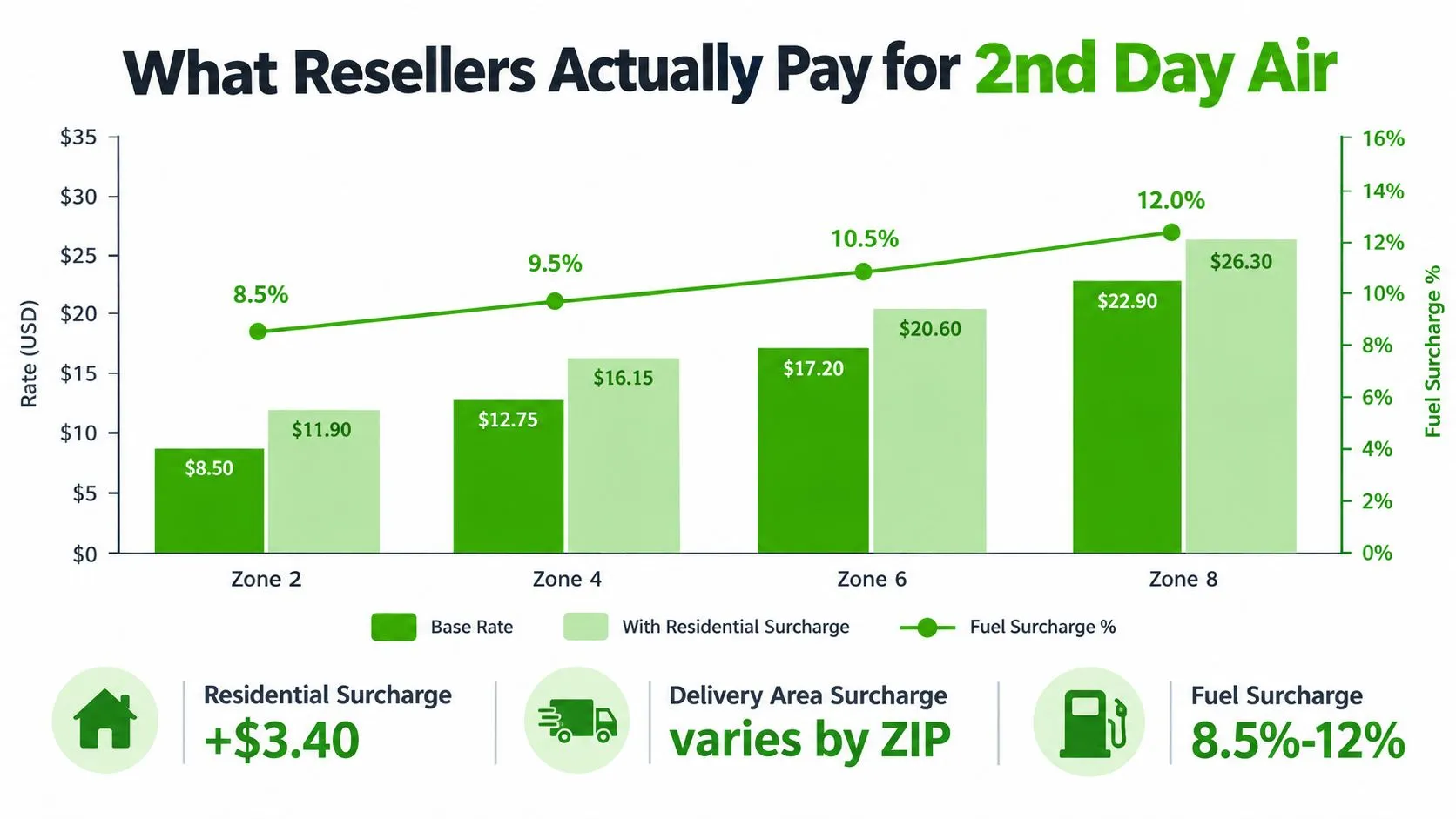
A quoted base rate is the starting point of the shipping cost, not the total. Zone distance, carton size, address type, and carrier surcharges each add a layer on top, so a reseller’s margin math needs the packed parcel and the actual route rather than the item’s catalog weight.
Bulky, light inventory is where the math turns against you. A pair of boots, a winter coat, a handbag, or a boxed collectible may weigh almost nothing while filling a large carton, and carriers price the space that carton occupies on the truck the way a freight elevator fills by volume rather than by how heavy the load is. For USPS parcels over one cubic foot, dimensional weight is calculated as length × width × height ÷ 139, with dimensions rounded up to whole inches; when that figure exceeds actual weight, dimensional weight becomes the billable basis under the USPS Priority Mail dimensional weight rules noted earlier.
The clock adds a second cost layer that rate quotes tend to hide until checkout. A residential address can carry a different fee than a commercial dock, and Saturday arrival, where the carrier offers it for a lane, is usually a priced option rather than part of the base commitment. Speed purchased after the local pickup cutoff can slip a full service day, which means the premium you paid buys the same arrival a slower label would have delivered.
Work the parcel, not just the item
Take a box measuring 24 × 18 × 12 inches. Its volume is 5,184 cubic inches. Divide by 139 and the dimensional weight lands near 37.3 lb, billed as 38 lb after rounding, though the contents weigh 8 lb. That is a 4.75-to-1 billed-to-actual weight ratio. Trim the carton to 20 × 16 × 10 inches and the dimensional figure falls to about 23 lb under the same formula.
Two boxes, same item, very different invoices.
Capture packed dimensions and packed weight before publishing shipping rates on a listing. Pull the carrier’s price for the buyer’s zone and address type, then check the billable weight shown in the label tool before purchasing. An item’s listed weight rarely predicts its final shipping charge.
Packaging is the cheapest lever you control. Fit the box to the item, remove unnecessary void fill, and skip oversized cartons that turn a light object into a heavy billable weight. For broader context on organizing storage and fulfillment operations, this guide to smarter warehousing for businesses offers ideas that pair well with careful parcel planning. If you are weighing carrier costs for your own shipment mix, this UPS-versus-USPS cost comparison gives another point of reference, followed by the live quote for the actual parcel and destination.
Calculating the Delivery Date Step by Step
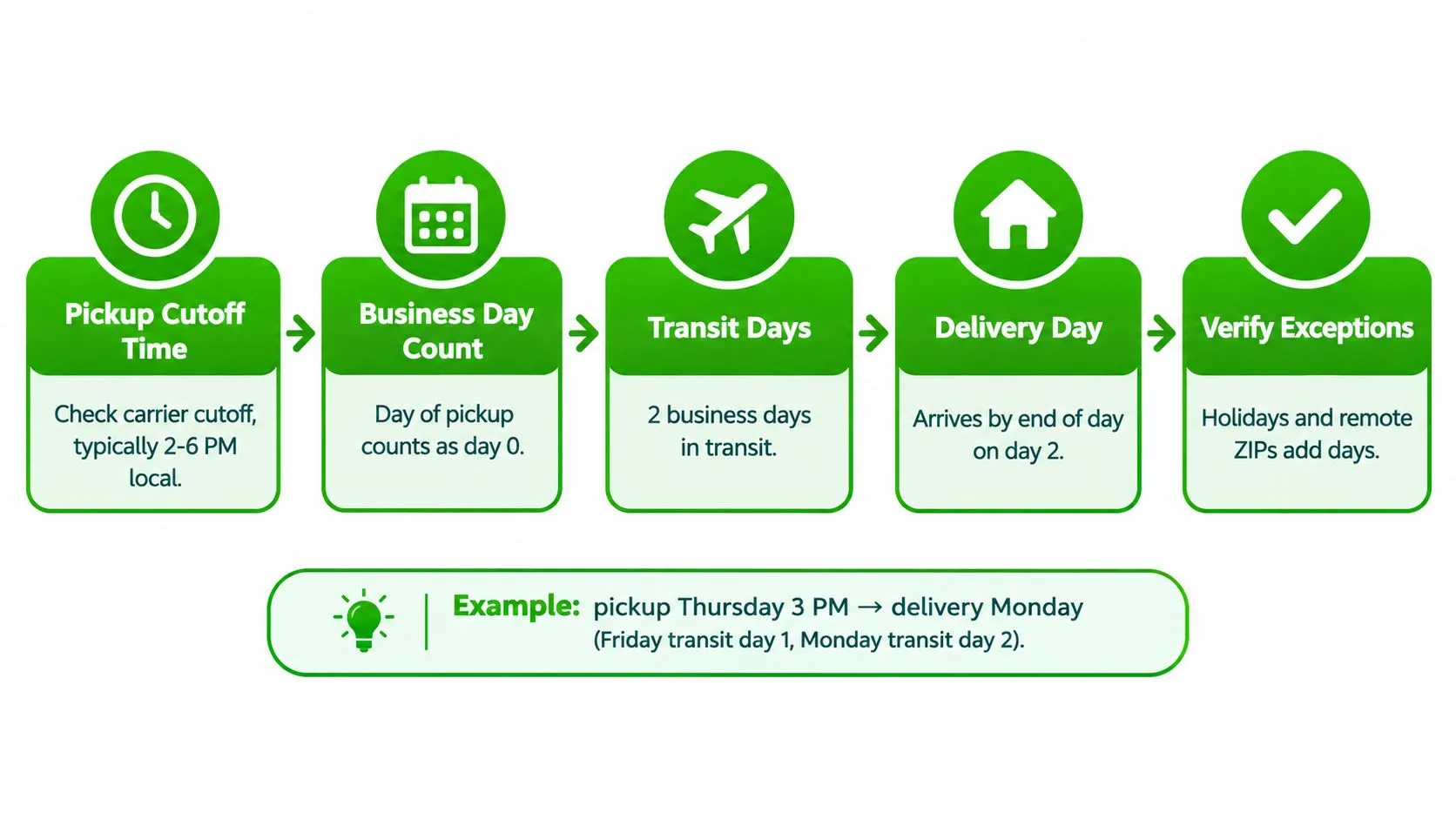
The service name tells you a transit length. Turning that length into a date you can promise takes five checks, run in the same order the carrier’s clock runs them.
- Find the local pickup cutoff. Check the cutoff for the carrier location or scheduled pickup that will handle the parcel. A box packed after the last pickup may not enter transit until the next service day.
- Separate label time from acceptance time. Keep the label-created timestamp, but record the carrier’s acceptance scan as the start of the transit calculation. A label sitting on a packed box doesn’t establish that the carrier has it.
- Count only eligible days. Apply the carrier’s schedule and holiday calendar. Weekends and holidays do not automatically count as transit days.
- Confirm the delivery window. Business and residential commitments can differ. FedEx, for example, publishes different typical delivery times for residences and businesses on its 2Day service page.
- Check Saturday and exceptions. Treat Saturday service as an option to verify, not a default. Confirm the destination and any added charge before promising weekend arrival.
Stress-test the calendar before you quote a date
Tuesday before Thanksgiving: The carrier accepts the parcel Tuesday, but Thursday is a non-service day on the holiday calendar, so the two business days land on Friday and the following Monday. A buyer who hears “two days” on Tuesday pictures Thursday. The calendar says Monday.
That one-week swing is why the count matters more than the service name. Holiday weeks compress the available transit days, and every skipped day pushes the buyer-facing promise a full day further out.
For each order, save four things in your operating procedure: order time, expected acceptance day, committed delivery date, and buyer-facing delivery window. If a marketplace asks for handling time, set it based on when your team can hand the parcel over, not on when someone can print a label. That one distinction keeps order processing and carrier transit from being mistaken for a single clock.
Matching Shipping Speed to Order Value and Buyer Promise
The fastest label isn’t automatically the best choice. Match the service to what the buyer needs, what the item can support in shipping cost, and how much room the order’s margin leaves for delivery.
| Service tier | Better fit | Buyer promise | Main trade-off |
|---|---|---|---|
| Overnight | Urgent, high-value, or time-sensitive orders | Fastest available delivery window, subject to service terms | Highest sensitivity to cost and cutoff |
| 2nd day air | Standard resale orders where faster, more definite transit matters | A defined business-day commitment, based on carrier acceptance | Costs more than slower options and requires careful date calculation |
| Three-day or economy | Orders with some urgency but more flexibility | A slower scheduled or estimated window, depending on service | The buyer waits longer |
| Ground | Bulky, lower-margin, or non-urgent inventory | A route-based delivery estimate | May not match an expedited expectation |
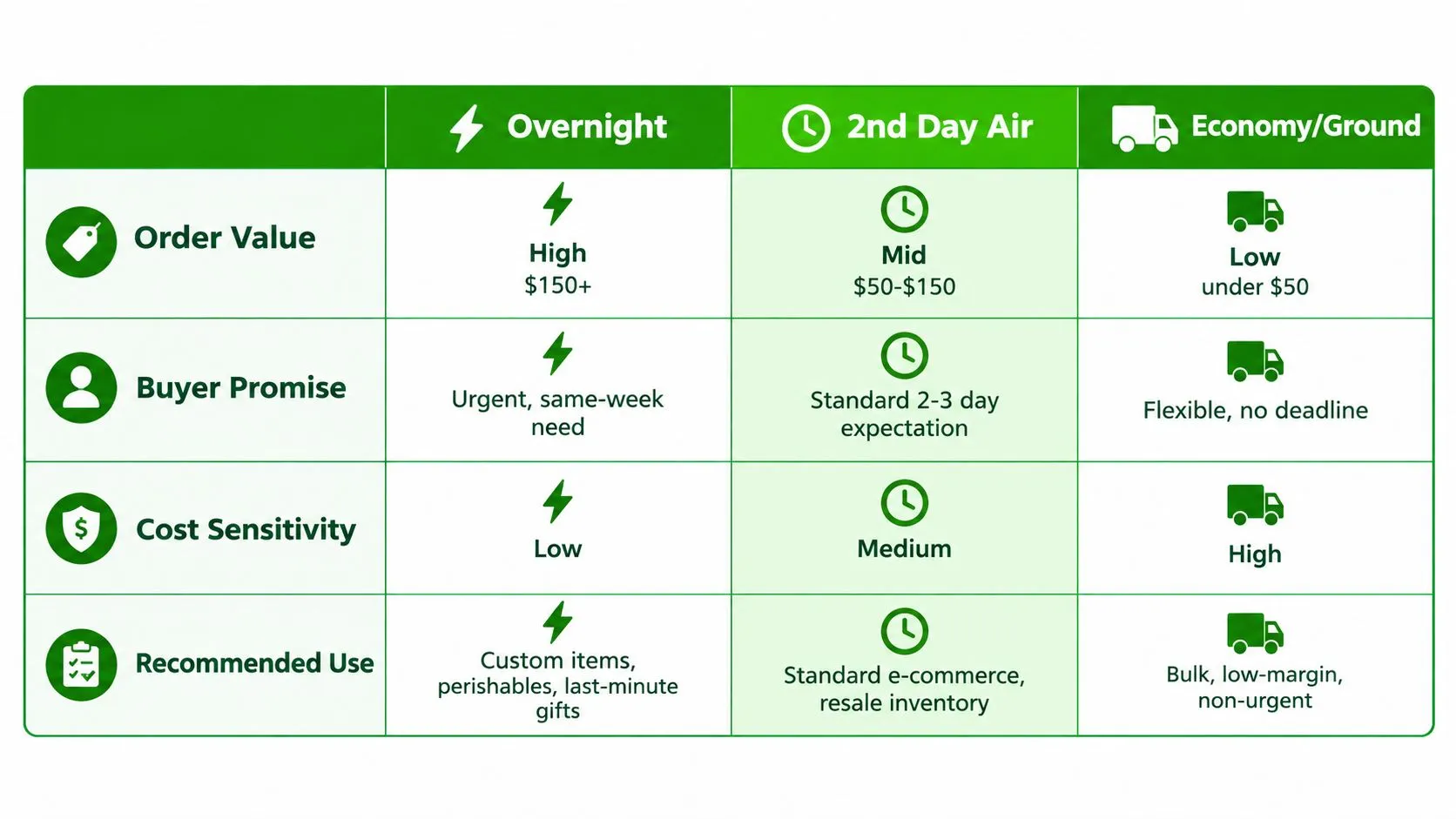
Consider three orders. A high-value vintage item needed for an imminent event may justify overnight service if the buyer has been given a realistic delivery date and the margin can absorb the cost. A standard collectible with no urgent deadline may suit 2nd day air when the buyer values a defined, faster arrival. A bulky, low-margin coat may be better sent by ground or another economical option if the buyer agrees to a longer window.
The promise belongs in the listing as much as in the shipping label. Avoid offering an expedited method that your team can’t consistently hand off before cutoff. A service that arrives quickly after acceptance still disappoints when the order waits in your stockroom over a weekend.
For marketplace-specific decisions, compare the available shipping options on eBay with your own packaging, buyer expectations, and handling schedule. The useful decision rule is simple: pay for speed when the buyer needs it and the order economics support it; otherwise, set a clear, honest delivery window that matches a slower service.
Tracking, Proof of Delivery, and Insurance for Higher-Value Parcels
Tracking helps your team answer the most basic question: has the carrier accepted the parcel, and what does the latest scan say? Capture the tracking number at handoff, not just when the label is created. A label event can show that shipment information exists; an acceptance scan is stronger evidence that the parcel entered the carrier’s network.
A delivery scan records the carrier’s reported delivery event. It doesn’t necessarily establish who personally received the parcel or whether a valuable item was handed to the intended buyer. When the risk of a delivery dispute is material, check whether a signature option is available and decide whether its added cost makes sense for that order.
Insurance and declared value also need a deliberate decision. Review the carrier’s terms and any existing coverage before adding protection, and compare the item’s sale value and potential loss against the cost and conditions of the option. Don’t assume a carrier’s basic liability covers every item, every cause of loss, or the full resale price.
For a collectible, think about the whole chain: protective packing, accurate declared value, acceptance evidence, tracking, and a delivery record that fits the item’s risk.
For delicate paper goods or flat collectibles, packing matters as much as the service tier. This guide for film poster collectors offers relevant ideas for protecting posters in transit. If a scan stalls or a holiday changes the expected date, contact the buyer promptly with the latest verified information rather than repeating the original estimate.
Common Misconceptions and a Quick Pre-Ship Checklist
2nd day air doesn’t mean two calendar days from checkout. It also doesn’t make a parcel move before the carrier accepts it, automatically include Saturday delivery, or guarantee the same delivery window for every address. And although a service may be widely available, its route, package rules, cutoff, and optional features still need checking.
Before buying a label, run through this checklist:
- Service: Does the selected product match the buyer’s urgency and the delivery promise in the listing?
- Package: Have you entered the packed weight and dimensions, not only the item details?
- Handoff: When is the carrier’s cutoff, and when will the parcel be accepted?
- Calendar: Do weekends, holidays, or destination rules affect the expected date?
- Delivery: Is the buyer’s address residential or commercial, and does that change the commitment?
- Protection: Do tracking, signature, and declared value suit the item?
- Promise: Have you communicated a specific, realistic delivery date rather than relying on the service label alone?
Use the same checks across your team, and record acceptance and delivery information with each order. A clear pick-and-pack workflow can help make those checks part of fulfillment instead of an afterthought.
Frequently Asked Questions
Does 2nd day air mean two days from checkout?
No. The clock starts when the carrier accepts the parcel, not when the order is paid for or the label is printed. A parcel accepted on Monday ordinarily arrives on Wednesday, and one that misses Monday’s cutoff and is accepted on Tuesday shifts to Thursday.
Does 2nd day air deliver on Saturday?
Not by default. UPS offers Saturday delivery for many destinations with a surcharge, and FedEx Saturday handling depends on the destination and may cost extra. Confirm the destination and any added charge before promising weekend arrival.
How is the cost of a 2nd day air parcel calculated?
The base rate is only the starting point. Zone distance, carton size, address type and surcharges add to it, and a large, light box is billed by dimensional weight: length times width times height, divided by 139. A 24 by 18 by 12 inch box holding 8 lb of contents is billed as 38 lb.
Is USPS Priority Mail the same as 2nd day air?
No. USPS describes Priority Mail as generally 2-3 business days and non-guaranteed, so it gives an estimated window rather than a commitment. It includes Saturday delivery and accepts packages up to 70 lb, but it can’t back a listing that guarantees a date.
When is 2nd day air worth paying for?
Pay for it when the buyer needs the item soon and the order’s margin can absorb the cost. For bulky, low-margin inventory, a slower service with a clear, honest delivery window is usually the better choice, and no service helps if the parcel misses the pickup cutoff.
Ruit helps professional second-hand sellers manage inventory, listings, orders, and buyer messages across marketplaces from one platform. If you want clearer operations around each order, visit Ruit to see how it can support your resale business.