ERP for E-Commerce: How to Choose the Right Platform


Table of Contents
- Table of Contents
- Why ERP Selection Is Really a Labor Economics Decision
- What ERP for E-Commerce Actually Does
- Marketplace and Webstore Integrations That Matter
- Inventory and Order Synchronization at Speed
- Comparing ERP Tiers for Multichannel Resellers
- API Strategy and Connector Architecture
- Matching ERP Shape to Reseller Profiles
- Picking the Right ERP and Avoiding Overcustomization
- Frequently Asked Questions
- Do I need a full ERP, or is a lightweight inventory platform enough?
- How long does an ERP implementation typically take for an e-commerce seller?
- What’s the difference between a native connector and third-party middleware?
- How much does an ERP for e-commerce cost?
- Can an ERP replace my accounting software?
Most advice about ERP for e-commerce starts in the wrong place. It tells you to compare modules, count integrations, and shortlist the platform with the longest feature sheet. That approach produces expensive software that still leaves staff reconciling stock, rekeying orders, and chasing exceptions across disconnected channels.
The better question is simpler: which system removes the most manual touchpoints from your operation? ERP has become a core operating layer for online sellers, with 46.45% of European Union enterprises using ERP applications in 2025, compared with 43.3% in 2023, according to independent ecommerce ERP market data. But adoption alone doesn’t create efficiency. The platform has to keep inventory, orders, purchasing, fulfillment, and accounting coherent while your team sells in several places at once.
| ERP decision area | Lightweight platform | Mid-market ERP | Enterprise ERP |
|---|---|---|---|
| Primary value | Removes repetitive channel work | Standardizes complex operations | Controls entities, countries, and deep processes |
| Best operating context | Small catalog and limited channels | Multiple warehouses, teams, and entities | Complex procurement, tax, manufacturing, or global operations |
| Main risk | Outgrowing the workflow | Implementation complexity | Paying for unused complexity |
| Selection test | Does it eliminate spreadsheet work? | Does it coordinate departments and partners? | Does it govern the operating model at scale? |
Table of Contents
- Why ERP Selection Is Really a Labor Economics Decision
- What ERP for E-Commerce Actually Does
- Marketplace and Webstore Integrations That Matter
- Inventory and Order Synchronization at Speed
- Comparing ERP Tiers for Multichannel Resellers
- API Strategy and Connector Architecture
- Matching ERP Shape to Reseller Profiles
- Picking the Right ERP and Avoiding Overcustomization
- Frequently Asked Questions
Why ERP Selection Is Really a Labor Economics Decision
ERP selection isn’t a feature-shopping exercise. A platform can have excellent purchasing, accounting, and warehouse modules yet fail commercially if employees still compare Shopify stock with Amazon stock in spreadsheets every afternoon.
Every manual touchpoint has a cost. Someone checks whether a marketplace order reached the warehouse. Someone rekeys a purchase order. Someone adjusts a stock figure after a bundle sells. Someone investigates why the accounting export doesn’t match the sales report. Those tasks consume paid time without increasing the number of orders your team can process.
A useful evaluation starts with an operational inventory, not a vendor demo.
- Count reconciliation work: Record who compares channel inventory, settlements, orders, and returns.
- Count re-entry work: List every field employees copy between marketplaces, spreadsheets, warehouse tools, and accounting software.
- Count exception work: Track oversells, duplicate orders, missing tracking numbers, failed imports, and incorrect SKU mappings.
- Attach a labor value: Estimate the internal cost of each recurring task, then compare it with the platform’s subscription, implementation, training, and maintenance costs.
A team of three spending 90 minutes each day on reconciliation work loses roughly 1,200 productive hours per year. That figure comes from the operating scenario itself, not a market statistic, and it illustrates why license price is only one part of ERP economics. The comparison is between total cost of ownership and productive capacity recovered.
Practical rule: Choose the ERP that removes the most repeated decisions and corrections, not the one that demonstrates the most screens.
The strongest business case appears when the ERP reduces work across channels at the same time. Centralized inventory matters because employees stop deciding which quantity is correct. Automated order orchestration matters because they stop routing orders manually. Connected accounting matters because finance stops rebuilding revenue and cost reports after operations closes the day.
This labor lens also explains why smaller sellers shouldn’t automatically buy smaller software, and why larger sellers shouldn’t automatically buy enterprise software. A compact operation with chaotic channel fragmentation may benefit more from a focused multichannel platform than from a broad ERP that demands heavy administration. The right answer is the one that raises profit per hour worked.
What ERP for E-Commerce Actually Does
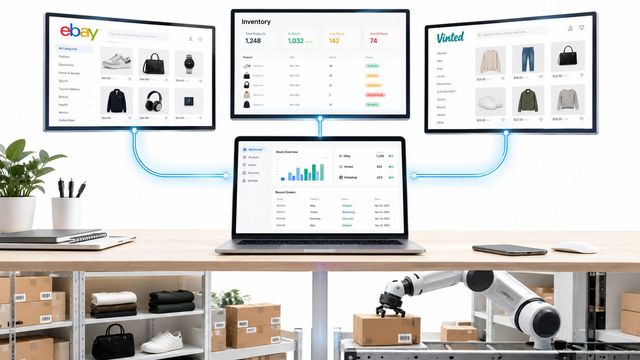
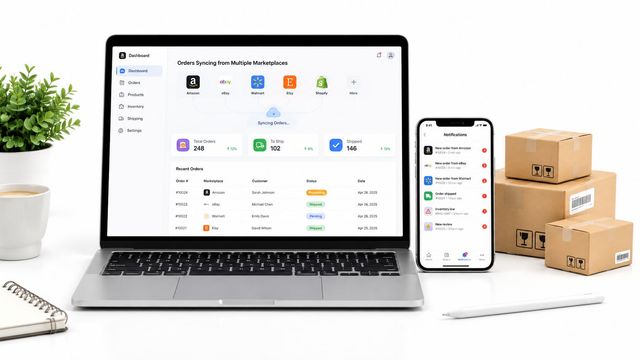
In ecommerce, an ERP is the system that turns separate selling channels into one operating model. It should receive orders, maintain an authoritative inventory position, trigger purchasing, support fulfillment, and send reliable financial data to accounting.
The five functional pillars are straightforward, but their connection determines whether the platform helps or creates another layer of work.
Centralized inventory management
The ERP should hold stock by SKU, warehouse, condition, bundle, and availability status. Quantity on hand isn’t always the same as quantity available to promise. Reserved units, damaged goods, incoming stock, and channel-specific allocations need distinct treatment.
A reseller handling unique or used items also needs practical support for one-off inventory, product variants, merged records, and delisting after a sale. If the system only works for uniform, replenishable products, it isn’t a complete ecommerce operating layer.
Order orchestration
Orders from a webstore, marketplace, social channel, or point-of-sale system should enter one queue. The ERP then applies routing rules based on warehouse, stock position, shipping method, location, or fulfillment partner.
Look for split-shipment support, backorder handling, cancellation states, returns, and fraud or payment exceptions. A dashboard that merely imports orders isn’t orchestration. Orchestration means the system decides what happens next and records the result.
Purchasing and supplier workflows
A credible platform connects reorder points and lead times to purchasing actions. Buyers should see what is available, what is committed, what is arriving, and what needs approval before creating supplier orders.
For second-hand and specialist resellers, purchasing may be opportunity-led rather than forecast-led. The system still needs a clean path from sourcing to intake, valuation, listing, sale, and accounting.
Financial control
Accounting isn’t an export added at the end. The ERP should preserve transaction detail needed for COGS, fees, refunds, taxes, settlements, and channel profitability. It should also distinguish sales from cash received, which prevents marketplace settlement timing from distorting performance reports.
Analytics that explain profit
Top-line revenue isn’t enough. Managers need contribution by channel, SKU, category, warehouse, and order type. The useful dashboard identifies where margin disappears through marketplace fees, shipping, returns, discounting, or labor.
For a practical explanation of the workflow between a store and its operating system, see how to integrate ERP with Shopify. The integration should preserve a shared product identity and a clear ownership model for inventory, orders, prices, and financial records.
These pillars are table stakes. The differentiator is whether they use the same data model. When inventory, orders, purchasing, warehouse activity, and finance share identifiers and statuses, automation becomes dependable. When each module keeps its own interpretation, employees become the integration layer.
Marketplace and Webstore Integrations That Matter
Integration breadth is a weak buying metric. A vendor may advertise dozens of channels while offering shallow support for the channels that generate most of your orders. Four deep connectors are more valuable than ten that import products but fail on returns, throttling, settlement data, or inventory reservations.
Start with the channels that drive your operation. Common marketplace requirements include Amazon SP-API, eBay, Walmart, TikTok Shop, and Etsy. Webstore requirements often include Shopify, BigCommerce, WooCommerce, and Magento. Adjacent channels can include Shopify POS, Faire, and Amazon Handmade.
Native, certified, and improvised connectors
A native connector is maintained by the ERP vendor and is usually the safest choice for important channels. A certified partner integration can work well, but you need clarity on support ownership, release testing, and incident response. Zapier-style middleware is fast for simple events, yet it often becomes fragile when you add high catalog volumes, complex statuses, or bidirectional inventory.
| Channel | Native connector quality | Common failure points |
|---|---|---|
| Amazon SP-API | Needs deep support for orders, listings, fulfillment, and settlements | Rate limits, FBA and MFN inventory separation, SKU and marketplace mapping |
| eBay | Strong when variation, returns, and order states are fully supported | Duplicate listings, variation mismatches, delayed status updates |
| Walmart | Valuable for sellers with the required operational controls | Catalog validation, fulfillment status, inventory allocation |
| TikTok Shop | Useful when order and stock events are handled reliably | Rapid channel changes, product mapping, webhook failures |
| Etsy | Appropriate for specific catalog types and handmade workflows | Listing attributes, personalization, message and order state handling |
| Shopify | Usually straightforward for core store operations | Bundles, refunds, fulfillment ownership, multi-location stock |
| BigCommerce | Good fit for structured catalogs and store workflows | Variant mapping, promotions, inventory reservations |
| WooCommerce | Flexible, but implementation quality varies | Plugin conflicts, scheduled sync, stock race conditions |
| Magento | Powerful for complex stores | Custom data models, upgrade compatibility, connector maintenance |
| Shopify POS | Important for unified retail and online stock | Location allocation, returns, offline events |
| Faire | Relevant for wholesale channel expansion | Wholesale order terms, availability, settlement reconciliation |
| Amazon Handmade | Requires product and category-specific handling | Listing rules, fulfillment differences, catalog duplication |
Amazon deserves special scrutiny because sellers may operate FBA and merchant-fulfilled inventory pools at the same time. A connector that treats both as one quantity can create false availability. Before approving a design, ask how the system models fulfillment ownership, reservations, cancellations, partial shipments, and settlement records. Teams assessing lower-level connectivity can also review the available API Direct Amazon endpoints, then compare those capabilities with the ERP’s supported connector rather than assuming every API field is implemented.
Use WooCommerce stock synchronization guidance when testing a store connection, especially if the storefront relies on extensions that alter order status or inventory behavior. The critical test isn’t whether a product imports. It is whether an order, refund, cancellation, bundle adjustment, and warehouse transfer preserve the same SKU identity throughout the workflow.
Test failure, not the happy path
Ask vendors to demonstrate rate-limit handling, retry queues, duplicate prevention, and error visibility. A good connector tells an operator what failed, why it failed, whether it retried, and what action is required. A bad connector leaves a partial order in an intermediate state.
Inventory and Order Synchronization at Speed
“Real time” isn’t a specification. Ask for latency targets, error rates, uptime commitments, and the conditions under which the platform degrades.
An industry integration playbook recommends sub-1-minute inventory and order-update synchronization, with leading implementations targeting under 5 seconds of latency and error rates below 0.1%. It also identifies 99.9% uptime and sub-24-hour fulfillment for automated workflows as useful operational targets. These benchmarks are documented in real-time inventory management guidance for ERP integration.
| Integration method | Order push latency | Inventory pull latency | Best for |
|---|---|---|---|
| Event-driven webhooks | Near real time when delivery succeeds | Near real time when events are complete | High-velocity stock and order changes |
| Scheduled polling | Depends on the configured interval | Depends on the configured interval | Systems without reliable event support |
| Batch file exchange | Delayed and fixed by the batch cycle | Delayed and fixed by the batch cycle | Legacy partners and controlled wholesale flows |
| Manual import and export | Human-dependent | Human-dependent | Temporary migration or exception recovery |
Webhooks are usually the preferred architecture because the source system pushes an event when an order or stock change occurs. They still need idempotency keys, retries, dead-letter handling, and reconciliation jobs. A webhook that arrives twice must not create two orders. A webhook that never arrives must be discoverable through a comparison process.
Polling has a place, particularly where an API doesn’t expose dependable events. The danger is assuming that a short polling interval guarantees correctness. Rate limits, pagination, failed requests, and processing queues can turn a nominally frequent schedule into stale inventory.
Test available-to-promise logic
A demo should show a unit selling on two channels at nearly the same time. Ask how the ERP calculates available stock after reservations, safety stock, warehouse allocation, inbound inventory, and pending returns. If the answer is “quantity on hand,” the model is too basic for serious multichannel selling.
The operating design also needs visible low-stock alerts and exception queues. For a deeper look at centralized order handling, review cloud-based order management practices. The objective isn’t speed for its own sake. It is preventing stale data from creating oversells, avoidable cancellations, and customer-service work.
Comparing ERP Tiers for Multichannel Resellers
ERP tiers should reflect operating complexity, not company pride. A seller with modest revenue but many fragmented channels may need stronger synchronization than a larger single-channel operator. Revenue, SKU behavior, warehouse design, entity structure, and exception volume are better indicators than headcount alone.
Lightweight platforms
Tools such as Cin7 Core, Brightpearl, and Linnworks fit sellers that need multichannel inventory, order management, purchasing, and practical accounting connections without a long enterprise program. They can deliver strong value when channel connectors are mature and workflows stay close to standard operating patterns.
Their limitation is usually depth. Complex multi-entity accounting, elaborate approval structures, advanced warehouse orchestration, and highly customized procurement may require add-ons or a move upmarket.
Mid-market ERP
NetSuite, Acumatica, and Microsoft Dynamics 365 Business Central are better suited to businesses coordinating multiple teams, warehouses, 3PL relationships, entities, and formal financial controls. They can standardize processes that lightweight tools often leave in separate applications.
The trade-off is implementation discipline. Configuration, data migration, role design, testing, training, and connector governance become major workstreams. A platform in this tier may be the right choice, but only if the business can define and enforce a target operating model.
Enterprise systems
SAP S/4HANA and Oracle Fusion make sense where international tax, complex procurement, manufacturing, multiple entities, or extensive governance justify enterprise architecture. They offer breadth and control, but they punish vague requirements and weak ownership.
| Tier | Typical GMV range | Accounting depth | Native channel connectors | 3-year TCO indicator |
|---|---|---|---|---|
| Lightweight | Smaller multichannel sellers | Practical core accounting and integrations | Often strong for common channels | Lower entry cost, but add-ons and migration risk matter |
| Mid-market | Growing operators with complex workflows | Stronger controls, entities, and reporting | Usually requires careful connector selection | Higher implementation burden with broader process coverage |
| Enterprise | Large, complex, multi-country operations | Deep governance, tax, procurement, and consolidation | Often partner-led or custom | Highest cost and strongest justification requirement |
Don’t accept a vendor’s “scalable” label without a process demonstration. Ask the system to handle a marketplace order, a partial fulfillment, a return, a stock transfer, a supplier receipt, and a settlement reconciliation. Then ask which steps require a user to intervene.
For sellers evaluating the operational layer below ERP, ecommerce inventory management software guidance can help clarify whether the immediate problem is inventory control or a broader enterprise process gap.
The tier decision should also account for implementation risk. A simpler system that removes manual work this quarter may outperform a platform that takes too long to stabilize. Conversely, choosing lightweight software when multi-entity accounting and warehouse governance are already unavoidable can create a second migration sooner than expected.
API Strategy and Connector Architecture
API strategy is a long-term liability decision, not an IT checkbox. The integration architecture determines who maintains the connection when a marketplace changes authentication, pagination, order states, product fields, or rate limits.
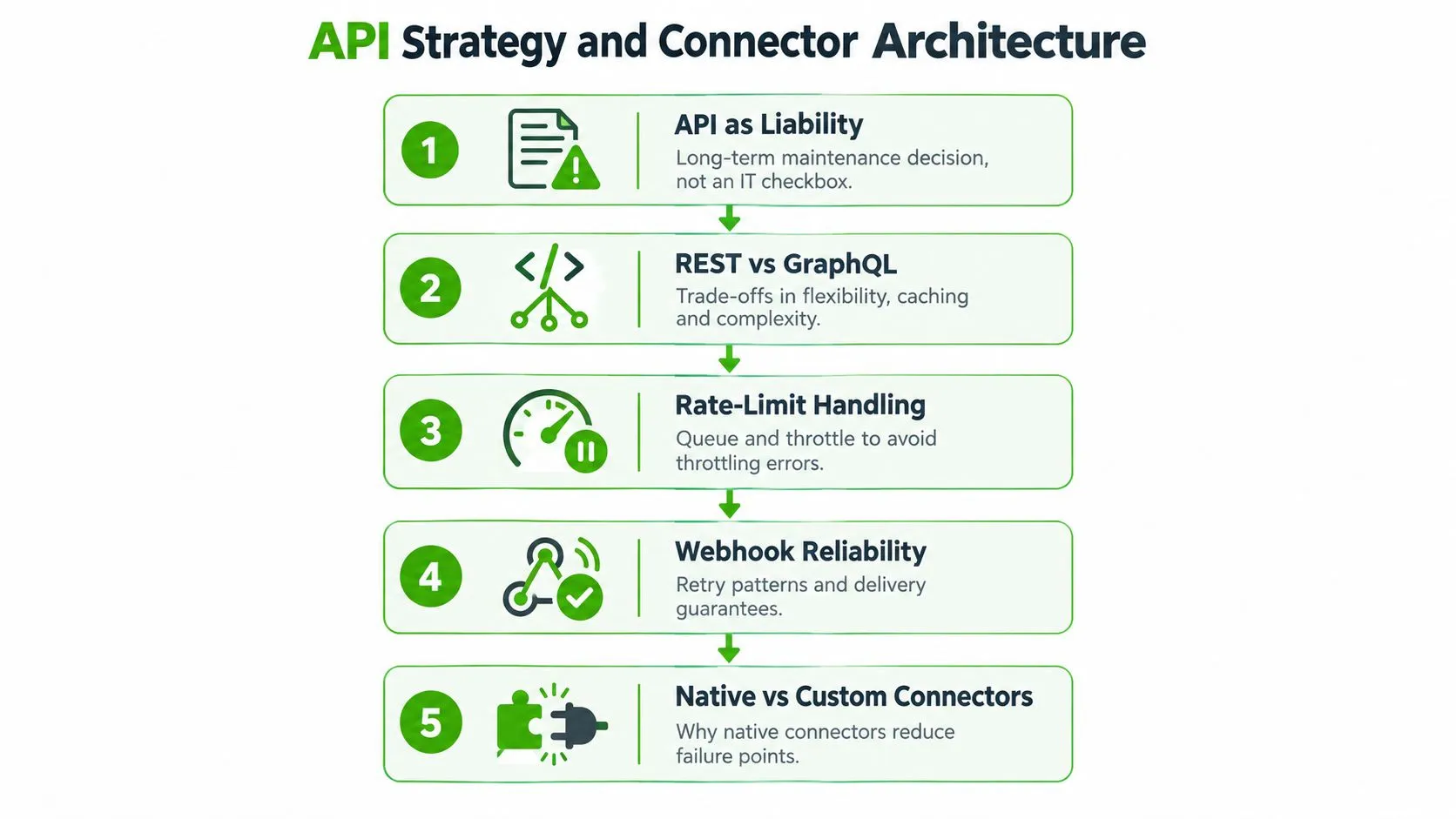
REST APIs are widely understood and often simpler to troubleshoot. GraphQL can reduce over-fetching and provide flexible queries, but it demands stronger schema governance and operational familiarity. Neither choice guarantees a reliable integration. Queue design, retries, observability, and ownership matter more than the label.
The controls that prevent quiet failure
- Rate-limit handling: Queue requests, throttle traffic, and use exponential backoff instead of allowing a marketplace to reject a burst of calls.
- Webhook reliability: Verify signatures, record delivery attempts, retry transient failures, and reconcile missed events.
- Pagination discipline: Test large catalogs and historical orders. A connector that only reads the first page is operationally broken.
- Authentication governance: Prefer supported OAuth 2.0 flows where available, protect API keys, rotate credentials, and document ownership.
- Sandbox testing: Use a safe environment for product, order, refund, and fulfillment scenarios before production activation.
Native connectors generally outperform improvised middleware for important, high-volume flows because the vendor owns both the ERP data model and the integration roadmap. Third-party middleware can still be useful for low-risk notifications, lightweight enrichment, or a channel that the ERP doesn’t support. The mistake is using a chain of small automations for inventory and order authority, then discovering that nobody owns the complete transaction.
Architecture test: If a marketplace API changes tomorrow, identify the person or vendor responsible for detection, remediation, testing, and customer communication.
Build a custom connector only when the workflow creates a genuine competitive or regulatory requirement, the data contract is stable enough to maintain, and your team accepts ongoing support responsibility. Otherwise, pay for a supported connector with documented release management. A lower initial development cost can become a permanent maintenance obligation when the channel evolves.
Matching ERP Shape to Reseller Profiles
The same ERP can be sensible for one reseller and wasteful for another. Match the system to the number of operational decisions your team makes, not to the ambition of your business plan.
The solo operator
A solo seller with under 500 SKUs, one Shopify store, and Amazon has a different problem from a distributor with several warehouses. If the operation processes fewer than 200 orders a week, a lightweight SaaS platform such as Cin7 Core or Linnworks may provide enough inventory, order, and channel control without forcing enterprise administration.
Use a standard cloud deployment, keep the data model simple, and avoid custom development. The implementation should focus on SKU normalization, channel mapping, stock rules, and accounting export. The first-year budget should be based on actual vendor and implementation quotes, not generic market assumptions, because catalog complexity and connector scope can change the economics.
The growing multichannel team
A team of 5 to 25 people with 5,000 or more SKUs, three or more channels, and a warehouse needs more than a better order inbox. It needs role-based workflows, purchasing control, warehouse visibility, financial discipline, and a reliable exception process.
NetSuite, Brightpearl, or Acumatica can fit this profile when the implementation partner understands marketplace operations. Plan a phased deployment around master data, inventory, orders, purchasing, finance, and reporting. Don’t activate every module at once. Stabilize the transaction spine before adding advanced automation.
The scaled reseller
A reseller with multiple warehouses, B2B portals, and regional entities needs stronger governance. SAP S/4HANA or Oracle NetSuite, supported by a dedicated implementation partner, may be appropriate when manual reconciliation blocks expansion and local financial requirements add real complexity.
The deployment should include formal ownership for master data, integration monitoring, release management, and user adoption. The timeline and first-year cost must come from a scoped program with real data and tested interfaces. A generic cost band would mislead buyers because the work depends heavily on entities, warehouses, tax rules, custom workflows, and channel architecture.
A useful self-location exercise is to list every recurring exception and assign it to a profile. If most work involves listing, delisting, stock sync, and order handling, choose a focused operational platform. If finance, procurement, warehousing, and entity control dominate, move toward a deeper ERP.
Picking the Right ERP and Avoiding Overcustomization
The buying scorecard should reward labor reduction. I recommend weighting five areas:
- Integration depth: Can the platform complete the full order, inventory, return, and settlement lifecycle for your priority channels?
- Synchronization behavior: Does it meet a defined latency and error target under realistic load?
- Accounting fidelity: Can finance trust COGS, fees, refunds, tax treatment, settlements, and channel profitability?
- API openness: Can your team monitor, extend, and repair integrations without depending on undocumented workarounds?
- Cost per order processed: What does the complete system cost after implementation, support, training, connectors, and internal administration?
The third category is the one buyers routinely underestimate. A 2025 industry guide identifies incorrect order syncing, duplicate data entry, slow transfers, inventory mismatches, and weak employee adoption as common ecommerce ERP problems in its implementation analysis. These failures point to workflow design, not only software selection.
Three warning signs
- The consultant rebuilds standard workflows: Renaming fields or recreating familiar processes may reflect preference rather than a business requirement.
- Dashboards have no operator: A dashboard nobody opens doesn’t reduce labor. Measure whether someone uses it to make a decision.
- Connector chains break during updates: Every extra handoff adds another failure point and another vendor relationship to manage.
Demand a 60-day pilot using real products, orders, returns, warehouse locations, and financial records before signing a broad rollout. Measure hours reclaimed per week, exception volume, duplicate entry, and reconciliation effort. Modules activated are not success metrics.
The best ERP for e-commerce disappears into the workflow. Employees shouldn’t spend their day thinking about the ERP. They should use it to make decisions about stock, customers, suppliers, and margin with fewer corrections.
Frequently Asked Questions
Do I need a full ERP, or is a lightweight inventory platform enough?
It depends on how many manual touchpoints your team removes, not on revenue alone. A solo seller with a handful of channels and a simple catalog usually gets more value from a focused multichannel platform such as Cin7 Core or Linnworks than from a mid-market ERP that demands ongoing administration. Move up a tier only when purchasing, warehouse governance, or multi-entity accounting are already unavoidable.
How long does an ERP implementation typically take for an e-commerce seller?
Timeline scales with operating complexity, not company size alone. A lightweight platform connecting a handful of established channels can go live in weeks once SKU normalization and channel mapping are done. A mid-market or enterprise deployment spanning multiple warehouses, entities, and formal financial controls should be scoped as a program with master data, inventory, purchasing, and finance rolled out in phases rather than activated all at once.
What’s the difference between a native connector and third-party middleware?
A native connector is built and maintained by the ERP vendor, so it usually gets first access to a marketplace’s API changes and carries clearer support ownership. Middleware, such as Zapier-style automation, can handle simple, low-risk events quickly but tends to become fragile once catalog volume, order states, or bidirectional inventory complexity increase. For high-volume, business-critical flows like orders and stock, a native or well-supported certified connector is the safer default.
How much does an ERP for e-commerce cost?
Total cost of ownership includes license or subscription fees, implementation, connector maintenance, training, and the internal administration time needed to keep the system running, not just the price on a vendor’s plan page. A generic cost band misleads buyers because catalog complexity, channel count, and entity structure change the economics; a scoped quote against real order volume and SKU count is the only reliable number.
Can an ERP replace my accounting software?
A capable ERP for e-commerce should preserve the transaction detail, including COGS, marketplace fees, refunds, taxes, and settlements, that accounting needs, and many mid-market and enterprise systems include native financial modules that replace a standalone accounting tool. What matters more than which system holds the ledger is whether sales and cash received stay distinguishable, so marketplace settlement timing doesn’t distort profitability reports.
For professional second-hand sellers that need multichannel listings and stock synchronization in one operating environment, Ruit offers a platform with marketplace publishing, Shopify and WooCommerce support, and automated stock synchronization. Visit Ruit to compare its workflow with your current manual touchpoints.