Master Inventory Management and Accounting for Resellers


Table of Contents
- Table of Contents
- The Hidden Cost of Disconnected Operations
- Understanding Inventory Management and Accounting Fundamentals
- Integrating Stock Valuation with Automated Cost Tracking
- Streamlining Sales Posting and Reconciliation Processes
- Leveraging Integrated Platforms for Accurate Reporting
- Driving Growth Through Margin Per Hour Analytics
- Building a Resilient Secondhand Business Ecosystem
- Frequently Asked Questions
8 turns is the basic example for inventory turnover when $4 million in average inventory is paired with $32 million in annual cost of sales, and the point is simple, inventory and accounting need to live in the same system if you want profit to show up before tax season. In a multichannel resale business, spreadsheet inventory plus separate bookkeeping turns margin into guesswork, while an integrated operating system posts sales automatically and syncs stock in real time.
When your stock lives in Excel and your accounting lives elsewhere, every sale creates a second job. You update the listing, chase the payout, log the fee, guess the shipping cost, and hope the count still matches after a return or a transfer.
Table of Contents
- The Hidden Cost of Disconnected Operations
- Understanding Inventory Management and Accounting Fundamentals
- Integrating Stock Valuation with Automated Cost Tracking
- Streamlining Sales Posting and Reconciliation Processes
- Leveraging Integrated Platforms for Accurate Reporting
- Driving Growth Through Margin Per Hour Analytics
- Building a Resilient Secondhand Business Ecosystem
The Hidden Cost of Disconnected Operations
A reseller can look busy all day and still lose money without noticing. One item sells on Wallapop, another on Vinted, a third on eBay, and the books sit in a different file on another screen. By Sunday night, the seller is not really reconciling a business, they’re untangling fragments of the same transaction.

Where the margin disappears
The damage usually doesn’t come from one dramatic mistake. It comes from small gaps that no one notices in the moment, like a shipping label logged late, a return that never got reversed, or stock that was sold on one channel but still marked available on another. That’s how a business can feel healthy on the surface while the actual margin per hour slips away.
Inventory management and accounting fall apart in different ways, but the owner feels both at once. The stock count is off, the sales ledger is incomplete, and the bank deposit doesn’t explain why the week was so exhausting for so little return.
Practical rule: if a sale changes stock, revenue, fees, and payout timing, all four changes need a single trail. If they don’t, the gap becomes hidden loss.
The pressure gets worse when items are one-off secondhand finds. A jacket bought cheaply, restored, photographed, and listed across several channels doesn’t behave like a standard retail unit. The item has its own cost, its own lifespan in inventory, and its own path to cash.
That’s why disconnected operations create “shadow losses.” Nobody books them as a line item, but they still erode the business through missed fees, stale inventory, and time spent fixing records instead of selling. In a resale workflow, that wasted time is part of the cost structure whether it appears in accounting or not.
Understanding Inventory Management and Accounting Fundamentals
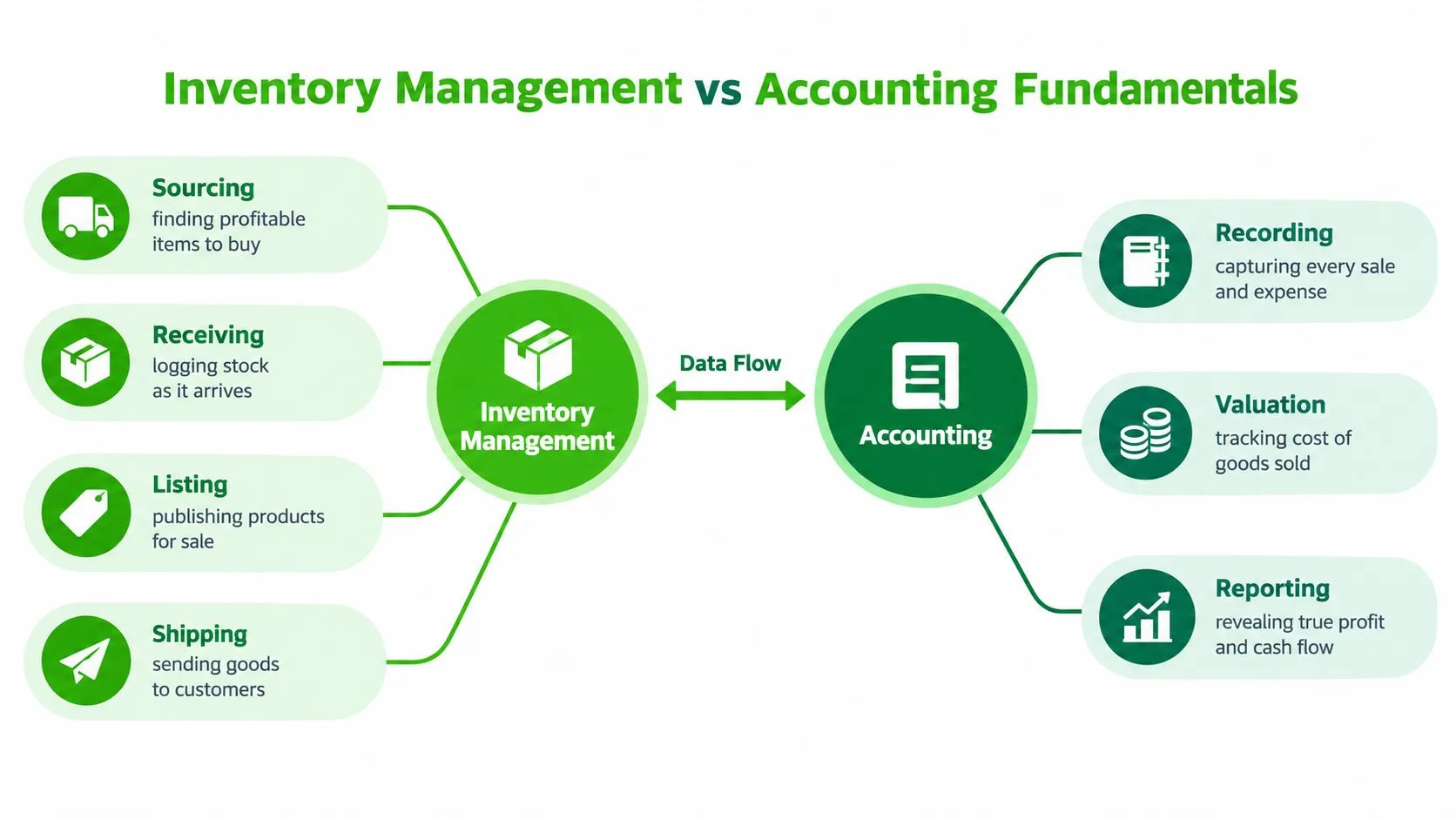
Inventory management and accounting solve different problems. One tracks where the item is, whether it’s listed, and whether it shipped. The other tracks what it cost, what it sold for, and what profit remains after expenses.
The physical side and the financial side
Think of inventory as a moving asset. It sits on your balance sheet until it sells, then it leaves inventory and becomes cost of goods sold. That shift matters because the same item is treated one way before the sale and a completely different way after it.
A clear definition helps here. Inventory turnover is calculated as annual sales in dollars divided by average on-hand inventory, and one example shows that $4 million in average inventory with $32 million in annual cost of sales equals 8 turns, according to a widely cited reference on inventory accounting inventory accounting overview. That sounds abstract until you apply it to resale: the faster an item moves from shelf to sale, the less capital sits idle.
Why resellers need tighter synchronization
Traditional inventory control and accounting can drift apart because they answer different questions. One asks, “Do we still have the item?” The other asks, “Did we record the sale correctly?” If those answers don’t match, financial reports become unreliable.
For a professional reseller, the useful mental model is simple. Inventory management is the operational ledger, accounting is the financial ledger, and every transaction has to land in both places with the same identity. When the records don’t match, you don’t just have a bookkeeping issue, you have a valuation problem.
If you’re choosing software for a small selling operation, a practical inventory app for small business can help, but the bigger decision is whether the tool keeps stock and accounting connected from the start. A disconnected app may track units well and still leave you doing manual financial cleanup later.
The same principle appears in basic reporting logic. Inventory is an asset until the sale is complete, then the cost moves into COGS and affects profit. That transition is the reason inventory and accounting can’t be treated as separate chores.
Integrating Stock Valuation with Automated Cost Tracking
Secondhand inventory makes costing harder because each item can have a different purchase price, a different cleaning or repair cost, and a different resale value. The fix is to capture cost at the item level from the moment you source it, not at month-end when memory is already fuzzy.
Build the cost record at intake
Start with a unique item ID or SKU for every piece you buy. Tie the purchase price, inbound shipping, restoration spend, and any other direct acquisition cost to that ID immediately. Once those amounts sit inside the inventory record, the sale can pull the correct cost automatically instead of forcing you to estimate it later.
That approach matters because low-friction valuation methods only work if the source data is clean. For broader context on valuation approaches, a helpful reference is inventory valuation methods 2026, but the practical priority in resale is usually item-level accuracy, not abstract method debates.
A good cost record is boring on purpose. If an item’s cost needs detective work after the sale, the system failed earlier.
Keep valuation tied to the real item, not an average
In textbook retail, average costing can seem tidy. In resale, it can blur the truth because two near-identical items might have very different acquisition costs, repair needs, and margins. That’s why item-level tracking is the safer path for professional resellers dealing with unique stock.
Use the same item ID across sourcing, listing, sale, and accounting export. That way, when the item moves from stock to sold, the system already knows the correct cost to release into COGS. The result is cleaner gross margin reporting and far less end-of-month adjustment work.
If your team imports stock from another system, the process has to preserve those identifiers. A useful internal reference on that workflow is https://ruit.es/en/blog/import-inventory/, because import logic only helps when it keeps the item history intact. Without that continuity, valuation becomes a patchwork of manual guesses.
The main benefit isn’t just fewer errors. It’s speed. Once cost capture happens at intake, each sale can be evaluated instantly against the exact item cost, and you can see which categories are worth sourcing again.
Streamlining Sales Posting and Reconciliation Processes
Manual posting feels manageable until volume rises. Then the process becomes a stack of CSV downloads, copy-paste errors, fee mismatches, and bank reconciliation that takes longer than the selling itself.
Manual posting versus automated posting
In the manual flow, you export sales from every marketplace, clean the columns, match fees to payouts, and type journal entries into accounting software. That works when the business is tiny, but it breaks quickly when every channel formats data differently. One missed line can distort revenue, fees, or both.
An automated workflow posts sales directly from connected platforms into the ledger. Orders, refunds, fees, and payouts flow into structured entries without someone rebuilding the transaction by hand. If you want a plain-language overview of how software can support that kind of workflow, the guide on inventory accounting in practice is a useful companion.
Reconciliation needs more than bank matching
Bank reconciliation alone doesn’t prove the books are right. A payout can be correct and still hide a missing refund, an unpaid fee, or a delayed transfer from one marketplace to another. The true check is whether the sale, the fee, the stock movement, and the cash receipt all agree.
Use a repeatable checklist:
- Match the sale ID: Confirm each marketplace order appears in the ledger with the right date and amount.
- Check platform fees separately: Don’t bury fees inside net payout numbers if you need margin visibility.
- Tie payouts to deposits: The bank line should match the payout batch, not the gross sales figure.
- Flag refunds and returns fast: A returned item needs both stock and revenue reversal.
- Review exceptions before month-end: Small differences become expensive when they accumulate.
One good rule is to reconcile by exception, not by habit. The goal isn’t to stare at every line forever, it’s to make the mismatches obvious so a human only touches the records that need judgment.
For teams looking at software architecture, a practical overview of ERP for e-commerce helps explain why posting, inventory, and finance need the same source of truth. When those systems are split, every reconciliation becomes a repair job.
Leveraging Integrated Platforms for Accurate Reporting
Reporting gets more honest when the same system sees sourcing, listing, sale, and accounting. Separate tools can each be “right” inside their own silo and still create a misleading overall picture.
Why integration changes the audit trail
Deloitte notes that once inventory becomes highly automated, physical counts and manual reconciliations aren’t enough, because integration errors, misconfigurations, unrecorded transfers, and mixed-lot or high-movement SKUs can create blind spots in standard controls Deloitte on inventory control considerations. For resellers, that point lands hard because the business often moves across marketplaces, storefronts, and returns channels faster than a spreadsheet can keep up.
An integrated platform gives every transaction a trail. When a sale happens, the stock updates, the order is recorded, and the accounting data is ready for export without someone rekeying it. That reduces human error and makes it easier to prove that the stock on paper matches the stock that physically exists.
Integrated data doesn’t remove the need for judgment. It removes the noise that hides where judgment is actually needed.
What accurate reporting looks like in practice
A clean report answers basic questions without a manual rescue mission. What sold, what returned, what was paid for, what remains unsold, and what still needs review. If the answer to any of those depends on three separate tools and a late-night spreadsheet, the reporting system is doing too much guessing.
This is also where professional reseller platforms stand out from basic crosslisting tools. Ruit, for example, combines inventory import, multichannel publishing, order management, accounting exports, and analytics in one operating system, which matters because the reporting engine only works when the operational data is complete. Other platforms may solve a piece of the problem, but the control layer is what keeps the records usable.
The deeper value is consistency. When the same source feeds the sale, the stock count, and the accounting entry, you don’t need to rebuild truth at month-end. You just review exceptions and move on.
Driving Growth Through Margin Per Hour Analytics
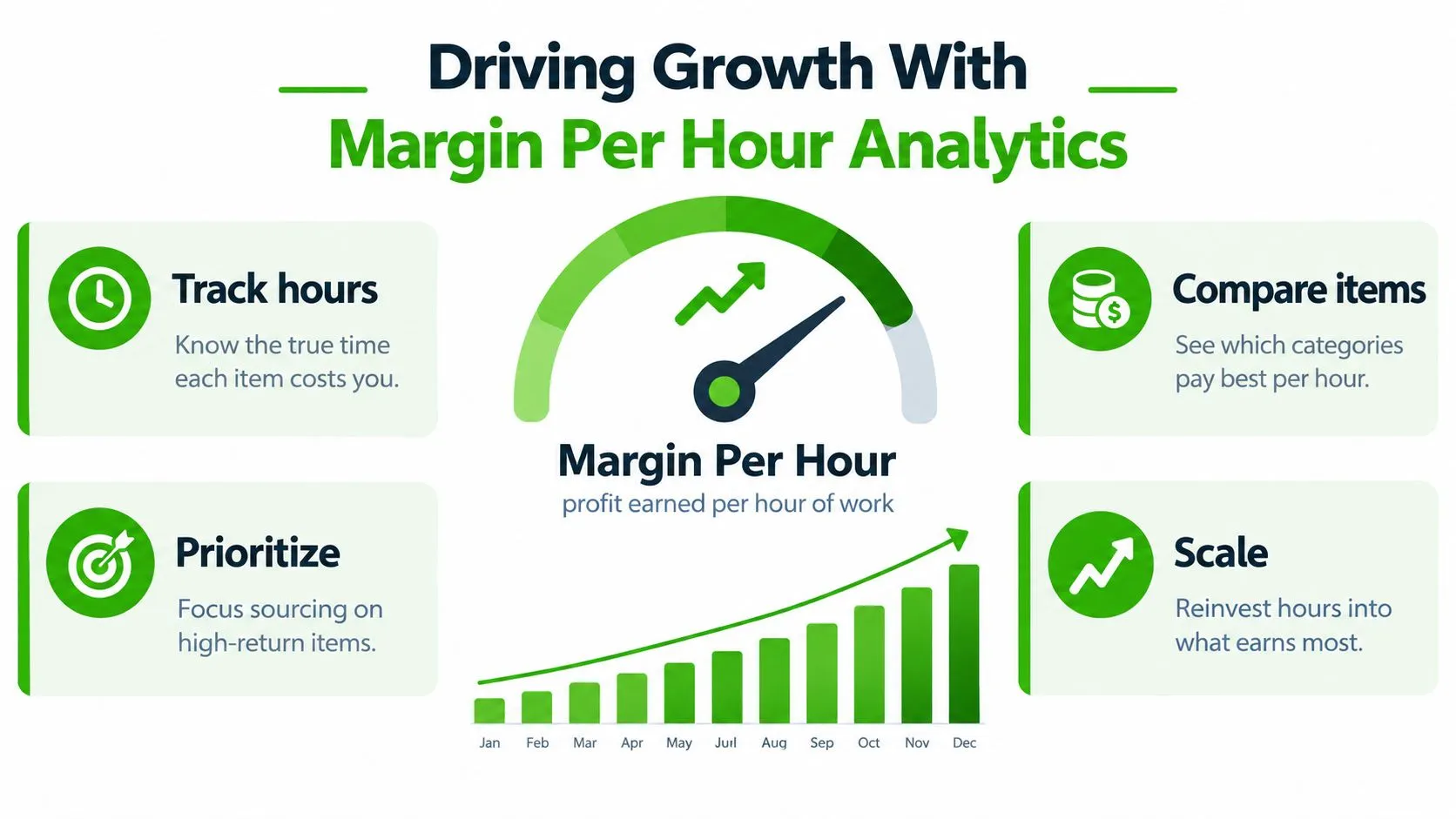
Revenue alone can fool a reseller. A busy week with strong sales can still be a poor week if sourcing took too long, listings were time-consuming, or returns ate the profit. That’s why the most useful metric is often margin per hour worked.
The dashboard that matters
A consolidated dashboard lets you compare items by real return, not just by sale price. One category might sell faster but need too much prep. Another might take longer to sell but generate better profit for the time invested. Without connected inventory and accounting data, those differences stay hidden.
Margin per hour works because it forces a full-cycle view. You’re not just asking what sold, you’re asking what it took to source, list, store, ship, and settle the item. That changes how you decide what to buy next.
If an item makes money but burns too many hours, it may be a poor use of capital and labor.
How resellers use the metric
The useful habit is to sort decisions by return on time. If a product category consistently creates strong profit with low admin overhead, it deserves more sourcing attention. If another category eats time through returns, relisting, or slow reconciliation, it may need tighter buying rules.
Integrated reporting becomes strategic rather than administrative here. Once the system connects sales, costs, and stock movement, you can stop treating every item as equal and start focusing on the inventory that supports the business model. The result is not just better accounting, it’s better time allocation.
Building a Resilient Secondhand Business Ecosystem
A secondhand business doesn’t become professional because it has more listings. It becomes professional when every part of the operation, sourcing, inventory, publishing, accounting, and reporting, speaks the same language. That’s the difference between a seller who works hard and a business that scales cleanly.
The strongest operating model is integrated by design. It reduces manual entry, protects margin, and gives you a reliable view of what’s real across channels. In practice, that means using one system as the backbone, not stitching together half a dozen tools and hoping the numbers agree.
Ruit fits that model as one option for professional resellers because it centralizes multichannel operations, inventory control, and accounting exports in a single workflow. That kind of setup matters most when your business no longer fits inside spreadsheets and memory.
Frequently Asked Questions
Why should inventory and accounting live in the same system?
Because every sale changes stock, revenue, fees and payout timing at once. When stock sits in a spreadsheet and the books sit elsewhere, each sale becomes a second job, and the gaps between the two records turn into hidden losses and unreliable reports.
Should a secondhand reseller use average costing?
Item-level tracking is the safer path. Two near-identical secondhand items can have very different acquisition costs, repair needs and margins, so capture the purchase price, inbound shipping and restoration spend against a unique item ID at intake.
Is bank reconciliation enough to prove the books are right?
No. A payout can be correct and still hide a missing refund, an unpaid fee or a delayed transfer. Check that the sale, the fee, the stock movement and the cash receipt all agree, and reconcile by exception so only the mismatches need a human.
If your resale operation still depends on separate spreadsheets, marketplace exports, and end-of-month cleanup, it’s time to tighten the system. Visit Ruit to see how a connected operating system can bring sourcing, inventory, publishing, and accounting into one workflow.