How to Get Free Stuff on eBay Without Scams

Table of Contents
The popular advice about getting free stuff on eBay starts in the wrong place: search for free items, find a bargain, and somehow avoid paying. An ordinary listing isn’t a giveaway just because someone puts “free” in the title. Start by identifying what’s free, then decide whether the opportunity deserves your time.
If you’re learning how to get free stuff on eBay, separate shopping from sourcing. A shopper might pursue an official prize promotion. A professional reseller needs something stricter: merchandise that still makes sense after collection, preparation, selling costs, and labor.
Table of Contents
- What Free Stuff on eBay Really Means
- Finding Official eBay Giveaways and Promotions
- Reading Free Shipping and Low Bid Auctions
- Turning Near Free Finds into Profitable Stock
- Staying Safe While Hunting Free eBay Deals
- Your Next Move After a Free Find
- Frequently Asked Questions
What Free Stuff on eBay Really Means
Free merchandise, free delivery, and free listing are different offers. Confuse them and you’ll waste time chasing a benefit that was never intended for you.
Historical examples of legitimate free-item opportunities on eBay center on promotional prizes, not a general right to claim ordinary inventory without paying. Treat a giveaway as a specific campaign with conditions, rather than a hidden shopping feature that grants access to everything.
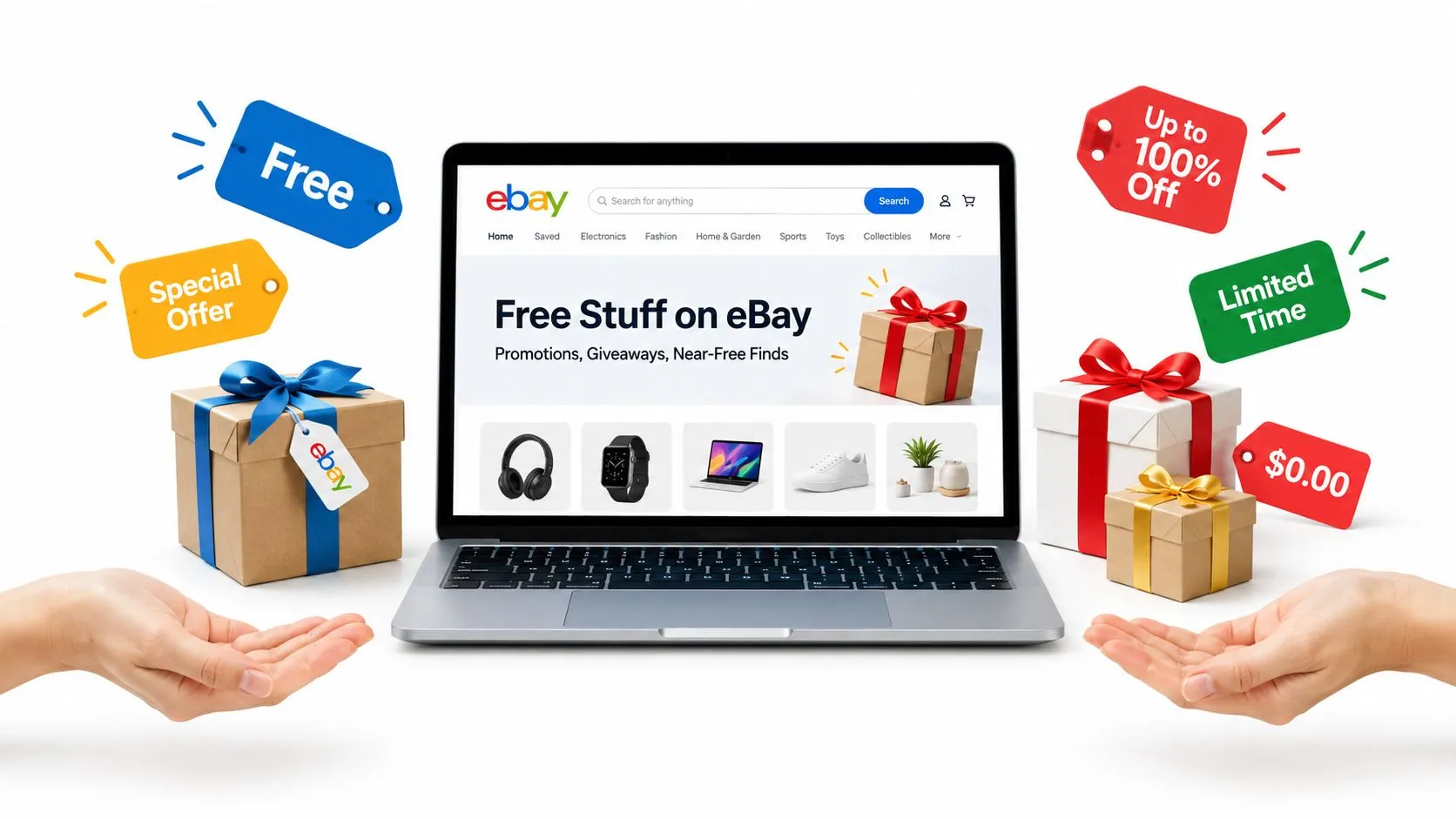
Identify who receives the benefit
The useful question isn’t whether the word free appears. It’s what obligation disappears, and for whom.
- A promotional prize: An eligible entrant has a chance to receive something under the campaign’s rules. Entry doesn’t mean ownership.
- Free shipping: The buyer doesn’t pay a separately stated delivery charge under the offer’s terms. The merchandise still has a purchase price.
- Free to list: The seller may avoid an insertion charge. That says nothing about whether a buyer receives the product free.
Suppose you search for free headphones. A result advertises free shipping, but the headphones have a price. Another result describes a sweepstakes, but you haven’t won anything by finding the page.
Neither result necessarily misrepresents the offer. The mistake is treating a delivery benefit or an invitation to enter as a promise of free merchandise.
Practical rule: Translate every “free” claim into a complete sentence: what do I receive, what must I do, and what could I still owe?
Don’t build your search around a magic price
I wouldn’t use a supposed zero-price listing as the foundation of a sourcing strategy. An unusual price display could reflect an incomplete offer, unclear terms, or something you haven’t understood yet. It isn’t evidence that the seller intends to give away the photographed item.
Likewise, a message promising that you can obtain any listed product free should prompt skepticism, not excitement. Don’t supply a missing explanation yourself just because the potential bargain looks attractive.
For personal shopping, pursue a clearly described benefit you want. For resale, remember that winning a product and sourcing dependable stock are different activities. You can’t plan inventory around a prize you might never receive.
Most free finds still cost attention. Before you spend that attention, establish whether you’re considering a prize, a paid purchase with a perk, or a seller-facing fee allowance. That distinction eliminates a lot of bad advice before it turns into wasted effort.
Finding Official eBay Giveaways and Promotions
Start with the campaign’s official page, not a repost announcing free products. You need the actual terms behind the announcement: what’s available, who qualifies, when entry closes, and what action counts.
A promotion should be understandable without relying on a stranger’s explanation. If you can’t find the governing rules, don’t treat a social post or forwarded message as sufficient evidence.
Follow the campaign requirements precisely
Use this sequence when assessing an offer:
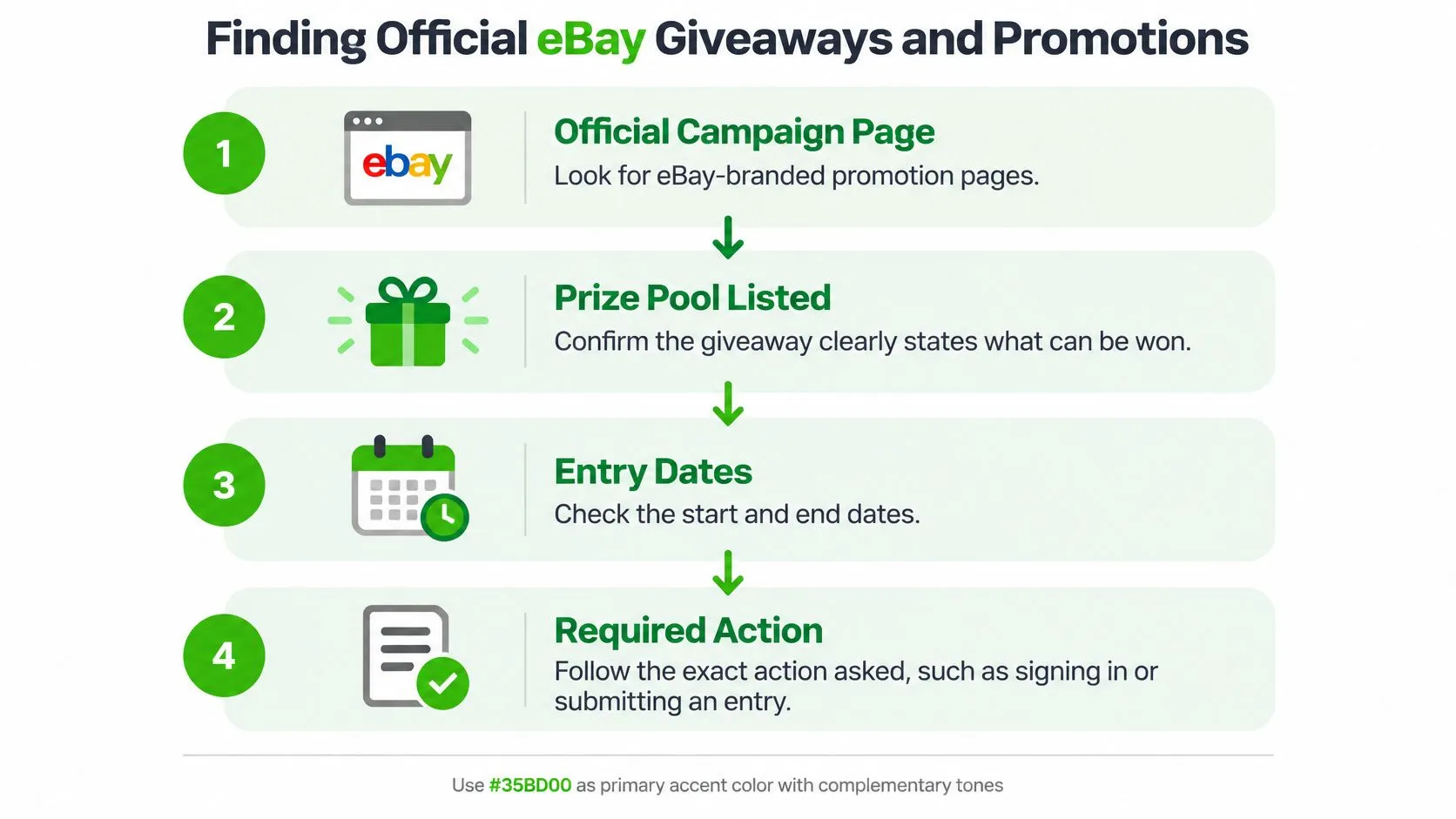
- Find the official campaign page. Go independently to eBay’s own website and look for confirmation of the promotion.
- Identify the prize pool. Check what entrants can win, including whether the advertised product is representative or specifically included.
- Read the entry window. Confirm both the opening and closing conditions, including the stated time zone.
- Match the required action. Determine whether entry requires registration, a game, a keyword, a code, or a qualifying purchase or sale.
Keep the terms available while completing the entry. Don’t substitute an action that sounds similar, such as browsing a category when the campaign requires a qualifying transaction.
Historical campaigns show the difference between entry and entitlement
The Imagine What You’ll Win campaign, launched for eBay Entertainment in September 2003, offered more than 5,000 prizes with a combined retail value of $146,500, approximately $29.30 per listed prize, and used entertainment-related keywords and game-piece codes for participation, according to the documented campaign account.
That same account records 7.2 million promotion-page visits, 807,121 game plays, and 477,853 unique players by email address between September 25 and December 31, 2003; 53% of plays came through offline partners, entertainment-category page views rose 100% to 7.5 million, and related radio activity generated 4.3 million gross impressions.
Those figures describe participation and marketing reach. They don’t establish that every visitor received something, and they shouldn’t be used to calculate personal winning odds without the complete rules and prize-allocation details.
The later StreetSweeps campaign followed a different pattern, connecting eligibility to qualifying buying or selling activity. The useful lesson is to read each promotion independently instead of assuming that every giveaway accepts the same kind of entry.
These are historical examples, not live offers. A campaign archive can explain a method without providing an opportunity you can enter today.
For ordinary bargain discovery between promotions, use saved searches, alerts, and liked items to organize what you’re monitoring. Keep those shopping alerts separate from promotion reminders so you don’t confuse a newly listed product with a newly opened giveaway.
Before entering, confirm geographic eligibility, account requirements, deadlines, and any limits on prize availability. If participation requires spending you weren’t already planning, evaluate that spending as a purchase. The possible prize shouldn’t become your excuse for an otherwise poor deal.
Reading Free Shipping and Low Bid Auctions
Free shipping means the seller priced delivery into the item or absorbed it. You still pay for the merchandise. Judge the listing by your checkout total, and treat the shipping label as marketing until the numbers prove otherwise.
Prize promotions muddy this further. In eBay’s 2019 StreetSweeps promotion, the company offered more than $10,000 in prizes for qualifying shoe or apparel purchases or sales, with the promotion ending June 30 at 4 p.m. Pacific Time. That was a drawing attached to spending. The shoes still cost money. Prize marketing and listing prices belong in separate mental categories.
What Free Usually Means on eBay
| Route | What is free | What you may still pay | How certain |
|---|---|---|---|
| Official prize entry | The prize, if awarded under the rules | Any required qualifying activity and applicable costs | Winning isn’t guaranteed |
| Free-shipping purchase | The separately stated delivery charge | Item price and applicable checkout charges | Delivery benefit depends on the listing terms |
| Low auction bid | Nothing automatically | Winning bid, shipping, and applicable charges | Final price remains unsettled until the auction ends |
Compare delivered totals for equivalent items. Match the model, condition, included accessories, and delivery destination before deciding which listing is cheaper.
A lower item price with paid shipping can beat a higher price with free shipping, and the reverse happens too. If you buy to resell, the delivered total is your acquisition cost. It has to leave room for selling fees and your time, and a free-shipping badge changes none of that math.
Treat a small bid as a purchase decision
A low opening bid invites competition. It says nothing about where the price will close. Review the bid history and time remaining, then fix your maximum total before you place anything.
Condition deserves more attention than the current bid. Read the description alongside the photos and ask whether missing accessories, untested functions, or visible damage would change your decision.
- Check the actual item. Make sure the photos and description refer to the same model, version, and included parts.
- Read delivery terms. Confirm shipping to your location and any collection requirement.
- Set a total-cost ceiling. Leave room for applicable checkout charges rather than using your entire budget as the bid.
- Resolve contradictions early. Ask for clarification before committing, not after winning.
A cheap auction is only a bargain if you still want the item after reading everything that makes it cheap.
Hold your ceiling when another bidder appears. You’re buying an object, not winning an argument.
A reseller’s ceiling also needs room for preparation and resale costs. A personal buyer’s ceiling needs to fit the intended use. Either way, a promotion attached to qualifying shopping is a separate opportunity, and counting it as a guaranteed refund is how bidders talk themselves into overpaying.
Turning Near Free Finds into Profitable Stock
For professional sellers, the better question is often not how to get merchandise free on eBay, but which free merchandise is worth selling through eBay. Acquisition price alone won’t answer that.
Under eBay’s U.S. seller-fee policy, sellers receive up to 250 zero-insertion-fee listings a month, but final-value fees generally range from 2.5% to 15.3% plus a per-order fee, and other applicable charges can still apply. That’s a listing allowance, not a cost-free resale business, and European sellers should check the rules applicable to their own market.
Apply a full landed-cost test
Use a working calculation before accepting stock:
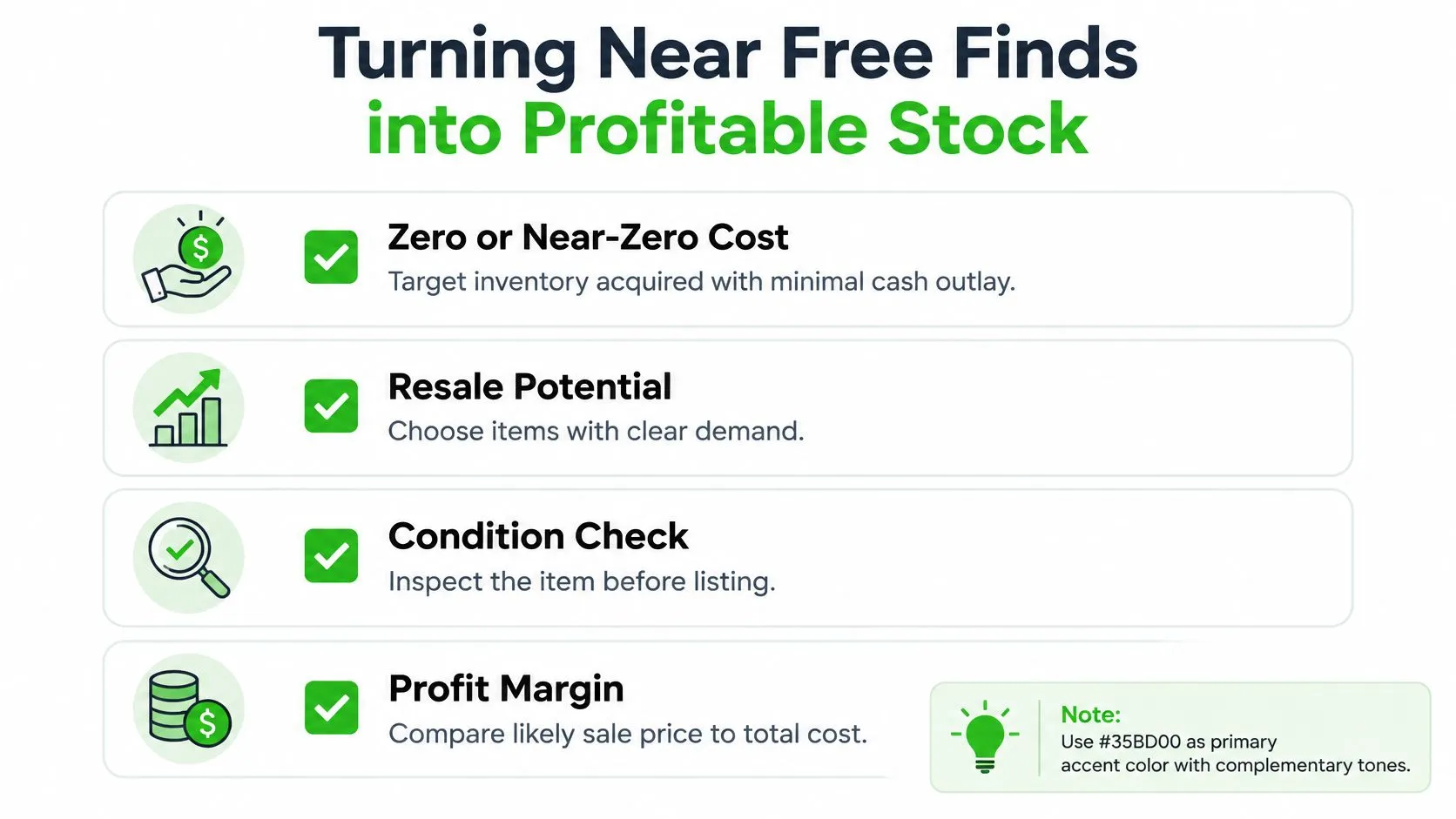
Expected resale proceeds minus acquisition, collection, preparation, packaging, selling costs, and a realistic allowance for problems equals the contribution you’re pursuing.
Then evaluate labor and storage separately. An item can leave cash after the sale and still be a poor use of your working day.
- Acquisition and collection: Include payment, travel, inbound shipping, loading help, and any special transport.
- Cleaning and repair: Estimate the work needed to make an accurate, sale-ready listing. Don’t assume an untested item only needs a quick clean.
- Packaging and platform costs: Consider suitable protection, outbound delivery where you bear it, and applicable selling charges.
- Returns and disposal: Ask what happens if the buyer returns it or you discover it can’t reasonably be sold.
- Storage and sell-through: Decide where it will sit, how long you’re prepared to hold it, and what evidence supports likely demand.
Use comparable items with matching condition and completeness when estimating proceeds. A guide to evaluating an item’s average eBay price can help structure that research, but an attractive asking price isn’t proof that your item will sell for it.
Choose sources by handling effort
Curb alerts deserve an inspection-first approach. Check condition, confirm that the owner intends to give the item away, and avoid collecting something merely because you’re already nearby.
With local giveaway groups, ask enough questions to make the trip worthwhile. Be transparent if you’re sourcing for resale, and respect any group rules or donor restrictions.
Estate-clearance leftovers need selective collection. Accepting an entire unwanted lot can turn a promising item into an obligation to sort, store, and dispose of everything around it.
A buyer no-show isn’t automatically a free-stock opportunity. The owner must explicitly agree to give the item to you; a failed sale doesn’t transfer ownership.
My recommendation is to favor predictable condition, clear demand, and short handling time over an impressive theoretical resale price. A compact, complete item you can inspect and prepare efficiently may be preferable to a bulky project.
Once an item passes the test, record its acquisition source, condition, preparation work, storage location, and intended price. Keep that record connected to its listings and sale. The aim is profitable stock, not a collection of objects that happened to cost nothing.
Staying Safe While Hunting Free eBay Deals
A free offer shouldn’t require you to suspend ordinary judgment. If someone insists that you must act before checking basic details, stop.
Verify a promotion by navigating independently to the official website rather than trusting a logo, an email display name, or a familiar-looking page. Read eligibility and geographic restrictions before investing time in an entry you may not be allowed to submit.
Refuse requests that change the deal
My rule is simple: don’t pay an unexpected release fee, share a password, or move a transaction outside normal checkout to obtain a supposedly free item. If a request wasn’t part of the offer you verified, treat it as a new claim that needs independent confirmation.
For low-price auctions, inspect the seller’s feedback and the consistency of the listing. Mismatched photos, vague condition descriptions, and pressure to arrange external payment are reasons to leave, not puzzles you need to solve.
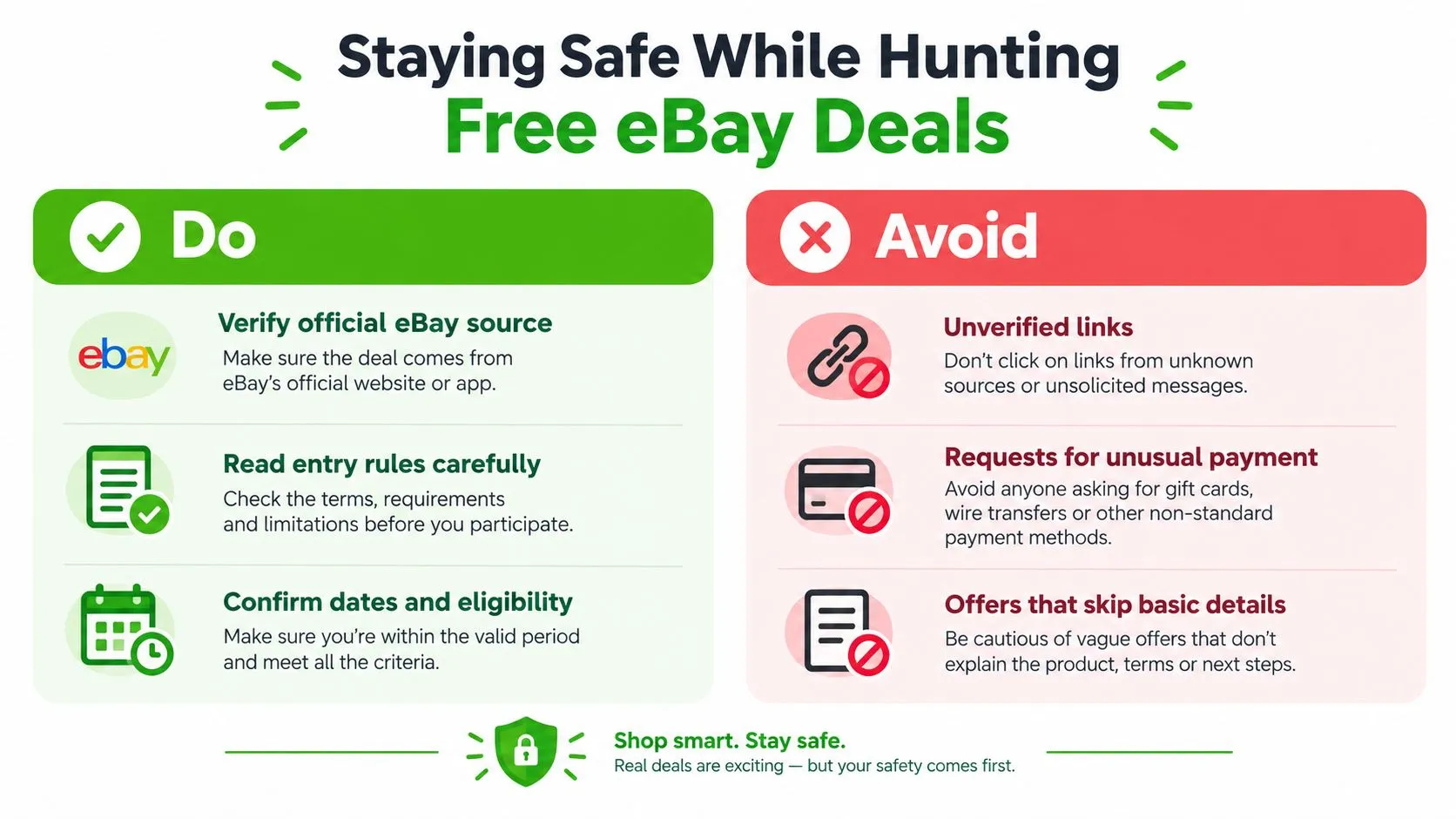
- Do verify independently: Confirm the promotion and its rules through the official site.
- Do retain the terms: Keep the relevant offer details and transaction messages.
- Don’t share credentials: A stranger doesn’t need your password to award or deliver an item.
- Don’t accept unexplained charges: Walk away when the supposed benefit depends on a payment you can’t verify.
If an offer also introduces a subscription or trial, evaluate that separately from the merchandise. Compass+ provides a resource on how to prevent free trials from auto-renewing, useful when a “free” benefit comes with an ongoing billing commitment.
Make local collection safe and manageable
For local stock, agree on the pickup arrangements before traveling. Choose a setting you’re comfortable with, arrange appropriate help for loading, and don’t enter an unsafe situation because you feel obliged to complete the collection.
Confirm that the donor owns the goods and can give them away. Before listing, check applicable resale restrictions and platform policies, particularly when authenticity, product safety, or ownership is uncertain.
Cross-marketplace sellers can also use this guide to avoiding Wallapop and Vinted scams when assessing offers outside eBay.
Free still has rules, dates, and availability. It doesn’t justify giving up control of your account, payment, or personal safety.
Heavy goods deserve a firm refusal when you can’t move or store them safely. Unknown contamination, substantial damage, or unclear disposal requirements are also valid reasons to decline.
You don’t owe an offer your time merely because you’ve already exchanged messages. Abandon a bad deal as soon as the unresolved risk exceeds the likely benefit.
Your Next Move After a Free Find
Choose the route that matches your goal. Don’t keep searching for a universal trick that turns every listing into free merchandise.
For a personal shopper, an official promotion is worth considering when the entry requirements suit you. A free-shipping purchase makes sense when the delivered total is competitive. A low auction bid belongs on your shortlist only when the condition and terms justify buying the item.
For a professional seller, the decisive question is different: does this object deserve space in the business? A free acquisition that creates excessive work isn’t automatically better than paid stock you understand and can handle efficiently.
If you’re shopping for yourself
Open eBay’s current official promotions or deals area through its website. Look for an offer that matches something you want, confirm the end date and required action, and decide whether the benefit warrants your attention.
Keep your decision tied to the item’s usefulness. Don’t make an unnecessary purchase to qualify for a chance at something else.
- Choose a relevant offer: Pursue something you would use, rather than entering everything with an appealing headline.
- Define the commitment: Know whether you’re entering, buying, or bidding before proceeding.
- Ignore universal promises: Leave any claim that every eBay item can be obtained free.
If you’re sourcing for resale
Take the item you’re considering and complete the cost test before collecting more. Write down the likely preparation, transport, packaging, selling costs, and storage requirements.
If the item passes, create an accurate inventory record and a listing based on its actual condition. Keep availability consistent wherever you offer it, rather than treating each marketplace as an unrelated task.
If it fails, decline it. You don’t need to rescue every unwanted object to run a good secondhand business.
The useful skill isn’t finding the word free. It’s recognizing which opportunity has a clear benefit after you account for the obligations attached to it. Buyers should protect their budget; resellers should protect both their budget and their working time.
Frequently Asked Questions
Can you really get free stuff on eBay?
Not as a general rule. Legitimate free items on eBay come from official prize promotions with their own rules, and entering one does not mean you will win. Free shipping and free listings are different offers that leave the item price in place.
Does free shipping on eBay mean the item is free?
No. Free shipping means the seller priced delivery into the item or absorbed it. You still pay for the merchandise, so compare delivered totals for equivalent items.
Is a low opening bid a way to get something for nearly free?
A low opening bid invites competition and says nothing about where the price will close. Review the bid history, fix your maximum total, and hold that ceiling when another bidder appears.
How do I spot a fake eBay giveaway?
Go independently to eBay’s own website and look for the official campaign page and its rules. Don’t pay an unexpected release fee, share a password, or move a transaction outside normal checkout to obtain a supposedly free item.
Ruit brings sourcing, inventory, multichannel publishing, stock synchronization, messaging, orders, accounting, and analytics into one workspace for professional secondhand sellers. Once a free or near-free find passes your profitability test, visit Ruit to centralize its record and manage it across connected marketplaces instead of retyping and updating each listing by hand.