eBay VeRO Guide for UK Sellers: Avoid Takedowns in 2026


Table of Contents
- TL;DR
- What the eBay VeRO programme is
- The eBay VeRO policy in plain English
- What typically gets a UK listing reported
- Is it safe to resell genuine second-hand goods?
- Writing listings that stay on the right side of VeRO
- What to do if eBay removes your listing
- Why VeRO is harder when you sell on several marketplaces
- Our perspective: compliance is a listing habit, not a lottery
- Keeping one inventory under control with Ruit
- Sources
- Frequently Asked Questions
- Recommended
This eBay VeRO guide answers the question most UK sellers ask after a listing vanishes: VeRO is the system rights owners use to report listings they say infringe their intellectual property, and as a seller you handle it by fixing the listing, contacting the rights owner or appealing. You do not apply to VeRO and you cannot be “on” it. It is a route for brands, and your job is to give them no reason to use it against you.
Below you will find what the programme does, what typically triggers a report, what eBay says to do after a removal, how the six-month appeal works and how to stop one problem listing from spreading to every marketplace you use. It applies to private sellers and small businesses alike, including clothing and vintage resellers.
TL;DR
- VeRO (Verified Rights Owner) is eBay’s notice-and-takedown programme. GOV.UK describes it as the route for rights owners to report suspected infringements.
- Your listing text and photos can be the problem, not only the item. Write your own descriptions, take your own photos and never imply you are an authorised dealer.
- After a removal, read the notification, fix what it points to and do not simply relist. If you think the action was wrong, you can appeal for free within six months.
- Genuine second-hand goods are lower risk, but “it is genuine” does not stop a complaint about how you presented the item.
- If you sell on several channels, pause the same item everywhere until the issue is fixed.
What the eBay VeRO programme is
VeRO stands for Verified Rights Owner. Brands, photographers, publishers and other IP owners (or their authorised representatives) join the programme so they can report listings to eBay. According to GOV.UK’s guidance on e-commerce stores, it is a notice-and-takedown programme: the owner sends a report, and eBay acts on it.
The rights involved are broader than most sellers expect. eBay’s intellectual property policy covers copyright, trade marks and design rights among others. That means a report can concern a fake handbag, but it can equally concern a photo you copied from a manufacturer’s website.
VeRO participant profiles
Many rights owners publish a profile page that explains which rights they protect and why a listing may have been removed. eBay hosts these in its VeRO profiles directory, and the content is written and managed by the owners themselves. Reading a profile before you buy stock for a brand is a sensible habit.
But the directory is not a complete list of protected brands. A brand with no profile can still request a takedown, so the absence of a page is not clearance.
The eBay VeRO policy in plain English
Ebay’s rules sit across a few pages. Together they say this:
| Topic | What eBay expects | Where it comes from |
|---|---|---|
| Your own content | Take your own photos and write your own descriptions. | Images, videos and text policy |
| Brand names | You may name a brand you genuinely sell and show photos you took. You must not suggest you are an authorised dealer if you are not. | Intellectual property policy |
| Counterfeits | List only if you are certain the item is genuine. eBay may ask for proof of authenticity. | Counterfeit policy |
| “Dupe” wording | “Dupe” next to a brand name is not allowed, because it can suggest the item is counterfeit. | Counterfeit policy |
| Appeals | Free, within six months of eBay telling you about the action. | Appeal an action taken by eBay |
EBay’s own UK Seller Centre makes a point worth remembering: the listing content is part of the compliance problem. It reviews your text and images, not only the physical item. Treat every photo and sentence as evidence.
What typically gets a UK listing reported
The following are the patterns we see described most often in eBay’s guidance and in seller discussions. None of them needs bad intent.
- Copied images or descriptions. Lifting a brand’s product photo or a catalogue paragraph is the simplest route to a copyright report.
- Implying authorisation. Phrases such as “official stockist” or logos used as if you were the brand’s partner.
- Doubtful authenticity. Items with missing tags, odd stitching or no provenance, especially in high-copy categories like trainers, designer bags and sportswear.
- Brand names stuffed into titles. Adding a famous name to a listing for an unrelated item to catch searches.
- Replica language. “Inspired by”, “style of” or “dupe” attached to a brand.
If you want a title that is accurate without drifting into keyword stuffing, our guide to 80 character eBay listing titles shows how to lead with what the item is and use the brand only where it truly describes the product.
Is it safe to resell genuine second-hand goods?
Generally the law is on the side of reselling genuine items. Under section 12 of the Trade Marks Act 1994, a registered trade mark owner generally cannot stop further dealings in goods that were put on the market in the UK or EEA under that mark by the owner or with their consent. There is an exception where the owner has legitimate reasons to object, for example where the condition of the goods has been changed or impaired.
GOV.UK’s guidance on exhaustion of IP rights (dated 30 January 2020) adds that, under the UK+ regime, goods placed on the EEA market by or with the rights holder’s consent are still treated as exhausted in the UK. It also warns that you must still check taxes, duties and customs rules if you import. In May 2025 the government confirmed it was keeping this regime, with no new requirements for businesses.
Now the practical catch. That legal principle does not decide a VeRO report on eBay. A rights owner can still challenge a listing because of how you used their trade mark, how you described authenticity or whose photos you used. And eBay still applies its counterfeit rules separately. So:
- Genuine goods lower your risk. They do not remove it.
- Your listing is judged as well as your item.
- If you cannot be certain an item is real, do not list it.
This is general information, not legal advice. If you receive a legal letter rather than an eBay notification, speak to a solicitor who handles intellectual property.
Checking authenticity before you list
For designer and luxury pieces, verification is the step that protects you. Looking at construction, labels, hardware and serial details is the same discipline that retailers use to verify designer goods before resale. Keep notes and photos of what you checked, because eBay may ask for proof of authenticity. If an item turns out to be counterfeit, eBay’s policy says it must be disposed of and not resold, and ignoring the policy can lead to restrictions or suspension.
Writing listings that stay on the right side of VeRO
A short routine before you publish makes most problems disappear.
Photos
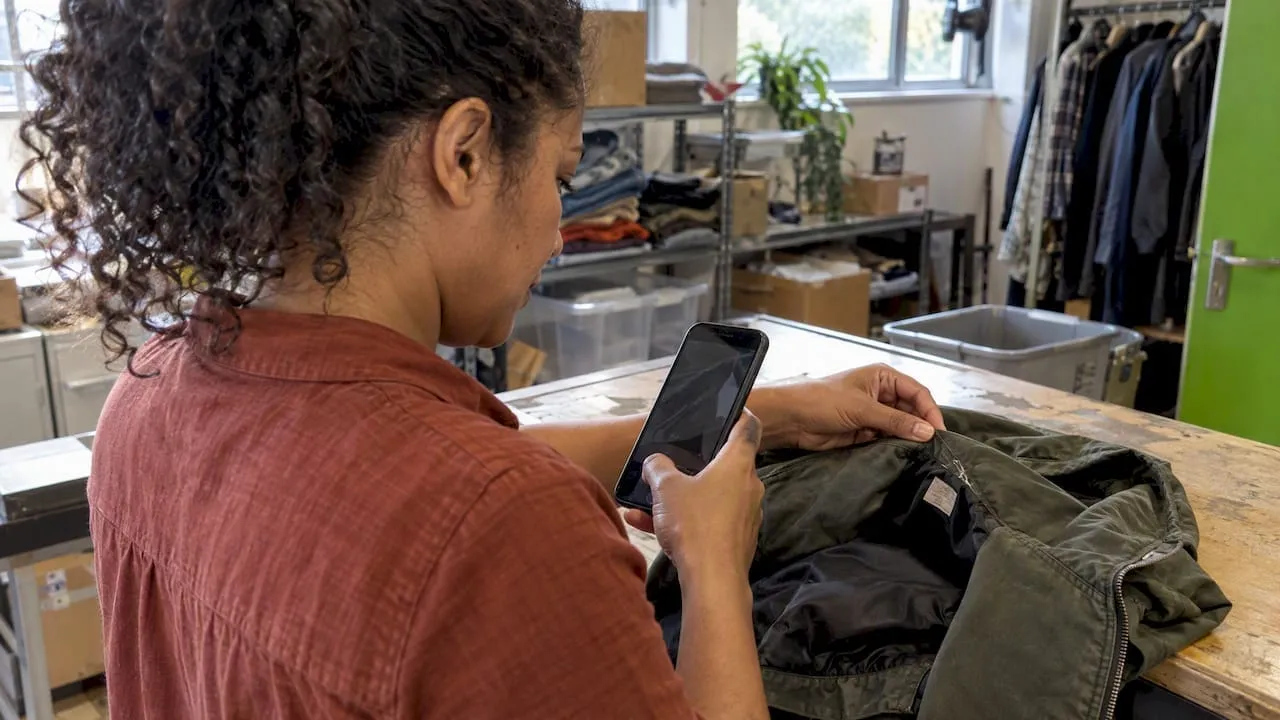
Take them yourself, on your own background, showing the actual item including flaws, tags and labels. Do not crop in a brand’s marketing image. If you are unsure about sizing and quality requirements, see our eBay photo size guide.
Titles and descriptions
Write the description from the item in your hand: size, condition, measurements, material, faults. Mention the brand because it is the brand, not to borrow its authority. Avoid wording that suggests you represent the maker.
Item specifics
Filling in brand, style and size accurately is useful for buyers and helps you stay specific rather than vague. Our guide to eBay item specifics walks through the fields that matter.
A quick pre-publish checklist
| Check | Pass if |
|---|---|
| Photos | All taken by you, nothing from a brand or other seller |
| Description | Written in your own words, no pasted catalogue text |
| Brand use | Names the brand only to describe the item |
| Authenticity | You are certain it is genuine and can show why |
| Wording | No “dupe”, “replica”, “inspired by” next to a brand |
| Claims | Nothing implying you are an authorised dealer |
What to do if eBay removes your listing
Start by reading the notification. eBay says it will tell you why the listing was removed, which part may have infringed and, where possible, how to revise it. Check your registered email and My eBay messages.
Then work through these steps:
- Do not relist straight away. eBay warns against relisting before you understand the reason, because it can lead to suspension and in some cases legal action.
- Identify the trigger. Compare your photos, title and description against the points in the notice. Was it a copied image, a brand claim or an authenticity doubt?
- Fix the listing. Retake photos or rewrite text so the specific problem is gone.
- Contact the rights owner if the notice allows it. The notification usually names them and explains the options. A polite message with evidence of authenticity can resolve a mistaken report.
- Appeal if you think it was unjustified. Pair the appeal with the concrete change you made.
Not every disappearance is VeRO. eBay lists other reasons for removed or hidden listings, including breaches of policy or law and listings that have been active for a year or more without any sales. The same page notes that similar listings may remain live because another seller may be an authorised retailer or the rights owner, or because the owner asked for removal of yours and not the others. Do not read that as a sign yours was picked on, or that you can copy them.
How the appeal works
eBay’s appeal page says you can appeal an action you believe was unjustified within six months of the day eBay informs you about it. It is free of charge. eBay says it reviews appeals in a timely and diligent manner and will reverse the decision without undue delay where there are sufficient grounds and it is technically and reasonably possible.
What counts as sufficient grounds is up to you to show. Useful evidence includes:
- Your own photos of the item, with tags and labels
- Receipts, order history or a description of where you sourced it
- A clear note on what you changed in the listing
- Any reply from the rights owner
Keep the tone factual and short. Say what the item is, why you are confident it is genuine and what you edited.
Why VeRO is harder when you sell on several marketplaces
Most resellers we talk to list the same item on more than one site. That is sensible for sales, but it multiplies the risk: if the same photos or title caused a report on eBay, the identical content is probably live on Vinted, Wallapop or your own shop, and a second complaint may follow. Because eBay warns against relisting without understanding the cause, the safest workflow is to treat one problem item as a problem everywhere.
A simple routine helps:
- Keep a record of any item that has had a notice, with the notice date and what you changed.
- Pause that item on every channel before you edit it.
- Republish only after photos and text have been corrected, and only on the channel where you understand the policy.
- Do not reuse the same pictures or title on another listing as a workaround.
If you are growing an eBay shop alongside a webshop, our guides on connecting Shopify to eBay and WooCommerce to eBay cover keeping stock and SKUs consistent.
Our perspective: compliance is a listing habit, not a lottery
We build Ruit for people who sell second-hand on Vinted and eBay at the same time, so we see how quickly a single weak listing travels. Our view is simple.
First, most VeRO trouble for small sellers is self-inflicted and avoidable. It comes from copied pictures, borrowed wording and optimistic brand claims, not from selling pre-owned goods. A seller who photographs their own stock and describes it honestly rarely meets a takedown.
Second, speed is the enemy of care. Listing in bulk on several channels is efficient, and that is exactly why the drafting step needs a human eye. When AI helps draft a title or description, read it, check that it describes your item and does not claim any authorisation, and correct it. A draft is a starting point, never proof.
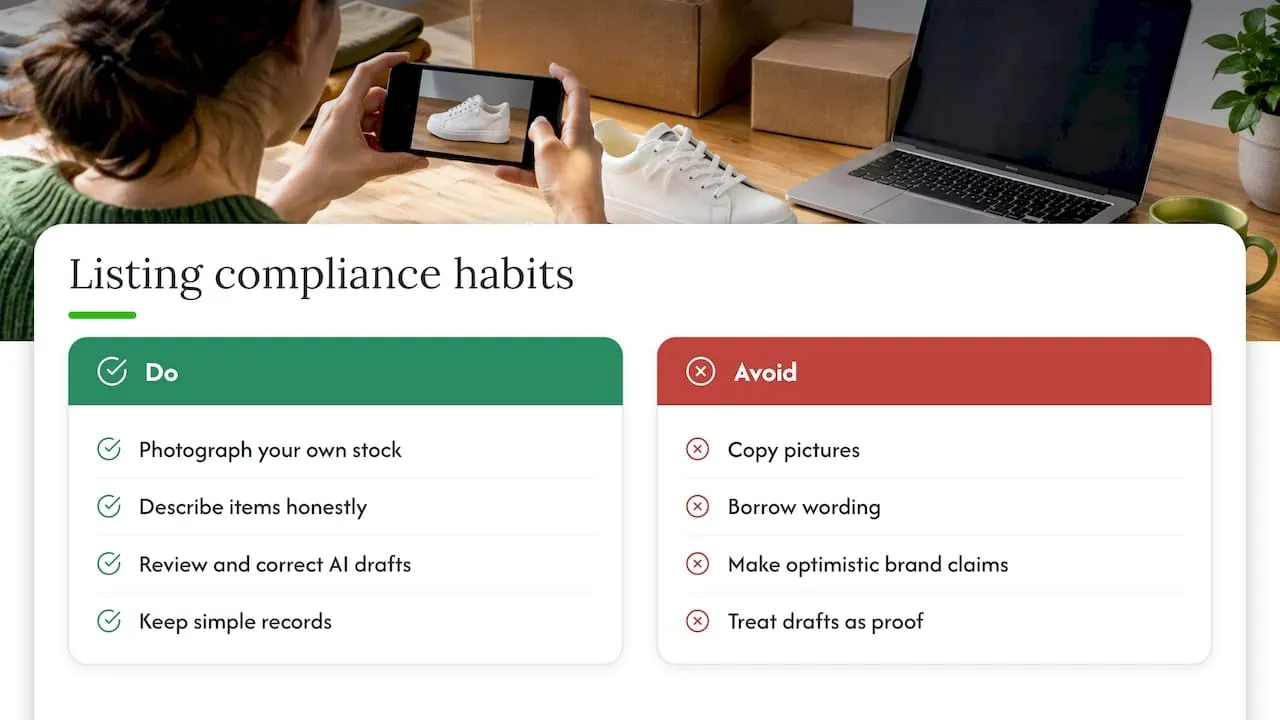
Third, stock hygiene and content hygiene go together. Listing once and having sold items removed from other channels keeps you from overselling. It does not replace checking what is being published. Pause a flagged item, fix it, then publish again.
We do not give legal advice, and eBay decides how it applies its own policy. What we can say is that sellers who keep simple records and write their own listings have far less to worry about.
- Luis
Keeping one inventory under control with Ruit
If you list on eBay and Vinted together, Ruit lets you list an item once and publish it to Vinted, eBay, Wallapop, todocoleccion, Shopify, WooCommerce and PrestaShop. When it sells on one channel, stock syncs and the listing is removed from the others. It also drafts titles and descriptions with AI, which you then check against the routine above. You can see how eBay fits in on our page about selling on eBay from a single inventory, or start with Ruit and try it on your own stock.
Sources
- GOV.UK: Protecting intellectual property rights on e-commerce stores
- GOV.UK: Exhaustion of IP rights and parallel trade
- GOV.UK: UK maintains IP rights regime
- Trade Marks Act 1994, section 12
- eBay UK Seller Centre: Intellectual property
- eBay UK Seller Centre: VeRO profiles
- eBay: Intellectual property policy
- eBay: Images, videos and text policy
- eBay: Counterfeit policy
- eBay: Removed or hidden listings
- eBay: Appeal an action taken by eBay
- How retailers verify designer goods before resale
Frequently Asked Questions
What does VeRO mean on eBay?
VeRO stands for Verified Rights Owner. It is eBay’s programme that lets intellectual property owners report listings they believe infringe their rights. Sellers do not join it to protect their stock; it exists for brands, creators and their representatives.
What happens if you get a VeRO on eBay?
eBay removes the listing and sends a notification explaining the reason, what may have infringed and, where possible, how to revise it. You should not relist until you understand the cause, because relisting can lead to suspension. You can fix the listing, contact the rights owner or appeal.
How do I avoid VeRO on eBay?
Use your own photos and your own wording, name brands only to describe what you really sell and never suggest you are an authorised dealer. List only items you are certain are genuine, and keep proof of how you checked them. Avoid words such as “dupe” or “replica” beside a brand name.
Is there a list of VeRO brands I can check?
eBay publishes VeRO participant profiles, written and managed by the rights owners. The directory is not complete, so a brand without a profile can still ask eBay to remove a listing. Treat the profiles as a helpful guide, not a guarantee.
How long do I have to appeal a VeRO removal?
eBay says you can appeal within six months of the day it informs you about the action, and the appeal is free. Include evidence such as your own photos and a note of what you changed. If you receive a legal letter instead of an eBay notice, seek advice from an intellectual property solicitor.