Key Order Management Activities for Resellers


Table of Contents
- Table of Contents
- Redefining Order Management for Unique Inventory
- The Core Lifecycle of Multichannel Fulfillment
- Mastering Real-Time Inventory Synchronization
- Optimizing Physical Picking and Packing Accuracy
- Transforming Returns into Strategic Sourcing Events
- Measuring Success and Centralizing Operations
- Frequently Asked Questions
Most advice on order management activities starts with software, dashboards, and warehouse throughput. That misses the hardest part of professional second-hand selling. When every coat, camera, book, or device may exist only once, order management isn’t administrative data entry. It’s the control system that connects a digital promise to a physical item.
A stale listing can create an unfulfillable sale. A vague location can turn a quick dispatch into a search operation. A return can sit in limbo while its resale value falls. The practical question isn’t whether your team can process orders. It’s whether each order moves through a traceable workflow that protects inventory, labor time, customer trust, and margin.
Table of Contents
- Redefining Order Management for Unique Inventory
- The Core Lifecycle of Multichannel Fulfillment
- Mastering Real-Time Inventory Synchronization
- Optimizing Physical Picking and Packing Accuracy
- Transforming Returns into Strategic Sourcing Events
- Measuring Success and Centralizing Operations
Redefining Order Management for Unique Inventory
Generic ecommerce workflows assume replacement stock exists. Professional second-hand resellers rarely have that option. If a buyer purchases one vintage jacket and the team cannot locate it, an equivalent substitute changes the transaction, the customer expectation, and often the margin.
The useful measure is still clear:
Order accuracy = error-free orders ÷ total fulfilled orders × 100.
Industry benchmark material places top-tier operations at approximately 99.5% to 99.9% order accuracy, with errors occurring in roughly 1 to 5 orders per 1,000, as reported in warehouse reporting guidance from Fynd. For a reseller, performance near that range does not make individual errors harmless. A wrong size, condition grade, or item can trigger customer service work, refunds, replacement shipping, inventory corrections, and marketplace consequences.
The hidden cost of a bad order
A spreadsheet can mark an item “available,” but availability is only useful when the physical unit is identified, correctly graded, photographed, stored in the recorded location, and still saleable. Those checks must sit inside the workflow rather than depend on memory.
Order management should connect:
- Order capture: Record the marketplace order, buyer details, item ID, price, and fees without rekeying.
- Inventory validation: Confirm that the exact unit is available and not reserved elsewhere.
- Fulfillment control: Link the order line to a storage location, condition record, and packing status.
- Exception handling: Send missing, damaged, duplicated, or conflicting orders to a visible queue.
- Financial closure: Record shipping, refunds, fees, and the final outcome for analysis.
Practical rule: If an order can be completed without confirming which physical item fulfills it, the system is tracking a listing, not inventory.
Manual tools can support a small operation when receiving and listing remain disciplined. A stock sheet becomes costly once several marketplaces, staff members, storage areas, and return decisions create more handoffs than one person can reliably remember. Every handoff adds a chance of stale availability, misplaced stock, or duplicated work.
The operating shift is to make every state change explicit. Sales, cancellations, returns, stock adjustments, inspections, and relists should leave a usable record. That record helps an operator separate a catalog defect from a picking mistake, then correct the responsible step instead of adding another manual check across the entire business.
The Core Lifecycle of Multichannel Fulfillment
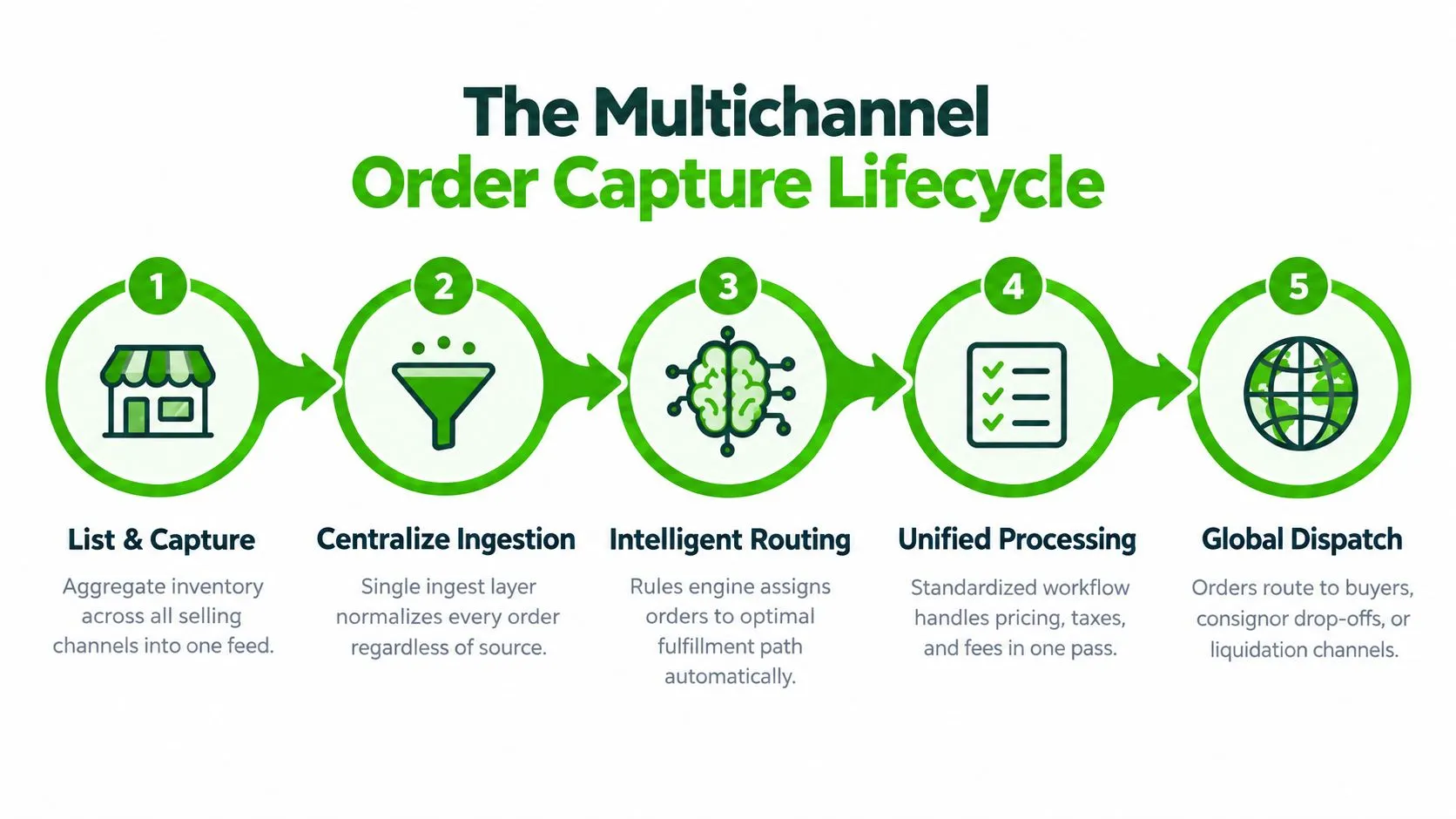
A multichannel order passes through several distinct activities, even when the buyer sees only a confirmation email. The operation must capture the order, validate the item, reserve it, guide a picker to the correct location, produce shipment documentation, communicate status, and close the financial record.
Capture and validation
Orders may arrive from Vinted, Wallapop, eBay, a WooCommerce store, or another connected channel. The first control is a single order record containing the source, buyer information, exact item ID, agreed price, shipping method, and payment status.
Validation should happen before fulfillment begins. The system or operator needs to check that the item is still available, the price is correct, the address or collection details are complete, and the order isn’t already being handled elsewhere. Disconnected tools cause avoidable friction here. Copying an address from Vinted into a shipping portal creates transcription risk, while manually removing a sold Wallapop listing after an eBay sale leaves an overselling window.
Reserve, pick, and pack
Reservation changes the item’s state from available to committed. It should be tied to the item ID, not only to the listing title. For unique inventory, “black leather boots” is not an adequate fulfillment reference. The record should identify the exact pair, its location, condition, images, and any notes that distinguish it from similar stock.
Picking then turns a digital instruction into a physical action. Packing verifies that the selected item matches the order and that the package, label, and documentation belong together. Shipping status should return to the central record, so customer communication and exception handling don’t depend on separate inboxes.
Invoice and reconcile
Automated invoicing doesn’t remove the need for financial review. The order record should preserve the sale amount, marketplace fees, shipping cost, refund status, and any adjustment required after delivery or return. A centralized view makes it possible to compare operational effort with the outcome of each channel.
A useful explanation of how these connected functions fit together appears in Wistec’s overview of order management systems. The important distinction is that order processing is one activity inside a wider operating model. Resellers need that wider model because a completed shipment isn’t the end of the item’s commercial history.
Mastering Real-Time Inventory Synchronization
The popular advice is to “sync inventory regularly.” That sounds sensible until a one-of-a-kind item sells on two channels during the gap between updates. Batch synchronization creates a period in which each marketplace can continue offering stock that has already been committed elsewhere.
Research on omnichannel retail reports that traditional batch systems can delay inventory updates by an average of 6.4 hours, while event-driven architectures reduce latency from roughly 240 minutes to under 800 milliseconds. The same research on event-driven inventory synchronization reports batch-system inventory accuracy of 88.3%, cross-channel discrepancies of 12.7% during promotions, a 76% reduction in discrepancies, and a 62% improvement in order-fulfillment accuracy for event-driven implementations.
The architecture matters, but the operating rules matter just as much.
Treat every change as an event
A sale is an inventory event. So are a cancellation, return, damage report, relist, manual correction, and completed inspection. Each event should update the item’s state and trigger the relevant channel action.
For a unique item, the basic state model might be:
- Available: The item can be offered for sale.
- Reserved: A valid order has claimed the item.
- Picked: The physical unit has been located.
- Shipped: The package has left the operation.
- Returned: The item is back but not yet cleared for sale.
- Relistable or restricted: Inspection has determined its next route.
This model prevents a returned item from becoming visible as available before someone confirms its condition. It also gives an operator a reason for every unavailable unit.
Build protection around conflicts
SKU-level reservation should happen before the order enters the picking queue. If two marketplaces report sales almost simultaneously, the system needs a conflict rule that accepts one reservation, rejects or flags the other, and preserves both events for investigation.
Three controls are particularly useful:
- Immutable event log: Keep the original events instead of overwriting history.
- Idempotent processing: Ensure a repeated marketplace notification doesn’t reserve or deduct the same item twice.
- Exception queue: Send reservation failures, duplicate events, and inventory divergence to a human review list.
Track synchronization latency at the 95th and 99th percentiles, along with reservation failures, duplicate events, and divergence by channel. These measures reveal whether the integration is reliable under ordinary conditions and during busy periods.
The operating team still has to maintain physical accuracy. As Ruit’s guide to multichannel inventory management explains, synchronization can’t correct an item that was never identified or stored correctly. Before troubleshooting APIs, verify the permanent item ID, location, condition state, and last physical check. Faster data movement won’t repair a weak receiving process.
Optimizing Physical Picking and Packing Accuracy
Picking errors often begin before the picker enters the storage area. If the listing contains a vague title, an incorrect condition grade, or a location that no longer matches the shelf, the picker is working from defective instructions.
Industry benchmarks place manual picking at approximately 100 to 200 picks per hour, with 1% to 3% error rates. Automated or light-directed systems can reach 400 to 800 or more picks per hour, with error rates below 0.5%, while another benchmark identifies picking as responsible for up to 50% of warehouse operating costs. These figures appear in warehouse picking guidance from Atomoving.
A reseller doesn’t need to buy a large automated system to apply the underlying lesson. The team needs better identification and confirmation at the points where errors occur.
Separate catalog defects from picking defects
An order can fail because the item was listed incorrectly, because the location was wrong, or because the picker selected the wrong unit. Those are different problems and need different remedies.
Use a permanent item ID and connect it to:
- A precise location: Record the room, rack, shelf, bin, or container rather than a broad warehouse label.
- A condition record: Store the grade and any defects found after cleaning or inspection.
- Validated imagery: Keep the photographs that identify marks, labels, serial details, or distinctive wear.
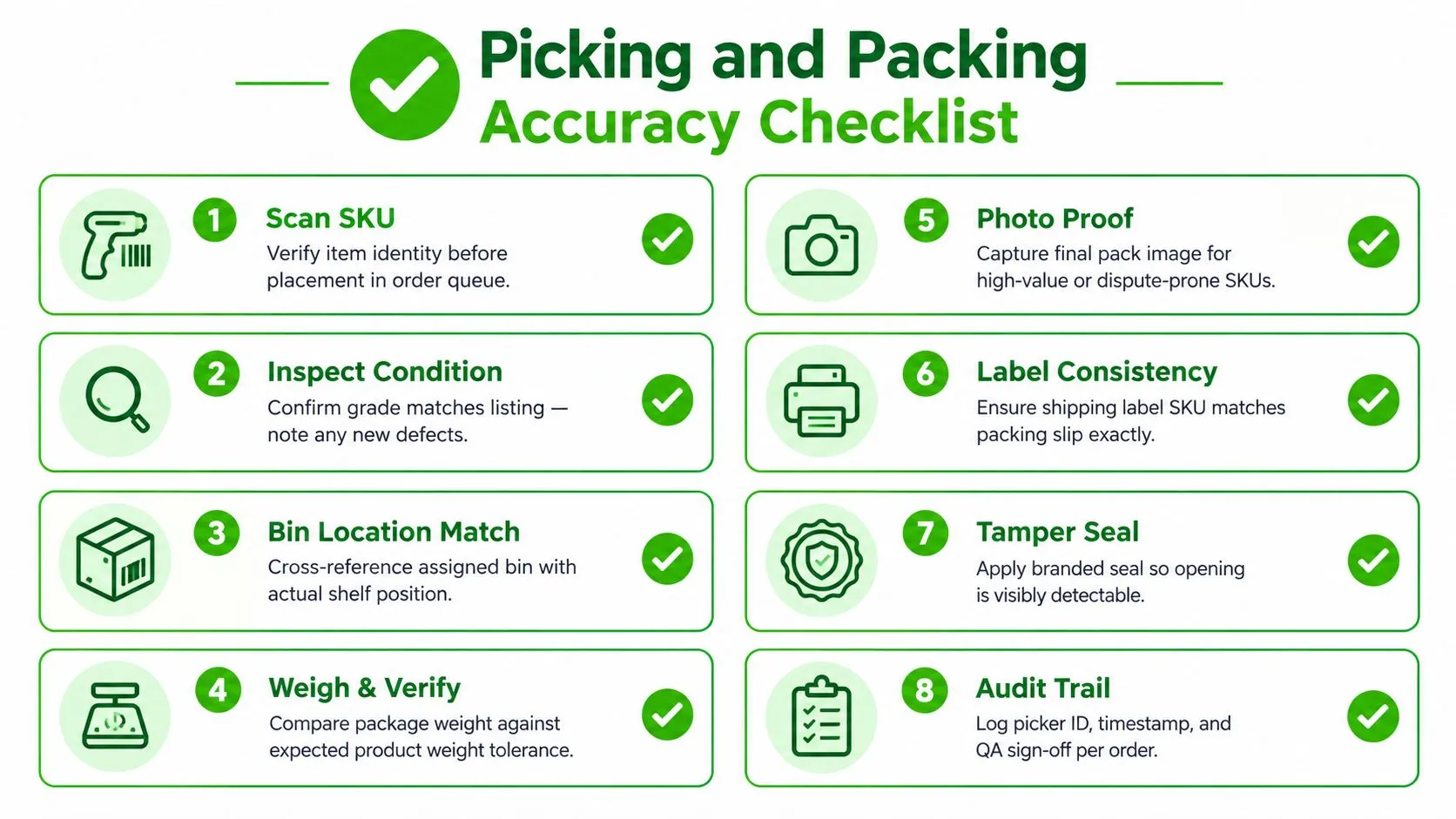
- A scan or confirmation step: Require the operator to verify the item before packing.
- An exception reason: Record “not found,” “condition mismatch,” “wrong bin,” or “duplicate commitment” separately.
Packing needs its own control. Compare the shipping label, packing slip, and order line. For high-value or dispute-prone items, a final photograph can document the item and package condition. Packaging choice also affects cost and damage exposure. For standard postal shipments, Postal Boxes with Free UK Delivery from Storage & Removal Boxes Ltd can help operators source suitable cardboard formats without treating every parcel as a custom project.
Watch this practical picking and packing demonstration before redesigning the station:
The useful KPIs are first-pass accuracy, mispick rate, exception rate, picks per labor hour, order-cycle time, and perfect-order percentage. Review them by operator, location, product type, and error source. A high picking score can conceal catalog failures if the team routinely finds that the right item was never correctly described or stored. The workflow has to expose both sides.
For a practical reference on the physical sequence, see Ruit’s pick-and-pack guidance. The best process isn’t the one with the most checks. It’s the one that places a fast, visible confirmation at the points where a wrong item would otherwise reach the customer.
Transforming Returns into Strategic Sourcing Events
A shipped order isn’t operationally complete when the parcel leaves the building. For second-hand sellers, the return creates a new inventory decision. The item may come back in the original condition, with additional wear, missing accessories, altered packaging, or a problem that wasn’t visible in the original listing.
Europe’s online market for used, open-box, and refurbished products was valued at €21.6 billion, with an expected €2 billion increase in 2025. More than 740 million products remained in circulation in 2024 across Germany, France, the UK, Italy, and Spain, according to Amazon Europe’s reporting on the European resale market. That context makes returns more than a service burden. They can become another controlled sourcing flow.
Give the returned item a new state
Don’t move a returned item directly from “received” to “available.” Create an inspection state and capture:
- Return reason: Fit, undisclosed defect, buyer change of mind, shipping damage, or marketplace issue.
- Condition change: Confirm whether the original grade still applies.
- Inspection time: Record labor required for testing, cleaning, repair, photography, or repackaging.
- Recovery route: Choose relist, repair, refurbish, discount, recycle, or write-off.
- Expected recovery value: Estimate what the item can generate after labor, platform fees, and shipping.
- Provenance: Preserve the original listing, images, condition notes, and order history.
This information prevents the team from treating every return identically. A high-demand item with a minor packaging issue may deserve immediate relisting. A low-margin item requiring extensive cleaning may be better routed to liquidation or recycling.
Make the decision economically
The relevant comparison isn’t the original sale price. It’s the expected value of the next route minus the work and costs needed to reach it.
A relist can be sensible when the item remains saleable and the listing can be corrected quickly. Repair may make sense when the defect is clear and the recovered selling price supports the labor. Discounting can clear an item whose condition is acceptable but whose original promise no longer matches reality. Writing off an item can be rational when handling it further consumes more time than the likely recovery.
A return becomes a sourcing event only after the business assigns it a condition, a cost to recover, and a next destination.
The hidden advantage is preserved history. A returned item shouldn’t lose its photographs, provenance, previous price, or defect notes just because it re-enters stock. That history helps the operator improve descriptions, identify recurring quality issues, and price future listings more intelligently.
Returns also reveal upstream weaknesses. Repeated “condition mismatch” returns suggest an inspection or listing problem. Repeated damage claims point toward packaging or carrier handling. The return queue should therefore feed operational reviews, not sit apart as customer-service paperwork.
Measuring Success and Centralizing Operations
Marketplace totals can look healthy while the operation loses money in the background. Gross sales, active listings, and views show demand, but they do not show how much labor each sale consumes or whether stock records can be trusted.
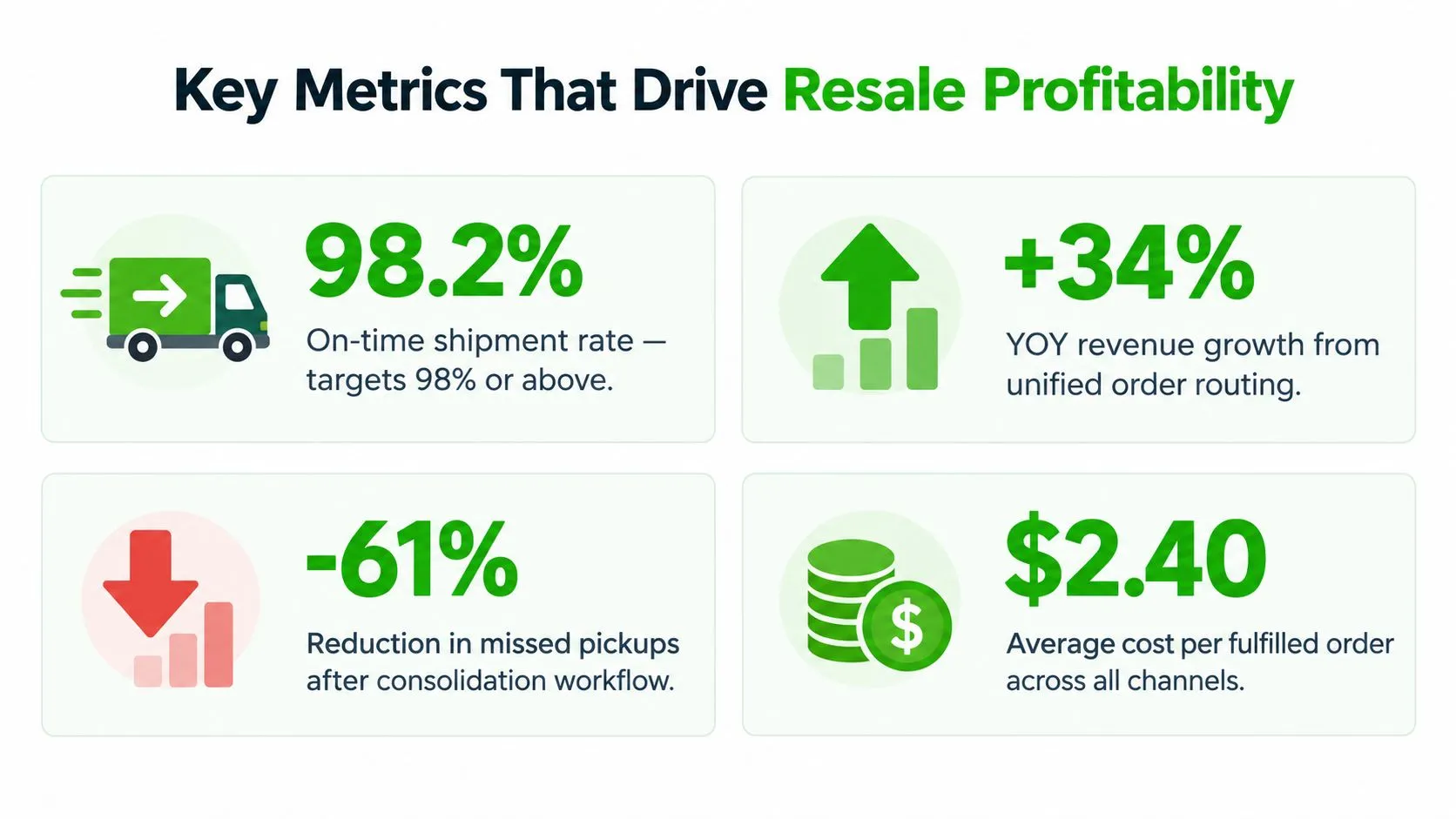
A useful dashboard connects commercial results with execution. Track order accuracy, fill rate, backorders, on-time shipment rate, order-cycle time, fulfillment cost per order, labor productivity, and return-processing time. For second-hand resale, add inventory divergence, reservation failures, listing age, recovery value after returns, and profit per hour worked. These measures expose the cost of handling unique items across several channels, where one wrong location or delayed update can create cancellations and extra customer-service work.
Use metrics that expose lost time
Order-cycle time measures the period from confirmed sale to dispatch or completion. Break it into capture, reservation, picking, packing, and carrier handoff. A long cycle points to a specific constraint, such as slow picking, missing information, or a queue without a clear owner.
Synchronization latency records how long a sale or adjustment takes to reach every connected channel. Review the highest delays as well as the average. A normal average can hide short periods during promotions or busy shifts when an item sells twice before another channel receives the stock change.
Perfect-order percentage combines the buyer-facing conditions that matter: the correct item, accurate documentation, timely shipment, and no avoidable exception. Keep catalog errors separate from physical mispicks. Otherwise, a team can appear efficient in the warehouse while inaccurate condition descriptions continue producing cancellations.
Profit per hour worked connects order management to the resale model. Include sourcing, photography, listing, messaging, picking, packing, returns, and reconciliation. A channel with attractive revenue may produce weak results when every sale requires repeated manual handling or extensive exception work.
Compare fragmented tools with a central operating layer
| Fragmented setup | Centralized operating layer |
|---|---|
| Marketplace inboxes divide customer communication | Orders and messages appear in one working view |
| Spreadsheets hold separate stock versions | One item record carries availability and history |
| Manual crosslisting creates repeated entry | A listing can flow to connected channels |
| Shipping tools lack full order context | Labels and fulfillment status remain connected |
| Returns sit outside inventory reporting | Returned units move through defined recovery states |
| Accounting is reconciled after the fact | Order and cost data can feed financial review |
Fragmented tools can suit a small operation that is still testing its process. They offer flexibility and may avoid an early system commitment. Their cost appears at the handoffs. Each copied field, delayed update, separate login, and manual reconciliation increases the chance that the physical item and digital record will diverge.
A central platform should reduce those handoffs rather than add another reporting layer. Require clear item IDs, channel integrations, event history, exception queues, mobile access for warehouse work, and reporting that connects effort with margin. Cloud-based order management guidance from Ruit can help teams assess whether an online system supports distributed work and connected order flows.
Build the review rhythm
Measure weekly, then investigate causes rather than reacting to isolated scores.
- Review exception categories: Count missing items, duplicate sales, condition mismatches, packing errors, and carrier issues separately.
- Audit dormant listings: Investigate records with unclear locations, incomplete condition data, or failed synchronization.
- Compare channels: Assess contribution after fees, returns, handling time, and customer-service effort.
- Inspect return recovery: Record how quickly returned units receive a decision and whether the selected route recovers value.
- Verify physical records: Cycle-count selected locations and reconcile differences with digital inventory.
Ruit is one option for professional resale operations. It combines multichannel listings, inventory synchronization, order handling, messaging, accounting data, and analytics in one platform. The choice should follow channel coverage, integration requirements, team workflow, and the system’s ability to expose exceptions instead of hiding them.
The goal is selective automation. Automate predictable state changes, such as reservations, status updates, and routine notifications, while giving staff the information needed for condition judgments, recovery decisions, and stock investigations. That turns order management activities into a measurable operating advantage.
Frequently Asked Questions
What are the core order management activities for a reseller?
Capturing the order, validating that the exact item is still available, reserving it, picking it from a recorded location, packing and shipping it, communicating status, and closing the financial record. For unique second-hand items, each step must stay tied to the permanent item ID, not just the listing title.
How do you stop one item from selling twice on different channels?
Treat every sale, cancellation, return, and correction as an event that updates the item’s state and triggers the channel actions. Reserve at SKU level before the order enters the picking queue, make sure a repeated marketplace notification can’t reserve the same item twice, and send conflicting sales to an exception queue for human review.
What should happen to a returned item?
Don’t move it straight from received to available. Give it an inspection state, record the return reason and any condition change, then choose a recovery route (relist, repair, discount, recycle, or write-off) based on the expected value after labor, fees, and shipping.
Which metrics show whether order management is working?
Order accuracy, order-cycle time, synchronization latency, perfect-order percentage, and profit per hour worked. Keep catalog errors separate from physical mispicks so a team can’t look efficient in the warehouse while inaccurate descriptions keep producing cancellations.
If your resale business still relies on spreadsheets, separate marketplace logins, and manual stock updates, map every handoff from sale to dispatch and return. Then visit Ruit to see how a centralized system can connect inventory, multichannel orders, fulfillment, messaging, accounting, and analytics around the same item record.