eBay Fees for UK Vinted Sellers: The £1,000 HMRC Threshold


Table of Contents
- At-a-glance fees table for UK sellers
- How final value fees are calculated and category exceptions
- Listing fees and optional upgrades: allocations and common add-ons
- Regulatory operating fee, international fee and seller currency conversion charge
- Private versus business sellers: which fees and thresholds differ
- Calculate your total fees: step-by-step example and calculator guidance
- Tax and HMRC: when you must tell HMRC about income from selling
- Practical ways UK sellers can reduce fees and protect margin
- Author perspective: practical notes from a reseller guide author
- How Ruit helps UK sellers list across marketplaces and avoid oversells
- FAQ
- Sources
- Recommended
eBay fees UK sellers face depend on whether you trade as a private or business seller. Private sellers on eBay.co.uk generally do not pay final value fees and get 300 free listings a month, while business sellers pay category-based final value fees plus a per-order fixed fee. Listing upgrades, international fees and currency conversion charges can apply to both, and once your trading income passes £1,000 you may need to tell HMRC.
TL;DR:
- Business sellers calculate final value fees on item price, postage, and VAT where applicable, then add a category rate and a separate order fee.
- Category rates and order fee bands vary; eBay changed thresholds and fixed fees effective February 12, 2026, so check current rates before pricing.
- International delivery can add fees from 1.05% to 3%; currency conversion applies when the settlement currency differs, and regulatory charges may also reduce payouts.
- Paid listing upgrades and listings beyond your free allowance can cost money even when items do not sell; repeated relisting can trigger fresh fees.
- After gross income, including postage, exceeds £1,000 per tax year, tell HMRC; its trading test considers resale intent and sales patterns, not account type.
At-a-glance fees table for UK sellers
Before working through calculations, it helps to see every fee in one place. The table below pulls from eBay’s own fee pages for private and business sellers, both updated 30 September 2026.
Private sellers rarely see the final value fee or the per-order fixed fee applied to their UK listings, which is the main practical difference from a business account. Business sellers, by contrast, see nearly every row in this table on a typical order, which is why understanding the calculation sequence below matters more for that group.
How final value fees are calculated and category exceptions
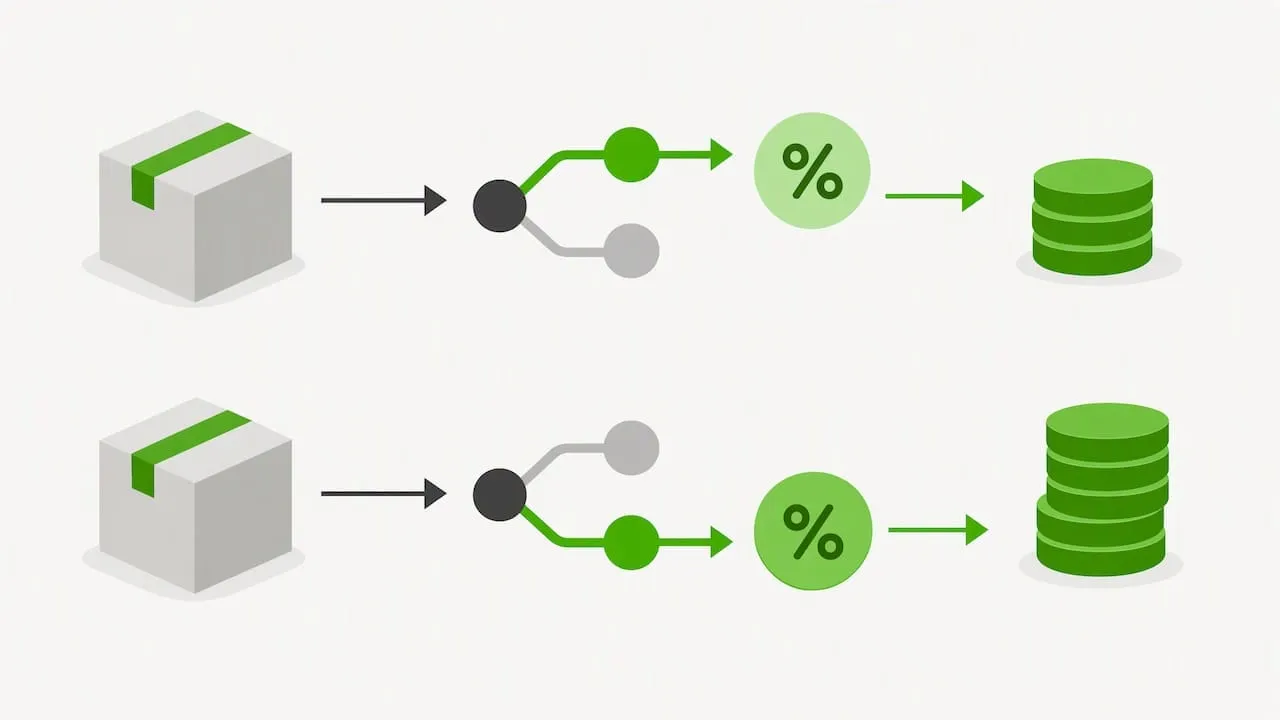
The final value fee on a business seller’s listing is worked out on the total amount the buyer pays: the item price plus postage, and VAT where it applies. eBay then applies two separate charges on top of that base: a variable percentage and a fixed per-order amount.
- The variable percentage depends on the category, commonly structured so a higher rate applies up to a threshold and a lower rate applies to the portion above it.
- For electronics categories such as digital cameras and laptops this works out to 6.9% on the first part of the sale and 3% on the remainder, while clothing pays a single 11.9%, according to eBay’s business seller fee page.
- Categories such as footwear, antiques and certain collectables can carry their own specific rate tables rather than the standard split.
- The per-order fixed fee is added separately and its value depends on the order total band, with eBay publishing adjustments effective from 12 February 2026 for selected categories and fee bands.
A £1,000 sale on eBay shows how the layers stack. In clothing, eBay’s business seller fees page applies 11.9% to the whole amount, about £119, plus the separate per-order fixed fee and the 0.35% regulatory operating fee, so the total deducted comes to roughly £123.
Working out the exact figure for your own category matters because the split point and rate differ depending on what you sell. A pair of trainers and a vintage watch sold for the same £1,000 price can end up with different final value fee totals once the category-specific thresholds are applied. eBay’s seller centre notice from January 2026 confirms that some of these thresholds changed from 12 February 2026, so it is worth checking the current rate card for your category before pricing stock, rather than relying on last year’s figures.
Listing fees and optional upgrades: allocations and common add-ons
Private sellers get a monthly allocation of free listings under eBay’s current private seller fee structure, which covers most casual resellers without ever triggering an insertion fee. Business sellers’ free allocation depends on whether they hold a shop subscription, with higher-tier shops unlocking a larger monthly allowance.
- Exceeding your free listing allocation triggers a small insertion fee per additional listing, charged regardless of whether the item sells.
- A shop subscription raises your monthly free listing allocation and can also reduce the final value fee percentage on some categories, which is why higher-volume business sellers often find the subscription pays for itself.
- Optional upgrades such as a subtitle, reserve price, gallery plus treatment or international site visibility each carry their own separate charge, billed whether or not the item sells.
- Relisting an unsold item, or running it as Good ‘Til Cancelled, generates a new listing fee event once your free allocation for that period is used up, so repeated manual relisting of slow-moving stock can quietly add up.
Sellers running the same stock across multiple channels often underestimate how much manual relisting costs in both fees and time; our guide to bulk uploading on eBay covers how to batch listings efficiently rather than creating them one by one. Getting postage pricing right from the start also avoids the need to edit and republish listings, which our free shipping setup guide explains in more detail.
Regulatory operating fee, international fee and seller currency conversion charge
Beyond the core final value fee, three additional charges can apply depending on how and where you sell.
- The regulatory operating fee is a small percentage applied to the order total, covering eBay’s compliance costs under UK and EU rules, and UK-based private sellers do not pay it.
- The international fee applies when the delivery address is outside the UK, with eBay’s published rate examples showing around 1.05% for the Eurozone and Northern Europe, rising to roughly 1.8% for the US and Canada, and around 2.0% for all other countries; UK private sellers pay a flat 3% instead.
- The seller currency conversion charge applies when a sale settles in a currency other than the one your account holds, with eBay retaining a percentage of the converted amount as part of the settlement process described on its business seller fees page.
- All three charges are deducted automatically from your payout, so they rarely show up unless you check your transaction breakdown line by line.
Sellers who ship regularly to Ireland, France or Germany should factor the international fee into their postage pricing rather than absorbing it from margin, particularly on lower-value items where a 1 to 2% deduction has a proportionally bigger effect.
Private versus business sellers: which fees and thresholds differ
The practical gap between the two account types comes down to which fees apply by default and how eBay expects you to report income.
- Private sellers typically avoid the final value fee and per-order fixed fee entirely on UK listings, and benefit from the 300 free listings per month described on eBay’s private seller fees page.
- Business sellers pay the full final value fee structure on every sale, along with category-specific rates and any shop subscription costs, as set out on eBay’s business seller fees page.
- Choosing a private account on eBay has no bearing on how HMRC views your activity for tax purposes: the two classifications operate independently.
- HMRC instead looks at “badges of trade”: factors such as frequency of sales, whether you bought items specifically to resell, and how you present your selling activity, as explained in commentary from Rhodium Accounting.
A seller who lists as “private” on eBay but regularly buys stock with resale in mind can still be classed as trading by HMRC, regardless of the account type eBay has on file. This is where many sellers come unstuck: they assume a private eBay account protects them from tax obligations, when the two systems are assessing entirely different things.
Calculate your total fees: step-by-step example and calculator guidance
Working out your net proceeds on any sale follows the same sequence, whichever category you sell in.
- Start with the gross sale price, including postage charged to the buyer and any VAT where it applies.
- Apply the variable final value fee percentage for your category to that gross figure.
- Add the per-order fixed fee for the relevant order value band.
- Add the regulatory operating fee percentage.
- Add the international fee if the delivery address is outside the UK.
- Deduct the total of steps 2 to 5 from the gross sale price to reach your net proceeds.
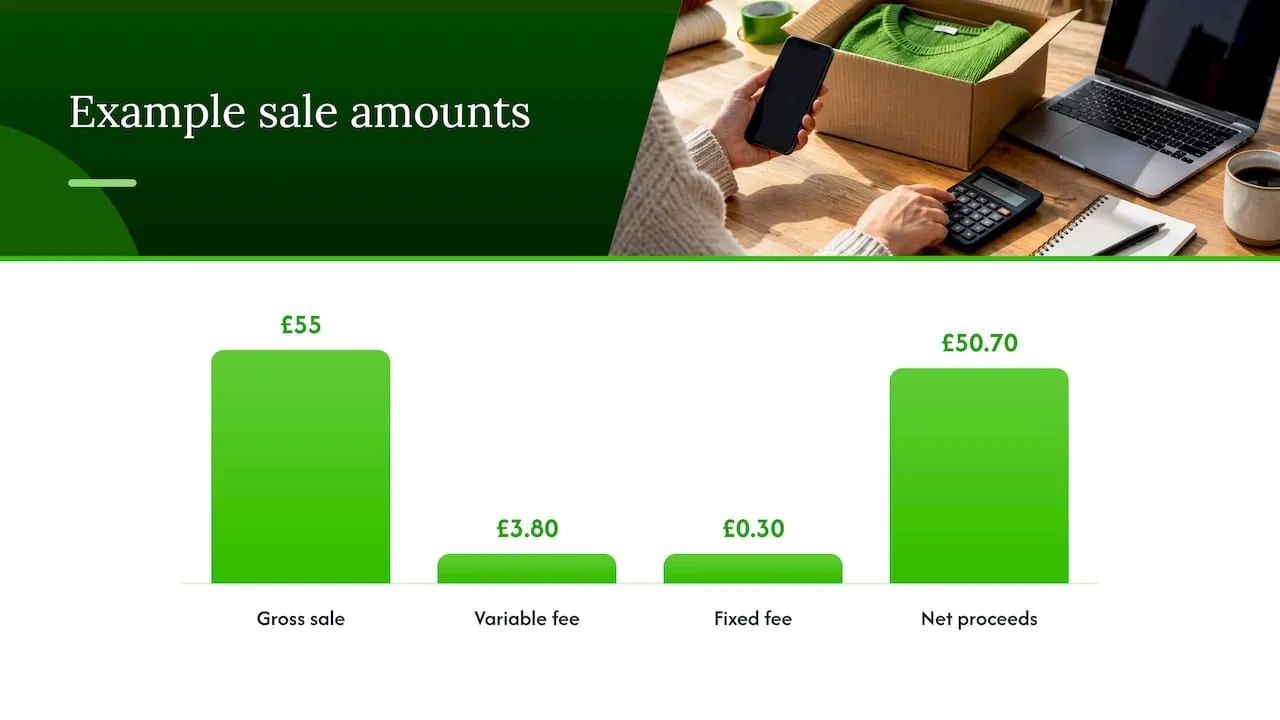
A worked example: say a business seller lists a jacket at £50, with £5 postage, giving a gross sale of £55. Applying the 11.9% clothing final value fee on that £55 gives roughly £6.55, plus a per-order fixed fee of £0.40, plus a regulatory operating fee of about £0.19. The seller’s net proceeds come out at approximately £47.86, before accounting for the original cost of the jacket and any postage paid to send it.
Pro Tip: Run your category’s exact rate through eBay’s own fee illustrations before pricing stock, since the split point between the higher and lower percentage bands varies by category and changed for some categories from 12 February 2026.
Our eBay pricing strategy guide walks through building fee buffers into your listing price so your margin stays protected even after all deductions.
Tax and HMRC: when you must tell HMRC about income from selling
HMRC gives every individual a trading allowance of up to £1,000 per tax year. Once your gross income from selling crosses that threshold, you must tell HMRC and may need to register for Self Assessment.
- The £1,000 figure covers gross income, not profit, so postage charged to buyers and the sale price itself both count towards it.
- HMRC assesses trading status using “badges of trade”: regularity of sales, whether items were bought with resale in mind, and the overall pattern of activity, rather than which eBay account type you hold, according to Rhodium Accounting’s commentary for UK sellers.
- Allowable expenses for resellers typically include the cost of goods sold, postage, packaging and professional fees such as accountancy costs.
Once trading income passes £1,000 in a tax year, registration with HMRC becomes a requirement rather than a choice, as set out in gov.uk’s trading allowance guidance. Keeping a simple record of what you paid for stock and what you spent on postage each month makes this calculation straightforward when the time comes, rather than reconstructing it from memory at the end of the tax year.
Practical ways UK sellers can reduce fees and protect margin
Small adjustments to how you list and manage stock can meaningfully reduce what you lose to selling app fees.
- Double-check the category before listing, since choosing the wrong one can push you into a higher final value fee band unnecessarily.
- Work out whether a shop subscription’s monthly cost is lower than what you currently pay in insertion fees and reduced final value fee percentages across your typical volume.
- Combine items into a single order where buyers are interested in more than one, since this spreads the per-order fixed fee across a larger sale rather than paying it repeatedly.
- Avoid repeating paid upgrades such as subtitles or gallery plus on items that have not sold after the first listing cycle.
Pro Tip: Review your eBay fee breakdown for the last 10 sales before changing your pricing strategy, so you are working from your own actual rates rather than general assumptions.
Author perspective: practical notes from a reseller guide author
Having written guides on connecting Shopify to eBay and on bulk upload workflows, the mistake I see most often is sellers pricing items without checking the category’s actual fee split first. A five-minute check against eBay’s own rate card before listing saves far more than any single optional upgrade ever earns back.
- Luis
How Ruit helps UK sellers list across marketplaces and avoid oversells
Listing the same jacket on both Vinted and eBay by hand, then remembering to pull it down the moment it sells elsewhere, is where most of the operational cost of multi-channel selling actually sits. We built Ruit so you list an item once and it publishes on several marketplaces together, and the moment it sells on one channel, we sync stock and remove it from the others so you never risk selling the same item twice.
We also auto-relist on some marketplaces, bring buyer messages into a single inbox, and draft titles and descriptions for you with AI, so the listing side of your workload shrinks while your eBay fee structure stays exactly as covered above. Take a look at our cross-listing features and current plans to see how it fits your stock, or head to our homepage to get started.
FAQ
How much does eBay take from a £1,000 sale?
On a business seller account, eBay applies a category-dependent final value fee, for example 11.9% in clothing or 6.9% up to £1,000 in digital cameras and laptops, plus a separate per-order fixed fee, as set out on eBay’s business seller fees page. The exact amount deducted depends on which category the item falls into and the current fixed fee band.
Are eBay fees changing in 2026?
Yes, eBay announced adjustments to per-order fixed fees and selected category thresholds effective from 12 February 2026. Sellers should check the seller centre notice for their specific categories rather than assuming last year’s rates still apply.
Does eBay take 20% of a sale?
No single flat percentage rate applies across eBay UK; final value fees are calculated using category-specific percentages, commonly structured as a higher rate up to a threshold and a lower rate above it, as described on eBay’s business seller fees page. Private sellers on UK listings generally do not pay this fee at all.
What are the HMRC rules for eBay sellers in the UK?
HMRC allows a trading allowance of up to £1,000 per tax year; once gross income from selling exceeds that, you must tell HMRC and may need to register for Self Assessment. HMRC determines whether you are trading using “badges of trade” rather than your eBay account type, according to accountant commentary for UK sellers.
Do private sellers pay eBay final value fees?
Private sellers on eBay.co.uk generally do not pay final value fees and receive 300 free listings per month, according to eBay’s private seller fees page. Charges can still apply for optional listing upgrades and for international delivery.