Price Sync Across Marketplaces: Vinted and eBay UK Guide


Table of Contents
- TL;DR
- Why one price everywhere is rarely the right answer
- What each channel takes from the sale
- How to change a price on Vinted and eBay
- Offers can move your price without you touching it
- What goes wrong when prices drift
- What to do when an item sells while both listings are live
- Our view: sync the stock, think about the price
- A weekly routine that keeps prices in line
- Making it easier with Ruit
- Sources
- Frequently Asked Questions
- Recommended
Price sync across marketplaces means keeping the asking price of one item consistent, or deliberately different, on every channel where it is listed. On Vinted and eBay UK there is no single switch that does it for you, so the practical answer is to set a price per channel after working out what you keep from each sale, then change it on both whenever it moves.
That sounds fussy, but it is where multichannel sellers lose money: an item sells at an old, lower price on one site, or a buyer finds two different prices for the same jumper. This guide shows how to change prices on each platform, what fees and offers do to your proceeds, and how to stop mismatches before they cost you a sale.
TL;DR
- Vinted and eBay each need their own price edit, so decide your price per channel instead of copying one number everywhere.
- Fees land differently: Vinted charges the buyer a checkout fee, while eBay UK private sellers pay no transaction fees and business sellers pay final value fees.
- Best Offer and Vinted offers can quietly lower what you receive, so set a floor before you list.
- Ruit lists once on Vinted, eBay and more, and removes a sold item from the other channels so you never sell it twice.
- A weekly price audit across channels catches most mismatches.
Why one price everywhere is rarely the right answer
The instinct is to type £20 on Vinted and £20 on eBay and move on. The trouble is that £20 does not mean the same thing on both. Buyers on each site expect different things, postage is handled differently, and the fee structure decides what lands in your account.
Gumtree’s guidance on listing across several sites makes a useful point: work out the real cost of selling on each marketplace, including listing charges, commissions and postage, before you settle on a price. That is the heart of price sync. You are not syncing a number, you are syncing an outcome: the amount you want to keep.
There are three sensible strategies:
- Identical price. Simple, and fine when your costs are the same on both channels, typically for private sellers who do not pay fees.
- Same proceeds, different price. You adjust each listing so you keep the same amount after fees and postage. Better for business sellers on eBay.
- Deliberate gap. You list slightly higher where buyers haggle more, so offers land where you want.
Whichever you choose, write it down. A pricing rule you can state in one sentence is a rule you can follow on a busy Sunday.
What each channel takes from the sale
Fees change from time to time, so treat this table as a snapshot and check the linked page before you set prices.
| Channel | Who pays what | Source and date |
|---|---|---|
| Vinted | The buyer pays a checkout fee, typically 3% to 8% plus £0.30 to £0.80 | Vinted price list, 8 October 2026 |
| eBay UK, private seller | No transaction fees on eBay.co.uk except for Vehicles; the buyer pays the Buyer Protection fee | eBay Buyer Protection information for sellers |
| eBay UK, business seller | Final value fee as a percentage of the total sale amount, plus a per-order fee, and a 0.35% regulatory operating fee | eBay fees for business sellers, 30 September 2026 |
| Vinted Pro orders | The buyer pays a Buyer Protection Pro fee calculated on the order price | Vinted Buyer Protection Pro fee |
Two things stand out. First, for a private seller the platform fee on both sites falls on the buyer, so a matching price often does give a matching result. Second, a business seller on eBay pays a percentage on the whole sale, so the same £20 price keeps less than it does on Vinted. If that is you, our guide to eBay fees in the UK and the £1,000 threshold walks through the numbers.
A worked example
Say you sell a vintage denim jacket and want to keep £18 after postage you pay yourself. These figures are illustrative, not real fee rates.
| Step | Vinted | eBay (business seller) |
|---|---|---|
| Asking price | £20.00 | £20.00 |
| Postage you cover | £2.00 | £2.00 |
| Percentage fee on eBay | none for you | for example 10%, £2.00 |
| What you keep | £18.00 | £16.00 |
To keep £18 on eBay in this made-up case you would need to list nearer £22.50. Swap in the current rates from eBay’s page and the same arithmetic works for your own stock. For used clothing in particular, our piece on pricing used clothing covers the cost side in more detail.
How to change a price on Vinted and eBay
Neither platform changes the other’s listing, so each edit is separate.
On Vinted
Vinted’s own advice is that you can change the price by editing your published listing. Open the item, choose to edit, enter the new price and save. Doing this one item at a time is fine for a wardrobe clear-out and painful for 200 items.
On eBay
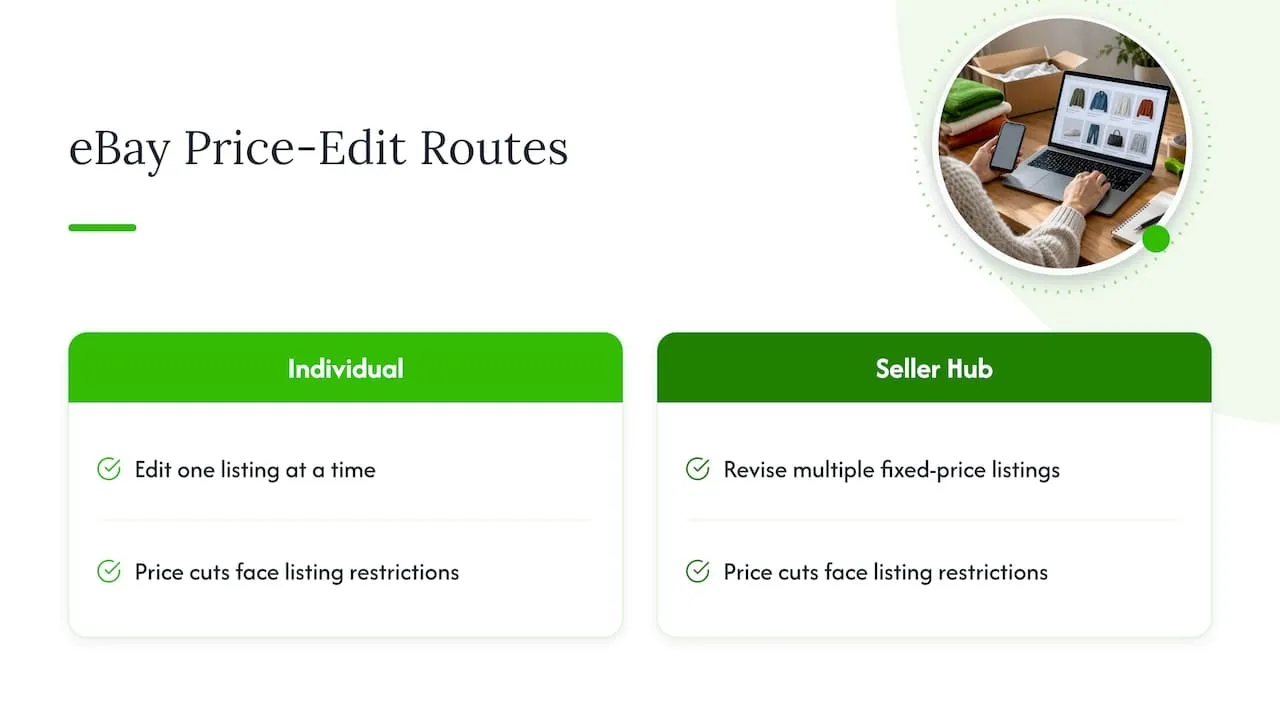
eBay lets sellers lower the price of fixed-price listings, subject to listing restrictions, and Seller Hub allows you to revise multiple listings at once. If you sell in volume, use that bulk route rather than opening items individually.
If you want to understand how prices interact with listing format and timing on eBay, our eBay pricing strategy guide goes further.
A simple order of work
- Decide the new price per channel using your proceeds target.
- Change the channel where the item is most likely to sell first.
- Change the second channel straight away, not later in the week.
- Check that any offers or promotions still make sense at the new price.
- Note the change and the date in your stock sheet.
Steps 2 and 3 matter most. The gap between the two edits is the window in which a buyer can grab the older price.
Offers can move your price without you touching it
Both sites invite haggling, and offers are where a synced price most often drifts.
On eBay, a changed Buy It Now price adjusts automatic offers by the same discount, and lowering the price below the offer level pauses sending, as eBay explains on its Best Offer page. In other words, if you cut the price, check what your automatic offers now mean in pounds.
To stay in control:
- Set an automatic decline below your floor price, not just a hope.
- Build the expected discount into the starting price, so a 10% offer still leaves your target.
- Treat the lowest of your two channel prices as the number buyers will see if they compare.
If you manage Vinted offers and pricing rules at scale, our page on Vinted offers and pricing rules shows what that looks like in practice.
What goes wrong when prices drift
Mismatches rarely come from carelessness alone. They come from busy people, small delays and several places to update. The usual culprits are a price cut on one site that never reaches the other, a promotion left running after you raised the price, and an old comparison price still showing.
The “was” price trap
If you show a reference or “was” price on eBay, you carry the responsibility for it. eBay’s comparative pricing policy says sellers must keep documentary evidence, such as sales records, to substantiate claims, and must comply with applicable laws, codes and guidance, including the CAP Code. Where the price you reference changes, the listing must be updated promptly. For second-hand sellers this means: do not show a higher “was” price on one site that you have not actually charged.
If a price is simply wrong
Typing £5 instead of £50 happens. Citizens Advice explains that in a shop a customer has no right to buy at the lower price, while online rights depend on whether a contract has been formed, and it advises keeping evidence of the mistake. Their page on goods advertised at the wrong price is worth reading before you argue with a buyer. If you are unsure of your position on a particular sale, ask Citizens Advice or Trading Standards rather than guessing.
Do not change a price mid-purchase
Gumtree’s advice applies on every site: keep each platform’s pricing clear and avoid altering it after a buyer has committed to a purchase. Raising a price on one channel while a buyer is mid-checkout on another is a quick route to a dispute.
What to do when an item sells while both listings are live
This is the real danger of running two channels. A price change is a small leak, but a double sale is a cancelled order, an annoyed buyer and possibly a mark against your account.
There are two defences. The manual one is to remove the item from the other site the moment you see a sale notification, which works until you are on a train or asleep. The automatic one is stock sync: when an item sells on one channel, the listing is taken down everywhere else.
That second job is what Ruit does. You list an item once and publish it to Vinted, eBay, Wallapop, todocoleccion, Shopify, WooCommerce and PrestaShop. When it sells on one channel, stock updates and the listing is removed from the others. To be clear about scope, Ruit handles listing and stock, so you still decide your price per channel using the method above. Our guide to stock sync across marketplaces explains how this works for UK sellers.
If you do have to react manually, this is the order:
- Confirm which sale came first, by time stamp.
- Take down the other listing immediately.
- If a second buyer has already paid, cancel and refund through that platform’s own process, and message the buyer politely and promptly.
- Fix the cause: a missed notification, a delayed update or a forgotten listing.
Our view: sync the stock, think about the price
We built Ruit around one idea: list once and never sell the same item twice. Over time we have noticed that sellers reach for price automation first, when the costlier mistake is nearly always a double sale. A £2 price gap annoys you. A sold-twice item costs you a sale, a refund and a buyer’s trust.

That is why our advice is to handle the two problems in a different order from how they feel. Get stock right first, so a sold item disappears from every channel. Then settle your pricing rule, and keep it simple enough to follow without a spreadsheet. Sellers who start with an identical price and move to channel-specific pricing only where fees clearly differ tend to keep their routine tidy.
And be honest about what you sell. Vinted buyers often expect a bargain on pre-loved clothes and eBay buyers search more widely, including for rarer vintage pieces. A slightly higher eBay price for a scarce item is not inconsistency, it is reading the audience.
- Luis
A weekly routine that keeps prices in line
You do not need software to avoid most mismatches. You need a fixed habit.
- Pick a day. Sunday evening works for many sellers.
- Sort by age. Look first at items listed more than a month ago. Those are your reduction candidates.
- Reduce in steps. A modest cut, applied on both channels the same day, beats a dramatic one on a single site.
- Check offers. Make sure automatic offers still sit above your floor.
- Refresh stale listings. Relisting can bring an old item back in front of buyers. Ruit relists automatically on Vinted and Wallapop, which saves you doing it by hand.
- Record the changes. One line per item is enough.
If you have a large backlog, getting listings live in the first place is the bottleneck. Our guides to bulk uploading on Vinted and bulk uploading on eBay cover that stage, and our overview of marketplace automation shows where each task fits.
Making it easier with Ruit
If you sell on Vinted and eBay at the same time, Ruit gives you one place to list. Write the item once, let AI draft the title and description, publish to your channels together, and let stock sync remove it elsewhere when it sells. Vinted and Wallapop buyer messages arrive in one inbox, so you are not hopping between apps. Try Ruit for UK Vinted and eBay selling and see how much of the routine above it takes off your hands.
Sources
- Choosing the price for your item, Vinted
- Revise a listing, eBay UK
- Adding Best Offer to your listing, eBay UK
- Buyer Protection information for sellers, eBay UK
- Vinted price list, 8 October 2026
- Fees for business sellers, eBay UK, 30 September 2026
- Buyer Protection Pro fee, Vinted
- Comparative pricing policy, eBay UK
- If something is advertised at the wrong price, Citizens Advice
- Should you list an item on more than one marketplace, Gumtree
Frequently Asked Questions
Should I charge the same price on Vinted and eBay?
Not necessarily. If you are a private seller and the fees fall on the buyer on both sites, the same price often gives the same result. If you are a business seller paying eBay final value fees, work out what you keep on each channel and adjust the listed price to match.
Can I change the price on Vinted and eBay at the same time?
Not from the platforms themselves, because each has its own edit screen. On Vinted you edit the published listing, and on eBay you can revise several listings together in Seller Hub. Make both changes in the same sitting so the older price is not live for long.
Does Ruit sync prices between marketplaces?
Ruit lists an item once on Vinted, eBay and its other channels, and syncs stock so a sold item is removed from the rest. You set and adjust prices yourself per channel, which suits sellers whose fees differ between sites.
What happens if an item sells on both sites?
Cancel the later order through that platform’s own process, refund the buyer if they have paid, and message them promptly. To prevent a repeat, remove listings quickly after each sale or use stock sync so it happens automatically.
Do Vinted Pro and business accounts price differently?
The fees differ. Business sellers on eBay pay final value fees and a per-order fee, and buyers of Vinted Pro items pay a Buyer Protection Pro fee based on the order price. Check both fee pages before setting prices for a business account.