Reseller Inventory Management: A Practical Guide


Table of Contents
- Table of Contents
- Why Reseller Inventory Management Is a Margin Problem
- Core Inventory Models Every Reseller Should Understand
- Intake, Merging, and Import Workflows That Scale
- Multichannel Synchronization and Preventing Oversells
- KPIs That Actually Move Profit in Reselling
- Compliance-Aware Inventory Records
- Returns, Fraud, and Recovery Economics
- Your First-Week Reseller Inventory Checklist
- Frequently Asked Questions
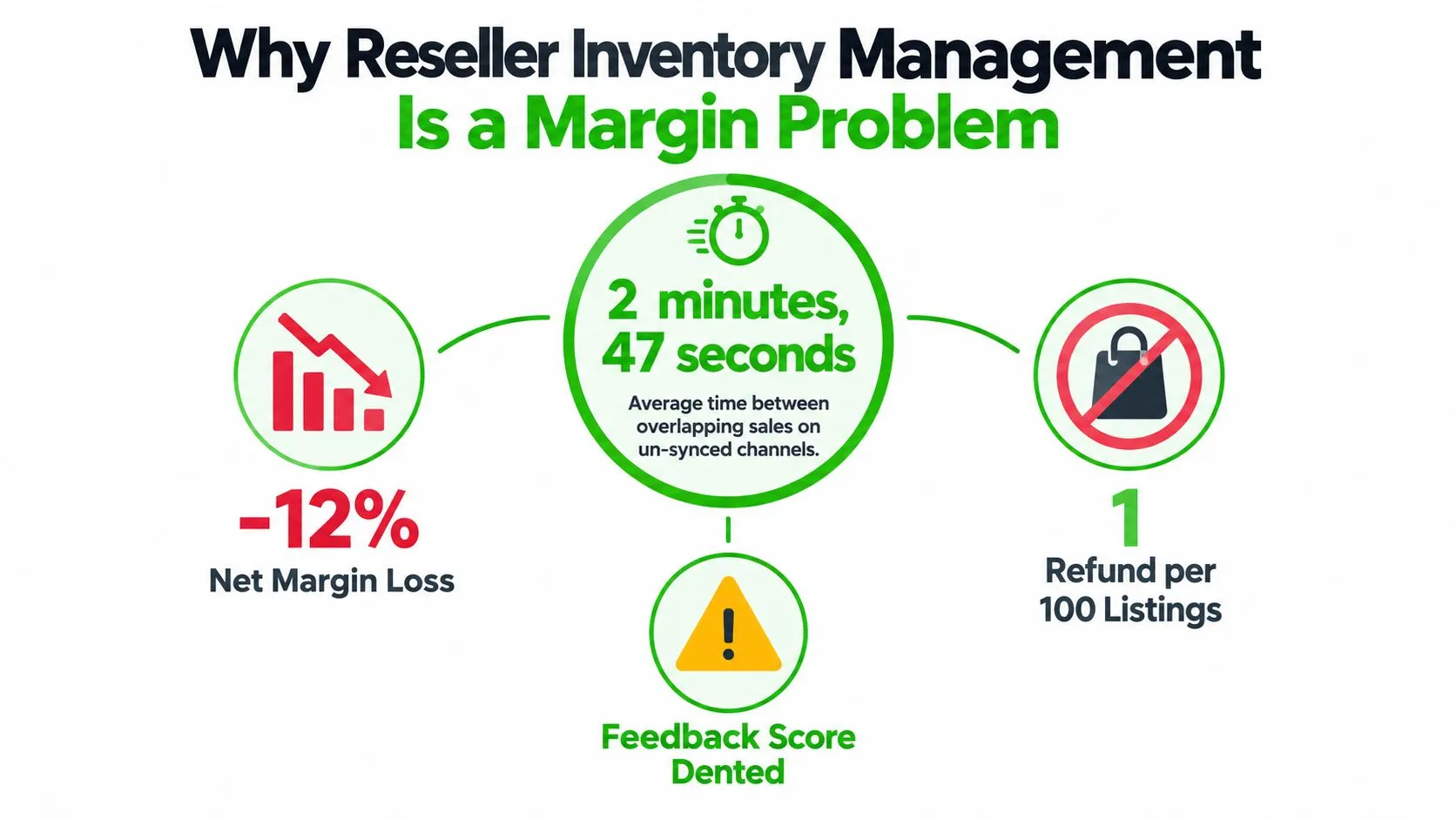
A handbag sells on eBay, then on Vinted three minutes later. The first buyer gets a cancellation, the second receives a refund, and you spend part of the afternoon explaining a mistake that began with one stale listing. The visible damage is a poor customer experience. The less visible damage is the margin lost through refund handling, relisting work, marketplace risk, and time that could have gone into sourcing or fulfilling another order.
The scale of the problem is larger than most reseller spreadsheets suggest. Inventory distortion, the combined effect of overstock and out-of-stock inventory, has been estimated to cost global retailers approximately $1.75 trillion annually, including overstocks, out-of-stocks, and preventable returns in the IHL Group inventory distortion analysis. A professional reseller faces the same opposing risks with a sharper edge because many items are unique, quantities are limited, and one inaccurate quantity can represent the entire available supply.
Table of Contents
- Why Reseller Inventory Management Is a Margin Problem
- Core Inventory Models Every Reseller Should Understand
- Intake, Merging, and Import Workflows That Scale
- Multichannel Synchronization and Preventing Oversells
- KPIs That Actually Move Profit in Reselling
- Compliance-Aware Inventory Records
- Returns, Fraud, and Recovery Economics
- Your First-Week Reseller Inventory Checklist
Why Reseller Inventory Management Is a Margin Problem
Reseller inventory management gets treated like admin work until the same item appears sold in two places, the buyer wants an answer, and someone has to clean up the mess by hand. At that point, the issue is no longer clerical. It has become a margin problem.
The cost reaches beyond the refund itself. A cancellation can pull support time away from other orders, trigger payment or return handling, weaken buyer trust, and leave a marketplace listing with a worse outcome than before. If the item was in demand, the business also loses the chance to sell it at the original price while the team deals with an avoidable exception.
The IHL figures break the broader retail problem into $471.9 billion attributed to overstocks, $634.1 billion to out-of-stocks, and $642.6 billion to preventable returns in the landmark study referenced by Retail Insight Network. Those categories map directly to second-hand operations. Inventory sitting unseen in storage ties up cash and space. Stock that appears available after it has already sold creates an oversell. A return that is not inspected and reclassified quickly turns into dead stock instead of recoverable inventory.
The margin leak behind a listing
A listing becomes useful when the item is identifiable, available, accurately described, easy to locate, and connected to a reliable fulfillment process. If any of those pieces fail, the listing can create work without creating profit.
The practical measure is profit per hour worked. A seller who processes more unique items with fewer manual checks can raise capacity without adding labor at the same pace. That matters as resale expands. ThredUp’s 2025 Resale Report says the global secondhand apparel market grew 15% in the latest measured year, represented 9% of global apparel spending, and is projected to reach $367 billion by 2029. The report also projects a 10% compound annual growth rate and says resale is expected to grow 2.7 times faster than the overall global apparel market.
Those figures do not make a spreadsheet effective on their own. They do show why manual controls get harder to sustain as assortment and transaction volume grow. The useful system connects intake, identity, stock changes, marketplace listings, returns, and reporting. It protects margin by reducing how often a person has to correct the same item.
Core Inventory Models Every Reseller Should Understand
Resellers generally operate with three practical inventory models. Each creates a different control point and risk profile:
| Model | Best For | Main Risk |
|---|---|---|
| Centralized ledger | Sellers who need one authoritative stock record across channels | Requires disciplined intake and strict event handling |
| Per-channel listings | Early testing or low-volume operations on a single marketplace | Quantities drift and sold items remain visible elsewhere |
| SKU discipline | Any operation handling unique or low-quantity items | Weak identifiers make every later workflow unreliable |
A centralized ledger holds the authoritative available-to-sell state. Marketplaces read from it, while sales, cancellations, transfers, holds, and adjustments update the central record before channel quantities change. That sequence gives the team one answer to whether an item can be sold. It also creates a usable audit trail for intake decisions, listing edits, compliance evidence, and post-sale recovery.
The trade-off is operational discipline. A centralized record makes quick test listings less casual because every item needs an identity and a defined status. Once several marketplaces, storage locations, or staff members are involved, that control usually costs less than correcting duplicate sales and unexplained stock differences.
The per-channel model keeps each marketplace responsible for its own listings and quantities. It can suit early testing or a small operation concentrated on one channel. Problems appear when the same jacket, camera, or handbag is published in several catalogues with different titles, condition notes, prices, or availability. A sale on one channel then depends on someone remembering to update every other channel.
SKU discipline supports either model. Assign one internal identifier to each physical unit, then map every marketplace listing back to that identifier. A replenishable product can use one SKU with a quantity. A one-of-a-kind item should normally have an identifier for the individual unit, especially when photographs, serial details, defects, certificates, or other evidence must stay attached to its record.
The difference between replenishable and one-of-a-kind stock offers context for separating those records. For replenishable goods, a seller can calculate your reorder point and connect that threshold to purchasing decisions. One-of-a-kind resale items usually need aging, demand, markdown, return, and recovery rules instead of automatic replenishment.
Intake, Merging, and Import Workflows That Scale
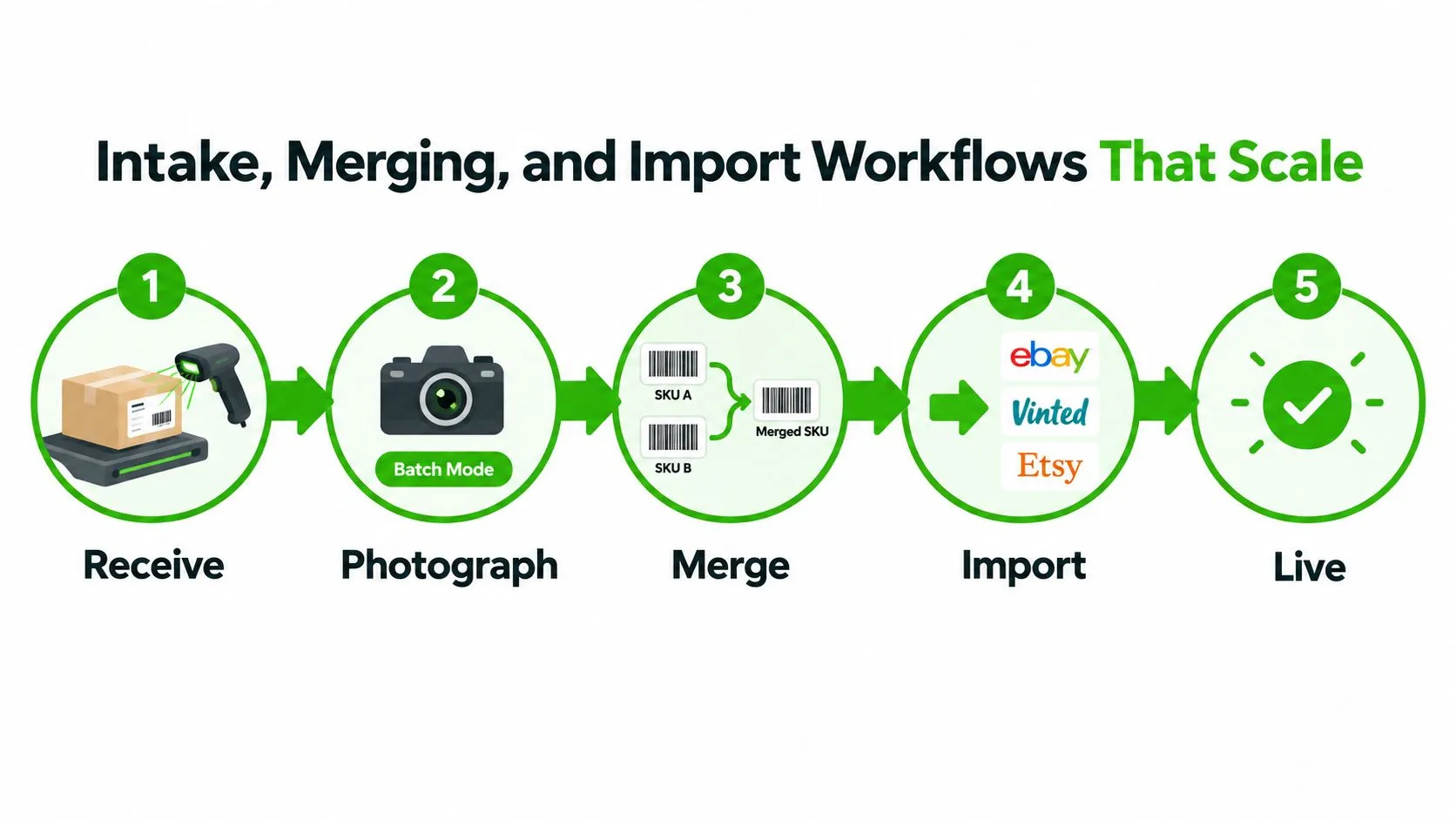
A reliable inventory process starts before an item becomes a listing. Receiving, photographing, grading, merging, and importing are interdependent steps in a single workflow. A weak handoff during intake can create incorrect listings, missing evidence, and stock errors across every marketplace.
Record each item as a physical object when it arrives. Capture its source, acquisition details, condition, defects, relevant measurements, photographs, storage location, and the person or process that handled it. Treat each change as an event linked to the item, so the record explains what happened instead of showing an unexplained quantity edit. That history supports day-to-day control and gives the business evidence when a buyer, platform, or supplier questions an item.
Start with identity, not publication
An incoming item may require a new SKU, belong to an existing SKU, duplicate stock already held, or enter quarantine for further inspection. Matching should use every reliable signal available, including UPC, EAN, MPN, serial number, brand, model, visual attributes, and source data. Fuzzy matching can propose a candidate, while a person approves ambiguous matches. A mistaken merge can attach the wrong images, condition notes, or ownership details to a physical item.
For unique goods, photographs form part of identity control. A serial number, distinctive mark, repair, missing accessory, or visible flaw can separate two otherwise similar items. Keep the image set attached to the internal record, where it remains available for relisting, disputes, returns, and channel updates. A marketplace listing can display the evidence, but the internal record should retain it.
Import from the authoritative record
After identity and condition checks are complete, create the listing from the central record. Keep the title, condition grade, price, measurements, and image set in that record before publication. This gives staff one approved version to review and makes later corrections traceable.
A practical event sequence includes:
- Received: The item entered the business and awaits inspection.
- Inspected: Condition, authenticity signals, accessories, and defects were recorded.
- Ready to list: The item has an approved SKU, location, and evidence file.
- Published: Channel listings were created from the central record.
- Reserved: A checkout or operational hold temporarily reduces available stock.
- Sold: The item is no longer available to sell.
- Returned or quarantined: The item requires inspection before becoming available again.
Batch photography can improve throughput when every image set is tied to the correct SKU before publication. Sellers handling wholesale clothing or mixed lots can consult this guide from OneTrendyCloset for sourcing context, then apply the same identity checks during receiving.
The inventory import workflow should finish with a reconciled record. Confirm that every imported item has one internal identity, one physical location, and a clear available-to-sell state. Stock changes then flow through the ledger as events, while marketplaces receive the approved result. This workflow turns inventory records into operating evidence, not just listing data.
Multichannel Synchronization and Preventing Oversells
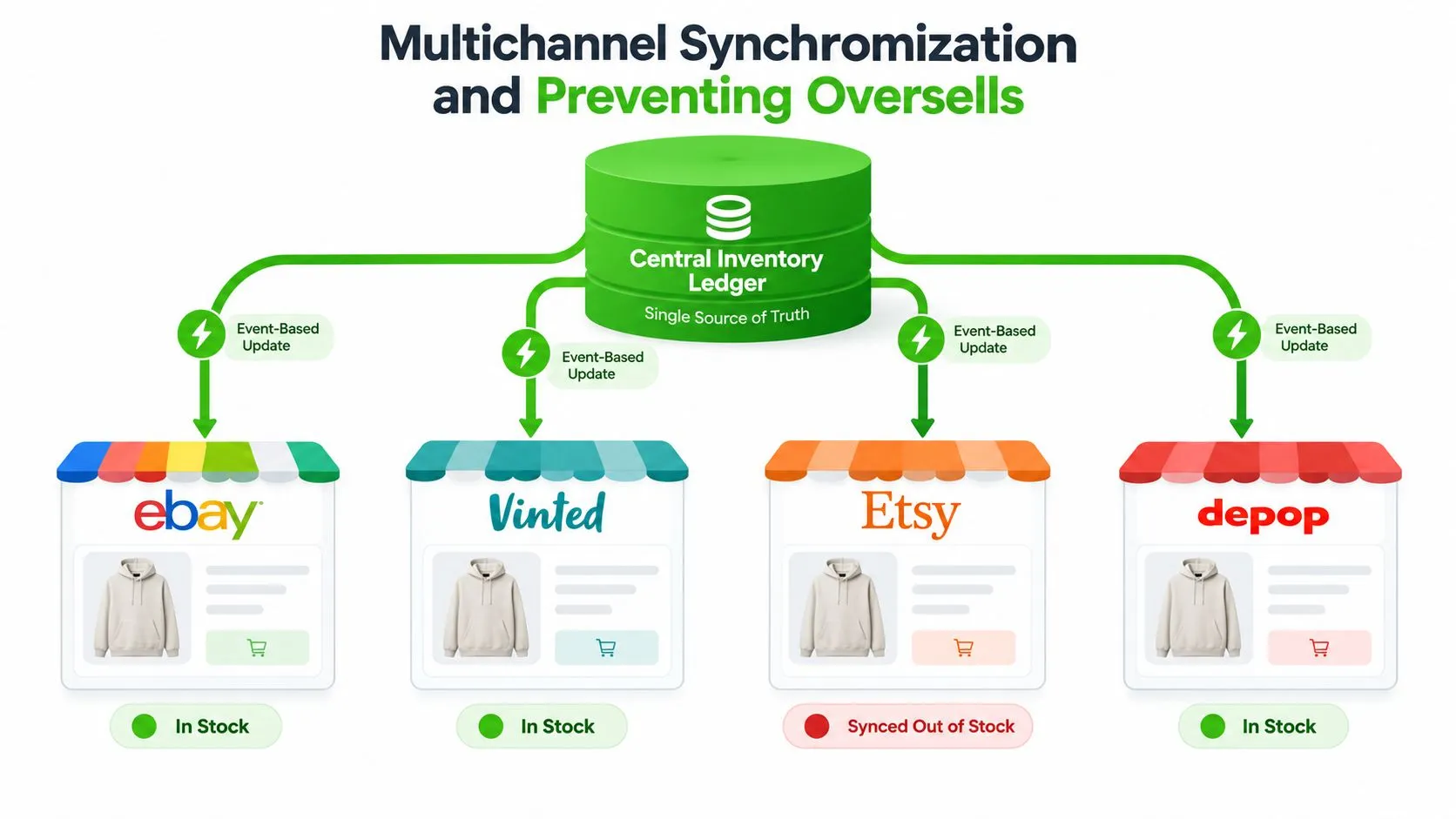
A central ledger must remain the operating system for every storefront. Marketplaces such as eBay and Etsy display availability from that record, but none should become the stock authority because its interface is easier to use. The ledger should also retain the event, timestamp, channel, and reason behind each change, giving staff evidence when an order, return, adjustment, or loss requires investigation.
Use an event-based workflow. A sale, reservation, return, correction, or loss creates one inventory event. The ledger processes it once, changes the item’s state, and sends the resulting availability to connected channels. Idempotent processing prevents a repeated marketplace notification from subtracting the same unit twice. Without that protection, a valid sale can create a false shortage and trigger unnecessary manual work.
Choose the right update mechanism
Polling checks a marketplace at set intervals. It remains practical where webhooks are unavailable, but the interval creates stale availability and repeated requests can consume API capacity.
Webhooks let a marketplace notify your system when an order or listing event occurs. They reduce unnecessary requests, but the receiver needs signature validation, retries, duplicate-event protection, and a fallback for missed notifications.
Pub/sub messaging sends events through a broker so separate services can handle stock, orders, analytics, and alerts independently. This arrangement supports higher volumes, but each service needs clear acknowledgement states, error handling, and monitoring.
Choose the mechanism according to channel capability and the cost of failure. Do not label a process “real time” when updates can stop without warning. Record when the sale occurred, when the ledger changed, when each channel acknowledged the update, and how long a channel remained stale. That history shows whether a sync failure came from the marketplace, the integration, or an internal workflow.
Build controls for messy orders
Auto-delist after a confirmed sale protects unique inventory. Scheduled relisting can restore visibility for stale stock, but the rule must check the current state before publishing. Sold, reserved, returned-for-inspection, lost, or authenticity-review items must stay inactive.
Reservations need an explicit expiry. Hold stock during checkout when the channel supports it, then release the hold after cart abandonment or payment-window expiry. A short timeout can remove an item while a buyer is still paying. A long timeout hides available stock and delays recovery of the selling opportunity.
Bundles require component-level logic. A kit containing a jacket and accessory must reduce the availability of both components. A split shipment should preserve the order relationship without making undelivered items available. Multi-quantity listings also need separate rules. Selling one unit should reduce the quantity, not close the entire listing.
If a marketplace returns an error, keep the ledger state as the source of truth, place the failed update in a retry queue, and alert a person after repeated failures. Run nightly reconciliation against channel-reported quantities, record the root cause, and feed recurring errors back into intake or integration rules. This multichannel inventory management guide provides further context for connecting those controls.
This video provides a visual explanation of how a central inventory workflow can coordinate multiple selling channels:
KPIs That Actually Move Profit in Reselling
A live catalogue can still be unprofitable if it takes too much labor to maintain. The useful question isn’t how many listings exist. It’s how much realized margin each hour of handling produces after cancellations, corrections, returns, storage, and relisting work.
Start with four operational measures. Keep definitions stable so the team can compare performance over time.
| KPI | How to Measure | Healthy Range | Profit Lever |
|---|---|---|---|
| Sync latency | Time between a stock event and acknowledgement from each channel | Consistently low and visible by channel | Reduces stale listings and manual intervention |
| Oversell rate | Orders canceled because the item was unavailable | Near-zero with every exception investigated | Protects refunds, reputation, and staff time |
| Inventory Record Inaccuracy | Difference between system stock and physically available stock | Low, with separate review of valuable or fast-moving items | Prevents false availability and missing stock |
| Time to relist | Time from intake or return approval to a live, accurate listing | Short enough to avoid unnecessary idle stock | Gets capital back into the selling cycle |
| Turn rate | Units sold relative to the inventory base over a chosen period | Appropriate to category and sourcing model | Shows whether buying creates movement |
| Aged-stock share | Portion of inventory held beyond your chosen action threshold | Falling or actively managed | Limits storage cost and forced markdowns |
Inventory Record Inaccuracy, or IRI, compares what the system says exists with what is physically available. A field study across 13 stores over 23 weeks found that RFID-enabled visibility reduced IRI by approximately 26%, while a larger experiment across 62 stores and five product categories produced improvements ranging from statistically insignificant in some categories to 81% in others, as reported in the Production and Operations Management study. The variation matters. Measure accuracy separately for high-value, fast-moving, and long-dwell items instead of trusting one catalogue-wide average.
Another controlled study reported that RFID improved inventory accuracy by more than 27% over 13 weeks, alongside a 21% reduction in understock and a 6% reduction in overstock, according to the University of Arkansas research summary. A reseller doesn’t need RFID to apply the principle. Scan audits, location checks, event logs, and exception queues can all improve visibility.
Don’t chase a universal “healthy range.” A solo seller and a small warehouse team have different workflows, channel mixes, and tolerance for manual review. Set a baseline, identify the costliest exception, change one workflow, and check whether profit per hour improves.
Compliance-Aware Inventory Records
A European Commission sweep found that 52% of checked businesses breached at least one consumer-protection rule, while 45% failed to provide complete information about remedies for faulty goods and 57% did not respect the one-year minimum legal guarantee applicable to second-hand goods in the relevant context. European second-hand traders must now treat inventory data as compliance evidence, not internal housekeeping, according to the European Parliament document on the sweep.
Treating inventory data as internal housekeeping is now a compliance risk for European cross-border sellers. The record attached to each item should support its location, disclosed condition, buyer-facing description, return handling, and the guarantee or policy applied to the transaction. Legal obligations vary by country, business model, and marketplace, so records should reflect the policies the reseller offers.
What belongs in an item evidence file
For a valuable handbag, camera, watch, or electronic device, a title and purchase price leave too many gaps. Build an item-level evidence file that follows the product from intake through sale and any later adjustment.
- Condition evidence: Store time-stamped notes, defect photographs, repair history, missing parts, and the approved condition grade.
- Identity evidence: Retain serial numbers, distinctive marks, model information, and authenticity checks where relevant.
- Sourcing metadata: Record the source, acquisition date, supplier information, and any internal decision about provenance.
- Listing history: Preserve the description, photographs, price, guarantee language, and return policy shown to the buyer. Save the version associated with each channel and order.
- Movement history: Track receiving, storage location, reservation, sale, dispatch, return, quarantine, adjustment, and final disposition.
- Channel context: Keep the marketplace, order reference, buyer-facing policy, and acknowledgement of important stock events.
These fields also connect compliance work to daily operations. Intake staff can attach evidence before a listing goes live. Marketplace operators can verify that condition claims and policies match the published version. Customer-service staff can retrieve the relevant record without relying on screenshots, memory, or an overwritten product page.
Use controlled adjustments and retain previous versions. A system that lets anyone overwrite the condition field weakens the evidence trail, even when the correction is legitimate. Require a reason for each change, record who made it, and restrict edits to fields that affect condition, authenticity, price, or buyer rights.
An item-level audit trail supports listing accuracy, customer communication, dispute handling, and policy review at the same time. It also gives the business a usable record when marketplace requirements or product-information rules change.
Returns, Fraud, and Recovery Economics
A return changes inventory status. It isn’t just a customer-service ticket to close after issuing a refund. The item may come back damaged, incomplete, counterfeit, worn, or unchanged. Until someone inspects and regrades it, the business doesn’t know whether it is available, recoverable, repairable, discountable, or unsaleable.
Returns data highlights the pressure. 44% of brands identify returns fraud and abuse as their biggest returns-process pain point, and apparel and footwear brands report inventory shrinkage and lower resale value from fraud, damage, or unsaleable items as major cost drivers in the 2025 State of Returns report from Radial. For unique second-hand goods, substitution is rarely possible. One returned item may be the only unit with that exact condition and history.
Use a recovery decision, not an automatic restock
When a return arrives, place it in quarantine until the inspection is complete. Compare intake photographs, packaging evidence, serial numbers, weight where appropriate, and the reason selected by the buyer. Then choose a disposition based on recoverable value and handling cost:
- Relist at the original grade if the item matches its evidence file and remains saleable.
- Regrade and reprice if wear, missing packaging, or a changed condition affects buyer expectations.
- Repair or clean when the recovered value justifies the work.
- Liquidate when speed matters more than the original price.
- Write off when inspection, storage, and resale costs exceed the likely recovery.
The system should assign refund cost, outbound shipping, inspection labor, depreciation, and recovered resale value to the original order and SKU. Review return reasons, recovery rate, and time to relist regularly. That exposes sourcing problems that a sales report hides, such as a category with attractive sell-through but poor post-return recovery.
| Variable | Value |
|---|---|
| Original item value | Use the item’s recorded sale value |
| Return frequency | Use your measured return rate for the relevant category |
| Resellable share | Record the proportion passing inspection |
| Recovered value | Record the resale value after regrading, repair, or discounting |
| Handling cost | Include shipping, inspection, labor, storage, and relisting |
| Net recovery cost | Refund and handling costs minus recovered resale value |
A permissive return policy can be commercially sensible, but it isn’t automatically cheap. Visibility is what makes it manageable. Timestamped intake records and event-based restock decisions also create a defense file for item-not-received disputes, chargebacks, and claims that the returned item differed from the item shipped.
Your First-Week Reseller Inventory Checklist
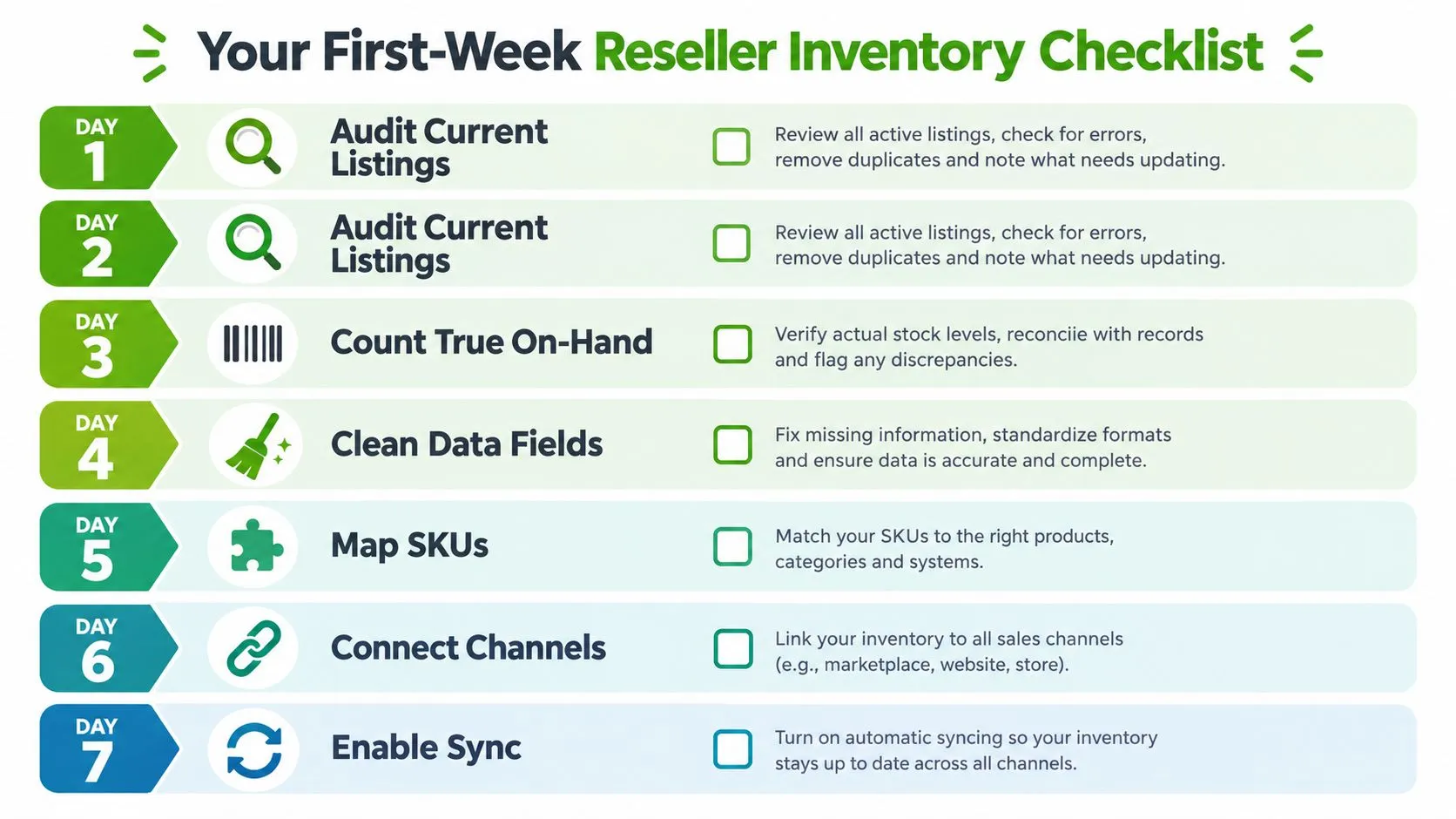
A workable system can begin with a focused audit rather than a complete technology replacement. The first week should establish the truth of your current stock, assign ownership to each record, and expose the workflow that creates the most expensive exceptions.
- Days 1 and 2, audit live listings: Export or review every active listing, identify duplicate items, and compare marketplace quantities with physical stock. Mark any item you can’t locate or confidently identify.
- Day 3, choose the operating model: If you sell on multiple channels, select a centralized ledger and create one internal SKU for every physical unit. Don’t allow marketplace item IDs to become your only identity system.
- Day 4, standardize intake: Require photographs, condition notes, location, serial or model details where relevant, source information, and a clear available-to-sell status before publication.
- Day 5, connect channel controls: Enable automatic removal after a confirmed sale, define reservation behavior, and create a retry or exception queue for failed updates. Schedule relisting only for items that remain genuinely available.
- Day 6, establish KPI baselines: Measure sync latency, oversell rate, IRI, and time to relist. The first baseline doesn’t need to look good. It needs to be trustworthy.
- Day 7, document recovery and disputes: Set return reason codes, quarantine rules, inspection evidence requirements, relisting decisions, and the documents needed for item-not-received or chargeback cases.
The checklist is a loop, not a finish line. Review the same four core KPIs each week, tag the cause of every exception, and use the results to adjust sourcing, pricing, channel selection, intake standards, and staffing. A stock system earns its keep when it helps you decide what to buy, what to list, what to recover, and what to stop handling.
Frequently Asked Questions
What is the difference between a centralized ledger and per-channel listings?
A centralized ledger holds the authoritative available-to-sell state: marketplaces read from it, and sales, cancellations, transfers, holds, and adjustments update it before channel quantities change. Per-channel listings leave each marketplace responsible for its own quantities, which can suit early testing but lets quantities drift once the same item is published in several catalogues.
How do you prevent oversells across marketplaces?
Treat every sale, reservation, return, correction, or loss as one inventory event that the ledger processes once before sending the resulting availability to connected channels. Idempotent processing stops a repeated marketplace notification from subtracting the same unit twice, failed updates go to a retry queue, and a nightly reconciliation compares the ledger with channel-reported quantities.
Which KPIs should a reseller track first?
Start with sync latency, oversell rate, inventory record inaccuracy, and time to relist. Keep the definitions stable, set a baseline, fix the costliest exception, and check whether profit per hour improves.
What should happen when a return arrives?
Place it in quarantine until inspection is complete. Compare it with the intake photographs, serial numbers, and the reason the buyer selected, then choose a disposition: relist at the original grade, regrade and reprice, repair or clean, liquidate, or write off.
Ruit centralizes inventory intake, SKU matching, multichannel publication, automatic stock synchronization, auto-delist, scheduled relisting, orders, and operational analytics for professional second-hand sellers. Visit Ruit to see how one operating system can connect your item records with the marketplace workflows that protect profit per hour.