Ecommerce ERP Integration: Step-by-Step Implementation Guide


Table of Contents
- Table of Contents
- Why Disconnected Systems Cost Professional Sellers
- The Measurable Business Case for ERP Integration
- Planning Your Ecommerce ERP Integration Strategy
- Engineering Event-Driven Inventory Synchronization
- The Hidden Post-Integration Challenge, Data Governance
- Compliance, Traceability, and Reverse Logistics
- Ruit as a Practical Integration Path for Professional Sellers
- Frequently Asked Questions
A sale on Vinted should remove the same item from eBay, update available stock in the ERP, create the correct order record, and flow into accounting without anyone copying details between screens. In a fragmented setup, one of those handoffs fails without warning. The seller ships the item, discovers a second buyer has paid elsewhere, then spends the end of the month comparing spreadsheets to marketplace settlements.
That’s the practical reason ecommerce ERP integration matters. The objective isn’t to connect software for its own sake. It’s to create one dependable operational record across listings, inventory, orders, payments, returns, and finance, with clear controls for the exceptions that automation can’t resolve by itself.
Table of Contents
- Why Disconnected Systems Cost Professional Sellers
- The Measurable Business Case for ERP Integration
- Planning Your Ecommerce ERP Integration Strategy
- Engineering Event-Driven Inventory Synchronization
- The Hidden Post-Integration Challenge, Data Governance
- Compliance, Traceability, and Reverse Logistics
- Ruit as a Practical Integration Path for Professional Sellers
Why Disconnected Systems Cost Professional Sellers
A professional reseller rarely has only one source of truth. Stock may begin in a spreadsheet, move into a marketplace listing tool, appear on Vinted or eBay, and then reach an accounting system through a manual export. Each system can look correct in isolation while the business record is already wrong.
The failure usually appears in a familiar sequence. An item sells on one marketplace, the delist reaches another channel but not the ERP, and the stock balance remains available. A customer places a second order. The team refunds one buyer, adjusts a spreadsheet, and later finds that the accounting entry doesn’t match the marketplace settlement. Nobody intended to create a control problem. The workflow had too many unverified handoffs.

The operational cost hides in small exceptions
Fragmentation consumes time in places that don’t appear on a software invoice:
- Overselling: A delayed stock update leaves an unavailable item live on another channel.
- Manual order entry: Someone retypes buyer, shipping, payment, and line-item information.
- Untracked returns: A returned product sits in quarantine while the sales and inventory records still show an ordinary sale.
- Spreadsheet reconciliation: Staff compare channel exports, ERP records, refunds, and fees instead of investigating genuine exceptions.
- Unclear ownership: When two records disagree, nobody knows which value should win.
Those issues become more serious as a business adds channels, warehouses, staff, and transaction volume. In the European Union, 46.45% of enterprises used ERP software in 2025, making it the most widely adopted among the major business-software categories tracked in the cited industry analysis. Adoption was 41.08% among small enterprises and 88.71% among large enterprises, according to ERP adoption analysis for European enterprises.
Practical rule: Integration should remove decisions from routine workflows, not hide unresolved decisions inside an automated connector.
For a useful discussion of the wider risks around connecting business systems, see Rite NRG integration insights. The key lesson for sellers is straightforward: integration becomes infrastructure when it protects the accuracy of every subsequent process, from fulfilment to reporting.
The Measurable Business Case for ERP Integration
The commercial case rests on more than fewer spreadsheet edits. Research involving more than 1,000 B2B ecommerce operators reported a 21% increase in conversion rates, an 11% increase in returning customers, a 16% reduction in order errors, and a 67% increase in revenue after ecommerce and ERP integration, as documented by Sana Commerce’s ERP ecommerce integration research.
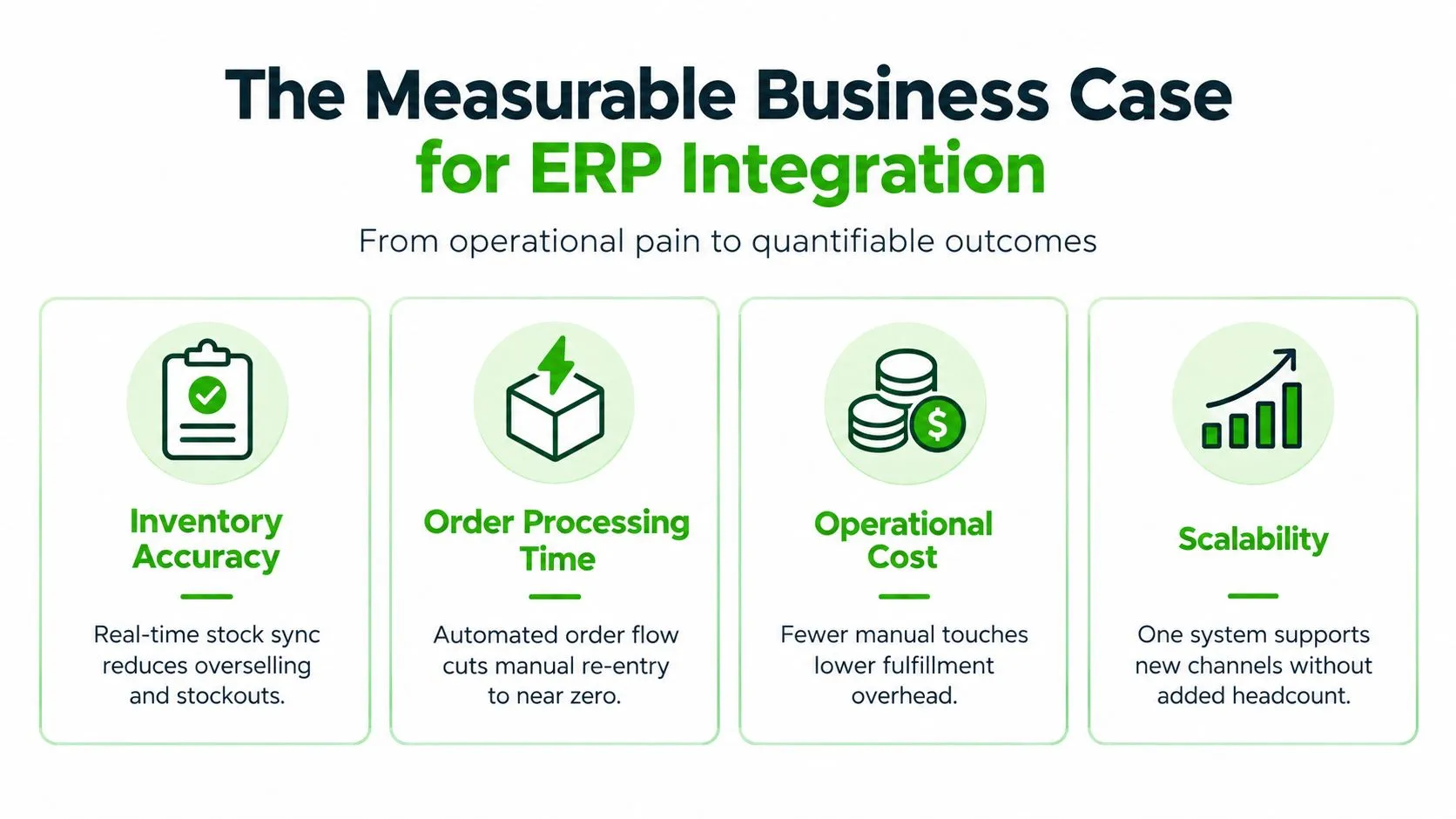
The useful part of these results is the mechanism behind them. When product, inventory, customer, order, and financial data move between systems without repeated re-entry, buyers see more dependable availability and ordering information. Staff spend less time correcting mismatches, which leaves more capacity for sourcing, customer service, merchandising, and margin decisions.
The 16% reduction in order errors is particularly relevant to multichannel sellers. A stale quantity, outdated price, or incorrectly mapped variant can create cancellations and fulfilment work that a customer never sees as a software problem. They experience it as an unavailable item, a wrong order, or an uncertain delivery.
What the numbers do and don’t prove
The reported 67% revenue increase shouldn’t be treated as a guaranteed result for every retailer. Sector, starting processes, implementation quality, catalogue complexity, customer demand, and market conditions all influence performance. Integration can expose bad data rather than instantly fix it, and a connector won’t repair unclear ownership or poor returns handling.
The figures still establish a strong business case because they cover several parts of the operating model:
| Outcome | Why integration can influence it |
|---|---|
| Conversion | Buyers receive more reliable availability and ordering information |
| Returning customers | Consistent fulfilment and service reduce friction after the first purchase |
| Order accuracy | Structured data reduces retyping and conflicting channel records |
| Revenue | Better execution supports more dependable selling across connected channels |
A sound business case therefore combines commercial metrics with operational controls. Track order exceptions, stock variance, reconciliation effort, and repeat-purchase behaviour before rollout. Then compare the same measures after each integration phase instead of judging success by whether the API responds.
Planning Your Ecommerce ERP Integration Strategy
Treat the project as a controlled data-and-process migration, not a connector installation. The connector is only the transport layer. The difficult decisions concern ownership, identity, state changes, and the actions people take when records conflict.
Establish ownership before mapping fields
Start with a system-of-record matrix. In many ecommerce models, the ERP should govern financial postings, product master data, and available inventory. The commerce layer should govern storefront content and customer-facing merchandising. That division isn’t universal, but leaving it undefined guarantees competing edits.
Write down the owner for each domain:
- Product identity: Decide how the business identifies a product, variant, one-off item, and bundle.
- Inventory: Define whether the ERP holds sellable, reserved, damaged, quarantined, and in-transit quantities separately.
- Commercial data: Specify where prices, promotions, tax codes, and marketplace fees are calculated.
- Order state: Map statuses such as paid, picking, shipped, cancelled, refunded, and returned.
- Financial records: Define when an order, refund, fee, and settlement becomes an accounting event.
For second-hand stock, “SKU” often isn’t enough. A unique jacket may have a marketplace listing ID, an internal item ID, a barcode, a purchase record, and a condition grade. Store immutable identifiers and document one-to-many relationships rather than relying on matching title text.
A practical introduction to the commercial and operational role of an ERP appears in Ruit’s guide to ERP for ecommerce. Use that perspective to scope processes, not just fields.
Clean, pilot, and test the exceptions
Clean legacy records before migration. Deduplicate products, validate units and currencies, check VAT treatment, and standardise condition attributes. Then pilot with both high-volume products and difficult exceptions, including one-off items, refunds, partial fulfilments, and returns.
Your test plan should include:
- Duplicate orders: Replaying the same event must not create a second order.
- Partial fulfilment: The system must preserve remaining quantities and status.
- Cancellations and refunds: Financial and inventory effects must be explicit.
- Overselling: The workflow must reserve or decrement stock before confirmation.
- API limits and retries: Temporary failures must retry without duplicating business actions.
- Out-of-order events: Older updates must not overwrite newer inventory states.
A synthesis of 53 ERP studies identified data migration and conversion, system integration, change management, project management, training, and business-process redesign among recurring implementation problems. Published failure estimates ranged from 40% to 90%, depending on how failure was defined, according to the ERP implementation study synthesis.
Roll out in phases. Stabilise product and inventory data first, then orders, returns, settlements, and advanced automation. Keep a rollback plan and require a named owner for every exception queue.
Engineering Event-Driven Inventory Synchronization
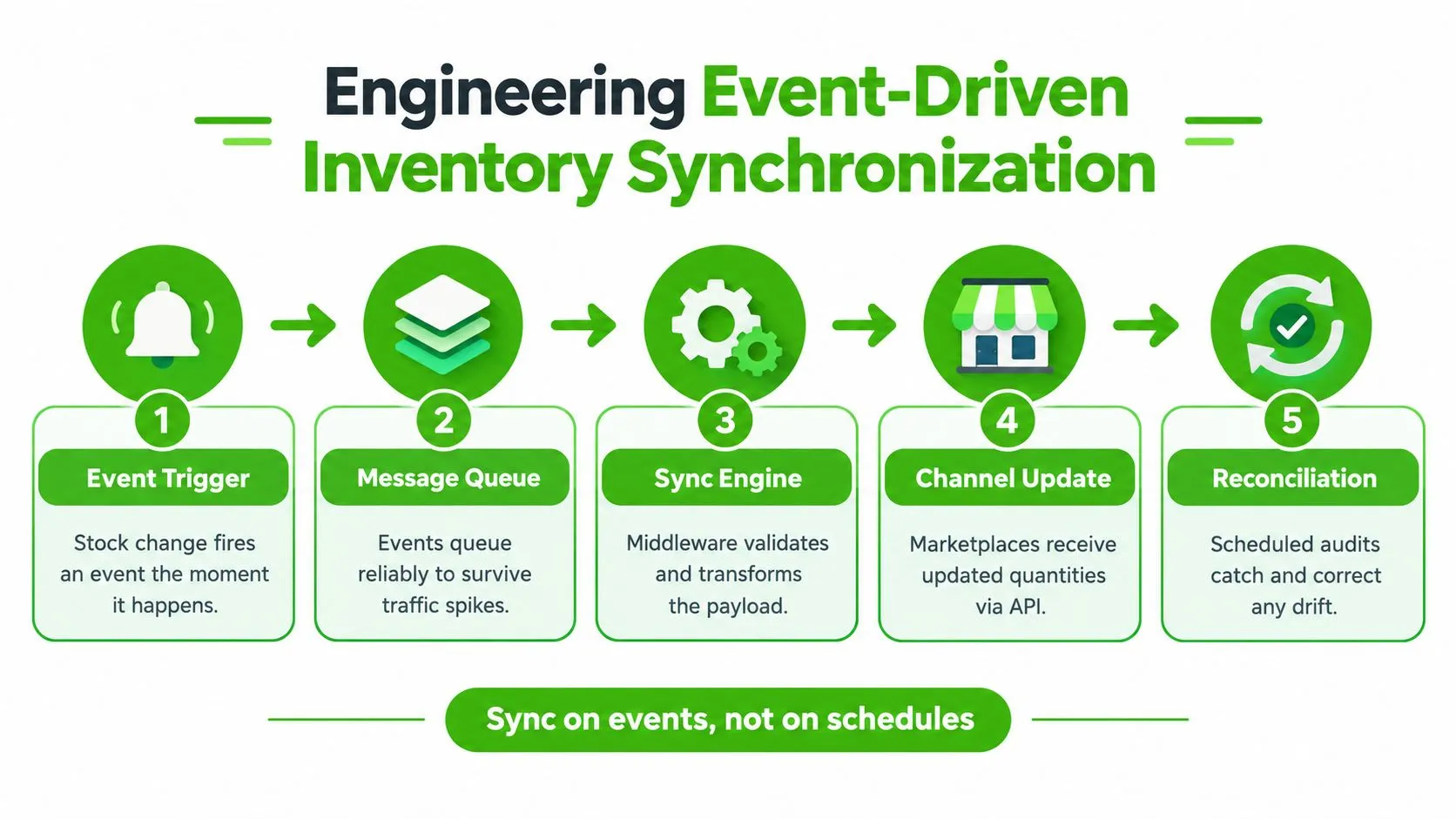
A batch export can make two systems look aligned at a particular moment. It can’t reliably explain what happened between exports. For multichannel inventory, use an event-driven and observable design that records changes, processes them safely, and periodically checks the resulting state.
An inventory event should carry enough context to be replayed and audited:
- Identity: Globally unique event ID, SKU or listing ID, and source channel.
- Change: Quantity delta and version number.
- Timing: Timestamp and correlation ID.
- Processing state: Accepted, rejected, retried, quarantined, or completed.
Consumers should process events idempotently, reject stale versions, retry transient failures with exponential backoff, and send poison messages to a dead-letter queue. Reserve or decrement stock atomically before confirming an order. Webhooks can be delayed, duplicated, or lost, so schedule full reconciliation rather than trusting event delivery alone.
Measure business reliability, not just API availability
An HTTP success response proves that a request reached an endpoint. It doesn’t prove that the marketplace accepted the quantity, that the right listing was updated, or that the ERP recorded the same state.
Use service-level objectives for:
- Synchronization latency
- Inventory-match rate
- Failed-message rate
- Duplicate-order rate
- Recovery time
- Unresolved exception volume
An independent pilot reported inventory corrections falling from 1.8% to 0.3%, median reconciliation delay declining from 74 minutes to 6 minutes, and inventory-match accuracy reaching 99.7% after API integration. That’s a single pilot, not a universal benchmark, but the API integration pilot report illustrates the value of measuring drift and recovery directly.
A reconciliation dashboard should compare channel stock, ERP stock, orders, and settlement records by item. Flag unmapped listings, conflicting quantities, late events, and return-state mismatches for review. Don’t overwrite a newer value with a late message.
For channel-specific operating considerations, consult Ruit’s guide to multichannel inventory management. The implementation principle remains the same: use events for speed and reconciliation for confidence.
The Hidden Post-Integration Challenge, Data Governance
The connector going live is often the moment teams discover that integration quality depends less on connector count than on the organisation’s ability to detect and correct bad data. A system can exchange records quickly and still distribute the wrong price, duplicate an item, or classify a returned product as sellable.
A 2025 data-integrity survey found that 67% of data professionals didn’t fully trust the data their organisations used. Retail research also found that only 17% of respondents had fully integrated ERP systems across departments, while nearly 40% reported limited integration across business functions, according to industry coverage of ERP data integrity and integration.
Second-hand inventory needs stronger controls
A standard catalogue assumes that products repeat. Professional second-hand sellers often handle unique items with individual condition, photos, flaws, purchase cost, price, and listing history. The system must distinguish two visually similar products rather than merge them because their titles happen to match.
When records disagree, define an operational answer:
- Authority rules: State which system wins for stock, price, condition, and financial values.
- Exception queues: Quarantine ambiguous mappings instead of publishing them automatically.
- Approval thresholds: Require human review when an AI or matching service has low confidence.
- Audit logs: Preserve who changed an item, what changed, and which event caused it.
- Reconciliation cadence: Compare channel and ERP states routinely, not only after a complaint.
- Recovery procedures: Document how staff replay events, restore stock, and resolve simultaneous sales.
Integration quality is constrained by data governance. A faster connector only spreads mistakes faster if ownership and identity rules are missing.
Ask operational questions before approving automation. Which record is authoritative when a marketplace and ERP disagree? How does the team match a one-off item without creating a duplicate? What happens when a webhook fails, two channels sell the same item, or a return changes the condition?
The answers belong in procedures, dashboards, and permissions, not in an undocumented assumption held by one employee. That’s what turns a live connection into a dependable operating system.
Compliance, Traceability, and Reverse Logistics
A one-off garment can pass through sourcing, listing, sale, payment, fulfilment, return inspection, and resale. Each stage needs a connected record. An ecommerce ERP integration should retain the item’s purchase cost, listing identity, marketplace fee, tax treatment, payment, condition changes, and final disposition.
EU marketplace rules cover illegal goods, notice-and-action procedures, complaints, advertising transparency, and recommendation disclosures. The EU’s 2025 VAT-in-the-Digital-Age directive allows Member States to require businesses to store transaction data for VAT reporting or audits, as described in the Council document on VAT in the Digital Age.

A return is a state change, not a quantity adjustment
A returned item is not automatically available stock. Staff may need to inspect it, confirm completeness, grade its condition, take new photographs, reprice it, repair it, relist it, quarantine it, or write it off. The original sale and tax record must remain traceable even if the item returns to inventory at a different price.
Reverse logistics often remains inside the retailer’s operation, where disconnected tools can hide the labour, fees, and margin impact of each recovered item. A disconnected returns process also makes it difficult to distinguish a resale-ready item from one awaiting inspection.
Use explicit return states:
- Received: The item has arrived but is unavailable for sale.
- Inspected: Condition and completeness have been checked.
- Approved: The item can return to sellable inventory.
- Reworked: New media, grading, pricing, or repair is required.
- Written off: The item is removed from sale with a recorded reason.
The ERP should preserve an immutable chain from sourcing cost through resale, return, and final disposition. It should reconcile VAT, marketplace fees, partial refunds, and settlement records without overwriting the original transaction history.
For multichannel second-hand sellers, the useful commercial measure is profitability per recovered item. It connects compliance evidence with buying decisions, pricing, labour, and the actual economics of reverse logistics. A platform such as Ruit can support that full-cycle control when return states, inventory, orders, and financial records need to work together.
Ruit as a Practical Integration Path for Professional Sellers
A custom connector makes sense when a business has unusual workflows, a dedicated technical team, and a clear reason to own every integration layer. It also creates ongoing responsibility for marketplace API changes, retries, monitoring, data mappings, return states, and support.
A full-cycle platform can be more practical when the business needs operational control before it needs a bespoke architecture. Ruit centralises sourcing, inventory, multichannel publishing, pricing, messaging, orders, accounting, and analytics for professional second-hand sellers. It supports native connections with WooCommerce and PrestaShop, and its Enterprise plan includes API access plus custom CRM and ERP integrations.
Compare the operating model, not just the connector
Ruit’s workflow includes automatic stock and price synchronisation, auto-delist after a sale, scheduled publishing, unified marketplace messaging, AI-assisted titles and descriptions, order management, accounting exports, and full-cycle analytics. It supports channels including Wallapop, Vinted, eBay, WooCommerce, PrestaShop, and Todocolección.
For sellers migrating existing stock, Ruit’s inventory import guide is relevant because clean migration and duplicate prevention are prerequisites for trustworthy synchronisation. Ruit reports more than 3,000 active businesses and more than one million published listings across European marketplaces.
Choose between a custom ERP connection and a full-cycle platform by assessing:
- Process complexity: Custom workflows may justify custom integration.
- Team capacity: A small team may benefit from managed operational tooling.
- Data requirements: Unique, condition-dependent stock needs strong identity and exception controls.
- Channel mix: Native marketplace and webshop connections can reduce implementation scope.
- Control requirements: Enterprise API and CRM or ERP options matter when the platform must fit existing systems.
The right solution is the one that preserves authority, exposes exceptions, and lets the team recover from failures without rebuilding the transaction history. Integration should increase profit per hour worked, not create another dashboard that staff must reconcile manually.
Frequently Asked Questions
What should an ecommerce ERP integration keep in sync?
One dependable operational record across listings, inventory, orders, payments, returns, and finance. A sale on one marketplace should remove the item from the other channels, update available stock in the ERP, create the correct order record, and flow into accounting without anyone copying details between screens.
Which system should own each type of data?
Start with a system-of-record matrix. In many ecommerce models, the ERP governs financial postings, product master data, and available inventory, while the commerce layer governs storefront content and customer-facing merchandising. That division isn’t universal, but leaving it undefined guarantees competing edits.
How do you keep inventory synchronised across channels?
Use an event-driven, observable design. Each inventory event carries a unique event ID, the SKU or listing ID, the source channel, a quantity delta, a version number, and a timestamp. Consumers reject stale versions, retry transient failures with exponential backoff, and send poison messages to a dead-letter queue, while scheduled full reconciliation catches webhooks that arrive late, twice, or never.
How should returns be handled after integration?
A returned item is not automatically available stock. Give it explicit states, such as received, inspected, approved, reworked, and written off, and keep the original sale and tax record traceable even if the item returns to inventory at a different price.
Ruit brings inventory, listings, orders, messaging, accounting, and analytics into one workflow, with WooCommerce, PrestaShop, marketplace connections, stock synchronisation, and Enterprise API and ERP options. Visit Ruit to evaluate whether its full-cycle approach fits your channels, team, and post-integration control requirements.