What Does OBO Mean When Selling: A Practical Guide


Table of Contents
- Table of Contents
- What OBO Actually Means When You List an Item
- How OBO Works Once the Listing Goes Live
- What Really Counts as the Best Offer
- Real Listing Examples Across Different Categories
- Best Practices for Professional Resellers Using OBO
- OBO Compared to Auction, BIN, and Firm Pricing
- Common OBO Mistakes and How to Avoid Them
- Frequently Asked Questions
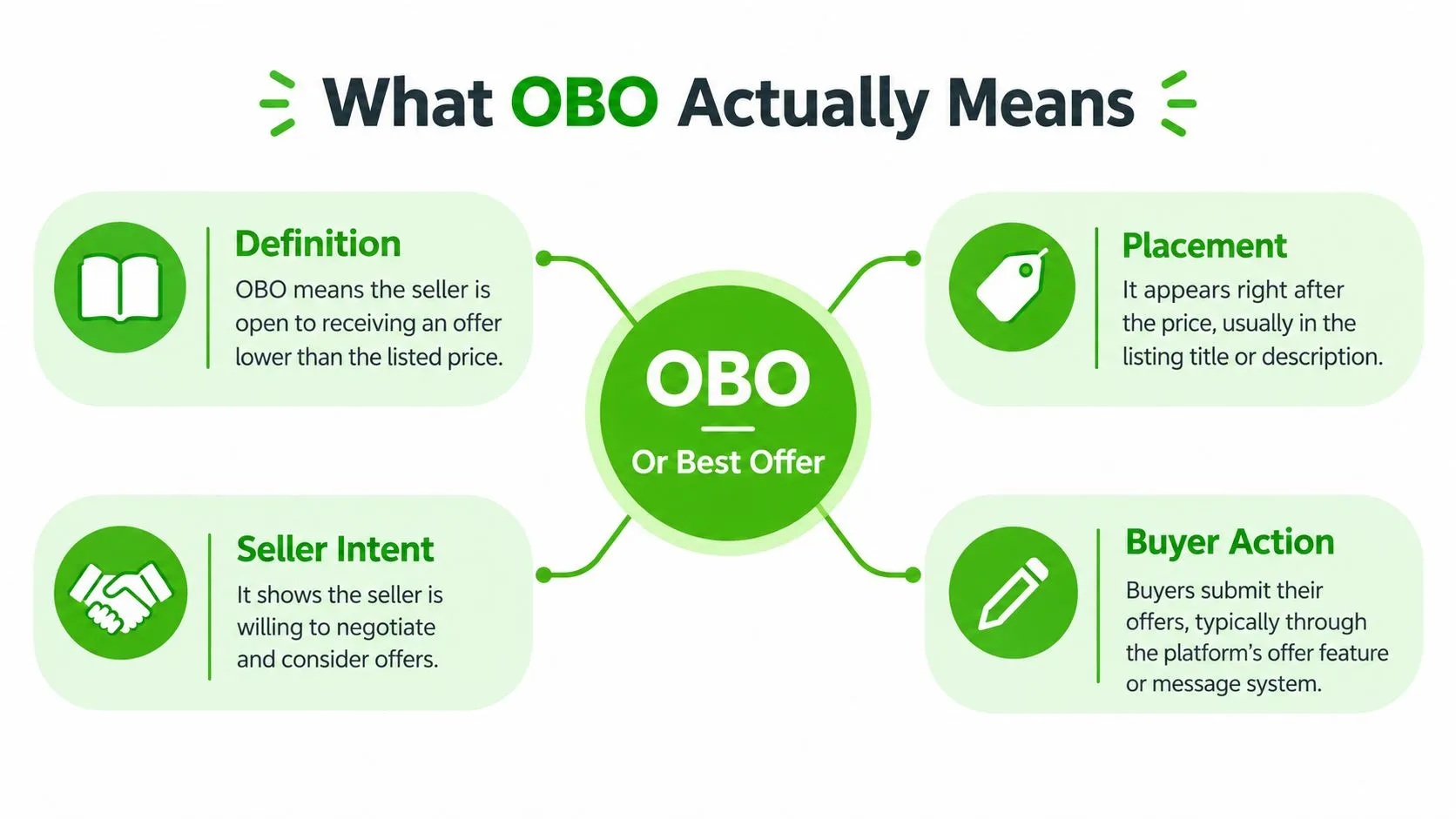
OBO stands for “or best offer,” goes after an asking price, and signals that you’ll consider lower offers without promising any specific discount. You still decide whether to accept, decline, or counter.
You’ve photographed the item, written the description, and reached the price field. Adding those letters seems straightforward until buyers start asking for delivery, requesting a hold, or offering less in exchange for immediate pickup. The useful question isn’t just what does OBO mean when selling, but how you’ll decide which offer deserves a yes.
Table of Contents
- What OBO Actually Means When You List an Item
- How OBO Works Once the Listing Goes Live
- What Really Counts as the Best Offer
- Real Listing Examples Across Different Categories
- Best Practices for Professional Resellers Using OBO
- OBO Compared to Auction, BIN, and Firm Pricing
- Common OBO Mistakes and How to Avoid Them
- Frequently Asked Questions
What OBO Actually Means When You List an Item
OBO is an invitation to negotiate. In a listing marked “$500 OBO,” the amount is the seller’s asking price, while the abbreviation tells buyers that a lower proposal may be considered, as How-To Geek’s explanation of OBO describes. It doesn’t turn the listing into a clearance sale or require the seller to accept whatever arrives.
For a secondhand sofa or used laptop, the buyer should read the listing as an item with a stated price and some negotiating room. They can propose different terms, but the seller retains control over the response. That distinction is worth understanding before you publish, not after an uncomfortable exchange.
Make the invitation match your intentions
Only add OBO if there’s a realistic offer you’d accept below the asking price. Otherwise, you’re inviting a conversation you already know you don’t want to have. A clear pricing position is more useful than an abbreviation added because other sellers use it.
Keep the item description separate from the negotiation signal:
- Describe the item clearly. Condition, included accessories, and known faults shouldn’t change depending on the buyer’s proposed price.
- Put OBO beside the price. Buyers shouldn’t have to hunt through the description to discover whether negotiation is welcome.
- State important restrictions. If collection is required or delivery isn’t available, say so before someone builds an offer around different arrangements.
Practical rule: Invite offers on terms you’re genuinely prepared to discuss.
You don’t need to publish your entire negotiating strategy. You do need to make the boundaries understandable. “Offers considered, collection only” communicates something useful; a vague listing that leaves buyers guessing about condition and transport doesn’t.
The abbreviation also shouldn’t compensate for an unsupported asking price. If you can’t explain why the item is priced where it is, adding OBO won’t resolve that uncertainty. Start with a defensible description and price, then decide whether flexibility serves your selling goal.
How OBO Works Once the Listing Goes Live
Once you publish, treat incoming messages as proposals to qualify, not sales waiting to be recorded. A buyer may name an amount, ask what you’ll take, or attach conditions that change the transaction. Your job is to establish what they’re offering before negotiating against yourself.
The asking price gives that conversation a starting point. Don’t immediately replace it with your lowest acceptable amount because someone asks for your best price. Ask the buyer to make a concrete proposal, including collection or shipping arrangements.
Turn messages into actionable offers
A useful offer answers more than the price question. It tells you what the buyer wants, how they intend to receive it, and whether their proposal depends on further inspection or another condition. Missing details deserve clarification, not an automatic rejection.
| Message type | Useful next action |
|---|---|
| An amount without collection details | Ask how and when the buyer plans to receive the item |
| A request for your lowest price | Invite a concrete offer rather than revealing your floor |
| An offer conditional on inspection | Clarify what remains undecided before agreeing to a hold |
| An amount with delivery included | Separate the item price from fulfillment terms |
Keep your reply short and specific. A counteroffer should make clear which terms it covers, rather than leaving the buyer to infer whether shipping or accessories are included. The documentation on replying to and negotiating offers is a useful workflow reference when organizing those exchanges.
Confirm the agreement, not just the amount
After the buyer accepts your counteroffer, summarize the agreed item, condition, price, payment arrangement, and handover plan. Ask them to confirm any detail that’s still unresolved. Avoid recording an inquiry, an accepted proposal, and a completed order as though they were the same stage.
- Inquiry: The buyer has expressed interest.
- Negotiation: You’re discussing price or conditions.
- Agreement: Both parties have confirmed the terms.
- Completion: Payment and handover have been resolved.
This separation matters when several conversations concern the same item. Keep a clear record of who has committed to what, and don’t promise the item to competing buyers simultaneously. A tidy negotiation queue is easier to manage than an inbox full of informal assumptions.
What Really Counts as the Best Offer
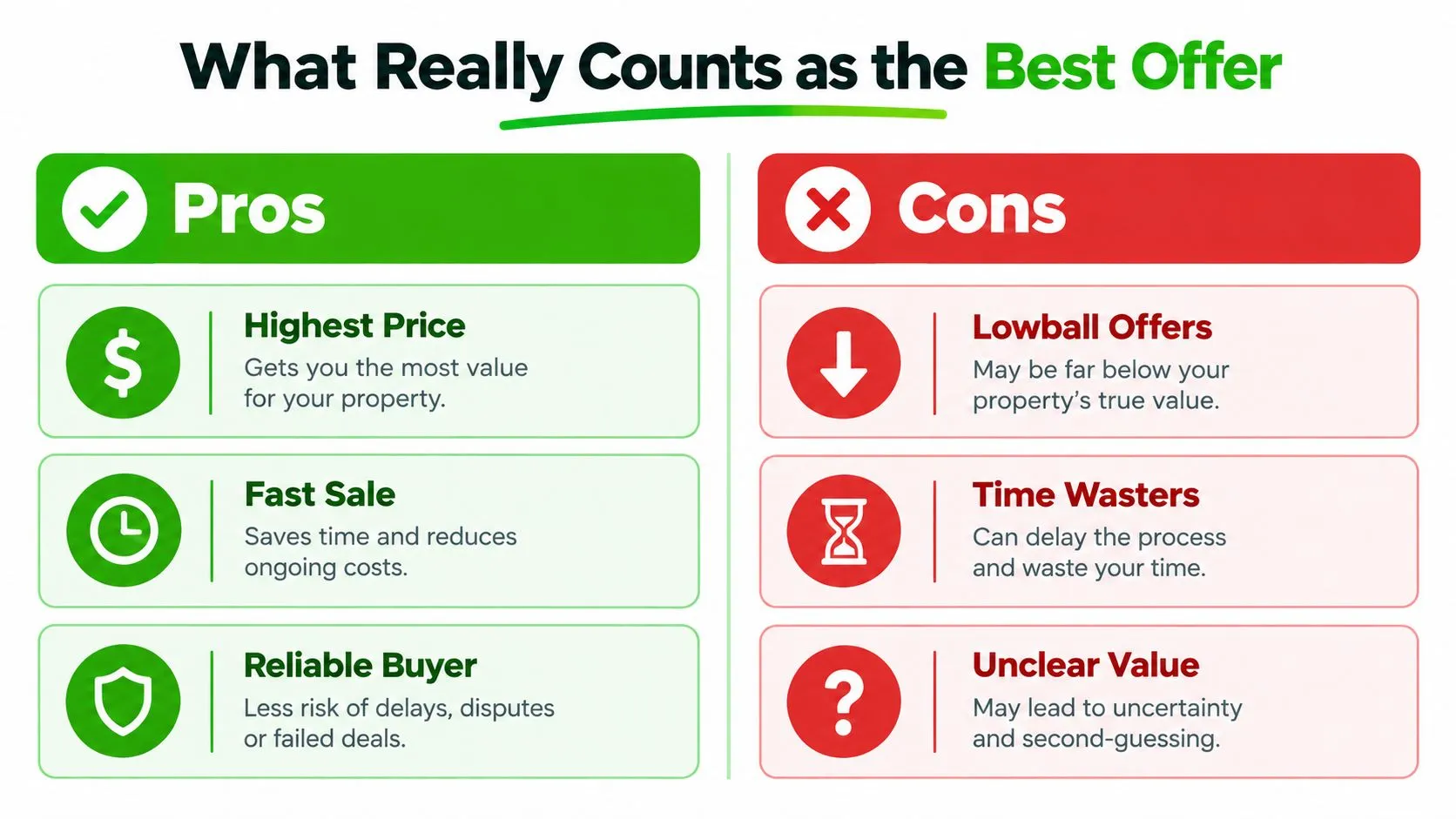
The highest proposed price isn’t automatically the strongest offer. Payment certainty, pickup speed, buyer reliability, and transaction risk can all affect the decision, alongside the amount itself. Chase’s guidance on what OBO means provides context for treating the phrase as flexibility rather than a promise to sell cheaply.
For a professional reseller, the practical test is whether the proposed transaction is worth completing. A higher amount with unresolved delivery demands isn’t directly comparable to a lower amount with straightforward collection. Compare complete offers, not isolated figures.
Evaluate the money you’ll keep
Work backward from the proposed deal to expected net profit. Account for the item’s acquisition cost, applicable selling costs, packing, and any transport you’ve agreed to provide. If an offer adds work, acknowledge that work rather than treating it as free.
Your price needs a sensible foundation before this comparison is useful. The guide to pricing used items for resale offers a relevant starting point for developing that foundation.
Category-specific negotiation resources can also help you prepare. For specialist stock, ECI Jewelers’ resource on negotiating luxury watch prices is worth consulting before deciding which terms you’re comfortable discussing.
Evaluate the likelihood of completion
Use the buyer’s behavior in the transaction, not personal assumptions, to judge reliability. Do they answer practical questions? Have they agreed to the disclosed condition? Can they confirm a workable handover arrangement?
A cautious buyer isn’t necessarily unreliable. Someone asking focused questions about an electronic device may be making a considered purchase. The concern is unresolved commitment, not the mere presence of questions.
Before accepting, check:
- Payment certainty: Is the payment arrangement clear and acceptable?
- Handover feasibility: Can the buyer collect, or have shipping terms been settled?
- Condition agreement: Does the buyer understand what they’re purchasing?
- Net return: Does the deal remain worthwhile after the agreed costs?
- Outstanding conditions: Could another request substantially change the offer?
A usable offer includes a credible plan to finish the transaction.
Don’t turn this into a complicated scoring exercise unless your operation needs one. A short checklist is enough to expose the difference between an attractive proposal and a dependable sale. Speed can justify a compromise, but it shouldn’t excuse a deal that fails your minimum requirements.
Real Listing Examples Across Different Categories
The following are illustrative scenarios, not reported sales. Each uses an asking price followed by OBO, without assigning an unsupported market value. The point is to show how a seller might choose between competing terms.
A secondhand smartphone and a mid-century armchair
For the smartphone, suppose a buyer offers closer to asking price but wants extra accessories included. Another proposes less for the phone exactly as described. The seller should compare the full package before deciding, rather than adding stock to preserve the headline price.
The armchair creates a different decision. One prospective buyer wants the seller to arrange delivery; another offers less but confirms suitable transport and collection. If delivery would consume resources the seller hasn’t priced in, the collection proposal may be preferable.
| Category | Typical asking range | Common offer pattern | Key decision factor |
|---|---|---|---|
| Secondhand smartphone | Assess the model and disclosed condition; no universal range | An offer tied to accessories or further testing | Agreement on the exact package |
| Mid-century armchair | Assess condition and item-specific evidence; no universal range | A price proposal with collection or delivery conditions | Transport responsibility |
| Used car | Assess the vehicle individually; no universal range | An offer subject to inspection | What remains conditional |
| Bulk vintage clothing | Assess the contents and selling unit; no universal range | A whole-lot proposal or a request to select pieces | Whether the lot stays intact |
OBO Offer Patterns by Category
A used car and a bulk lot of vintage clothing
For a used car, consider a higher proposal that remains subject to inspection and a lower proposal from someone who has already viewed the vehicle. The seller shouldn’t treat the first as final. Clarify the inspection conditions before relying on either buyer’s commitment.
With vintage clothing, a buyer might offer to take the complete lot while another wants only selected garments. Those aren’t equivalent transactions, even if the second buyer proposes an attractive amount. The seller must also consider the remaining stock and the work required to sell it separately.
Across these examples, keep the selling unit explicit. A phone with accessories, a chair with delivery, and a clothing lot split into selected pieces are different offers from the original listing. Don’t approve a price before confirming what that price buys.
Best Practices for Professional Resellers Using OBO
Build the rules before publishing inventory. You can still exercise judgment, but you shouldn’t need to reconstruct the item’s economics every time a buyer sends a message. A repeatable process also helps colleagues negotiate without making conflicting promises.
Establish your boundaries privately
Set a private floor price based on the return you need from the transaction. Keep it in your inventory record, not in the public description. Distinguish that price from your wider acceptance conditions, including payment and fulfillment.
A price floor protects the money side of the deal; the acceptance conditions protect how you complete it. An offer can clear the price threshold and still require a counteroffer because the buyer expects delivery you haven’t agreed to provide.
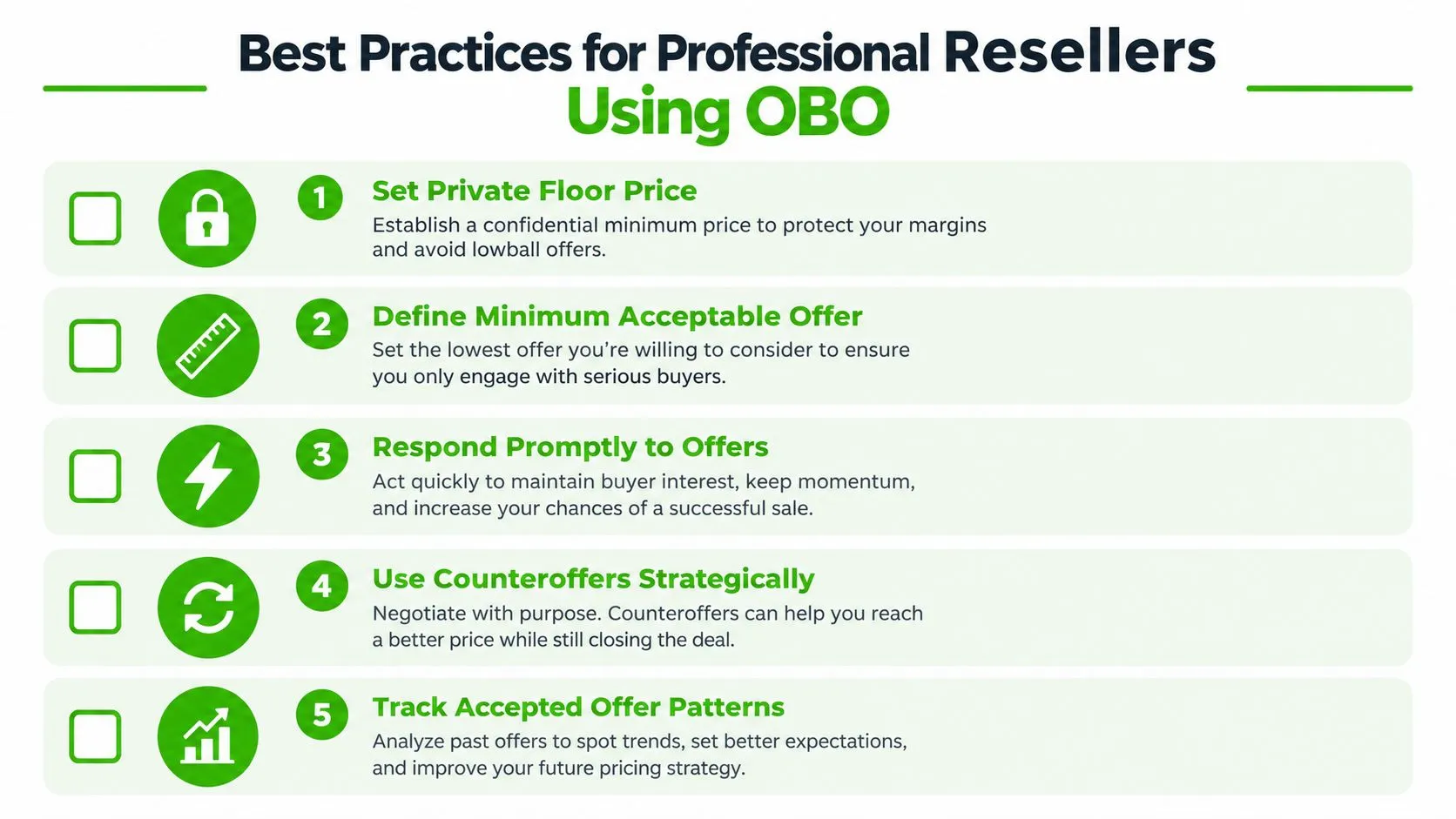
- Define an expiry point. Tell the buyer when a counteroffer or agreed hold ends, using a deadline you can enforce.
- Separate fulfillment options. Record whether your minimum assumes collection, shipping paid separately, or another arrangement.
- Choose a reply routine. Assign responsibility for checking messages so colleagues don’t duplicate negotiations.
- Counter with a purpose. Change the amount or terms to reach an acceptable deal, not merely to prolong the exchange.
- Record exceptions. If you accept below your normal floor, note why so the exception doesn’t become an unexplained precedent.
Keep item preparation separate from bargaining
Resolve the listing’s basic readiness before inviting offers. For a Mac in your inventory, Used Mobiles 4 U’s guide to selling your Mac is a category-specific resource to consult alongside your own preparation checklist. Negotiation shouldn’t substitute for knowing what you’re selling.
Use a spreadsheet, inventory system, or shared operating record to log the asking price, proposed terms, counteroffer, outcome, and reason for acceptance or rejection. Keep the record practical enough that the team will maintain it. Notes buried in individual chats are harder to compare later.
Operating discipline: Review completed outcomes, not just the offers that looked promising.
Compare results by marketplace, category, response time, and realized margin when your records support those comparisons. Don’t assume every failed negotiation calls for a price reduction. Separate price objections from unavailable collection, changed requirements, and buyers who never confirmed.
Your aim is a consistent decision process, not identical decisions for every item. A bulky piece taking up needed space may justify different terms from compact stock you’re comfortable holding.
OBO Compared to Auction, BIN, and Firm Pricing
Choose the pricing format according to the conversation you want to have. OBO suits a seller who’s prepared to evaluate proposals. If you don’t want to negotiate, use a format that communicates that position rather than inviting offers and resenting the replies.
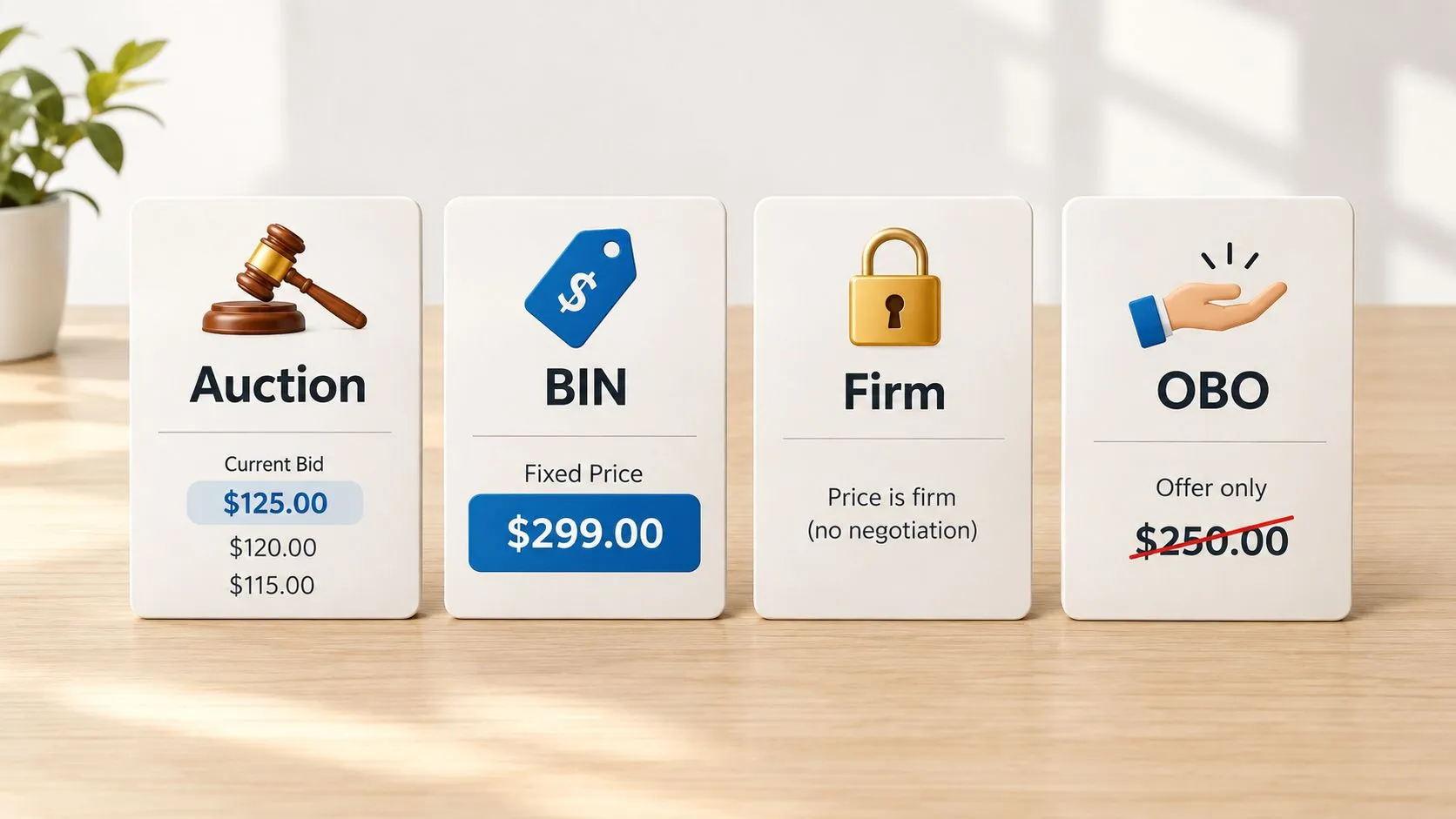
An auction uses a defined bidding mechanism, while OBO involves private negotiation. The important operational difference is that you’re assessing individual proposals with OBO, not just following an auction’s winning rules.
Match the format to your selling goal
BIN means buy it now, a stated purchase price rather than an invitation to haggle by itself. Firm pricing explicitly communicates that the seller isn’t seeking price negotiation. Check the marketplace’s available settings as well as your description so the two don’t send conflicting messages.
| Format | Seller’s role | Suitable goal | Trade-off to consider |
|---|---|---|---|
| OBO | Evaluate and negotiate proposals | Retain flexibility over price and terms | Requires message handling |
| Auction | Choose and follow the bidding setup | Invite competing bids | Outcome depends on participation and rules |
| BIN | Set a direct purchase price | Offer a straightforward buying decision | Less room for individualized negotiation |
| Firm | State a non-negotiable amount | Maintain a clear price boundary | Buyers wanting flexibility may move on |
Don’t choose OBO solely because you hope it will make an item sell faster. You still need acceptable offers and buyers who complete the transaction. No pricing label guarantees either.
For marketplace-specific planning, the eBay pricing strategy guide is a relevant resource to consult when choosing your setup. Make the format fit your item, margin requirements, and capacity to handle conversations.
Common OBO Mistakes and How to Avoid Them
Most avoidable mistakes happen when the seller reacts to inbox pressure instead of following the rules they set. A quiet listing can make you anxious; a busy one can make you impatient. Neither feeling is a sound acceptance criterion.
Correct the decision before changing the price
- Underpricing out of anxiety: Don’t reduce the asking price just because the first messages are low. Recheck your item assessment and decide whether the listing itself needs clarification.
- Accepting to silence the inbox: Use a short decline or counteroffer. You don’t owe a buyer an unfavorable sale because they’re persistent.
- Ignoring fulfillment costs: Recalculate whenever a buyer adds delivery, packing, or other work. The original acceptance decision may no longer apply.
- Leaving unavailable stock listed: Update availability when the sale completes and remove conflicting listings. Don’t keep negotiating for inventory you can no longer supply.
- Changing terms without confirming them: Restate any revised package or handover arrangement before proceeding.
A disciplined seller can remain polite without conceding every request. Give buyers clear answers, keep commitments you’ve made, and decline transactions that don’t meet your requirements. Flexibility works when you control the boundaries, not when you abandon them under pressure.
Frequently Asked Questions
What does OBO mean when selling?
OBO stands for “or best offer.” It goes after the asking price and tells buyers that a lower proposal may be considered, without promising any specific discount. You still decide whether to accept, decline, or counter.
Do I have to accept the highest offer?
No. The highest proposed price isn’t automatically the strongest offer. Payment certainty, pickup speed, buyer reliability, and transaction risk can all affect the decision, so compare complete offers rather than isolated figures.
How should I reply when a buyer asks for my lowest price?
Invite a concrete offer rather than revealing your floor. Ask the buyer to make a specific proposal, including collection or shipping arrangements, before you negotiate against yourself.
What is the difference between OBO, BIN, and firm pricing?
OBO invites private negotiation around the asking price. BIN means buy it now, a stated purchase price rather than an invitation to haggle. Firm pricing explicitly communicates that the seller isn’t seeking price negotiation.
How do I set a minimum price for an OBO listing?
Set a private floor price based on the return you need from the transaction, and keep it in your inventory record, not in the public description. Account for the item’s acquisition cost, selling costs, packing, and any transport you’ve agreed to provide.
Ruit offers unified buyer messaging, inventory management, and order data as an option for managing secondhand sales across connected marketplaces. Visit Ruit to explore bringing offer conversations and stock records into one workflow, so your team can negotiate with the item’s status and transaction details in view.