White Labelling vs Private Labelling: What to Choose

Table of Contents
- Table of Contents
- The Fork in the Road for Product Sellers
- White Labelling and Private Labelling Defined
- Comparing Cost, Control, and Supply Chain
- The Legal Reality Most Guides Miss
- When Extra Customisation Is Not Worth It
- How to Choose Based on Your Business
- Situational Recommendations for Resellers and Retailers
- Frequently Asked Questions
You’ve found a manufacturer who replies, ships on time, and makes a product your buyers will pay for. Now comes the choice most resellers rush. Do you put your logo on the version that’s already sitting in their warehouse, or do you pay for a custom run made only for you? That decision looks like branding. It isn’t. It’s a commitment about inventory risk, cash, legal responsibility, and how much control you can handle without slowing your business down.
Table of Contents
- The Fork in the Road for Product Sellers
- White Labelling and Private Labelling Defined
- Comparing Cost, Control, and Supply Chain
- The Legal Reality Most Guides Miss
- When Extra Customisation Is Not Worth It
- How to Choose Based on Your Business
- Situational Recommendations for Resellers and Retailers
- Frequently Asked Questions
The Fork in the Road for Product Sellers
A reseller I advise found two offers for the same basic product on the same morning. Supplier one could ship a small batch within days, ready for a new label. Supplier two offered a better spec, custom packaging, and exclusivity, but only if the reseller committed to a much larger first order and waited for a dedicated production run.
The first offer felt easy, and that’s exactly the point. The product already existed, competitors could buy something very similar, and differentiation would come mostly from photos, pricing, service, and speed of execution. The second offer felt like ownership, but ownership came with forecasting, quality checks, and cash locked in boxes before a single unit sold.
That’s the shape of white labelling vs private labelling. You’re not choosing a prettier box. You’re choosing where you sit on a spectrum between low operational burden and high product control.
What Changes When You Move Along That Spectrum
Move toward speed and you’ll launch faster, test cheaper, and walk away from a weak product with less pain. Move toward control and you’ll get a product customers can’t buy elsewhere under another name, but you’ll also own more of the mistakes. If the spec is wrong, if demand drops, if packaging fails in transit, that’s your problem to fix and finance.
Most sellers ask the wrong first question. They ask which model sounds more professional. Ask instead what your current sales volume can support.
Don’t buy exclusivity you can’t forecast. A custom product that sits in storage isn’t brand equity. It’s expensive dead stock.
That framing matters because both models can work, and both can fail for predictable reasons. White label fails when sellers assume a logo creates differentiation and then get pulled into price wars. Private label fails when sellers confuse customisation with demand and commit before they’ve proven repeat sales.
Treat this as an operating decision first and a branding decision second. Your answer should change as your volume, cash position, and ability to manage suppliers change.
White Labelling and Private Labelling Defined
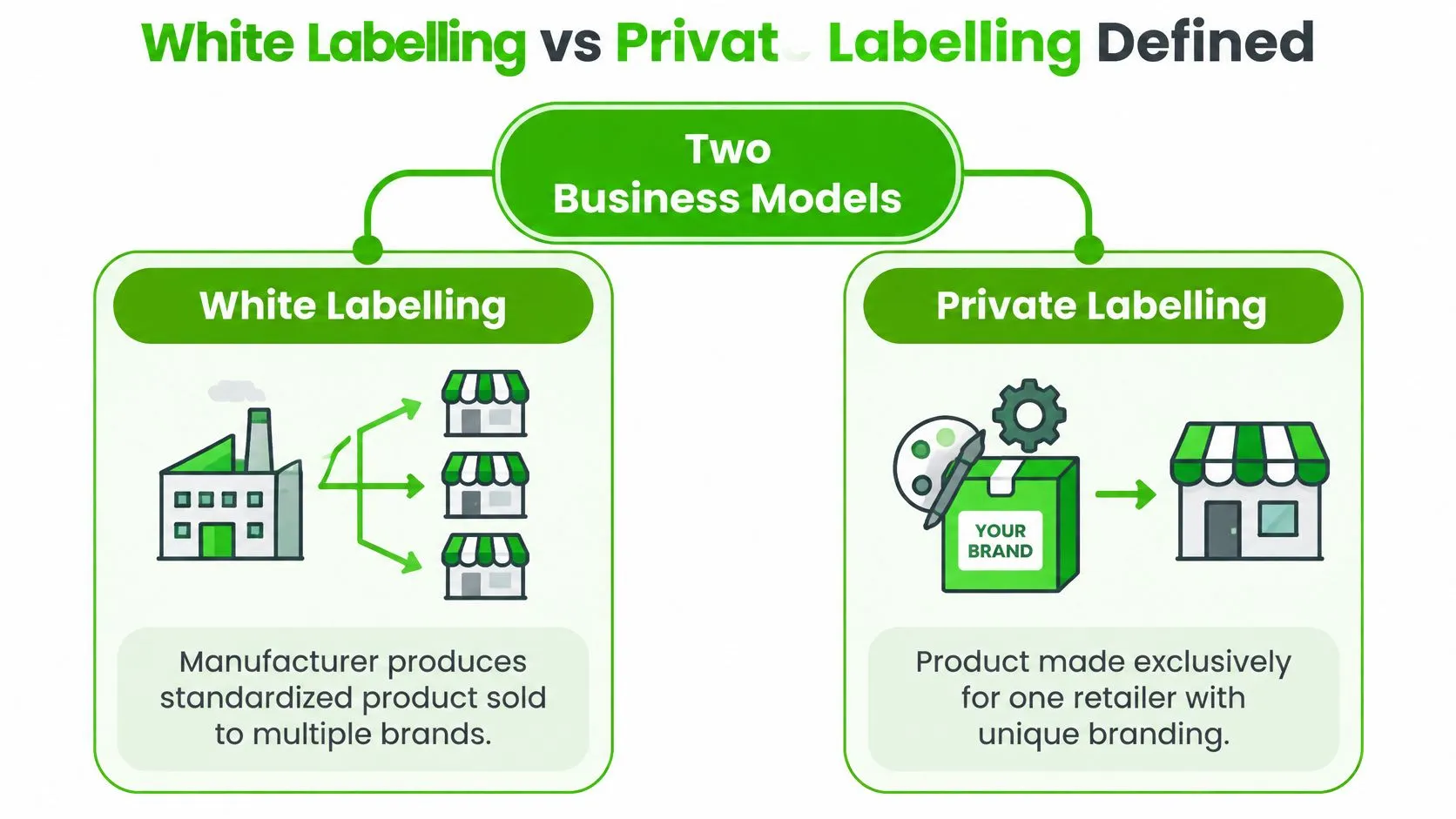
White labelling means a manufacturer produces a standardized, usually uncustomized product that multiple businesses can rebrand and sell under their own names. You typically change the label and outer packaging, not the formulation or core spec. The same underlying product can appear under several brands, which is why speed and execution matter more than exclusive product identity.
Private labelling means a manufacturer makes a product for one retailer or brand owner. You control the branding and may specify formulation, packaging, quality requirements, or channel exclusivity. That extra control is the whole reason to accept a dedicated run instead of buying what’s already made.
The diagram below shows the structural difference before you get into cost or paperwork.
Why Private Label Gets More Strategic Attention
Private labels started in consumer packaged goods as low price alternatives to national brands, then moved toward quality and premium positioning. They’re now mainstream. The American Marketing Association’s reporting on private label brandification puts private labels at 19.4% of global consumer goods value sales in 2023, rising to 36% in Western Europe. That scale explains why retailers treat them as a growth lever, not a sourcing trick.
Europe shows the point even more clearly. NielsenIQ data reported through the International Private Label Yearbook and covered in Global Retail Mag’s summary of European private label sales put private label grocery sales across 17 European markets at €352 billion in 2024, or 38.1% of total grocery sales. When a retailer owns the customer facing brand, it can use spec, pricing, packaging, and sales data together. A white label seller usually can’t.
If you’re mapping how that retailer owned brand gets built in practice, this private label brand guide is a useful next read on the brand building side. For your decision, remember the simple distinction. White label rents a proven product. Private label commissions a product position.
Comparing Cost, Control, and Supply Chain
Start with the constraint that kills most launches, minimum order size. Published manufacturing benchmarks in GTSetu’s comparison of white label and private label manufacturing place white label MOQs at roughly 25 to 500 units with lead times of about 1 to 4 weeks, because the manufacturer has already developed and stocked the product. The same benchmarks put private label at approximately 500 to 5,000+ units and around 8 to 16 weeks, because you’re paying for a dedicated run.
Those ranges aren’t trivia. They decide whether you can test a product across fragmented markets or whether you must be right the first time.
White Label vs Private Label at a Glance
| Criterion | White Label | Private Label |
|---|---|---|
| Upfront cost | Lower, product already developed | Higher, custom run and setup |
| Minimum order | Roughly 25 to 500 units | Roughly 500 to 5,000+ units |
| Lead time | About 1 to 4 weeks | About 8 to 16 weeks |
| Branding control | Label and packaging mainly | Branding, spec, packaging, quality requirements |
| Exclusivity | Same product sold to others | Made for one retailer or brand owner |
| Supply chain flexibility | Easier supplier substitution | Tied to your spec and production slot |
| Speed to market | Fast test and launch | Slower, planning dependent |
| Legal responsibility | Brand owner duties can still apply | Brand owner duties can still apply |
The Hidden Cost Is Working Capital
Sellers focus on unit price and miss the cash cycle. A larger private label order ties up money in stock, storage, and returns handling while you’re still learning the true sell through rate. If your forecast is optimistic, you don’t just earn less. You carry the product longer, discount harder, and delay your next buying decision.
White label flips that risk. You can reorder in smaller batches, test seasonal demand, and drop a weak SKU before it eats your quarter. The trade off is blunt. If another seller lists the same core product cheaper or with better content, you have no exclusive spec to defend your price.
- Choose speed when: you’re validating demand, testing a new category, or selling across markets where local demand is uneven.
- Choose control when: a SKU already sells predictably and a better spec or pack will protect margin.
- Watch cash first: if a minimum order would strain your ability to buy other stock, you’re not ready for that run.
If you’re building that test assortment from existing stock lines, it helps to think in terms of bulk items to resell that can move in small, repeatable batches. Don’t let a theoretical margin on a custom run override a proven ability to turn inventory.
The Legal Reality Most Guides Miss
Most sellers assume the manufacturer carries the legal risk because the manufacturer physically made the goods. In the EU, that assumption can be wrong. If you only add your logo, who is legally liable when something goes wrong?
Under the General Product Safety Regulation, a business can be treated as the manufacturer when it sells a product under its own name or trademark, even if another company made it, as explained in EU Representa’s guidance on GPSR duties for private label sellers. That point applies to both private label and white label goods. The label you put on the deal doesn’t reliably decide responsibility.
The image below captures the part sellers skip until a marketplace, authority, or unhappy customer asks for documents.

Duties That Can Land on the Brand Owner
Once your name is on the product, you may carry duties involving product safety, traceability, contact details, technical documentation, recalls, and cooperation with authorities. Those aren’t paperwork niceties. They’re the evidence chain you need if a batch is defective, a listing is challenged, or a regulator asks who placed the product on the market.
Your contract with the manufacturer matters, but it doesn’t erase your market facing role. Responsibility depends on the market, product category, modifications you request, and contractual structure. A private label deal with strong supplier documentation can be safer than a casual white label purchase with no test files. The reverse is also true.
Contract rule: Before you order, agree in writing who holds test reports, who approves spec changes, who manages a recall, and how quickly the manufacturer must supply traceability records.
Timing adds another reason to get this right now. The EU’s revised Product Liability Directive is scheduled to apply to products placed on the market after 9 December 2026. If you’re building a brand for EU consumers, build the compliance file at purchase stage, not after your first complaint. White labelling vs private labelling is a commercial choice. Legal exposure follows control of the brand and placing on the market.
When Extra Customisation Is Not Worth It
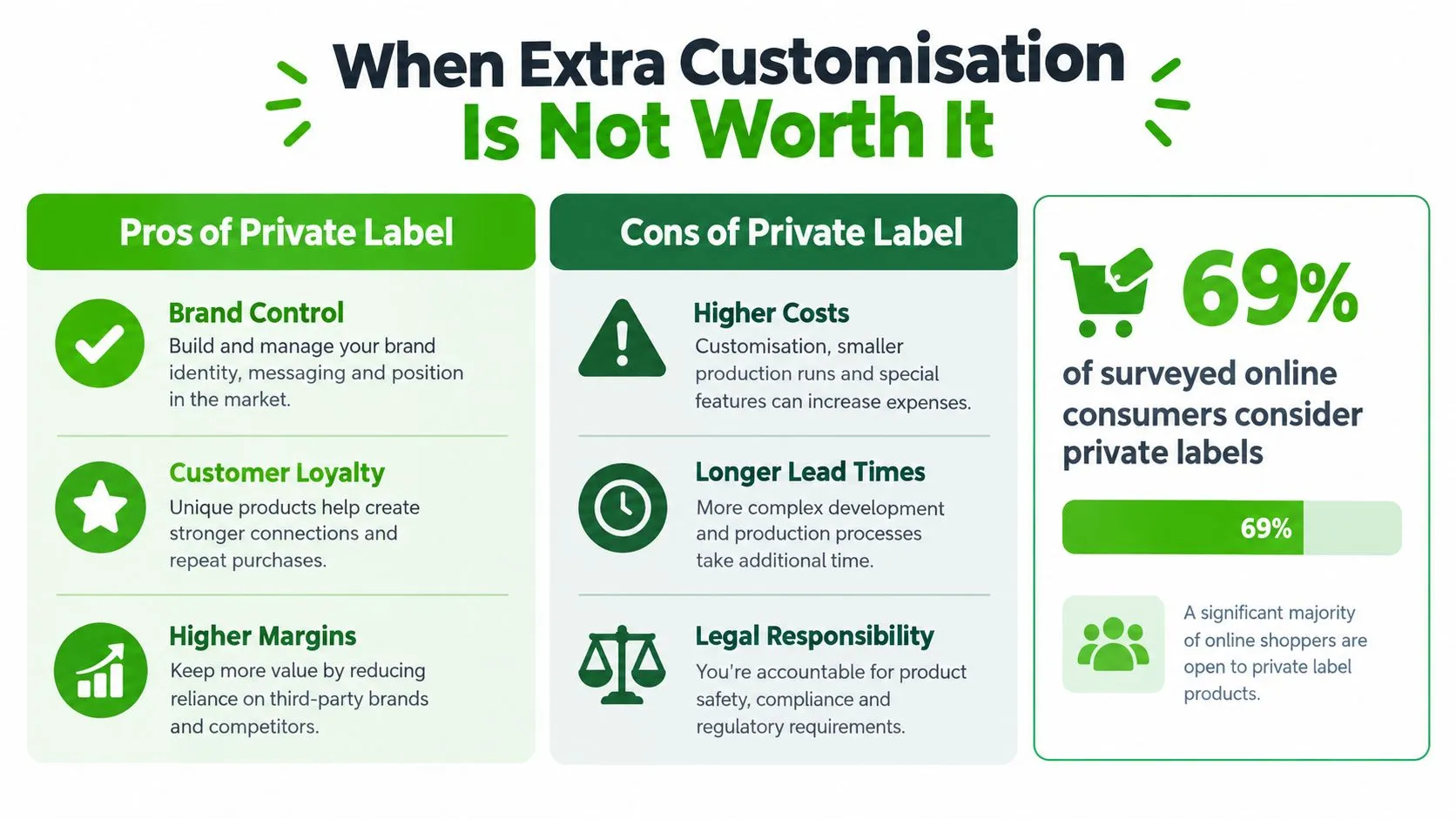
Private label isn’t automatically the superior growth strategy, even though consumer acceptance is strong. In Ipsos research on the rising tide of private labels, 69% of surveyed online consumers consider private labels good value, 68% see them as good alternatives to name brands, and 74% say private label products are as good as branded products. Yet the same research context shows European private label growth slowed from nearly 12% in 2023 to just under 4% in 2024.
Acceptance doesn’t guarantee your custom run will sell faster. It only tells you buyers aren’t allergic to retailer brands.
The infographic below separates the genuine upside from the operational price you pay for it.
Ask What the Customisation Actually Buys
Custom packaging alone rarely justifies a much larger order. A different colour box won’t save a generic product from price comparison. Customisation earns its cost when it changes the buying decision, for example a spec buyers can feel, a pack size that fits your channel better, or a formulation that reduces returns and complaints.
Work through three checks before you commit.
- Prove repeat demand first: Has the standard version sold through more than once without heavy discounting?
- Name the differentiator: Can a buyer explain in one sentence why yours is different, without reading your brand story?
- Price the burden: Have you accounted for tooling, testing, sampling, slower replenishment, and quality control time, not just unit cost?
If you can’t answer those clearly, stay with white label and improve execution. Better photos, tighter delivery promises, bundles, and responsive messaging can lift conversion without locking you into a spec. You’ll also keep supplier substitution open if quality slips.
Private label becomes worth it when exclusivity protects a proven margin. Until then, extra control is often just extra responsibility dressed up as ambition.
How to Choose Based on Your Business
Make the decision from three numbers you already have, even if they’re rough. You need your current sales volume, your cash available for inventory, and your honest capacity to manage specs and compliance. If one of those is weak, it should veto the more demanding model.
The checklist below turns those factors into a quick self assessment before you talk terms with a manufacturer.
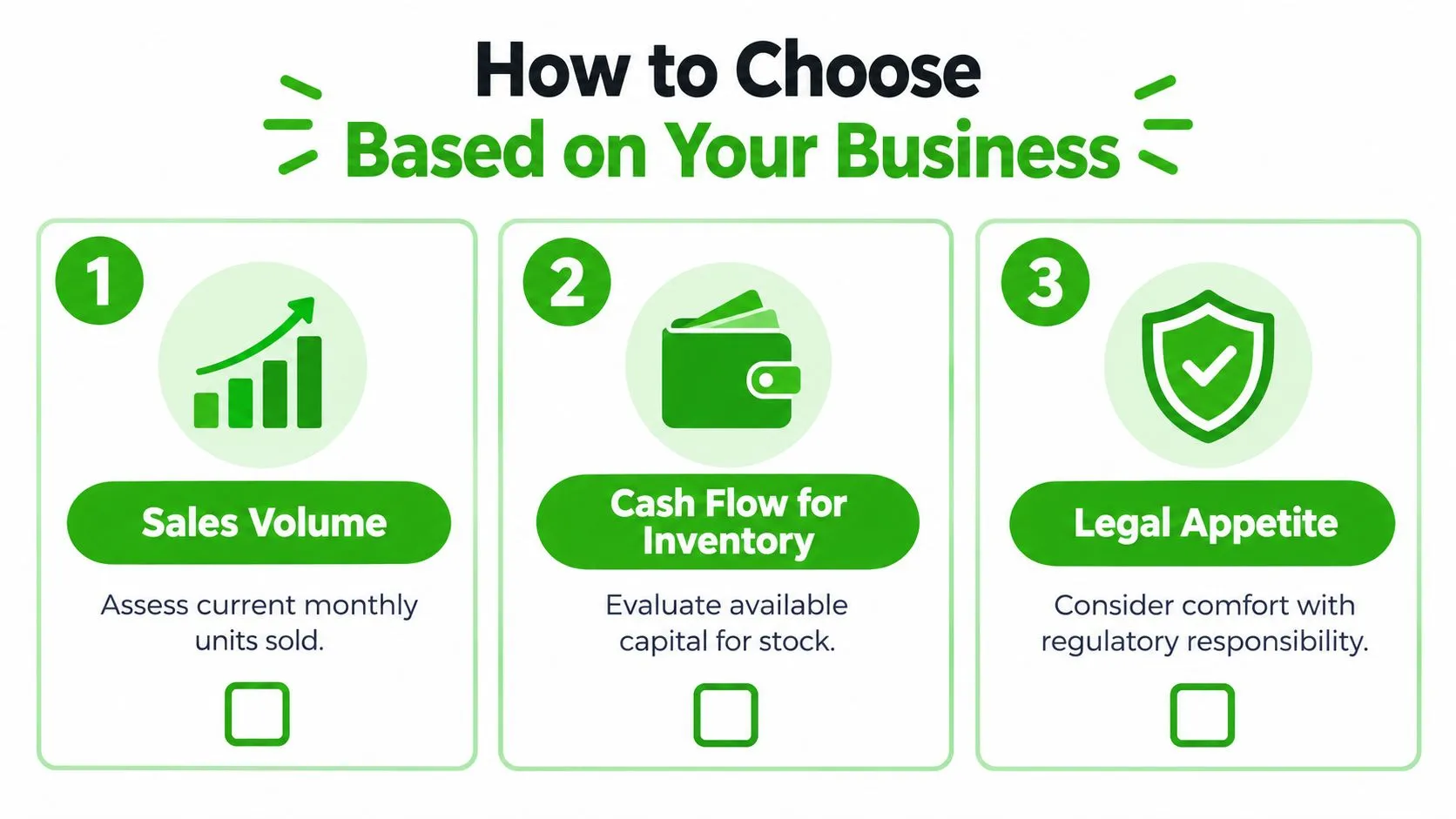
Start with volume, because it exposes fantasy quickly. If a product moves slowly or unpredictably, a large dedicated run forces you to become a warehousing business. If it moves steadily across channels, you can plan replenishment around longer production cycles.
- Sales volume: Could you sell the minimum order without extending your normal stock holding period beyond what you can finance?
- Cash flow: After paying for stock, can you still fund returns, marketplace fees, shipping, and your next purchase?
- Management capacity: Do you have time to approve samples, check batches, maintain documents, and chase a manufacturer when a deadline slips?
Supplier selection discipline matters in every category, whether you’re sourcing resale stock or following the same due diligence logic used when choosing a hotel amenities supplier, where consistency and documentation affect the end customer experience. Apply that mindset here. Sample properly, verify claims, and don’t accept vague answers on lead times.
For sellers still formalising the wider operation, the basics in how to start a resell business should come before a custom manufacturing commitment. Get sourcing, listing, pricing, and fulfilment stable first.
The video below is a useful companion if you want to hear the model explained in spoken form before you run your own numbers.
Situational Recommendations for Resellers and Retailers
For professional resellers testing new categories, choose white label first. You need learning speed more than exclusivity. Run small batches, compare sell through by channel, kill weak listings early, and only promote winners into a private label conversation.
For small retailers with a loyal local customer base, private label can work sooner, but only on narrow, proven lines. Your shop name already does some trust work, yet that doesn’t reduce inventory risk. Start with one hero product where repeat purchase is visible in your till data, not with a full branded range.
Use white label to find the product. Use private label to defend the product after buyers have already proved they want it.
For online stores selling across borders, be conservative. Fragmented European demand, language specific packaging, and different return patterns make large custom runs harder to forecast. White label gives you room to test country by country. Private label fits when one SKU wins in several markets with the same spec and you can centralise stock planning, ideally with disciplined inventory for store management that prevents overselling while stock is in transit.
Category matters too. In regulated or specification sensitive lines, supplier paperwork and batch consistency should outweigh a small unit saving, which is why buyers in niche wholesale categories, including those sourcing bac water wholesale, should vet documentation with the same seriousness as price. The cheaper quote isn’t cheaper if you can’t trace the batch.
My recommendation is sequential, not ideological. Validate with white label. Graduate proven SKUs to private label. Keep the rest flexible. That sequence protects cash while still giving you a path to proprietary products where differentiation will be rewarded.
Frequently Asked Questions
Can a Business Use Both Models at Once
Yes, and most sensible sellers should. Use white label for tests, seasonal lines, and long tail products where speed matters. Reserve private label for proven sellers where a distinct spec, pack, or formulation protects margin and repeat purchase.
How Do I Switch From White Label to Private Label Later
Promote only SKUs with repeat sell through and manageable returns. Lock the winning spec, sample the custom version against the standard one, confirm documentation and recall responsibilities in writing, and order at a level your forecast can absorb. Don’t switch because you’re bored with the packaging. Switch because exclusivity will change profit or loyalty.
Does the Choice Affect How I Sell on Marketplaces Like eBay or Vinted
It changes what you can defend. With white label, your listing quality, price, dispatch speed, and service do most of the differentiating, because buyers may find a similar product elsewhere. With private label, you can build a recognisable product identity, but you must keep stock, descriptions, and compliance details consistent across every channel.
In every case, the framework stays the same. Pick the level of exclusivity and control your current volume can profitably support, then revisit the decision when the sales data earns you a bigger commitment.
Whatever model you choose, you still have to source stock, sync inventory, publish across channels, and avoid overselling while orders move. Ruit brings sourcing, inventory, multichannel publishing, pricing, messaging, orders, accounting, and analytics into one operating system for professional sellers in Europe, so your white label tests and private label winners run on the same clean workflow. Visit Ruit to see how it can raise profit per hour worked across Wallapop, Vinted, eBay, and your own store.