Stock Sync Across Marketplaces: A UK Seller's Guide

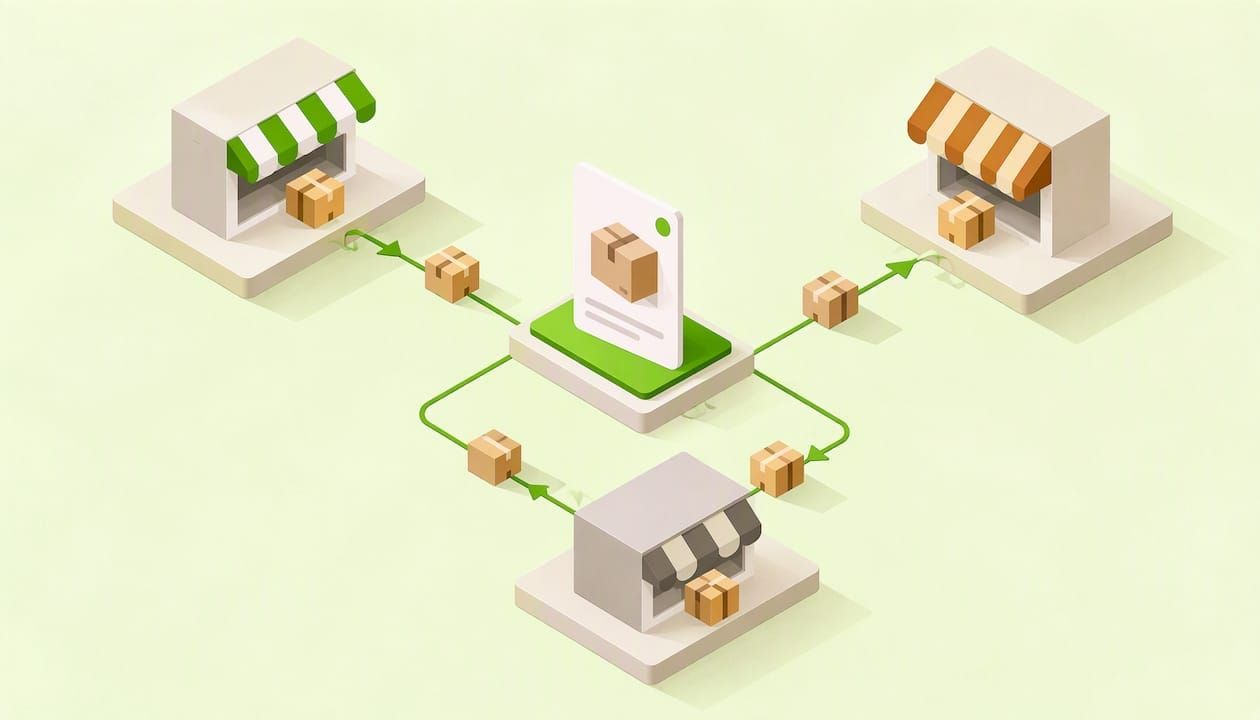
Table of Contents
- TL;DR
- What stock sync across marketplaces actually does
- Why second-hand sellers feel it more than shops
- How Vinted and eBay handle stock
- Three ways to keep stock in sync
- Where stock sync goes wrong
- A worked example
- Our view: list once, then let stock follow
- When selling across channels meets HMRC
- How to set up stock sync in a week
- Try it with Ruit
- Sources
- Frequently Asked Questions
- Recommended
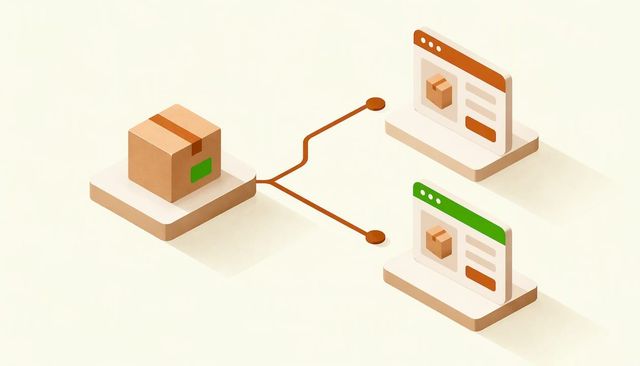
Stock sync across marketplaces means that when an item sells on one channel, every other listing of that item is removed or reduced straight away, so you cannot sell it twice. You can do it by hand with a spreadsheet and a lot of discipline, or let software do it, and the right choice depends on how many items you list and how fast they sell.
This guide is for UK sellers on Vinted and eBay, from people clearing a wardrobe to Vinted Pro accounts and small resale businesses. It covers how syncing works, what each marketplace lets you do, what goes wrong, and the tax point that catches out sellers who grow.
TL;DR
- Selling one unique item on two marketplaces is the classic overselling risk. The fix is one record of stock that every channel follows.
- Vinted and eBay handle stock differently: Vinted listings are single items, eBay fixed-price listings can carry a quantity.
- Manual syncing works for a few dozen items. Past that, a delay of even an hour can mean a cancelled order and an annoyed buyer.
- Selling on several platforms does not change your tax position, but the £1,000 trading allowance is a single limit across all your side income.
- Ruit lists once, syncs stock and removes sold items from the other channels automatically.
What stock sync across marketplaces actually does
Every marketplace keeps its own count of what you have. Vinted does not know what eBay has sold, and eBay does not know what is on Wallapop. Stock sync is the layer that connects those counts.
In practice it does three jobs:
- Holds one master record for each item, with its quantity.
- Watches each channel for a sale.
- Pushes the change out: the item is ended, hidden or reduced everywhere else.
For one-off second-hand pieces, such as a vintage jacket or a single pair of trainers, the quantity is always one. So the job is simply “sold here, delete there”. For sellers with duplicates, say five identical phone cases, it becomes a counting job as well.
People search for this under different names: real-time inventory sync, multichannel inventory sync, or inventory sync between marketplaces. They all describe the same thing. The word that matters is the speed. A sync that runs once a day is a clean-up job, not protection against overselling.
Why second-hand sellers feel it more than shops
A shop selling new stock usually has depth: 200 units, and a sale on one site barely matters. A second-hand seller has one of everything. The moment it sells anywhere, the other listings are wrong.
That is why the problem is sharper for vintage and clothing resellers. You are also likely to list on several channels because each attracts a different buyer. Vinted suits everyday fashion, eBay reaches collectors and shoppers searching by brand or model, and a Shopify or WooCommerce shop is your own storefront.
The cost of getting it wrong is not only the refund. You cancel on a buyer who has already paid, and on eBay a cancelled order can count against your seller performance. It also wastes the time you spent packing and messaging.
How Vinted and eBay handle stock
Understanding the platform rules tells you where a sync tool has to be careful.
| Vinted | eBay UK | |
|---|---|---|
| Typical listing | One item, one listing | Fixed price with a quantity, or an auction |
| What happens on sale | Item is marked sold | Quantity drops by one; listing ends at zero |
| If sold elsewhere | Hide or delete the listing | End the listing or reduce the quantity |
| Out-of-stock handling | Not applicable for single items | Optional out-of-stock setting hides a listing at zero quantity |
On Vinted, the help centre says that if you sold an item on a different platform, you should hide or delete it rather than marking it as sold. The “Mark as sold” button is meant for items sold outside Vinted’s payment system, and Vinted says it is not for reserving items. This matters for sync: an item removed in the right way keeps your account tidy.
On eBay, fixed-price listings are Good ‘Til Cancelled, so they stay live until the quantity you set is sold or you end them. eBay also offers an out-of-stock option that hides a listing from search results until you restock. It is useful for repeat stock, but it only knows about eBay sales, not what happened on Vinted.
Both help pages can change, so check them when you set up your process.
Three ways to keep stock in sync
Manual: a spreadsheet and a routine
You keep a sheet with one row per item and a column for each channel. When something sells, you update the sheet and remove the other listings straight away.
This works if you list under roughly 50 items, check your notifications several times a day and sell mostly on two channels. It fails at weekends, on holiday, and whenever two buyers pay within the same hour.
Built-in marketplace tools
Shopify, WooCommerce and eBay each manage stock inside their own system. Connect a shop to eBay and you can often share quantities between the two. That helps for those two channels, but it does not reach Vinted or Wallapop, which are where many second-hand sellers do most of their volume. Our guides on connecting Shopify to eBay and stock synchronisation for WooCommerce cover that route in detail.
Dedicated stock sync software
A tool sits above all your channels, keeps the master record and reacts to sales. Compare any option on these criteria:
| Criterion | What to ask |
|---|---|
| Channel coverage | Does it include Vinted, not just eBay and shop platforms? |
| Speed | Does a sale trigger removal in minutes, or on a daily schedule? |
| Direction | Does the sold item get removed everywhere, automatically? |
| Listing creation | Can you list once, or must you recreate each item on every channel? |
| Messages | Are buyer messages in one place, so you catch a sale quickly? |
| Cost | Is the monthly fee small against what one avoided cancellation saves? |
The generic stock sync apps that dominate search results are built mainly for online shops with product catalogues and suppliers. If you sell used clothing and one-off finds, check the channel list before anything else. Our broader piece on inventory sync software goes into the differences, and the guide to multi-channel inventory management covers the operational side.
Where stock sync goes wrong
Even with software, a few problems come up again and again.
- Duplicate items under different titles. If the same jumper is listed twice with different wording, the system cannot tell they are one item. Give each item one master record, and list it once from there.
- Sales that complete outside the system. A buyer collects in person or you sell at a car boot. Remove the item yourself the same day.
- Unpaid or reserved items. A reservation is not a sale. Decide in advance how long you hold an item before it goes back on every channel.
- Variants. Sizes and colours need their own stock lines. A single quantity for a shirt in four sizes will mislead you.
- Delayed notifications. If you rely on emails to learn about a sale, you are already behind. Check the app regularly during busy periods.
A worked example
Say you list a vintage Barbour-style wax jacket on Vinted, eBay and your own Shopify shop. With manual routines, the timeline might look like this:
- 10:02: a Vinted buyer pays.
- 10:40: a Shopify visitor buys the same jacket. You have not yet seen the Vinted notification.
- 11:15: you notice both, cancel the Shopify order and apologise.
With sync, step 2 never happens, because the jacket was removed from the other channels shortly after step 1. The saving is not dramatic on one jacket, but across a few hundred listings the cancellations add up.
Our view: list once, then let stock follow
We built Ruit around one idea: you should not have to enter an item more than once. In our experience, overselling rarely comes from carelessness. It comes from the gap between a sale and the moment someone notices it.
That is why we put the two things together. You list an item once and publish it to Vinted, eBay, Wallapop, todocoleccion, Shopify, WooCommerce and PrestaShop. When it sells on one, stock updates and the listing is removed from the others. A sync that only deletes is half a solution if you still spend an evening retyping descriptions for every channel.
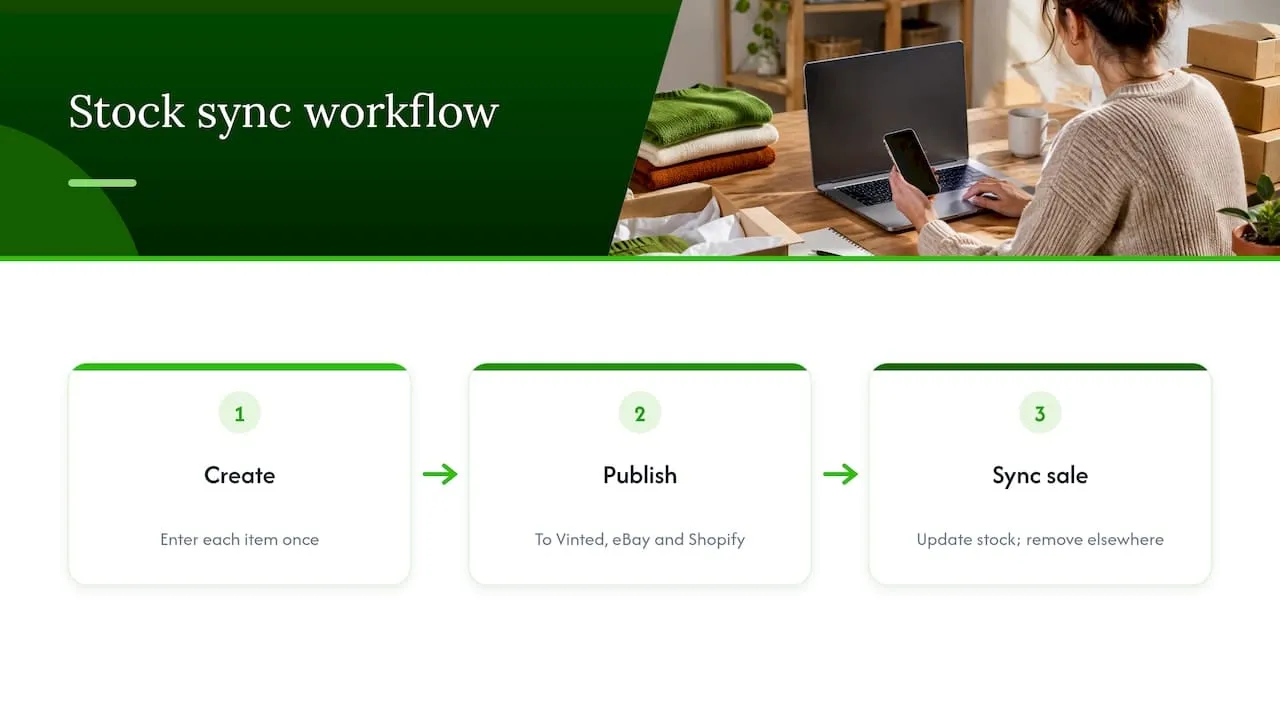
The second thing we hear from sellers is that the gaps appear during the day, when they are busy elsewhere. So we also bring Vinted and Wallapop buyer messages into one inbox, and relist automatically on Vinted and Wallapop, so your stock is not only accurate but also visible. AI drafts titles and descriptions, which takes the dullest step out of listing.
Our advice: pick a process before you pick a tool. Decide what counts as sold, how long you reserve items, and who removes in-person sales. Then make the software enforce it.
- Luis
When selling across channels meets HMRC
A tool that makes selling on several platforms easy can also make your volume jump. That has a tax side worth knowing about.
According to GOV.UK, if you earn more than £1,000 from side hustles in a tax year (6 April to 5 April), you may need to complete a Self Assessment tax return. Selling your own unwanted belongings is generally different from trading. Buying items to resell, or selling regularly for profit, is treated as trading.
Two points matter for multichannel sellers:
- The allowance is one aggregate limit across your self-employed income, not a separate £1,000 per platform. Sales on Vinted, eBay and your own shop add together with other side income.
- You cannot claim the trading allowance and deduct business expenses at once. It is one or the other.
Platforms also report to HMRC. Under rules in place since 1 January 2024, digital platforms may need to collect and report seller details. GOV.UK sets out exceptions for sellers with fewer than 30 sales and income under about 2,000 euros in a calendar year, but that does not replace your own duty to tell HMRC if you pass the allowance.
If you are unsure whether your activity counts as trading, ask HMRC or an accountant. Our guides on eBay fees and the £1,000 threshold and Vinted Pro seller rules in the UK go through the practical side for each platform.
How to set up stock sync in a week
- Count and tidy. Give every item a single name and, if you can, a SKU or reference number. Remove duplicates.
- Choose your channels. Start with the two that make most of your sales. Add the others once the routine holds.
- Set your rules. Decide how long you reserve an item, what to do with in-person sales and how you handle returns.
- Connect and test with a few items. Sell a low-value item on one channel and check it disappears from the others, and how quickly.
- Move the rest across. Do it in batches, so you can spot a problem early.
- Review weekly. Compare what you think you hold against what is on each channel. Fix the gaps and note why they happened.
If you also sell large volumes on eBay, managing eBay inventory across channels and bulk upload on eBay help with the first load.
Try it with Ruit
If you sell the same stock on Vinted and eBay, and perhaps Wallapop or your own shop, Ruit lets you list once, keeps stock in sync and removes sold items from the other channels. See how Ruit works and try it on a handful of items first.
Sources
- Say ‘I do’ to getting your side hustle tax right, GOV.UK
- Tax rules for content creators, HMRC guide
- Selling goods or services on a digital platform, GOV.UK
- An item is displayed as “Sold”, Vinted Help Centre
- Multi-quantity listings and listings with variations, eBay UK Help
Frequently Asked Questions
Can I sync stock between Vinted and eBay?
Yes. Vinted listings are single items, so the aim is that a sale on eBay removes the Vinted listing, and the other way round. Ruit does this for you across Vinted, eBay and the other channels it connects to.
Is real-time inventory sync necessary for second-hand items?
For one-off items, yes, more than for new stock. With a quantity of one, a sale anywhere makes every other listing wrong, so the shorter the delay, the lower the chance of a double sale.
Should I mark an item as sold on Vinted if it sold on eBay?
No. Vinted’s help centre says to hide or delete the listing if the item sold on another platform. “Mark as sold” is meant for sales made outside Vinted’s payment system.
Does selling on several marketplaces change what I owe HMRC?
Not in itself, but your income from all platforms and other side hustles counts towards one £1,000 trading allowance per tax year. If you may be over it, check GOV.UK or speak to an accountant.
Is a spreadsheet enough to keep stock in sync?
For a few dozen items on two channels, it can be. As listings and sales grow, the delay between a sale and your update is where double sales happen, and that is when software starts to pay for itself.