Bulk Listing Tool for Resellers: How to Choose Right


Table of Contents
- Table of Contents
- Why Professional Resellers Need a Bulk Listing Tool in 2026
- What a Bulk Listing Tool Actually Does
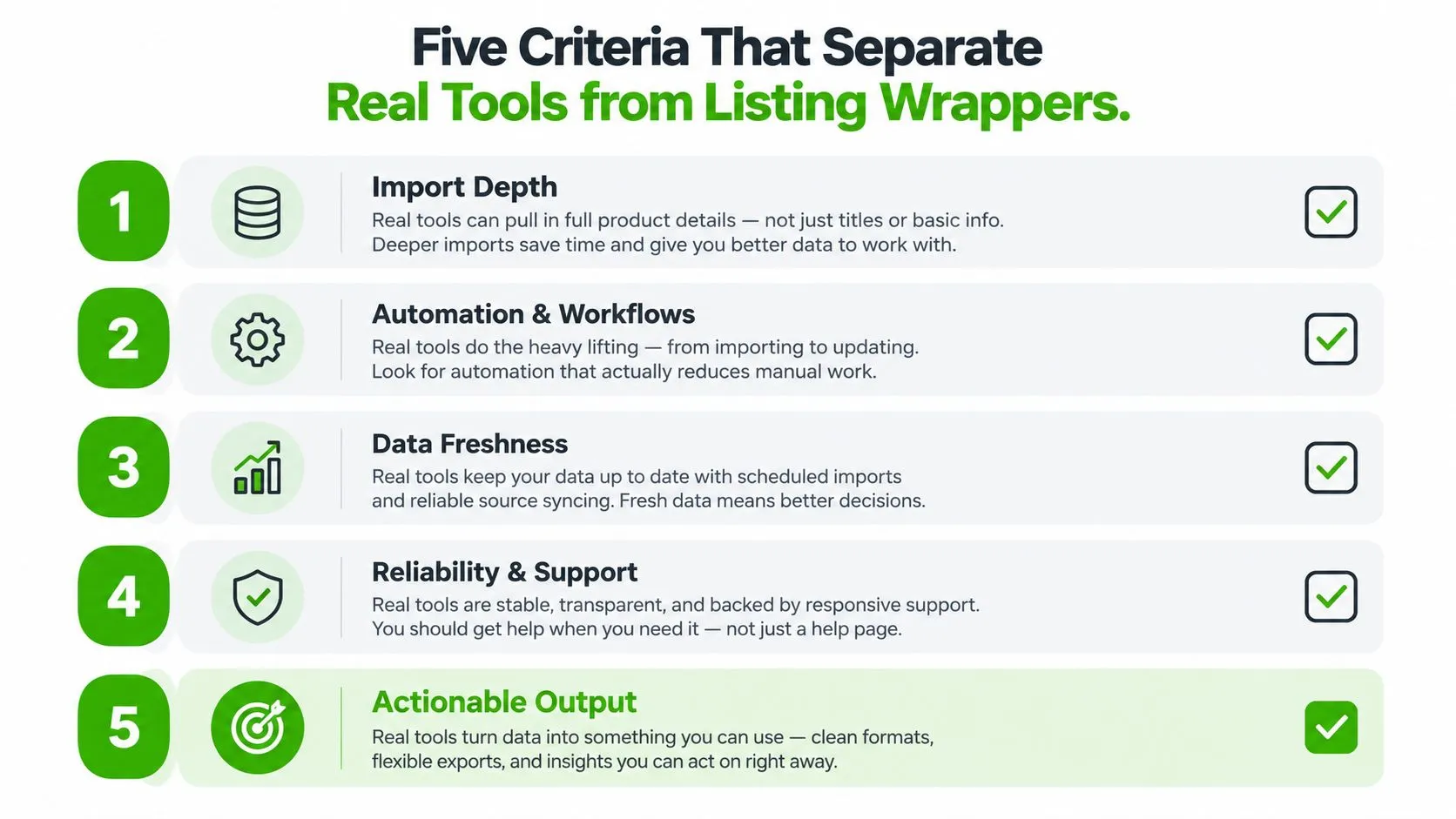
- Five Criteria That Separate Real Tools from Listing Wrappers
- Comparing Three Bulk Listing Tool Archetypes
- The Selective Publish Argument That Most Comparisons Skip
- Inventory Sync as the Real Operational Backbone
- Matching the Right Tool to Your Reseller Profile
- Final Decision Checklist Before You Commit
- Frequently Asked Questions
A reseller can have a profitable stockroom and still lose money every day through poor listing operations. One item sells on eBay, but the Vinted listing stays live. A price changes on Shopify, yet the marketplace copy remains outdated. Someone spends the afternoon copying titles, condition notes, photos, and shipping details between channels instead of sourcing, packing, or improving margins.
That problem gets worse as inventory becomes more varied. European second-hand sellers often handle unique products, incomplete product data, changing conditions, and marketplace-specific requirements. The right bulk listing tool removes repetitive work, but the wrong one spreads bad data and stale stock faster.
The practical comparison is not “which tool publishes the most listings?” It’s “which system protects margin while making more inventory available to the right buyers?”
| Capability | Basic bulk uploader | Crosslister | Inventory-led commerce platform |
|---|---|---|---|
| Import options | Usually one file or marketplace format | Files and existing marketplace listings | Files, feeds, APIs, and connected channels |
| Templates | Reusable fields with limited rules | Marketplace templates and overrides | Structured data, rules, mappings, and validation |
| Publishing | Usually one channel | Several channels | Several channels with scheduling and workflow controls |
| Inventory sync | Often limited or one-way | Varies by integration | Central stock ledger with reconciliation |
| Best fit | Single-channel operator | Multichannel reseller | Professional operation managing complex stock |
| Main risk | Manual work returns at scale | Sync gaps and shallow analytics | Higher setup effort and process complexity |
Table of Contents
- Why Professional Resellers Need a Bulk Listing Tool in 2026
- What a Bulk Listing Tool Actually Does
- Five Criteria That Separate Real Tools from Listing Wrappers
- Comparing Three Bulk Listing Tool Archetypes
- The Selective Publish Argument That Most Comparisons Skip
- Inventory Sync as the Real Operational Backbone
- Matching the Right Tool to Your Reseller Profile
- Final Decision Checklist Before You Commit
Why Professional Resellers Need a Bulk Listing Tool in 2026
A professional reseller running eBay, Vinted, Amazon, and a Shopify storefront doesn’t have one catalog. They have several versions of the same catalog, each with different titles, categories, condition fields, prices, delivery settings, and image requirements. Every manual change creates another opportunity for duplicate listings, stale stock, or a missed relist.
The European market gives this operational problem real weight. Online resale reached an estimated €21.6 billion in 2024, while online second-hand purchases kept more than 740 million products in circulation and generated approximately €37.7 billion in consumer savings, according to Amazon’s overview of the European resale market. The same research projected €2 billion of additional growth in 2025, so sellers have a larger opportunity but also more pressure to expose inventory quickly.
The manual listing tax
A unique item creates work several times over. The operator has to prepare the record, adapt it to each channel, publish it, monitor its status, and remove it after sale. That work doesn’t scale linearly because every extra channel introduces another listing record, price, description, image set, and customer-service obligation.
The sector’s share of European Union e-commerce grew from 5.7% in 2020 to 11.6% in 2024, according to Statista’s recommerce market estimates. That shift moved second-hand goods from a specialist segment into a meaningful part of digital retail, while many sellers still manage one-off products manually.
Operational rule: Treat listing throughput as a capacity constraint, but treat data accuracy and contribution margin as the controls that determine whether extra throughput helps.
The buying lens
Evaluate a bulk listing tool against five questions:
- Can it ingest your real data? Check spreadsheets, feeds, images, existing listings, and API access.
- Can it map product information correctly? Look for reusable templates, category rules, and channel-specific fields.
- Can it control publication? Scheduling matters when you want a steady flow rather than a single inventory dump.
- Can it publish reliably? A failed batch needs visible errors, retries, and a clear correction path.
- Can it protect stock and margin? Two-way inventory synchronization and channel-level profitability rules matter more than a glossy dashboard.
The best purchase is rarely the tool with the largest feature list. It’s the tool that prevents the most expensive operational failure in your business.
What a Bulk Listing Tool Actually Does
A bulk listing tool should be defined by the work it removes, not by the number of buttons in its interface. At minimum, a serious system takes structured or unstructured product information, converts it into channel-ready records, publishes those records, and keeps the resulting listings aligned with the source inventory.
Five capability groups
Bulk import is the starting point. The tool may accept CSV files, marketplace imports, product feeds, image batches, or API data. Import depth matters because a spreadsheet-only workflow becomes restrictive once product information lives across warehouse systems, marketplaces, and image libraries.
Template and variation engines turn a master record into channel-specific content. A good template can preserve condition notes, measurements, brand, material, defects, identifiers, and image metadata while changing the fields required by each marketplace. For fashion or parts sellers, variation handling is essential. For one-off second-hand goods, accurate condition and defect mapping often matter more than conventional size variations.
Scheduling and relisting logic controls when listings become visible and what happens when they age or end. Scheduling can distribute operational workload. Relisting rules should be more selective than “publish everything again,” because an old listing may need a new price, a different channel, or liquidation instead.
Multichannel publishing means creating a record once and distributing it to two or more marketplaces. A single-channel uploader can be useful, but it isn’t a multichannel operating system. A crosslister usually copies existing listings. A broader platform also manages orders, stock, pricing, and channel-level rules.
Inventory synchronization updates availability and, where supported, price across connected channels. It should include failure reporting, retries, and reconciliation rather than relying on a one-time push.
Image preparation can also become a hidden bottleneck. Sellers handling large photo batches may benefit from a practical resource on e-commerce image prep at scale, especially when inconsistent backgrounds or slow manual editing delay publication.
Know which category you’re buying
A marketplace-native bulk uploader is usually efficient inside one ecosystem. A standalone crosslister is better at replicating listings across several destinations. A PIM-lite or multichannel commerce platform adds structured product data, inventory controls, order workflows, and integrations.
Use this working definition when scoring vendors:
A real bulk listing tool converts a controlled source record into validated, channel-specific listings, publishes them reliably, and keeps availability and commercial data synchronized after publication.
If a product only duplicates text and images, it may save clicks, but it hasn’t solved the operating problem.
Five Criteria That Separate Real Tools from Listing Wrappers
Speed is easy to demonstrate in a product tour. Reliable data transformation is harder, and it matters more. Use the following criteria in order because each one exposes a different trade-off between setup effort, control, and operating risk.
Import depth and source flexibility
A tool that only accepts CSV works when your catalog is already clean. It becomes a bottleneck when photographs, marketplace listings, warehouse records, and supplier feeds all contain part of the product truth. Ask whether the system can import existing marketplace data, preserve identifiers, process images, and connect through an API.
The trade-off is clear. Flexible import requires more configuration, but it prevents staff from retyping information that already exists elsewhere.
Template power and attribute mapping
Templates save time only when they preserve the fields that buyers and marketplaces need. Look for conditional rules, category mappings, reusable descriptions, image ordering, and channel-specific overrides. A template should be able to say, in effect, “use this condition language on one channel, this shipping field on another, and never publish without measurements.”
The quality problem is substantial. GS1 India’s marketplace assessment found approximately 14% of SKUs below an 80% data-quality benchmark, while consumer-facing attributes were the largest failure area, with 40% of SKUs failing related quality tests. That makes validation and field completeness core product requirements, not optional enhancements.
Scheduling and relist intelligence
Scheduling lets an operator control workload and publication cadence. Relisting needs more judgment. A stale item may deserve a revised price, a new category, a different channel, or a deliberate exit from inventory.
Aggressive automatic relisting creates activity, but not necessarily profit. Choose a tool that lets you define rules based on age, price, channel, and status rather than treating every unsold item identically.
Channel coverage and overrides
Broad integration coverage is useful only when each integration handles the fields and events your business depends on. Check category mapping, condition values, image rules, shipping options, returns, order imports, and delisting behavior.
A narrow tool with deep support for the channels that produce your sales is often more valuable than a broad tool with shallow connectors. Review the actual workflow, not the marketplace logo wall.
For teams evaluating a dedicated solution, Ruit’s bulk listing feature is a useful reference point for assessing simultaneous publication, scheduling, and multichannel inventory workflows.
One-way push or two-way reconciliation
This is the decisive test. A one-way tool sends listings outward. A complete system also receives sales, returns, cancellations, price changes, and stock changes, then reconciles differences.
Ask what happens when a marketplace rejects a listing, a sale arrives on two channels close together, or an operator changes a price directly on a marketplace. If the answer is “the user checks it manually,” you’re buying an uploader with a cleanup burden.
Comparing Three Bulk Listing Tool Archetypes
The right architecture depends on how much operational control your business needs. Don’t select a platform because it has the lowest monthly price. Select it based on the cost of the failures it can prevent.
| Capability | Marketplace-Native Uploader | Standalone Crosslister | Multichannel Commerce Platform |
|---|---|---|---|
| Import depth | Strong inside one marketplace, usually structured files | Moderate, often imports existing listings | Broad, with feeds, APIs, files, and system connections |
| Template flexibility | Rigid to moderate | Moderate with channel templates | High, with mappings and rules |
| Scheduling | Basic or channel-specific | Usually available | Advanced, connected to workflows |
| Publish coverage | One marketplace | Several marketplaces | Several marketplaces and owned stores |
| Sync reliability | Limited outside its own channel | Varies by connector | Designed around a central inventory record |
| Pricing transparency | Usually simple | Usually subscription-based | Often tiered and configuration-dependent |
| Best fit | Single-market seller | Reseller active on several channels | Complex operation with material stock risk |
| Where it breaks | Manual work returns as the catalog grows | High-volume reconciliation becomes difficult | Setup and process discipline become mandatory |
Marketplace-native uploaders
A native uploader wins on cost, familiarity, and direct access to marketplace fields. It’s the sensible choice for a seller focused on one channel with clean product data and limited synchronization needs.
It breaks when the same unique item must appear elsewhere. Staff then maintain parallel records, and every sale or price change creates another manual task.
Standalone crosslisters
A crosslister is the practical middle option for a reseller using several marketplaces. It can reduce duplicate content creation and provide broad channel reach without demanding a full operational redesign.
Its weakness is usually depth. It may copy a listing effectively but offer limited profitability logic, weak conflict resolution, or delayed inventory updates. Read this guide to multichannel listing tools with that distinction in mind. Crosslisting is publication automation, not necessarily inventory control.
Multichannel commerce platforms
A full platform earns its higher complexity when stockouts, stale prices, order errors, and manual reconciliation have become expensive. It can connect marketplaces, owned stores, inventory records, orders, pricing rules, and team workflows in one environment.
The cost is process discipline. Someone must define the master SKU, standardize fields, document exceptions, and decide which system owns each data point. Without that governance, a powerful platform becomes an expensive place to store inconsistent information.
The trade-off is capacity versus complexity. Buy the simpler archetype if your operation genuinely needs fewer controls. Don’t buy it if its limitations will force the team back into spreadsheets.
The Selective Publish Argument That Most Comparisons Skip
More channels don’t automatically mean more profit. Every added marketplace creates another combination of commission, payment processing, shipping, returns, promoted placement, currency effects, customer messages, and compliance work.
Marketplace charges can exceed 15% of sale and shipping totals in some cases, and eBay raised final-value fees in most categories by up to 0.35 percentage points in February 2025, as discussed in this marketplace fee analysis. Those costs make blanket publication a poor default for low-value or operationally difficult items.
Route inventory by economics
A selective publishing model starts with a contribution-margin forecast for each item and channel. The forecast should include:
- Expected selling price: Use realistic channel-level outcomes, not the highest visible asking price.
- Marketplace deductions: Include commissions, payment charges, promoted placement, and currency effects.
- Fulfilment cost: Add packaging, shipping, handling, and likely return exposure.
- Operational effort: Include the time required to answer buyers, correct data, manage returns, and reconcile orders.
- Inventory priority: Reserve scarce or high-demand items for channels that convert reliably and preserve margin.
The result is a routing decision. One item may belong on eBay and the seller’s own store. Another may work only on a local marketplace. A low-value item with expensive handling may be better bundled, discounted, or liquidated rather than distributed everywhere.
Commercial rule: Use the bulk listing tool to enforce a marketplace mix, not to publish every SKU to every available channel.
Build rules instead of relying on judgment
Define channel rules by category, price band, condition, shipping profile, and expected contribution margin. The tool should then support exceptions without making the entire process manual again.
This approach also avoids inventory dilution. If the same unique item appears on many channels, a sale on the highest-converting channel can arrive after another channel has already sold it. Selective publishing reduces exposure to that race condition while keeping the best inventory visible where it has a credible path to profit.
The contrarian recommendation is simple. A smaller, better-controlled channel mix can outperform maximum reach because it reduces fee leakage, service workload, and stale-stock management.
Inventory Sync as the Real Operational Backbone
Listing speed attracts attention, but inventory synchronization protects the transaction. When a unique second-hand item sells, every other active listing must change quickly and reliably. If it doesn’t, the seller faces cancellations, disappointed buyers, manual refunds, and possible marketplace penalties.
Industry inventory-management research cited in this multichannel inventory synchronization analysis reports manual multichannel oversell rates of 3% to 8% per month. It also reports stock discrepancies falling from about 6.2% to 0.7% with properly synchronized systems. The exact result depends on implementation, but the operational lesson is consistent: synchronization is a control layer, not a convenience feature.
Define the source of truth
Start with one canonical inventory record for each item. That record needs an immutable SKU or item identifier, available quantity, current status, price, channel assignments, and transaction history.
Then define how changes travel:
- Change detection: The system receives a marketplace webhook, polls for updates, or reads an internal order event.
- Decision rule: The central ledger determines whether the item is available, reserved, sold, returned, or under review.
- Channel update: The system sends a delist, quantity, or price update to every affected channel.
- Confirmation: The platform records success, failure, retry status, and the time taken to complete the update.
Batch-only feeds deserve caution. Some marketplace documentation indicates that bulk feed processing can take up to eight hours, creating a significant exposure window for unique inventory.
Monitor operational signals
A reliable workflow surfaces failure before the customer does. Track sale-to-delist latency, channels updated within the target service level, reconciliation exceptions, duplicate SKU collisions, stale listings, and orders requiring cancellation because stock was wrong.
The system should also use idempotent callbacks, automatic retries, alerting for delayed channels, and a scheduled reconciliation job. This guide to multichannel inventory management provides a useful checklist of the controls a professional seller should expect.
Diagnostic rule: If the team discovers sync failures through buyer complaints, the tool isn’t giving you enough telemetry.
Matching the Right Tool to Your Reseller Profile
Tool selection becomes easier when you start with operating reality rather than ambition. A small seller needs low friction. A growing operation needs control. A sourcing or retail team needs governance, permissions, and integration depth.
| Reseller Profile | Recommended Archetype | Core Need | Where Budget Tools Break |
|---|---|---|---|
| Side business on eBay and Vinted | Lightweight standalone crosslister | CSV import, reusable templates, simple publication | Manual stock checks and duplicate edits return quickly |
| Mid-volume operator on eBay, Amazon, Etsy, and Shopify | Inventory-led multichannel platform | Rule-based publishing, reliable sync, API access | Cheap crosslisters struggle with reconciliation and channel exceptions |
| High-volume brand reseller or sourcing team | Full commerce platform with integrations | Permissions, audit trails, custom workflows, ERP or CRM connections | Basic tools cannot control team activity or complex data flows |
Profile A needs simplicity
If one person manages a modest catalog across two channels, don’t buy an enterprise implementation. Choose a lightweight crosslister with dependable import, straightforward templates, and clear flat pricing.
The important control is still selective publishing. Even a small operation should avoid listing an item on a channel where shipping or service requirements make the sale uneconomic.
Profile B needs synchronization
A seller managing several marketplaces and an owned storefront should prioritize a central inventory record over extra copywriting features. Channel-specific rules, price controls, API access, and visible error queues will usually save more money than another description generator.
This is the point where a cheap tool becomes expensive. Manual reconciliation consumes staff time, and stale stock can turn a successful sale into a cancellation.
Profile C needs governance
A team handling sourcing, photography, listing, fulfilment, and customer messages needs role permissions, audit logs, integrations, and defined ownership of product data. The system should show who changed a price, who approved a listing, and which channel rejected a record.
Don’t force a team workflow into a consumer crosslister. The subscription may be lower, but the hidden cost appears in duplicated work, weak accountability, and untraceable inventory changes.
Final Decision Checklist Before You Commit
Before signing, answer these questions with the vendor and with your own operations team:
- Which channels will be live at launch, and which might be added later?
- How quickly will your catalog and team activity grow?
- Can the tool calculate or support channel-level margin decisions?
- Does it support the channels that generate your sales?
- Is synchronization one-way, two-way, event-driven, or batch-based?
- What happens when a sale, return, cancellation, or price change arrives?
- How does the system handle rejected listings and failed updates?
- Does pricing scale by user, channel, order, listing, or usage?
- Can you export your complete catalog, identifiers, images, and history if you leave?
- What support response and implementation help are included?
Ask for a live test with your own imperfect records. Use a mixed sample containing missing attributes, condition issues, duplicate identifiers, inconsistent images, and items that should publish only to selected channels. A polished demo catalog tells you very little.
The final decision should not be based on the tool with the most features. Choose the one whose weakest capability isn’t the capability your business can least afford to break.
Frequently Asked Questions
What is the difference between a bulk uploader, a crosslister, and a multichannel platform?
A marketplace-native bulk uploader is efficient inside one ecosystem. A standalone crosslister replicates listings across several marketplaces. A multichannel commerce platform adds structured product data, a central inventory record, order workflows, and integrations, at the cost of more setup and process discipline.
Why does two-way inventory sync matter more than publishing speed?
A one-way tool only sends listings outward. A complete system also receives sales, returns, cancellations, price changes, and stock changes, then reconciles the differences, so a unique item that sells on one channel is removed everywhere else before it can be sold twice.
Should every item be published to every channel?
No. Each marketplace adds commission, payment, shipping, returns, and service work, so route each item by its expected contribution margin. A smaller, better-controlled channel mix can outperform maximum reach because it reduces fee leakage, service workload, and stale stock.
How should you test a bulk listing tool before committing?
Ask for a live test with your own imperfect records: a mixed sample with missing attributes, condition issues, duplicate identifiers, inconsistent images, and items that should publish only to selected channels. A polished demo catalog tells you very little.
Use Ruit when you need a European resale workflow that combines bulk and scheduled publishing across connected marketplaces with inventory, pricing, orders, messaging, and analytics in one operating system. Start by testing your real catalog, define the channels where each item can earn a positive contribution margin, and use the platform to publish and synchronize that inventory with fewer manual interventions.