Best Software for Resellers in 2026: 7 Tools Compared


Most resellers start with a spreadsheet and two or three marketplace apps. It works until every new channel creates another round of copied photos, duplicate listings, stock corrections, and missed buyer messages. A sale on one marketplace can leave the same one-of-one item live somewhere else, while the operator searches several inboxes to answer a simple question about condition or shipping.
This roundup compares software for resellers by the work it removes from the daily cycle, not by the length of its feature page. The list starts with lightweight cross-listing tools and moves toward full operational platforms covering inventory, orders, messaging, accounting, and analytics. The right choice depends on where your hours disappear today. Before committing, use this guide alongside a practical framework for choosing inventory software for retailers.
Table of Contents
- 1. Vendoo
- 2. Sellbrite
- 3. Ruit
- 4. Veeqo
- 5. BaseLinker
- 6. Linnworks
- 7. Descartes Sellercloud
- Top 7 Reseller Software Comparison
- Match the Stack to Your Bottleneck
- Frequently Asked Questions
1. Vendoo
Vendoo is built around the first bottleneck most growing resellers feel: creating one listing repeatedly across several marketplaces. It supports cross-posting to eBay, Poshmark, Mercari, Etsy, Depop, Grailed, Vestiaire, Facebook Marketplace, Shopify, Whatnot, and other channels. For fashion, vintage, collectibles, and hard goods, that focus keeps the listing workflow quick rather than forcing a small seller into a full warehouse system.
The practical advantage is speed at the point of publication. AI-assisted listing enhancements can help refine titles and descriptions, while bulk actions reduce the time spent delisting sold items, relisting stale stock, or preparing several similar listings. Sale detection and automatic delisting are particularly useful for unique inventory, where leaving a sold item active creates a cancellation problem rather than a back-order workflow.
Where Vendoo fits
The mobile app suits operators who photograph, source, and publish away from a desk. Its plans cover solo sellers through higher-volume and enterprise use, so a team can start with a reseller-focused workflow instead of stitching together browser extensions and spreadsheets. The trade-off is scope. Vendoo isn’t a full order-management or warehouse-management system, and advanced accounting will require another tool.
Shopify connectivity also carries an additional charge through Shopify Billing, so include that in the actual stack cost rather than comparing only the base subscription. For a deeper view of the inventory problem, see this guide to eBay inventory management software.
Practical rule: Use Vendoo when listing creation and marketplace coverage are the constraint. Don’t buy it expecting purchasing, accounting, or warehouse controls to appear later.
Visit Vendoo to assess its current marketplace coverage and workflow.
2. Sellbrite
Sellbrite suits a reseller whose daily bottleneck is keeping several major channels current. It centralizes listings, bulk publishing, inventory synchronization, and order routing across Amazon, eBay, Etsy, Walmart, Shopify, and WooCommerce. The interface is easier to operate than a broad enterprise suite, which matters when one person sources stock, photographs products, packs orders, and answers buyers.
The practical gain is fewer repeated channel updates. Maintain product information once, publish it to connected marketplaces, and bring incoming orders into one working view. Live inventory and price synchronization reduces the risk of a marketplace showing stock after the last unit sold elsewhere. Optional fulfillment support, including an FBA Multi-Channel Fulfillment add-on, extends the workflow for sellers using external fulfillment.
The trade-off for resellers
Clear tiering and fast setup make Sellbrite a practical choice for a small or midsize operation focused on major marketplaces. Its free plan supports up to 30 orders per month according to Sellbrite’s published plans, giving a small operator a low-friction starting point. Confirm current terms before subscribing because plans can change.
The trade-off is connector breadth. Sellers focused on regional European channels or niche resale platforms may find the available integrations less useful than the headline channel list suggests. Warehouse and ERP controls are also lighter than those in a dedicated operations suite. Review this guide to inventory sync software before making Sellbrite the central system.
Choose Sellbrite when your channels are the major US marketplaces and setup speed matters more than regional connector depth. Visit Sellbrite to review its current marketplace coverage.
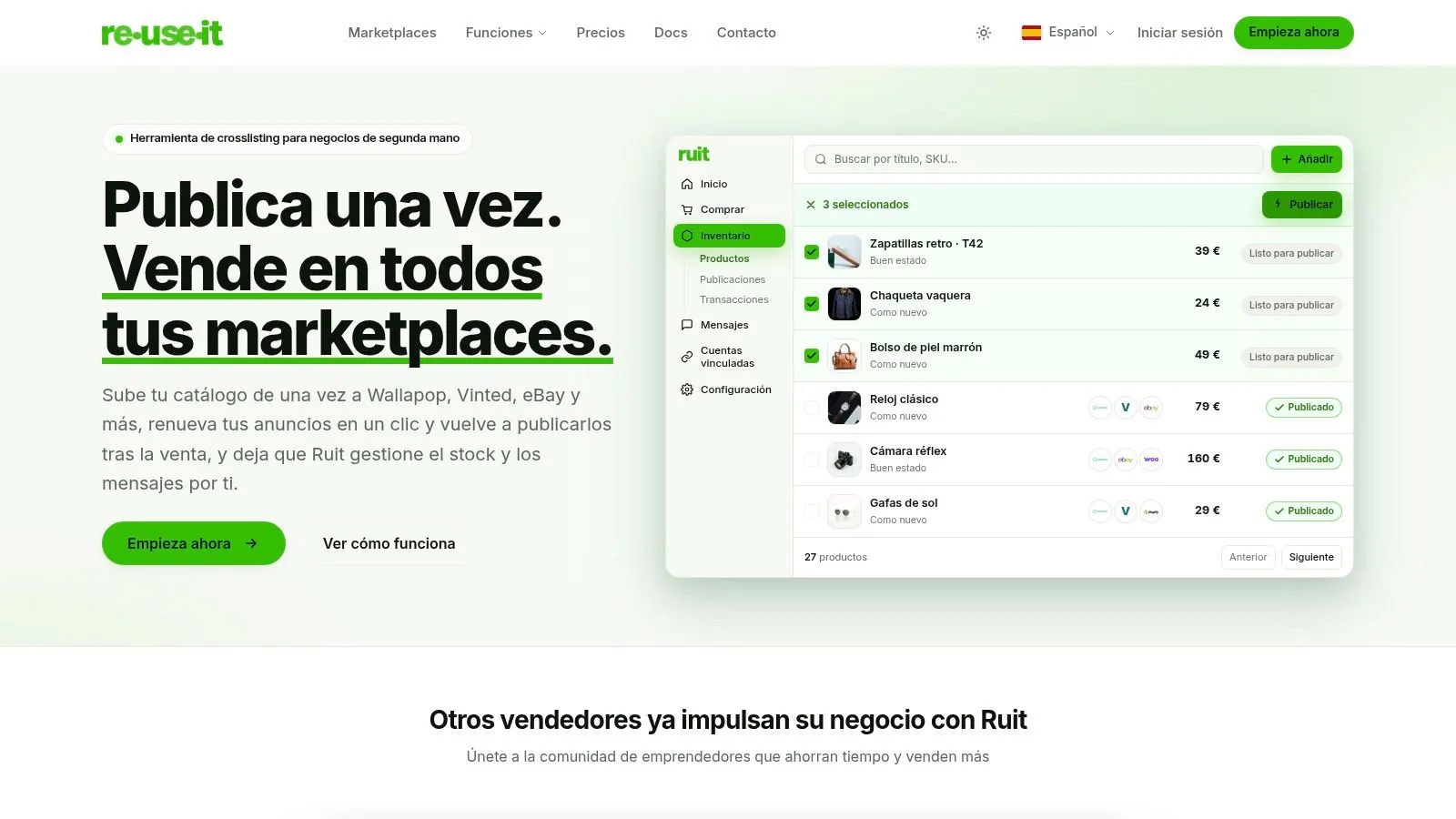
3. Ruit
A reseller can lose hours each week moving the same item between sourcing notes, marketplace listings, buyer messages, orders, and spreadsheets. Ruit targets that full cycle, connecting sourcing and purchase decisions with inventory, publication, communication, accounting exports, and analytics. The practical benefit is margin control. You can review whether an item was bought at the right condition-adjusted cost, sold through a suitable channel, and handled with enough margin left after labor.
From sourcing to publication
Ruit brings marketplace search, comparison, price history, and AI opportunity alerts into one sourcing workflow. Inventory can be imported and merged from connected marketplaces, so sellers do not have to recreate records by hand. Listings can then be published across Wallapop, Vinted, eBay, Shopify, WooCommerce, PrestaShop, and Todocolección. Bulk and scheduled publication help when the catalog grows beyond one-off listing work.
After publication, automatic stock and price synchronization reduces duplicate updates. Sold items can be removed from other channels, while scheduled relisting keeps aging inventory visible. AI can assist with titles, descriptions, and photo editing, including bulk background removal. Web, iOS, and Android access keeps sourcing, listing, and order tasks available away from a desk.
Where Ruit earns its subscription
The unified messaging inbox addresses a daily problem in second-hand commerce. Buyers ask about condition, measurements, authenticity, bundles, and negotiated prices, often before placing an order. Suggested AI replies reduce repeated typing, while centralized order handling and accounting exports cut the reconciliation work that otherwise returns to spreadsheets daily.
Ruit suits volume sellers and teams more than occasional operators. Basic, Premium, and Enterprise plans cover different operating needs, with API, CRM, ERP, and custom development options at the advanced end. The platform supports several interface languages and offers chat or email support, with priority treatment on higher plans. Sellers should review the subscription terms carefully. Prices are shown monthly without VAT, access begins immediately after subscribing, and the fourteen-day withdrawal period is waived per the published terms.
Trace one item from sourcing decision to realized margin, buyer conversation, order, and accounting export before you judge the platform.
Ruit is less suitable for low-volume sellers. A casual operator may pay for capabilities that are not yet needed, and marketplace coverage varies by country. For a professional European operation with separate tools for sourcing, multichannel publishing, messaging, and profit analysis, consolidating those jobs can justify the subscription. Review the Ruit sourcing and inventory workflow before deciding whether its coverage matches your channels.
4. Veeqo
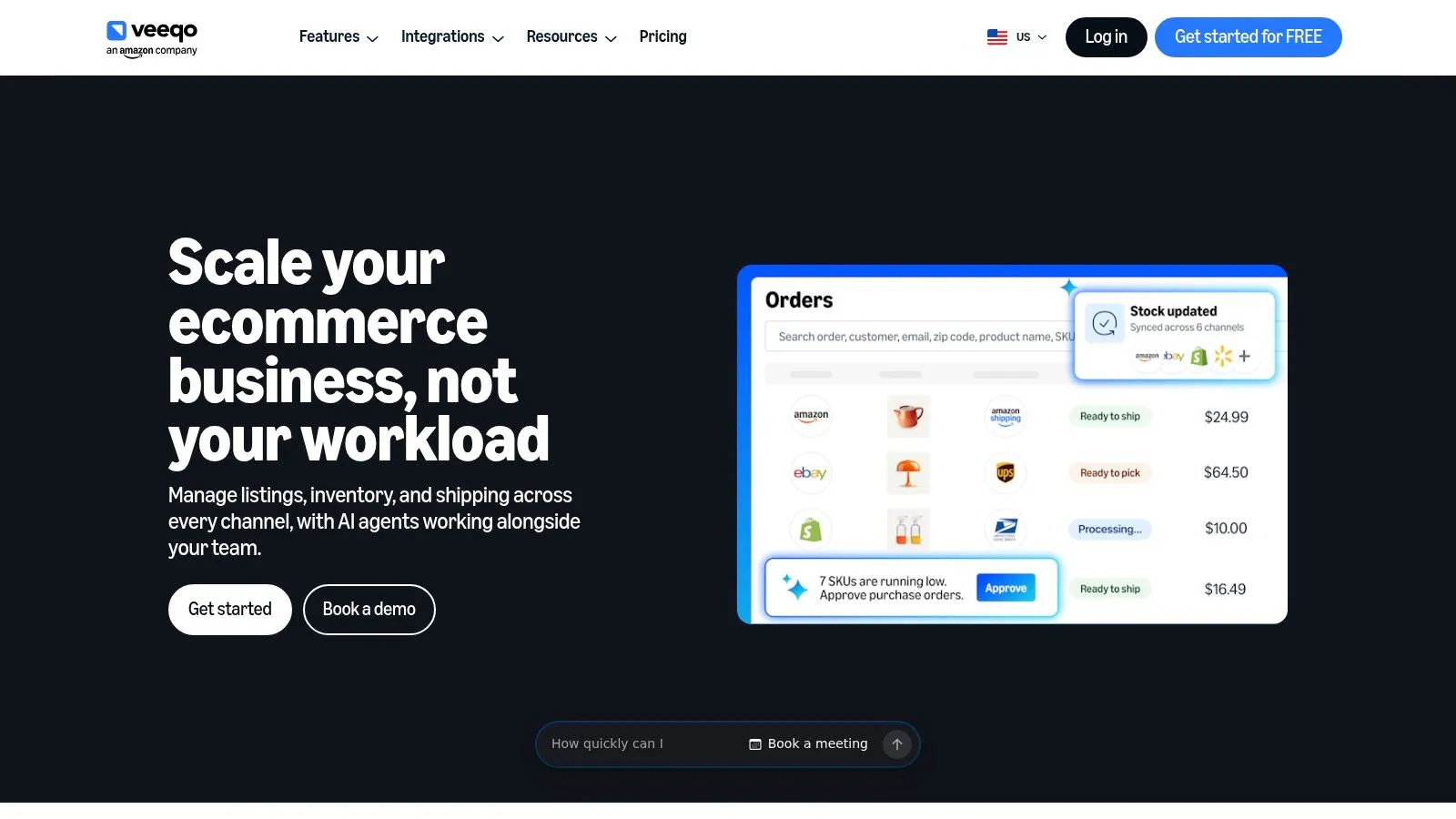
Veeqo is strongest when shipping is the daily pain. Its free Shipping plan offers unlimited orders and access to carrier rates, while integrations connect Amazon, eBay, Shopify, Walmart, WooCommerce, and other channels. That makes it attractive to sellers who already have their catalog under control but need a cleaner process for picking, packing, labels, and dispatch.
The inventory side is modular. Automated inventory synchronization and demand forecasting sit in an optional Inventory plan, so the base shipping product shouldn’t be mistaken for a complete resale operating system. Unlimited users, warehouses, and SKUs across plans can make growth easier to administer, especially when more than one person handles fulfillment.
What it doesn’t solve
Veeqo can remove a large amount of shipping repetition, but advanced listing and inventory features require paid additions. Resellers should map the handoff carefully. If Vendoo or another listing tool owns the catalog, determine which system controls quantities, order status, and cancellations before connecting both.
Veeqo is an Amazon company. Some operators will value the ecosystem and shipping economics, while others will prefer a platform with less direct marketplace ownership. That isn’t a universal objection, but data policy, support expectations, and channel neutrality deserve review before rollout.
Choose Veeqo when shipping execution matters more than sourcing intelligence or reseller-specific listing speed.
5. BaseLinker
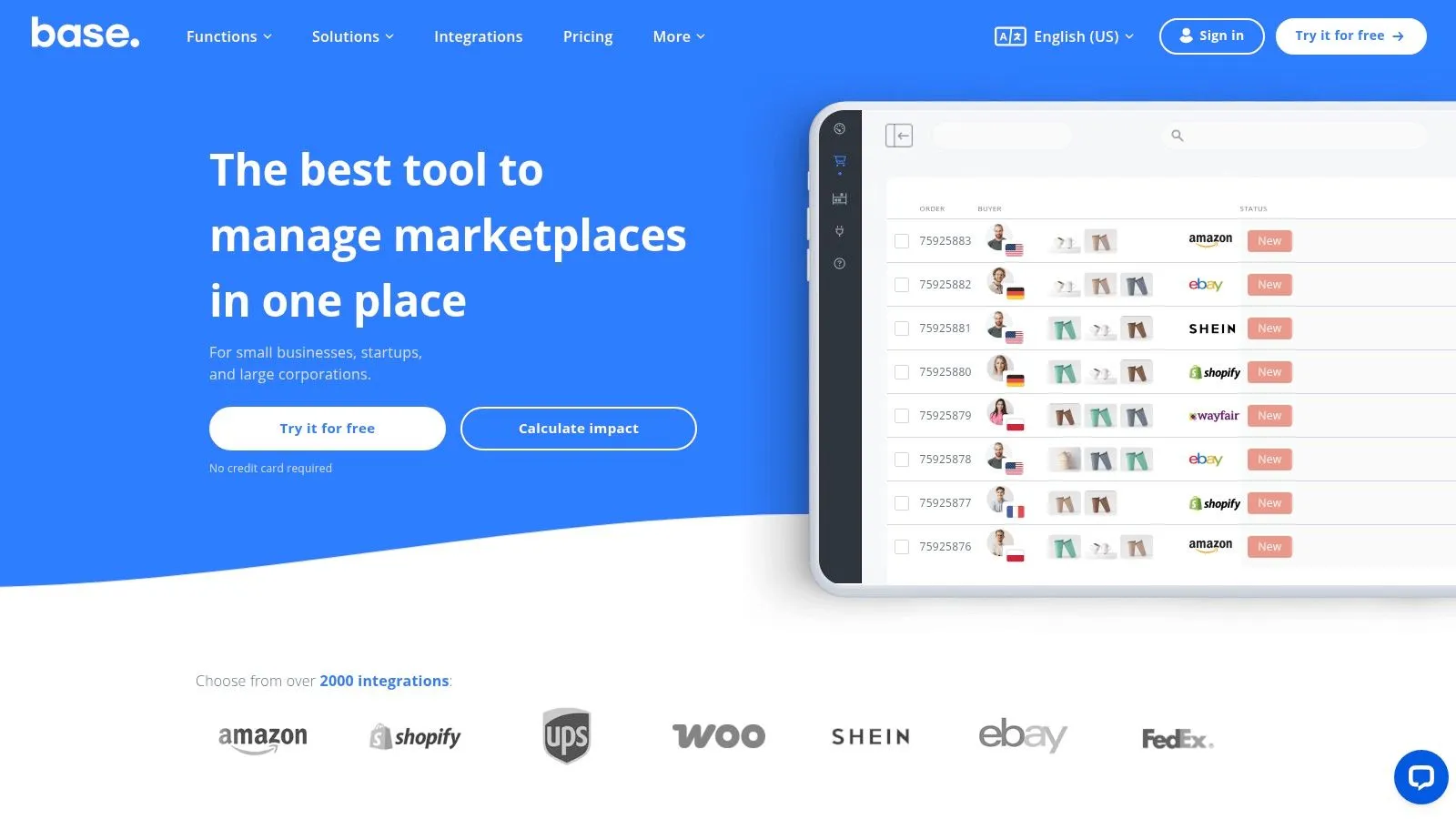
BaseLinker is a strong European option for sellers whose operation stretches beyond the standard Amazon and eBay setup. It connects marketplaces, webstores, couriers, accounting systems, and ERP tools, then synchronizes listings, orders, stock, and prices across that network. The value is less about one brilliant listing screen and more about reducing the number of handoffs between commercial channels and back-office processes.
Its breadth suits a seller operating several country-specific marketplaces, a store built on a local ecommerce platform, and multiple courier services. An API supports custom workflows, which becomes useful when standard rules don’t match how the business grades, stores, bundles, or ships used stock. Partner connectors can also extend the platform into more complex setups.
Implementation is the price of breadth
BaseLinker’s weakness is the work required to configure it well. A wide integration catalog can create more decisions around field mapping, order states, courier rules, and ownership of inventory data. First-time users may need time to build those rules before the system feels simple.
Public pricing isn’t clearly listed as a single self-serve figure, and the cost depends on order and listing volume. Treat the commercial conversation as part of the evaluation. Ask for a complete estimate that includes the connectors, order volume, support, and any implementation assistance you need.
BaseLinker is a good match for a European multichannel operation with integration complexity, not necessarily for a seller who only wants faster cross-posting.
6. Linnworks
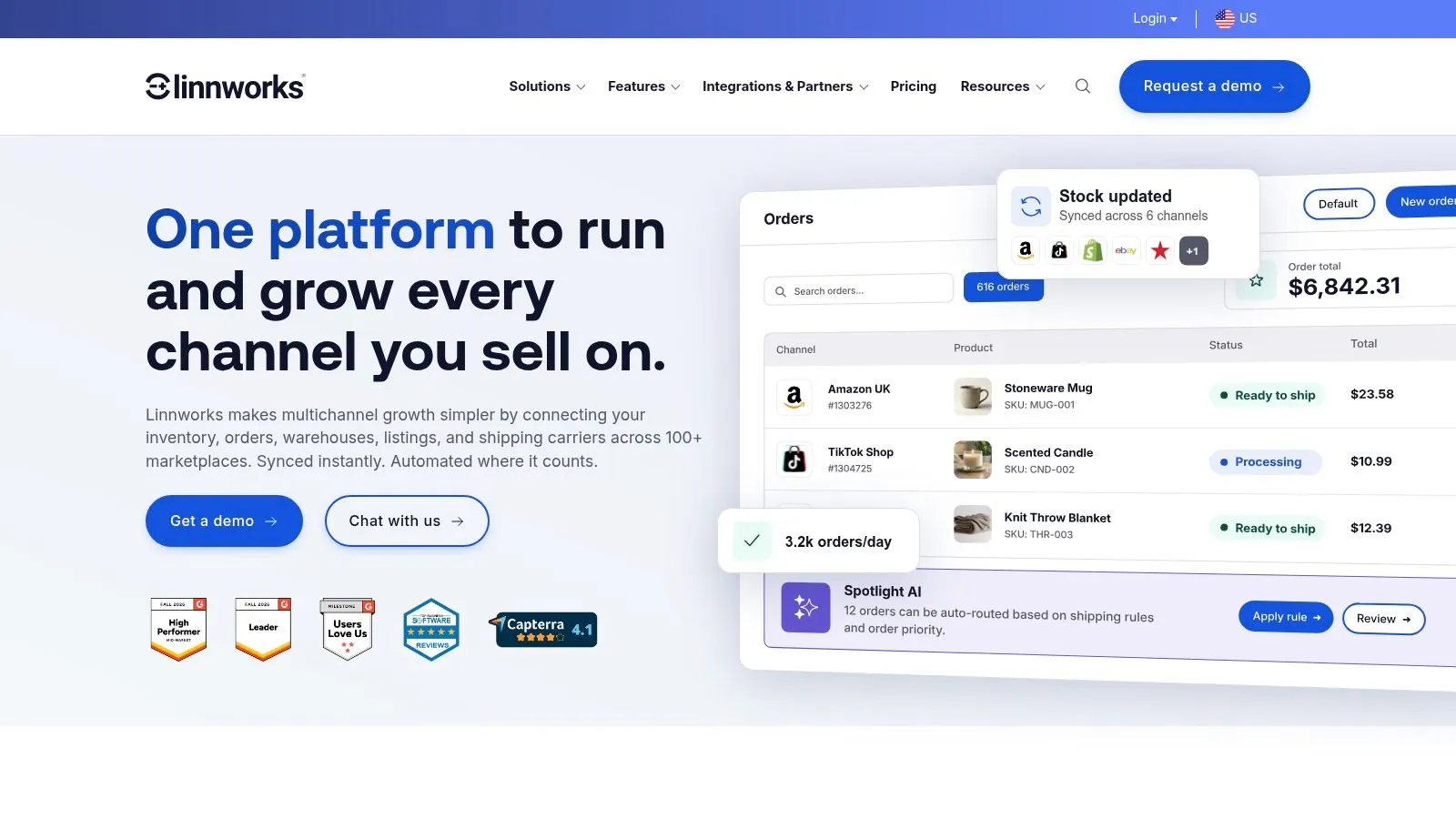
Linnworks is built for sellers with complex catalogs, multiple warehouses, and a need for durable order and inventory controls. It provides centralized inventory and order management, bulk listing, shipping connections, and a broad integration ecosystem with more than 100 native channel integrations described in the product brief. Partner connections extend the platform into logistics, couriers, 3PLs, and custom operational services.
That scale changes the implementation question. A reseller isn’t merely asking whether the tool can publish a product to eBay. The team needs to define how inventory moves between warehouses, how orders are routed, how exceptions are handled, and which system remains authoritative when a marketplace update fails.
Built for operational discipline
Linnworks is a better fit when the business has enough process complexity to justify formal configuration. It can support bulk operations and broad channel coverage, but the learning curve is higher than with lightweight cross-listing apps. Pricing is quote-based, so a small seller may find the buying process disproportionate to the immediate need.
Before signing, run realistic events through a test environment. Include simultaneous sales, returns, cancellations, relists, warehouse transfers, and manual quantity corrections. For more context on why centralized order control matters, read about cloud-based order management.
A platform that supports every channel but hides failed updates is dangerous. Require visible exceptions, an audit trail, and a recovery process.
Visit Linnworks if your operation needs enterprise-scale channel, warehouse, and order management.
7. Descartes Sellercloud
Descartes Sellercloud is aimed at established resellers that need more than a listing hub. It combines catalog management, multichannel listing, inventory synchronization, purchasing, shipping, reporting, and native warehouse-management capabilities through SkuStack. FBA and shopping-cart integrations extend the operational scope, while API access supports custom workflows and external systems.
The strongest use case is a complex resale business where inventory is spread across locations and products need more structured handling than a single bin or shelf label. Advanced shipping and routing rules can reduce manual decisions during fulfillment, while warehouse controls provide a clearer link between the digital catalog and physical stock.

Powerful, but not lightweight
Sellercloud’s advantages come with a higher entry cost and a larger implementation burden than tools such as Vendoo or Sellbrite. It makes sense when purchasing, warehouse operations, routing, reporting, and channel management already involve several people or systems. It doesn’t make sense to introduce that complexity merely to publish a handful of listings more quickly.
The platform offers enterprise capabilities, unlimited users and integrations on standard pricing, private-cloud options, and 24/7 support as an optional service. Confirm which support and infrastructure choices apply to your contract. The right evaluation is a process simulation, not a feature tour. Give the team a receiving task, a stock adjustment, a multichannel sale, a return, and a shipment exception, then measure how many manual interventions remain.
Descartes Sellercloud is the heavyweight choice for high-volume, multi-warehouse resale operations.
Top 7 Reseller Software Comparison
| Solution | Implementation complexity 🔄 | Resource requirements ⚡ | Expected outcomes ⭐📊 | Ideal use cases | Key advantages 💡 |
|---|---|---|---|---|---|
| Vendoo | Low, simple web/mobile setup and workflows | Low, subscription tiers; Shopify connector extra $9.99/mo | ⭐⭐⭐, much faster listing and reliable cross-posting; sale auto-detection | Individual resellers, fashion/vintage sellers, mobile-first listing | Quick bulk/list relist, strong mobile UX, AI listing enhancements |
| Sellbrite | Low, fast onboarding and intuitive UI | Low, clear tiered pricing; Free plan up to 30 orders/mo | ⭐⭐, consistent inventory sync and fast multichannel publishing | Small to midsize sellers needing quick setup across major channels | Transparent pricing, straightforward multichannel listing, easy start |
| Ruit | Medium-High, full-platform with integrations and AI configuration | Medium-High, subscription for teams/volume; onboarding for integrations | ⭐⭐⭐⭐, end-to-end automation, measurable time savings | Professional second‑hand resellers in Europe, teams scaling operations | All-in-one ops, AI sourcing/pricing, multichannel EU coverage |
| Veeqo | Medium, shipping-first with optional inventory/listing modules | Low-Medium, free shipping plan; add-ons for inventory/forecasting | ⭐⭐⭐, significant shipping cost savings; scalable shipping ops | Sellers prioritizing shipping rates and fulfillment scalability | Competitive carrier rates, unlimited users/warehouses/SKUs, free shipping tier |
| BaseLinker | Medium, broad connector setup; initial config time for complex setups | Medium, freemium with volume-based upgrades | ⭐⭐⭐, wide EU marketplace reach and flexible integrations | EU professional sellers needing many marketplace/courier/accounting links | Extensive EU integrations, API for custom workflows, scalable connectors |
| Linnworks | High, enterprise-grade platform with steeper learning curve | High, quote-based pricing for large/multi-warehouse operations | ⭐⭐⭐⭐, robust multichannel scale, deep integrations and automation | Large sellers with complex catalogs, multiple warehouses, high volume | 100+ native integrations, partner ecosystem, built for scale and complexity |
| Descartes Sellercloud | High, comprehensive OMS/WMS and advanced configuration | High, higher entry price, enterprise add-ons, private cloud options | ⭐⭐⭐⭐, deep control over multi-warehouse operations and reporting | High-volume resellers needing WMS, private cloud, 24/7 support | Native WMS, enterprise features, API access, optional private cloud/support |
Match the Stack to Your Bottleneck
Start with the task that costs the team the most hours. If the problem is recreating listings, Vendoo is the focused option. If the requirement is straightforward synchronization across major marketplaces, Sellbrite offers a simpler route. If shipping consumes the day, Veeqo deserves attention. BaseLinker and Linnworks fit operations where integrations, orders, warehouses, and regional channels create the complexity. Sellercloud belongs on the shortlist when purchasing and warehouse control need to live beside marketplace operations.
Ruit sits differently from the lighter tools because it connects sourcing, inventory, publication, pricing, messaging, orders, accounting exports, and analytics. That broader scope is valuable only if the business will use it. A professional reseller should test whether the platform improves decisions about acquisition cost, condition, price, channel choice, aging stock, and profit per labor hour, not just whether it publishes listings quickly.
Run a controlled trial with your own inventory. Include unique one-unit items, incomplete marketplace data, condition variations, negotiated orders, returns, and a sale that must remove the item from every other channel. Track listing minutes, manual touches, synchronization exceptions, message response work, order-handling time, and the effort required to reconcile payouts. Compare the labor removed with the monthly subscription and any connector or implementation charges.
Don’t build a stack around overlapping ownership. Decide which system controls the catalog, stock quantity, price, order status, and accounting export. Add a second tool only when the first leaves a specific gap, and document the handoff so an operator knows where to fix an error.
For a small seller, the best software may be the tool that removes repetitive publication without adding administrative overhead. For a growing team, the better choice is usually the platform that preserves data quality as channels and people multiply. The software earns its place when it prevents overselling, reduces manual handling, exposes exceptions, and helps the operator buy and price stock more profitably.
Frequently Asked Questions
Which reseller software should I choose first?
Start with the task that costs the team the most hours. If the problem is recreating listings, a focused cross-listing tool such as Vendoo fits. If shipping consumes the day, a shipping-first platform such as Veeqo deserves attention, and BaseLinker or Linnworks fit operations where integrations, orders and warehouses create the complexity.
How do I compare reseller tools before subscribing?
Run a controlled trial with your own inventory. Include unique one-unit items, condition variations, returns and a sale that must remove the item from every other channel, then track listing minutes, manual touches and synchronization exceptions against the monthly subscription and any connector charges.
Can I combine several tools in one stack?
Yes, but decide which system controls the catalog, stock quantity, price, order status and accounting export. Add a second tool only when the first leaves a specific gap, and document the handoff so an operator knows where to fix an error.
Which tools suit high-volume, multi-warehouse resellers?
Linnworks and Descartes Sellercloud are built for complex catalogs, multiple warehouses and formal configuration. Both are quote-based or carry a higher entry cost, so they make sense when purchasing, warehouse operations and routing already involve several people or systems.
Ruit connects sourcing, inventory, multichannel publication, synchronized stock, messaging, orders, accounting exports, and analytics in one platform for professional second-hand businesses. If your current stack leaves work scattered across spreadsheets and marketplace inboxes, visit Ruit and assess whether a full-cycle workflow can increase profit per hour worked.