Multi-Account Marketplace Management for UK Sellers (2026)


Table of Contents
- TL;DR
- What multi-account marketplace management means for a UK seller
- What the rules allow on Vinted and eBay
- Keeping listings consistent across accounts
- Stopping the same item selling twice
- Orders, dispatch, returns and messages
- Tax checks when you sell across platforms
- Our view: fewer accounts, better systems
- Building a routine that scales
- Putting it into practice with Ruit
- Sources
- Frequently Asked Questions
- Can I have two Vinted accounts in the UK?
- Can I run more than one eBay account?
- What happens if the same item sells on Vinted and eBay?
- Do I need to tell HMRC if I sell on Vinted and eBay?
- Does splitting sales across accounts avoid the tax thresholds?
- How do I manage buyer messages from several marketplaces?
- Recommended
Multi-account marketplace management means running your selling across several accounts or platforms, such as Vinted and eBay, without breaking each site’s rules or selling the same item twice. In the UK you can do it legitimately: eBay allows more than one account for separate purposes, and Vinted allows one standard account plus one Pro account, each with its own email address and phone number. Anything beyond that risks a ban, so the work is mostly about staying inside the rules and keeping your stock honest.
This guide covers what each platform permits, how to keep listings and stock consistent, what to do about orders and messages, and the tax checks that apply once you sell at volume.
TL;DR
- eBay UK allows multiple accounts for genuine purposes, such as separate product lines, but not to dodge limits or restrictions. Restrictions on one linked account can affect the others.
- Vinted allows a standard account and a Pro account side by side, with distinct email addresses and phone numbers. Other multiple accounts can lead to a permanent ban.
- Selling the same item on two platforms is the main operational risk. On eBay, cancelling because stock is gone counts as a transaction defect.
- HMRC wants to hear about trading income above the £1,000 trading allowance, and platforms report sellers with 30 or more sales or roughly £1,700 in a year.
- A repeatable routine (one source of truth for stock, fixed photo and description standards, set response times) matters more than the number of accounts.
What multi-account marketplace management means for a UK seller
The phrase covers two different situations, and the rules differ for each.
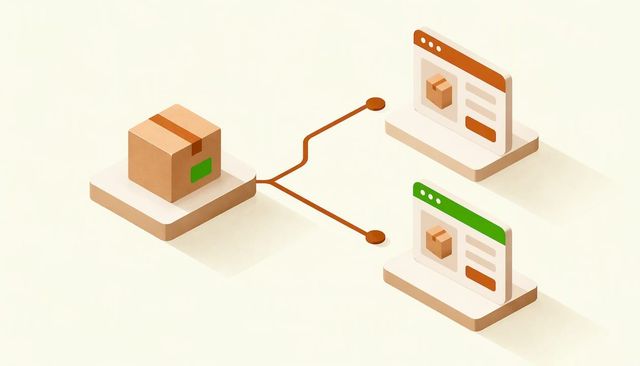
The first is one seller, several marketplaces: the same stock on Vinted, eBay and perhaps your own shop. Each platform has one account from you, and the challenge is keeping listings, stock and messages in step.
The second is one seller, several accounts on the same marketplace: for example a personal eBay account for buying and a separate one for selling, or a Vinted standard account alongside a Vinted Pro account. Here the challenge is compliance, because platforms treat duplicate accounts as a risk signal.
Most UK resellers meet both at once. A clothing reseller might clear personal wardrobe items on a standard Vinted account, run sourced stock through Vinted Pro, and list higher-value pieces on eBay. Each of those channels has different fee structures, return rules and expectations, and the workload multiplies quickly.
What the rules allow on Vinted and eBay
Start here, because a tidy workflow on an account that gets banned is worth nothing.
| Question | eBay UK | Vinted UK |
|---|---|---|
| Can I have more than one account? | Yes, for purposes such as separating buying from selling or managing different product lines | Only one standard account plus one Pro account |
| What must be different? | Each account must follow eBay policies and seller standards | Distinct email addresses and phone numbers |
| What is prohibited? | Opening an account to evade restrictions, limits or policy consequences | Other multiple accounts, which can lead to permanent banning |
| Is there a linkage risk? | Restrictions on one linked account may affect others | Account blocking can follow duplicate accounts |
| Commercial selling | Allowed, with extra consumer obligations for business sellers | Must be done through a Pro account |
The eBay position comes from its multiple accounts policy, which permits separate accounts for legitimate purposes but prohibits using them to circumvent restrictions, and warns that action on one linked account may affect others. The Vinted position comes from its guidance on why an account was blocked, which says multiple accounts can lead to a permanent ban unless one is a standard account and the other a Pro account, with distinct email addresses and phone numbers.
Private, business and Pro: choosing the right account type
Vinted’s standard accounts are for non-professional use. Its commercial selling page says that anyone buying or sourcing items to resell for profit must register as a Pro seller. If you buy job lots at car boots and auctions to resell, that is the Pro route, even if the volume feels small.
Pro status brings obligations. Vinted’s Pro seller page states that Pro sellers must let buyers return an item within 14 days of receiving it, and its platform information explains that consumers buying from Pro sellers have rights including withdrawal. We cover the costs and obligations in more detail in our guide to Vinted Pro seller rules, fees and HMRC.
On eBay the line is different: you can sell as a private or business seller, and business sellers carry legal duties. eBay’s selling practices policy says business sellers must offer consumers a returns policy for faulty or damaged goods and respect the right to return items when a buyer changes their mind.
A practical rule: decide which account carries which stock before you list anything. Personal belongings go on the personal account. Sourced stock goes through the business or Pro account. Mixing them is the quickest way to create a compliance problem and a messy set of records.
Keeping listings consistent across accounts
When the same item appears on two platforms, the two listings should describe the same physical thing. Three habits help.
One listing per item per platform
Vinted does not allow the same item to be listed twice on Vinted. Its guidance on hidden or removed listings tells sellers with several similar items to use one listing with accurate quantity, size or colour details and clear photos. Duplicating a listing on a second Vinted account is exactly the pattern that gets listings removed and accounts questioned.
Photos and descriptions of the actual item

Which? notes that most platforms tell sellers not to use stock images, because they are copyrighted and do not show the condition of the item. The same guide says detailed, honest descriptions and clear photographs of the real item, defects included, help reduce disputes and defend against claims.
Take one set of photos and write one master description, then adapt only what each platform needs. Keep a fixed checklist:
- Front, back, label and any flaws, shot in the same light.
- Measurements for clothing (flat chest width, length), not just the tag size.
- Condition wording that means the same thing on every platform.
- A stock code in your own records that matches the item on every channel.
With Ruit you list an item once and publish it on Vinted, eBay, Wallapop, todocoleccion, Shopify, WooCommerce and PrestaShop, and the AI drafts titles and descriptions you can then edit. That removes most of the retyping, though you still check the wording against the real item.
Bulk work on eBay
If you are moving a rail of stock onto eBay, our guide to bulk upload on eBay walks through the process and the mistakes that cause rejected rows.
Stopping the same item selling twice
Once an item is live on two platforms, the race begins. A buyer on Vinted and a buyer on eBay can both pay within minutes of each other, and you can only post one parcel.
On eBay this is not a minor embarrassment. Under eBay’s seller standards policy (version dated 15 October 2026), cancelling an order because the item is out of stock or was sold elsewhere counts as a transaction defect. The policy sets a maximum defect rate of 2% and says sellers who fall Below Standard may face limitations. For a small seller with a few hundred orders a year, a handful of oversells can be enough to matter.
Three ways to control stock
| Method | Works when | Weak point |
|---|---|---|
| Manual delist after each sale | Fewer than about 20 live items | You are asleep, at work or out sourcing when it sells |
| Spreadsheet of stock codes | Moderate volume, one person | Updated by hand, so it is always slightly behind |
| Automatic stock sync | Any volume, multiple channels | Needs every channel connected and checked |
The third approach is what Ruit is built for: when an item sells on one channel, the stock is updated and the listing is removed from the others, so you do not sell the same item twice. Our guides to stock sync across marketplaces and to managing eBay inventory across channels go through setting this up and what to check after a first week.
One caution applies whichever method you use. Unique second-hand pieces are the easy case, because quantity is one. If you sell multi-quantity stock, such as new-with-tags bundles, decide which channel holds the master count and treat the others as mirrors.
Orders, dispatch, returns and messages
Each platform sets its own clock, and a multi-channel seller has to meet all of them.
| Task | Vinted | eBay UK |
|---|---|---|
| Dispatch | Standard sellers must ship within 5 business days of purchase or the order is cancelled and the buyer refunded | Upload accurate tracking within your stated handling time |
| Returns | Pro sellers must accept returns within 14 days of receipt | Business sellers must offer a returns policy and honour change-of-mind returns |
| What to state | Item details and condition | Dispatch times, postage costs and return policy in every listing |
The Vinted figures come from its selling basics page and its guidance on returning an item to a Pro seller, where buyers must request a return within 14 days of receiving the parcel. The eBay points come from the selling practices policy, which asks for accurate tracking within your handling time to meet seller standards and protect against non-receipt claims.
A daily routine that works for most part-time resellers:
- Morning: check new sales on every channel, print or book postage, and pull the items.
- Midday: answer buyer messages. Set yourself a target, for example the same day.
- Evening: post, upload tracking, and relist or refresh anything that has gone stale.
Messages are where multi-channel selling gets noisy. Ruit brings Vinted and Wallapop buyer messages into one inbox, and it relists automatically on Vinted and Wallapop, which cuts two of the most repetitive jobs. eBay messages and eBay relisting stay in eBay itself.
Tax checks when you sell across platforms
More accounts and more channels mean more sales on record, and since platforms now report to HMRC, it is worth knowing where the lines are. This is general information, not tax advice: if your position is unclear, speak to an accountant or contact HMRC.
| Rule | What it says | Source |
|---|---|---|
| Trading allowance | If total income from trading is above £1,000 in the tax year (6 April to 5 April), you need to tell HMRC | GOV.UK, 13 February 2025 |
| Platform reporting | Since 1 January 2024, platforms must collect seller information and report to HMRC for 30 or more sales of goods in a calendar year, or 2,000 euros (about £1,700) or more | GOV.UK, 22 September 2025 |
| Personal possessions | Probably no Income Tax; selling an item for over £6,000 may trigger Capital Gains Tax, and the threshold applies to the total value of a set | GOV.UK, 13 February 2025 |
Two points are often misread. First, HMRC stated on 4 December 2024 that platform reporting is not a new tax, and reaching the reporting threshold does not itself mean tax is due. Second, the £1,000 allowance applies to your income from trading overall, not per account or per platform. Splitting sales across several accounts does not reset it.
If you sell sourced stock, you are probably trading, and our guide to eBay fees in the UK and the £1,000 HMRC threshold explains how fees interact with the allowance. Reporting rules differ by country, as this piece on tax on selling trading cards in Belgium shows for sellers who also trade across the Channel.
Keep one record of every sale, cost and fee, whichever account it came through. It makes the tax return simpler and gives you evidence if a platform or buyer queries something.
Our view: fewer accounts, better systems
We talk to a lot of Vinted and eBay sellers, and the pattern is consistent. People reach for extra accounts when the real problem is workload: too many listings to refresh, too many inboxes, too much risk of a double sale. A second account does not fix any of that, and on Vinted it can end the first one.
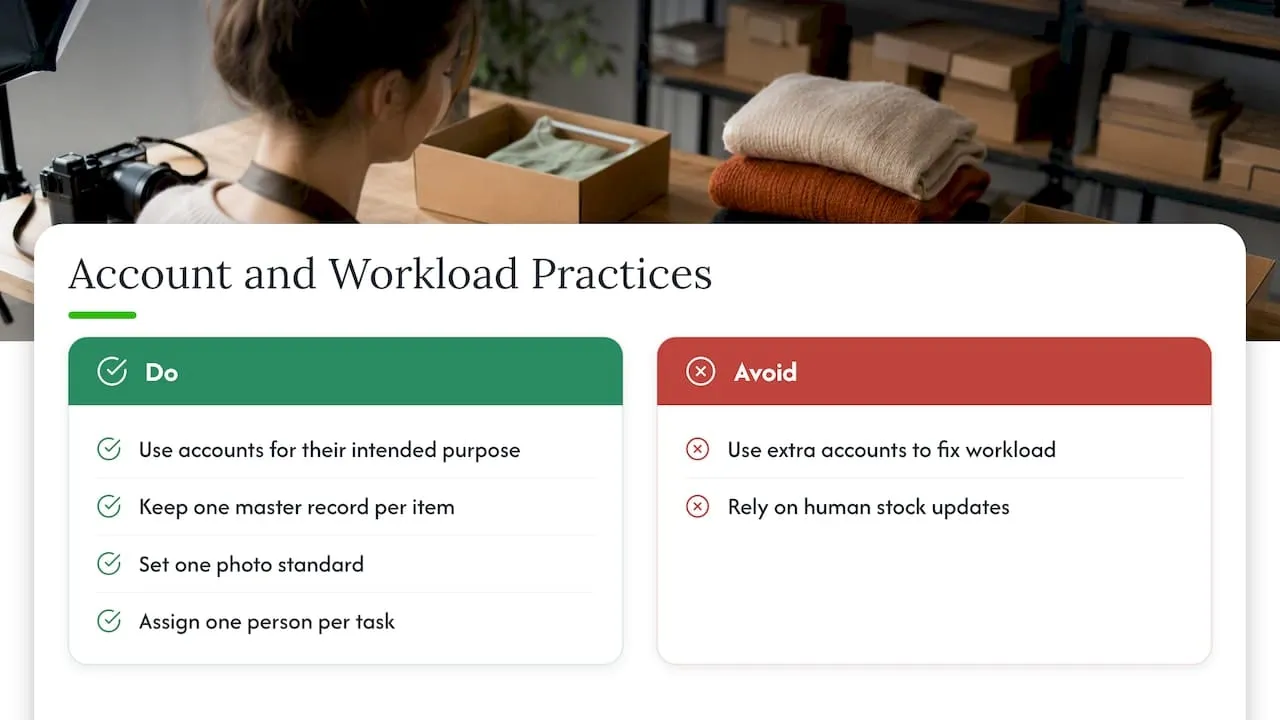
Our advice is to use accounts for what the platforms intend (a standard account for your own things, a Pro account for trade stock, a separate eBay account where you have a real product-line reason) and then fix the workload with process. One master record per item. One set of photo standards. One person responsible for each task, even if that person is you on different days. Stock that updates itself across channels, because the human version fails at the worst moments.
If you do run more than one account on a marketplace within the rules, it helps to have them under one roof; we describe how that works on our page about several accounts on the same marketplace.
- Luis
Building a routine that scales
General marketplace-management guidance says growth creates duplicated work, conflicting data and platform-specific compliance risk, and recommends shared standards, clear ownership and regular reviews (February 2026). For a one-person resale business, that translates into something modest.
A weekly review
Spend 30 minutes a week on the numbers that warn you early:
- Oversells or cancellations this week (the target is zero, and eBay’s ceiling is a 2% defect rate).
- Items live for more than 60 days without a view or offer, which need a new price, photo or title.
- Messages unanswered for more than a day.
- Returns and the reason for each. Repeated reasons point at a listing problem, such as vague sizing.
Setting standards once
Write down your photo checklist, your condition wording, your postage rules and your returns approach. When you take on help, whether a family member or a part-time packer, the document does the training.
Pricing and offers
Price rules differ between platforms, especially around offers. Our page on Vinted offers and pricing rules covers the Vinted side, so you can set a floor price before a buyer asks for a discount.
Moving to your own shop
Many resellers eventually add a Shopify, WooCommerce or PrestaShop store alongside Vinted and eBay. Ruit publishes to all three, and our guides on connecting Shopify to eBay and PrestaShop to eBay show how the pieces fit.
Putting it into practice with Ruit
If you sell on Vinted and eBay at the same time, Ruit lets you list an item once and publish it on Vinted, eBay, Wallapop, todocoleccion, Shopify, WooCommerce and PrestaShop. When it sells on one channel, the stock updates and the listing comes off the others. Auto-relist runs on Vinted and Wallapop, one inbox holds your Vinted and Wallapop messages, and AI drafts titles and descriptions. You can see how it works and start at Ruit.
Sources
- eBay: Using multiple accounts policy
- Vinted: Why was my account blocked
- Vinted: Commercial selling
- Vinted: Selling with Vinted for Professionals
- Vinted: Our platform
- eBay: Selling practices policy
- Vinted: Listing was hidden or removed
- Which?: How to sell second hand online
- eBay: Seller standards policy
- Vinted: Selling basics
- Vinted: Returning an item to a Pro seller
- GOV.UK: Check if you need to tell HMRC about your income from online platforms
- GOV.UK: Selling goods or services on a digital platform
- GOV.UK: Information for online sellers
- Virto Commerce: Marketplace account management
- MagicFranco: tax on selling trading cards in Belgium
Frequently Asked Questions
Can I have two Vinted accounts in the UK?
Only if one is a standard account and the other is a Pro account, each with its own email address and phone number. Vinted’s guidance says other multiple accounts can lead to a permanent ban. If you resell sourced items, the Pro account is the one meant for that.
Can I run more than one eBay account?
Yes, for genuine reasons such as separating buying from selling or running different product lines. Each account must follow eBay’s policies, and you cannot use a new account to get around a restriction or limit. Action on one linked account can also affect the others.
What happens if the same item sells on Vinted and eBay?
You have to cancel one order and refund that buyer. On eBay, cancelling because the item sold elsewhere counts as a transaction defect, and eBay sets a 2% maximum defect rate in its seller standards. Automatic stock sync that removes the other listings when an item sells is the reliable way to avoid it.
Do I need to tell HMRC if I sell on Vinted and eBay?
If your total income from trading is above the £1,000 trading allowance in a tax year, you need to tell HMRC. Platforms also report sellers with 30 or more sales or about £1,700 in a year, but that report does not itself mean tax is due. Personal possessions sold for less than they cost you are usually not taxable, but check the GOV.UK guidance or ask an accountant if unsure.
Does splitting sales across accounts avoid the tax thresholds?
No. The £1,000 allowance applies to your total trading income, not per account or per platform. Spreading sales across accounts only adds the risk of being flagged for breaking platform rules.
How do I manage buyer messages from several marketplaces?
Set a response target and check every channel at fixed times each day. Ruit brings Vinted and Wallapop messages into one inbox, while eBay messages stay in eBay, so you check two places instead of three.