Multi Marketplace Publishing for UK Vinted and eBay Sellers


Table of Contents
- TL;DR
- What multi marketplace publishing actually involves
- Why the double sale is the problem to solve
- Preparing one listing that works on Vinted and eBay
- A worked example: one vintage jacket, two marketplaces
- Manual or automated: where the line falls
- Real-time versus scheduled stock sync
- Messages and relisting: the daily maintenance
- Are you a private seller or a business?
- Our view: list once, then let stock follow the sale
- Start publishing to more than one marketplace
- Frequently Asked Questions
- Sources
- Recommended
Multi marketplace publishing means writing a listing once and putting it live on several selling sites at the same time, then removing it everywhere the moment it sells. With Ruit you list once and publish to Vinted, eBay, Wallapop, todocoleccion, Shopify, WooCommerce and PrestaShop, and stock stays in step so you never sell the same item twice.
This guide is for UK sellers on Vinted and eBay: private sellers clearing wardrobes, Vinted Pro accounts, and small resale businesses. It covers how to prepare one listing that works on both sites, how to keep stock in sync, and what to watch on eBay’s seller standards.
TL;DR
- Publishing to Vinted and eBay together reaches two different sets of buyers with one set of photos and one description.
- The real risk is the double sale: an item sells on one site while still live on the other.
- On eBay, cancelling an order because the item is out of stock counts against your seller standards, so fast delisting matters.
- Adapt titles and descriptions per marketplace, even when the photos stay the same.
- Ruit publishes from one listing, syncs stock, removes sold items elsewhere and relists on Vinted and Wallapop automatically.
What multi marketplace publishing actually involves
There are four jobs in selling one item on several sites:
- Create the listing: photos, title, description, price, condition.
- Publish it on each marketplace, in that marketplace’s format.
- Sync stock, so a sale on one site takes the item off the others.
- Maintain it: relisting, answering messages, adjusting price.
Done by hand, each job is repeated once per marketplace. That is fine for a handful of items. It becomes the bottleneck as your stock grows, because the delisting step is the one people forget when they are busy parcelling an order.
The benefit is reach. Vinted buyers tend to browse by brand, size and condition fields, while eBay buyers search by keywords and filter by item specifics. The same jumper can find a buyer on either. Stopping at one site means waiting for that site’s audience alone.
Why the double sale is the problem to solve
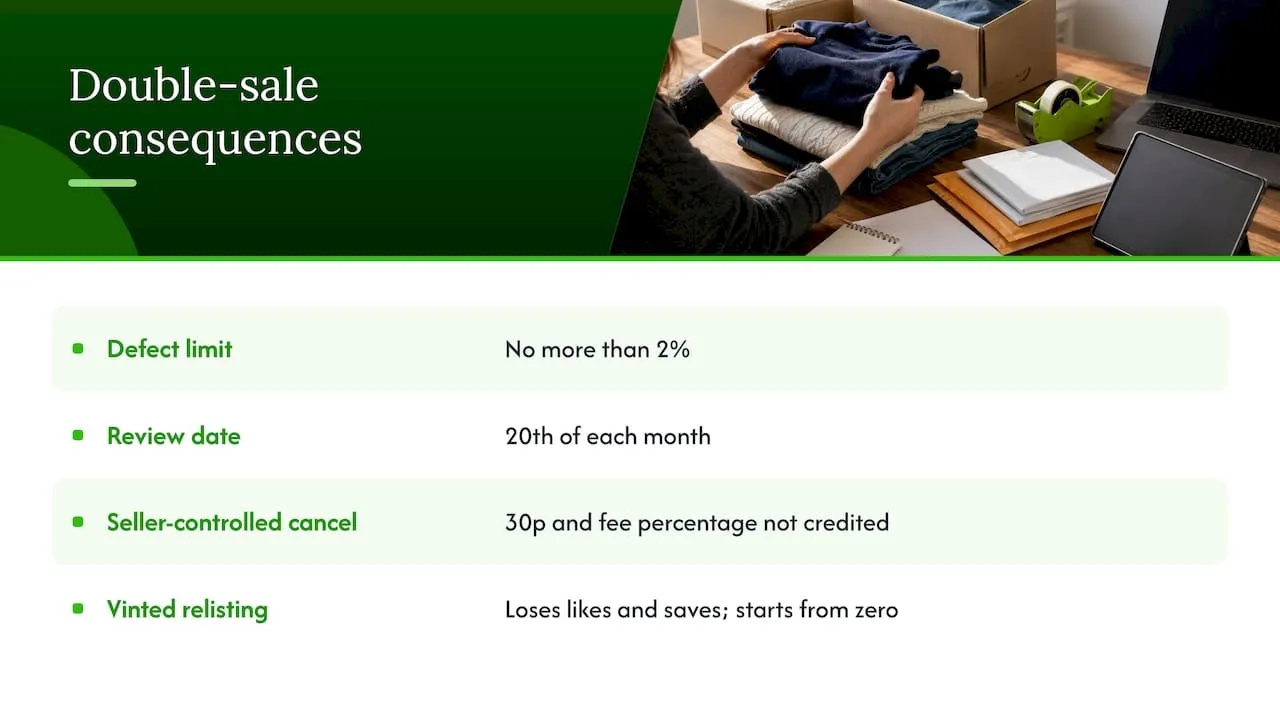
When the same item is live in two places and sells in both, one buyer has to be disappointed. That has a real cost on eBay. eBay UK’s seller standards policy (page dated 15 October 2026) counts a transaction defect when a seller cancels an order unexpectedly, for example because the item was out of stock or sold elsewhere. It asks sellers to keep the transaction defect rate to no more than 2%, and performance is evaluated on the 20th of each month.
There is a fee angle too. eBay’s fee credits page explains that when a seller cancels because the item is out of stock or damaged, a reason within the seller’s control, the final value fee percentage and the 30p per order fixed amount are not credited back. Cancellations for reasons outside your control, such as a buyer asking to cancel, are treated differently.
On Vinted the consequences are softer but still unpleasant: a cancelled sale means a buyer who wasted time and a listing you now have to start again. A relisted item loses the likes and saves the first listing had collected, so you restart from zero.
The fix is not complicated: the moment an item sells anywhere, it must disappear everywhere else. The question is whether you rely on your memory or on automation. Our guide to auto delisting sold items goes through the routine in detail, and how to cross list on eBay without double sales covers the eBay side.
Preparing one listing that works on Vinted and eBay
Photos can be shared. Text should be adapted. A sensible master listing contains everything either site might need, and you trim it for each channel.
Photos
Shoot in daylight against a plain background. Show the whole item, labels, fabric and every flaw. eBay UK’s Seller Centre advises adding as many photos as possible, covering all angles and imperfections. Vinted’s help page on describing an item says flaws mentioned in the description should also be visible in the photos. One shoot satisfies both.
Titles
The two sites read titles differently:
| Vinted | eBay UK | |
|---|---|---|
| Title style | Short and specific: brand, type, colour, a distinguishing detail | Up to 80 characters, used as fully as possible with brand, type, colour, style and model number |
| Words to avoid | Vague words such as “nice” or “pretty” | Special characters |
| Structured fields | Brand, size, condition | Item specifics, many prefilled, which feed search filters |
| Description | Measurements, materials, alterations, missing labels, flaws | Detailed specifications and condition |
Sources: Vinted help, describing an item and eBay UK Seller Centre, create great listings, both checked for this article in November 2026.
A good habit: write the long eBay title first, then cut it down for Vinted. Starting from the keyword-rich version makes the short version easier than the other way round.
Description
Use the same skeleton for both sites: what it is, size and measurements, condition and flaws, what is included, and postage or collection details. Measurements matter more than size labels, particularly for vintage and clothing, where sizing has changed over the decades.
Price
Base the price on recent sold listings, not on asking prices. Vinted buyers expect to make offers, so leave a little room there. If you want the same net return on both sites, remember that fees fall on different sides of the sale. Our guide to pricing used clothing works through the fee and postage maths, and eBay fees in the UK explains how the £1,000 HMRC reporting threshold fits in.
A worked example: one vintage jacket, two marketplaces
Say you have a 1990s waxed jacket.
- Photograph it once: front, back, collar label, lining, cuffs, the worn patch on one elbow.
- Write the master description: brand, style, size, pit-to-pit and length measurements, material, condition, the elbow wear stated plainly.
- For eBay, build an 80-character title: brand, jacket type, colour, size, era, material. Fill in the item specifics.
- For Vinted, shorten it to brand, type, colour, size, and choose the condition field honestly.
- Set the eBay price with a little margin and the Vinted price to allow for offers.
- Publish both, and note where it is live.
When it sells on Vinted on Tuesday evening, the eBay listing must come down that same evening. That final step is where multi marketplace publishing either saves you time or creates a customer service problem.
Manual or automated: where the line falls
Manual cross-listing is a perfectly workable starting point. It gets harder as the count of live items rises, because every sale triggers a delisting task and every relist triggers a rewrite. The table below sets out the difference by task.
| Task | Doing it by hand | Publishing from one listing with Ruit |
|---|---|---|
| Creating the listing | Retype or copy for each site | List once and publish to Vinted, eBay, Wallapop, todocoleccion, Shopify, WooCommerce and PrestaShop |
| Writing text | Draft each version yourself | AI drafts titles and descriptions for you to check and edit |
| Item sells | Remember to delist elsewhere | Stock syncs and the listing is removed from the other channels |
| Relisting | Delete and recreate | Automatic relisting on Vinted and Wallapop |
| Buyer messages | Check each site | Vinted and Wallapop messages in one inbox |
The more channels and items you have, the more the right-hand column pays for itself in hours. Our multichannel inventory page shows how the stock side works.
Real-time versus scheduled stock sync
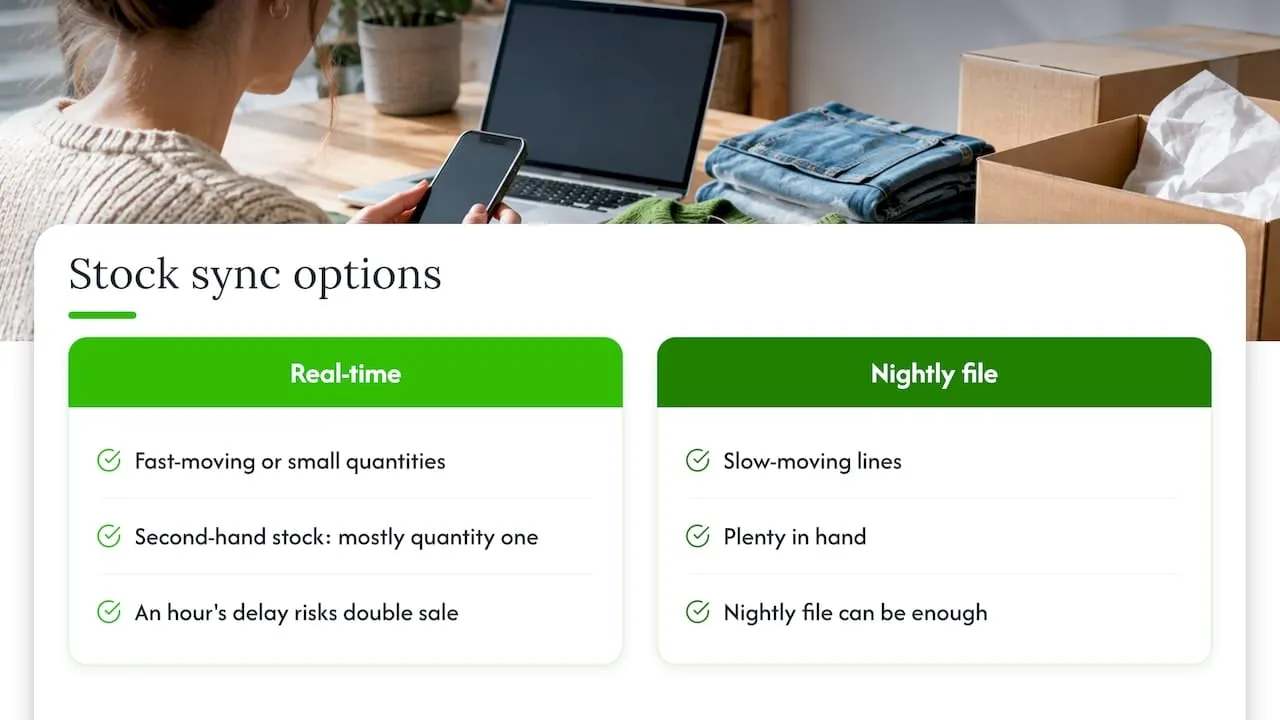
Stock sync simply means keeping the quantity of an item identical in every place it is sold. As the UK web agency Futurestore explains in its guide to stock sync, without it a sale in one place does not update the others, and you can sell the last item twice. It also suggests using a consistent SKU, deciding which system is the master record and holding a small safety buffer on lines with only a few left.
The same source notes that real-time sync suits fast-moving stock or small quantities, while a nightly file can be enough for slow lines with plenty in hand. For second-hand sellers the answer is almost always real-time. Most of your stock is quantity one, so a delay of even an hour is a window for a double sale. If you run your own shop on WooCommerce as well, WooCommerce store automation can help bring buyers to that channel, and our guide to stock sync across marketplaces and inventory sync software cover the sync itself.
Messages and relisting: the daily maintenance
Publishing is only the start. Two chores eat the most time afterwards.
Relisting. Vinted listings lose visibility as they age, so sellers refresh them. Ruit relists automatically on Vinted and Wallapop, which removes the repetitive part of the job. Our guide to auto relisting on Vinted explains how this fits with stock sync.
Messages. Buyers ask about measurements, postage and discounts, and a slow answer often loses the sale. Ruit brings Vinted and Wallapop messages into one inbox, so you are not switching between apps.
For Vinted parcels specifically, it also helps to know which carriers suit which item. See Vinted postage options in the UK.
Are you a private seller or a business?
Cross-listing often turns a casual clear-out into regular trading, and the rules differ. eBay UK’s business seller policy says you must register as a business if you sell items bought to resell, make items to sell, or buy items for your business. Business sellers must give full contact details, clear price information, a VAT number if applicable, and a returns policy, and must tell buyers about the 14-day withdrawal right under the Consumer Contracts Regulations. They must also accept returns of faulty items within 30 days under the Consumer Rights Act 2015.
If you buy stock to resell, treat yourself as a business from the start. Our guides to the Vinted Pro seller route in the UK and the HMRC threshold are a good place to check how your own situation lines up. For tax questions about your own circumstances, speak to an accountant or contact HMRC directly.
Our view: list once, then let stock follow the sale
We built Ruit around a simple observation: the listing is the easy part, and the aftermath is the hard part. Taking photos and writing a description is something you do once. Taking the item down in three other places at the right moment, relisting it when it goes stale and answering the same questions in two apps are the jobs that repeat every day.
That is why Ruit starts with listing once. You publish to Vinted, eBay, Wallapop, todocoleccion, Shopify, WooCommerce and PrestaShop from a single place, and when an item sells on one channel, stock updates and the listing is removed from the others. The double sale is designed out of the process rather than left to memory.
We also think AI is best used as a drafting assistant. Ruit drafts titles and descriptions, and you check the brand, size, measurements and flaws before anything goes live. You know the item; the draft saves you typing.
If you sell on Vinted and eBay at once, that combination of one listing, synced stock, automatic relisting on Vinted and Wallapop, and one inbox for Vinted and Wallapop messages is what lets a growing stock stay manageable.
Luis
Start publishing to more than one marketplace
If you already sell on Vinted and want eBay’s search-driven audience too, or the other way round, the quickest route is to list once and publish to both. Ruit does this for Vinted, eBay, Wallapop, todocoleccion, Shopify, WooCommerce and PrestaShop, keeps stock in sync, and relists on Vinted and Wallapop for you. See how it works at Ruit.
Frequently Asked Questions
What is multi marketplace publishing?
It is listing the same item on several marketplaces from one set of photos and text, then removing it from all of them once it sells. For UK sellers that usually means Vinted and eBay, sometimes with a shop of their own. The goal is wider reach with less repeated work.
Does listing on Vinted and eBay at once cause double sales?
It can if you delist by hand and a sale slips through. On eBay an order cancelled because the item sold elsewhere counts as a transaction defect under eBay’s seller standards. Syncing stock so the other listings come down automatically removes the risk.
Should the title and description be identical on both sites?
No. eBay allows titles of up to 80 characters and uses item specifics for search, while Vinted favours shorter, specific titles and structured fields such as brand, size and condition. Keep the photos and facts the same, and adapt the wording to each site.
Do I need to register as a business to sell on eBay?
According to eBay UK’s business seller policy, you must if you sell items bought to resell, make items to sell, or buy items for your business. Business sellers then have extra duties on information, returns and buyer rights. If you are unsure about tax, ask an accountant or HMRC.
Sources
- eBay UK seller standards policy
- eBay UK fee credits
- eBay UK Seller Centre: create great listings
- Vinted help: describing an item
- eBay UK business seller policy
- Futurestore: what is stock sync?