Crosslisting Policy Compliance for Vinted and eBay UK Sellers

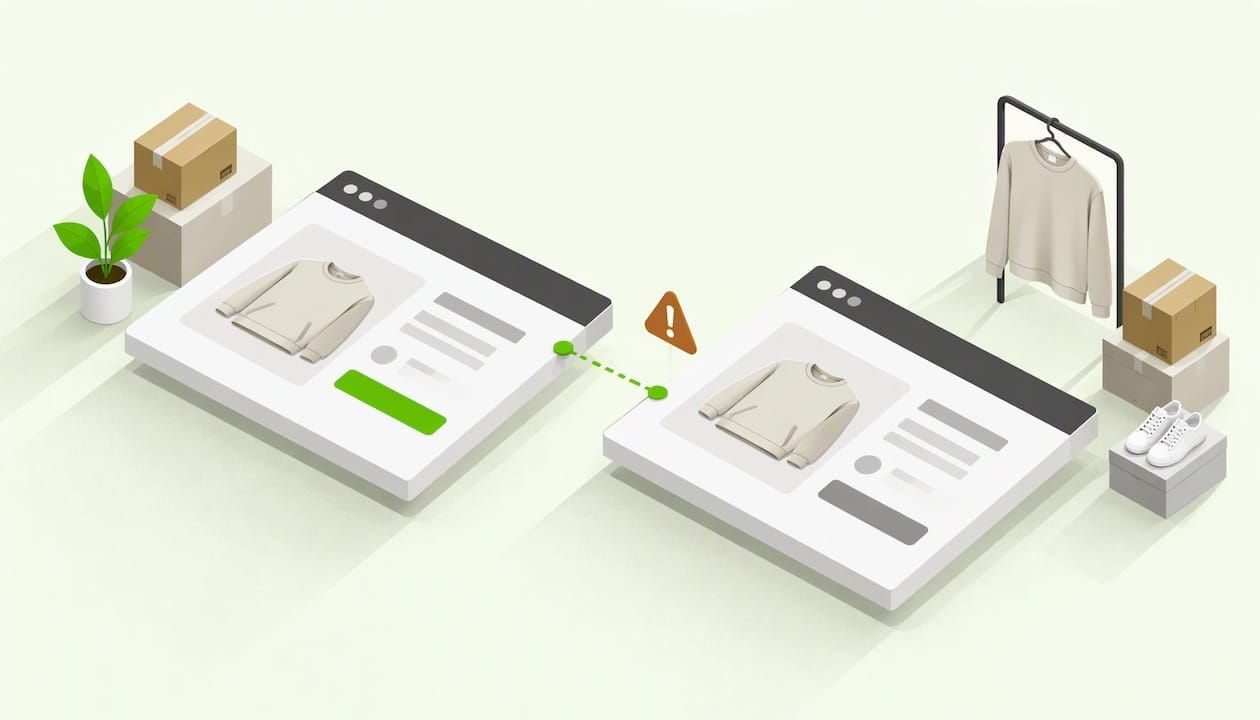
Table of Contents
- TL;DR
- What the platforms actually allow
- Crosslisting policy compliance checklist
- What happens when a cross-listed item sells twice
- Private sellers, Vinted Pro and eBay business sellers
- Manual or automated: what to check before you trust a tool
- Our view on crosslisting safely
- How Ruit fits in
- Common mistakes UK crosslisters make
- A worked example
- Sources
- Frequently Asked Questions
- Recommended
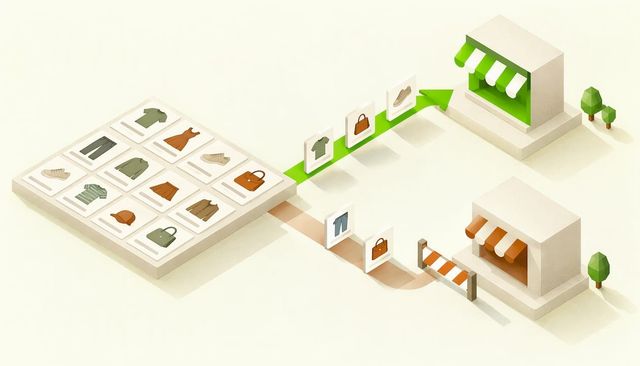
Crosslisting policy compliance comes down to one rule: you may list the same item on Vinted and eBay, but only if you really have it in stock and pull it from every other channel the moment it sells. Neither marketplace bans crosslisting as such. Both punish the result of sloppy crosslisting: sold items still live, cancelled orders and duplicate listings.
This guide sets out what each platform’s rules say, what happens if you break them, how private sellers differ from Vinted Pro and eBay business sellers, and a practical routine you can follow whether you sell ten items a month or a thousand.
TL;DR
- Crosslisting the same physical item on Vinted and eBay is allowed, provided the item is available and you never list the same item twice on one platform.
- When an item sells elsewhere, hide or delete the Vinted listing rather than marking it “Sold”, as Vinted UK advises.
- Cancelling an eBay order because you are out of stock counts as a transaction defect and can cost you fee credits and seller standing.
- Business sellers have extra duties: Consumer Rights Act 2015 standards, a Vinted Pro account for commercial selling and platform reporting to HMRC.
- Automation helps only if stock updates reliably, so check what it does before you trust it.
What the platforms actually allow
The short version: selling one item in several places is a normal practice. What the rules police is availability and duplication.
| Rule area | Vinted UK | eBay UK |
|---|---|---|
| Same item on another marketplace | Not banned. Vinted advises hiding or deleting the listing if the item sold elsewhere | Not banned, but you must have enough stock before listing it elsewhere at the same time |
| Duplicate listings on the same platform | Catalogue rules govern what may be uploaded | No more than one fixed-price listing of an identical item at once |
| Unavailable or sold items | Must not be uploaded or left up | Items must stay available for the duration of the listing |
| Penalties | Hidden or removed listings, account restrictions, permanent ban for repeated or serious breaches | Transaction defects, selling limits, higher final value fees |
eBay: availability and duplicates
eBay’s duplicate listings policy prohibits more than one fixed-price listing of an identical item from the same seller at the same time. If you hold three identical hoodies, you should normally use one listing with a quantity of three, not three separate listings.
The selling practices policy goes further for crosslisters. It expects you to keep items available for the duration of the listing, and not to list an item simultaneously outside eBay without first making sure you have enough product available. For a one-off vintage jacket, that means the moment it sells on another channel, your eBay listing has to come down.
Vinted: catalogue rules
Vinted’s catalogue rules forbid uploading an item that is unavailable or already sold. Vinted may hide or remove non-compliant listings, and repeated or serious violations may lead to account restrictions or a permanent ban. It also does not refund the cost of a bump if it removes or hides a non-compliant listing, so a breach can cost you money as well as visibility.
One detail catches many crosslisters. When an item sells on another platform, Vinted UK advises hiding or deleting the listing instead of marking it as “Sold” on Vinted. The “Sold” status is meant for sales completed through Vinted itself.
Crosslisting policy compliance checklist
Use this as a standing routine. It works manually and it is the same logic any automation should follow.
- Confirm you own and hold the item. Never list something you do not physically have, or are still waiting to receive.
- One listing per identical item per platform. On eBay use quantity for multiples. On Vinted, keep one live listing per item.
- Describe the item identically everywhere. Condition, flaws, measurements and brand should match, so a buyer on any channel gets what they saw.
- Know your sold-item routine before you publish. Decide who removes the other listings, and how fast. Minutes matter for single items.
- Hide or delete on Vinted, do not mark “Sold”. Follow the Vinted UK guidance above when the sale happened elsewhere.
- Tell a buyer early if something goes wrong. If you have double-sold, contact the second buyer immediately and cancel through the proper route rather than going quiet.
- Keep records. Note where and when each item sold. You will need them for accounts, returns and, if you trade, tax.
If you want to see how this plays out on eBay specifically, our guide to crosslisting on eBay without double sales walks through the practical side.
What happens when a cross-listed item sells twice
A double sale is the single most expensive compliance failure, because the second buyer is the one who gets cancelled and the platform records it against you.
On eBay
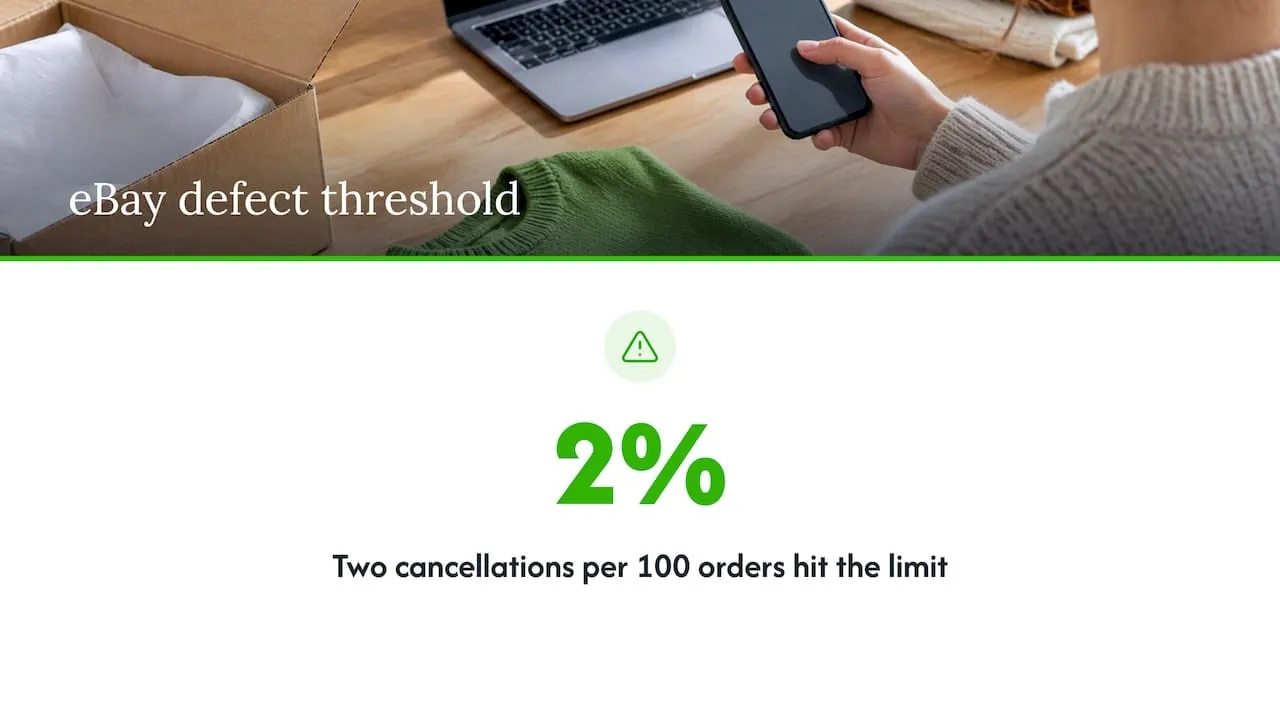
Cancelling an eBay UK order because an item is out of stock results in a transaction defect. Under eBay’s seller standards policy (page dated 15 October 2026), sellers may have up to a 2% transaction defect rate before falling below the minimum standard. Sellers evaluated as “Below Standard” may face selling limitations and higher final value fees.
There is a direct cost too. Under eBay’s fee credit rules, when you cancel for a reason within your control, such as the item being out of stock or damaged, eBay does not credit the variable percentage of the final value fee or the fixed per-order amount.
To make the 2% figure concrete: if you complete 100 orders in a period, two unexpected cancellations would already reach the limit. A small seller with low volume can fall below standard after a very small number of mistakes, which is why single-item stock deserves the most care.
On Vinted
Vinted does not publish a defect percentage like eBay does. Its catalogue rules instead describe hiding or removing listings and, for repeated or serious breaches, account restrictions or a permanent ban. In practice, selling the same item twice is most likely to show up as a cancelled order, an unhappy buyer and a hit to your reputation, so treat it as a risk to the account.
| Scenario | Likely consequence | What to do |
|---|---|---|
| Item sold on eBay, still live on Vinted | Vinted listing may be removed if sold or unavailable items stay up | Hide or delete the Vinted listing straight away |
| Item sold on Vinted, still live on eBay | eBay order may need cancelling if it also sells | End the eBay listing immediately |
| Both sell at once | eBay cancellation counts as a transaction defect and the fee is not credited | Contact the buyer, cancel properly and review your process |
| Repeated unavailable listings | Selling limits or higher fees on eBay, restrictions on Vinted | Tighten your sold-item routine or automate it |
Private sellers, Vinted Pro and eBay business sellers
The crosslisting rules above apply to everyone. What changes is the legal and platform context around you.
| Private seller | Vinted Pro / eBay business seller | |
|---|---|---|
| Vinted account | Standard account for private, non-commercial use | Pro account required for commercial selling |
| Consumer law | Mostly outside trader rules | Consumer Rights Act 2015 applies to you as a trader |
| Distance selling | Not generally applicable | 14-day cooling-off period generally applies |
| Platform reporting | Reported to HMRC only above thresholds | Same reporting rules, but tax is likely to be due |
Vinted: when you need a Pro account
Vinted is primarily intended for peer-to-peer second-hand selling. According to its catalogue rules, standard accounts are for private, non-commercial use and commercial sellers need a Pro account. Vinted Pro descriptions must also follow applicable product-safety and product-compliance laws, including mandatory information about the manufacturer or economic operator, labelling and product marking, as set out on Vinted’s platform page. Our Vinted Pro guide for UK sellers covers the practical differences.
Consumer law for traders
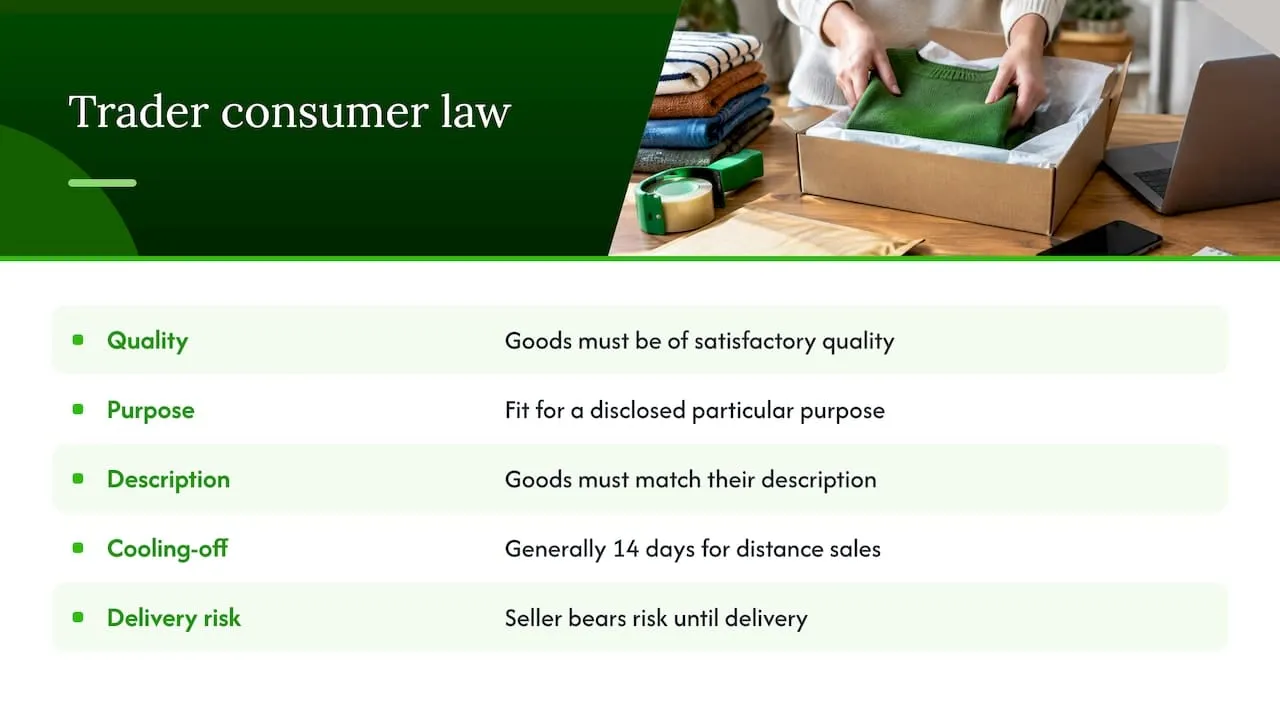
If you trade, the Consumer Rights Act 2015 requires goods to be of satisfactory quality, fit for a particular purpose made known to you and as described. A June 2026 Business Companion guide from a local authority adds that distance sellers must generally offer a 14-day cooling-off period and keep goods at their own risk until delivery.
This matters for crosslisting because inconsistent descriptions across channels become a legal problem, not just a customer service one. If your Vinted listing mentions a flaw and your eBay listing does not, the eBay buyer can argue the item was not as described. Write the description once and copy it faithfully.
Tax reporting
Since 2025, online platforms have to share information about sellers’ earnings with HMRC under rules the UK agreed through the OECD. According to MoneyHelper, reporting applies to accounts that sell more than 30 items or earn more than 2,000 euros a year. That is not a new tax, only the same income tax that applies to any trading income. Crosslisting makes it easier to cross those thresholds, because your sales across several platforms add up for you even when each platform sees only its own share. Keep your own combined records.
Manual or automated: what to check before you trust a tool
Manual crosslisting works for a handful of items. Past that, the delay between a sale and a delisting is where double sales come from. Multi-channel businesses commonly use a single pool of stock with an integration layer that updates inventory in near real time across connected channels, rather than splitting stock by channel.
Before you rely on any automation, ask:
- Which channels does it remove listings from when something sells? A tool that only syncs some channels leaves gaps.
- How does it treat Vinted? Given Vinted’s guidance on sold items, you want listings hidden or deleted, not marked “Sold”.
- What happens to quantity? On eBay, multiples should sit on one listing.
- Do descriptions stay consistent? Edits should carry across, not drift.
- Can you still intervene manually? You stay responsible for the listing, not the software.
We go deeper on this in our guides to inventory sync software and managing eBay inventory across channels.
Our view on crosslisting safely
We built Ruit around one idea: the risk in crosslisting is not the listing, it is the gap between a sale and a removal. Every complaint we hear from sellers comes back to a few minutes in which an item was live somewhere it should not have been.
So our advice is to treat stock as the thing you protect and listings as copies of it. Write the listing once, publish it everywhere you sell, and decide in advance what happens the instant one channel sells. For a seller with one-off pieces, such as vintage clothing, that decision is simple: the item is gone, so every other listing goes with it.
We would also say this to anyone tempted to skip the discipline because a tool exists: read the platform rules yourself. Vinted and eBay are the ones who decide whether your account is in good standing, and their rules are short enough to read in an afternoon. A tool should make following them effortless, not make you forget they exist.
- Luis
How Ruit fits in
Ruit lets you list an item once and publish it on Vinted, eBay, Wallapop, todocoleccion, Shopify, WooCommerce and PrestaShop. When it sells on one channel, stock syncs and the item is removed from the others, which is exactly the gap this article warns about. It also relists automatically on Vinted and Wallapop, brings Vinted and Wallapop buyer messages into one inbox and drafts titles and descriptions with AI. You can see the plans on our pricing page, or read what automatic relisting on Vinted involves.
Common mistakes UK crosslisters make
- Marking an item “Sold” on Vinted after it sold on eBay. Vinted UK says to hide or delete instead.
- Listing the same identical item several times on eBay. Use quantity.
- Leaving stale listings up over a weekend. Single-item stock can sell twice in minutes.
- Treating a cancellation as harmless. On eBay it is a transaction defect, and the fee is not credited.
- Using a private Vinted account for a business. Commercial sellers need Pro.
- Ignoring trademark and brand rules. Crosslisting a counterfeit or a disputed item on several channels multiplies the risk. See our eBay VeRO guide.
- Not tracking combined sales. Each platform reports its own figures, not yours in total.
A worked example
Imagine you list a vintage Barbour jacket on Vinted and eBay on a Friday evening.
- Saturday morning, a buyer purchases it on eBay.
- You end the Vinted listing straight away by hiding or deleting it, not by marking it “Sold”.
- You post the item and note the sale in your records.
- Had a Vinted buyer paid at the same moment, you would contact whoever you cannot fulfil, cancel through the platform and accept that on eBay the cancellation counts as a transaction defect.
The second path is what a sold-item routine exists to prevent. The first takes about a minute when you do it by hand, and no time at all when your stock sync handles it.
Sources
- Duplicate listings policy, eBay UK
- Selling practices policy, eBay UK
- Catalogue Rules, Vinted UK
- An item is displayed as “Sold”, Vinted UK
- Order cancellation policy, eBay UK
- Seller standards policy, eBay UK
- Fee credits, eBay UK
- Our platform, Vinted UK
- Consumer Rights Act 2015, legislation.gov.uk
- Selling and supplying goods, Business Companion
- Do I have to pay tax when I sell items online?, MoneyHelper
- Multi-channel fulfilment in the UK, Ogden Fulfilment
Ready to list once and keep every channel in step? Try Ruit.
Frequently Asked Questions
Is it against the rules to sell the same item on Vinted and eBay?
No, neither platform bans it. eBay expects you to have enough stock before you list an item elsewhere at the same time, and Vinted forbids uploading items that are unavailable or already sold. The risk is in leaving a sold item live.
Should I mark an item as sold on Vinted if it sold on eBay?
Vinted UK advises hiding or deleting the listing instead. The “Sold” status is intended for items sold through Vinted, so use hide or delete when the sale happened elsewhere.
What happens if I sell an item twice and have to cancel an order on eBay?
A cancellation because the item is out of stock counts as a transaction defect, and eBay does not credit certain final value fee elements. Sellers may have up to a 2% defect rate before falling below standard, so repeated cancellations can lead to selling limits and higher fees.
Do I need a Vinted Pro account if I crosslist?
Crosslisting itself does not decide it. Vinted says standard accounts are for private, non-commercial use and commercial sellers need a Pro account. If you buy stock to resell regularly, you are likely to count as commercial.
Will HMRC see my Vinted and eBay sales?
Platforms must report sellers who sell more than 30 items or earn more than 2,000 euros a year. Those are reporting thresholds, not tax thresholds, and your tax position depends on whether you are trading. Keep combined records and speak to an accountant or HMRC if unsure.