Inventory Sync Software for Resellers


Table of Contents
- Table of Contents
- The Hidden Cost of Fast Sync and Bad Data
- Why Inventory Records Fail in Multichannel Resale
- Point Solutions Versus Full-Cycle Platforms
- Technical Criteria for Reliable Stock Synchronization
- Maximizing Profit Per Hour Worked
- Real-World Scenarios and Exception Handling
- Strategic Migration and Implementation Guidance
- Frequently Asked Questions
Most advice about inventory sync software starts with the wrong question: “How quickly can it push stock updates, and how many marketplaces does it connect?” Those features matter, but they don’t create inventory truth. If your master records contain duplicate listings, stale quantities, unprocessed returns, or items still in transit, faster synchronization can spread bad information across every channel before your team notices.
The operational target is simpler and harder: sell only what you can fulfill, while reducing the labor required to prove that stock is accurate. For a professional resale business, the right platform should identify each unique item, model its state, resolve conflicts, expose failures, and show whether automation is improving profit per hour worked.
A useful evaluation starts with the difference between a publishing tool and an operating system:
| Evaluation area | Basic crosslisting tool | Full-cycle inventory platform |
|---|---|---|
| Listing distribution | Pushes listings to selected marketplaces | Publishes from a central product record |
| Stock handling | Deducts or removes stock after a sale | Tracks available, reserved, returned, damaged, and sellable states |
| Exceptions | Often requires manual review | Routes conflicts and failed updates into visible queues |
| Returns and condition changes | Usually handled outside the tool | Connected to inventory status and relisting workflows |
| Team operations | Separate inboxes and spreadsheets remain common | Orders, messages, inventory, and reporting share one workspace |
| Business measurement | Focuses on listings and channel activity | Measures labor, margin, sell-through, and operational exceptions |
Table of Contents
- The Hidden Cost of Fast Sync and Bad Data
- Why Inventory Records Fail in Multichannel Resale
- Point Solutions Versus Full-Cycle Platforms
- Technical Criteria for Reliable Stock Synchronization
- Maximizing Profit Per Hour Worked
- Real-World Scenarios and Exception Handling
- Strategic Migration and Implementation Guidance
- Frequently Asked Questions
The Hidden Cost of Fast Sync and Bad Data
Fast synchronization doesn’t rescue incorrect inventory. It makes incorrect inventory travel faster.
Recent field research found that only 36% of surveyed retailers report full inventory visibility, while 57% experience at least minor visibility problems. The same research says 60% sell on four or more marketplaces. Those figures point to a control problem, not merely an integration problem. A seller can connect every channel and still lack a dependable answer to the basic question, “Is this exact item available for sale right now?” Linnworks’ State of Commerce Operations research puts that visibility gap into practical context.
A synchronization engine may instantly propagate a quantity of one. If that quantity belongs to a duplicate listing, a reserved item, or a return awaiting inspection, the system has created a synchronized error. The buyer still receives an order confirmation, and your team still has to cancel, explain, refund, and repair the underlying record.
Inventory truth comes before propagation
For resale, a central record needs more than a SKU and a number. It should distinguish at least these operational conditions:
- Sellable: The item has passed the checks required for listing and fulfillment.
- Reserved: A buyer, order, offer, or internal allocation temporarily holds the item.
- In process: The item is awaiting inspection, cleaning, repair, photography, or pricing.
- Unavailable: The item is damaged, missing, in transit, or otherwise blocked from sale.
- Returned: The item has come back but hasn’t yet been approved for relisting.
A platform that sends “available” everywhere without understanding those states is only automating distribution. It isn’t controlling inventory.
Practical rule: Never judge a sync provider by its fastest successful update. Test how it behaves when the source record is incomplete, two channels change the same listing, or a return comes back in a different condition.
Measure exceptions, not just speed
Ask vendors to demonstrate duplicate detection, failed mapping alerts, stale listing reports, and a reconciliation queue. Require an audit trail that shows which event changed a quantity, which channel accepted the update, and whether a human overrode the result.
The most useful operating metrics include oversell rate, stale-listing rate, failed-update count, and time to resolution. These metrics tell you whether the platform protects customer experience and staff time. Raw channel count doesn’t.
Why Inventory Records Fail in Multichannel Resale
Inventory accuracy has never depended on software alone. In a 2008 empirical study of nearly 370,000 inventory records across 37 stores, researchers found that 65% were inaccurate. The study also found that 26.4% of the total variation in inaccuracy occurred between product categories, while only 2.7% occurred between stores. Product characteristics and category complexity mattered more than store location alone. The study published in Management Science also identified auditing as a factor that reduces inaccuracies, while complex environments and distribution structures increase them.
That finding translates directly to second-hand commerce. A unique camera, jacket, book, or collectible doesn’t behave like a replenishable unit in a uniform warehouse. Its condition, accessories, measurements, photographs, location, and listing identity all affect whether the item is genuinely sellable.
Why manual checks fail
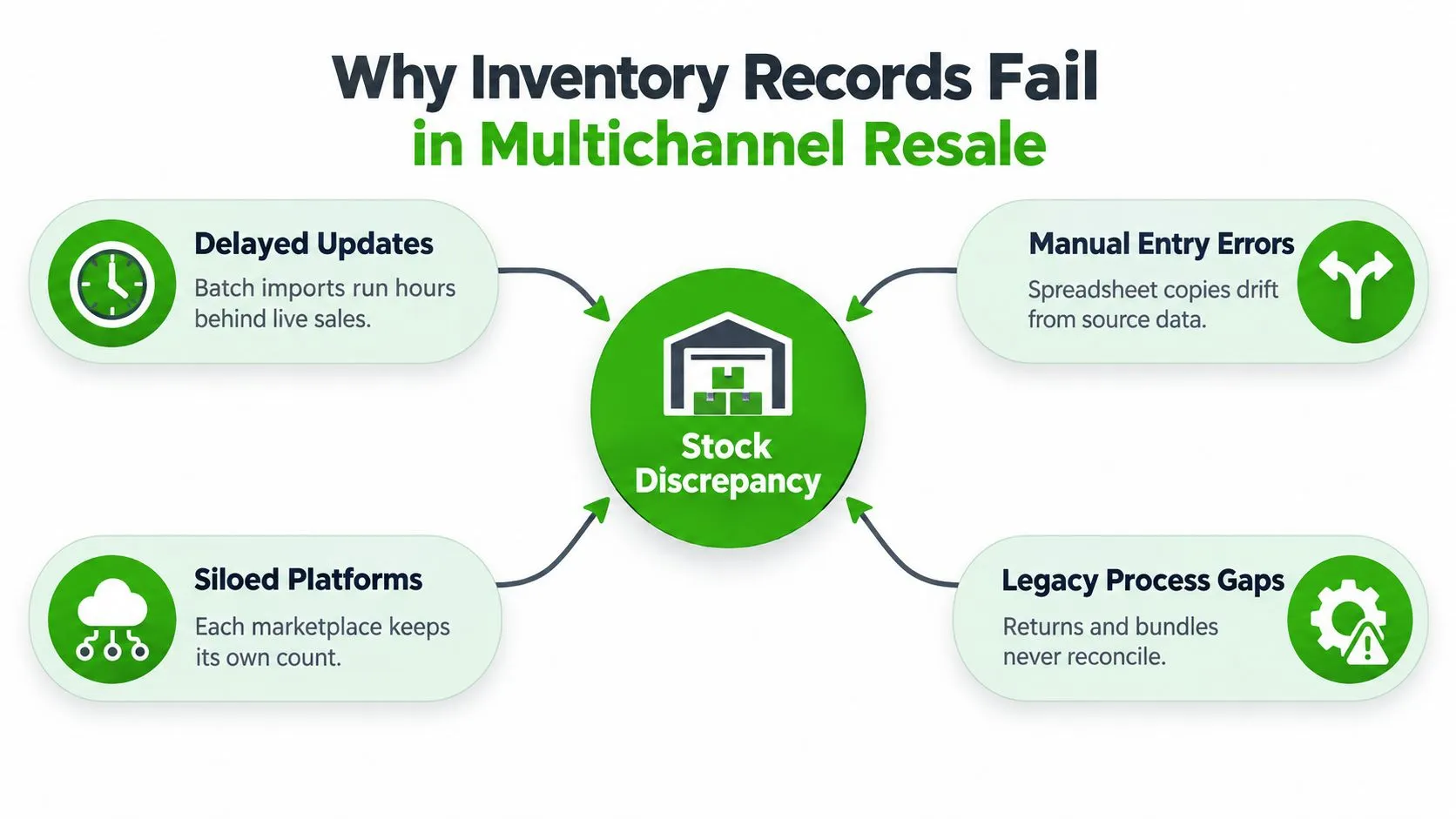
Separate marketplaces, ecommerce stores, warehouses, and spreadsheets each create opportunities for drift. A sale on one channel may reduce stock in one place while another channel continues displaying the item. A return may be logged as received before anyone confirms that it is complete and usable. A bundle may consume components that remain individually listed.
The result isn’t always an obvious stockout. It can be a listing that looks active but lacks accurate images, a price that no longer reflects the item’s condition, or an order that staff can fulfill only after searching through several systems.
A 2013 field study used daily physical counts over 23 weeks in 13 stores, with 8 treatment stores and 5 control stores. RFID-enabled visibility reduced inventory-record inaccuracy by approximately 26%, although results varied by category, with some categories showing no statistically significant improvement and others improving by as much as 81%. The Production and Operations Management study supports a clear operational lesson: visibility helps teams detect and correct discrepancies sooner, but the effect depends on product and process complexity.
For a professional reseller, periodic checks aren’t enough. Each item needs a persistent identity, a defined status, and a history of changes. Ruit’s guide to multichannel inventory management offers a practical framework for thinking about that central record across connected channels.
Point Solutions Versus Full-Cycle Platforms
A crosslister solves a real problem. It prevents staff from recreating the same listing repeatedly and can remove duplicate listings after a sale. For a small catalog with simple product states, that may be sufficient.
The trouble begins when the business treats publication as the whole operation. Listing content often remains in one tool, stock adjustments in another, buyer conversations in marketplace inboxes, order processing in email, and financial records in a spreadsheet or accounting application. Every new channel adds another place where someone must answer messages, interpret policies, revise prices, and reconcile data.
| Feature Category | Point Solution (Crosslister) | Full-Cycle Platform |
|---|---|---|
| Sourcing | Usually outside the workflow | Centralized opportunity research and purchase records |
| Catalog identity | Maps listings for publishing | Maintains a master item record across the lifecycle |
| Inventory | Shares quantities between channels | Controls sellable states, reservations, returns, and adjustments |
| Messaging | May provide limited channel support | Unifies buyer conversations and response workflows |
| Orders | Basic order import or status updates | Connects orders with fulfillment and accounting data |
| Pricing | Channel-level edits | Centralized price management and scheduled changes |
| Analytics | Listing or channel activity | Operational reporting across sourcing, sales, labor, and margin |
| Migration | Often listing-focused | Can import and merge existing marketplace inventory |
Count labor, not integrations
A tool with more marketplace logos isn’t automatically more efficient. The relevant question is how many manual actions remain after a sale, return, price change, or failed connection.
A 2025 survey of 470 ecommerce leaders in the US and Europe found that sellers operate on an average of six marketplaces, 52% still manage listings and inventory with spreadsheets or internal tools, and 20% spend half their work week fixing listings, changing prices, or correcting data errors. Digital Commerce 360’s coverage of the survey shows why channel expansion can increase operational burden instead of improving efficiency.
A full-cycle platform earns its cost when it removes repeated work across sourcing, listing, messaging, orders, and reporting. For broader context on the operational case for centralization, review these benefits of an all-in-one platform, but judge any system against your own exception volume and labor records.
Choose the narrower tool deliberately
A point solution still makes sense when your catalog is stable, product states are simple, and one person can resolve exceptions without switching between systems. It becomes a poor fit when your team spends more time proving stock than preparing items for sale.
A centralized order workflow should connect inventory events to fulfillment, returns, and accounting rather than leaving those processes in separate queues. Cloud-based order management for multichannel sellers explains why shared operational data matters once several people or channels touch the same order.
Technical Criteria for Reliable Stock Synchronization
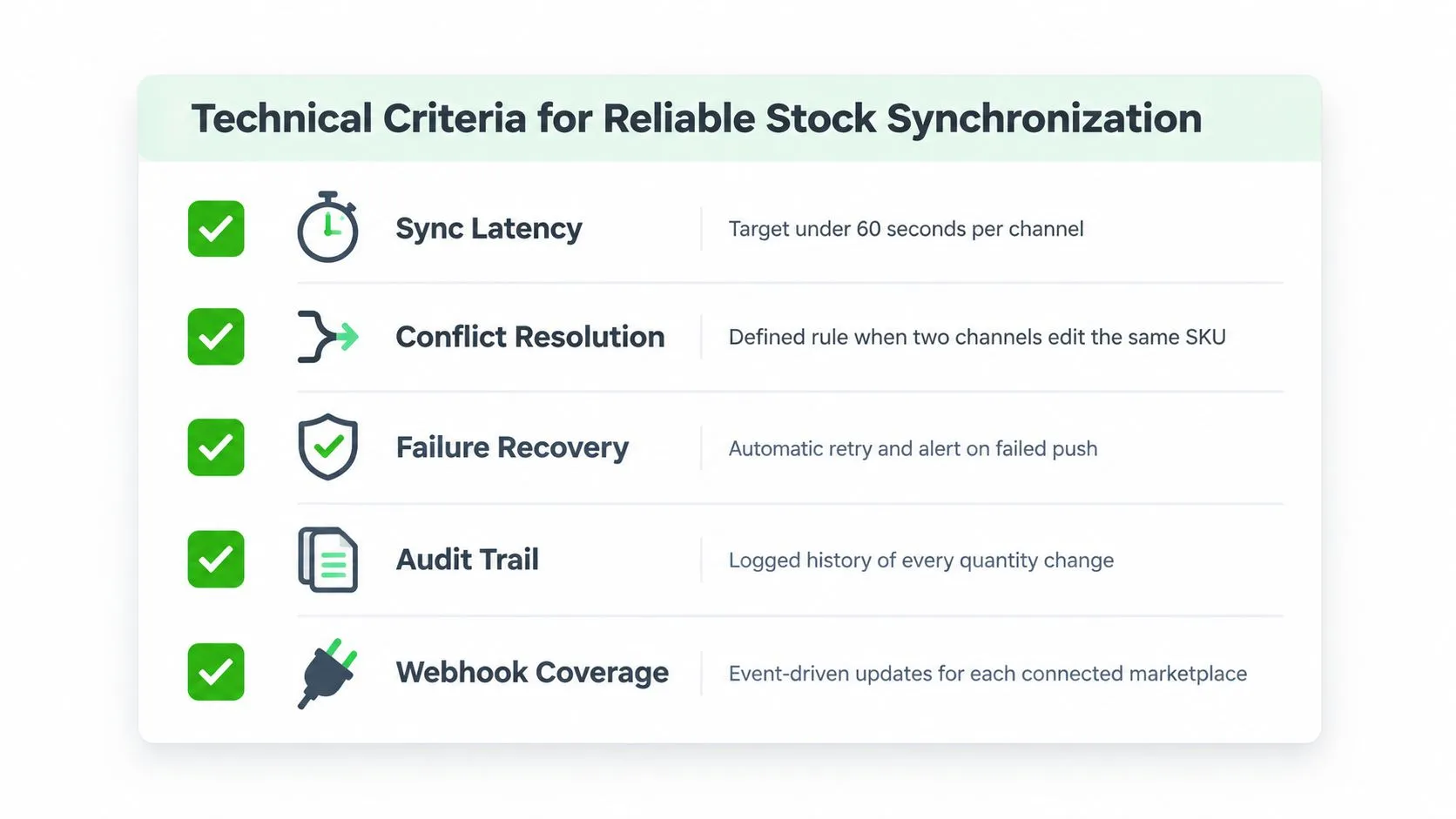
“Real time” is a marketing phrase until you define where the clock starts and where it stops. For inventory sync software, measure the elapsed time from a sale, return, cancellation, or manual adjustment to the corrected quantity appearing on every connected channel.
Independent implementation guidance recommends targeting normal-operation updates below 60 seconds, while peak-sale workflows may require propagation below 10 seconds for unique items. Measure p50, p95, and p99 latency, not only the average, because rare delays during traffic spikes can create the incidents that damage trust. This inventory management implementation guidance also emphasizes separating marketplace API time from queue, transformation, and retry latency.
Demand these engineering controls
- Event-driven updates: Webhooks should trigger changes as events arrive, instead of forcing every workflow through slow batch imports.
- Periodic reconciliation: Scheduled comparison should detect missed webhooks, disconnected listings, and quantities that no longer match.
- Idempotent writes: Replaying the same order event must not deduct stock twice.
- Reservation logic: Concurrent purchases need an explicit hold mechanism before both orders reach fulfillment.
- Conflict rules: The system must define which status wins when two channels edit the same item.
- Failure alerts: A failed push needs a visible error, a retry path, and an owner.
Latency alone won’t solve identity problems. Most second-hand items have a quantity of one, so the system must map every marketplace listing to one master item and prevent a duplicate record from behaving like replenishable stock.
Test the item state model
Ask the vendor to demonstrate an item moving through inspection, cleaning, repair, reservation, sale, return, and relisting. Check whether each transition changes marketplace availability and whether staff can see who made the change.
The audit trail matters as much as the API. When a buyer disputes an order or a teammate asks why a listing disappeared, you need an event history, not a vague status badge.
Maximizing Profit Per Hour Worked
The business case for inventory sync software isn’t the number of integrations. It is the amount of profitable work your team can complete without adding equivalent labor.
Start with the tasks that consume skilled operator time but don’t create differentiated value: copying listing data, removing sold items, checking several inboxes, correcting prices, reconciling quantities, and searching for the source of an order error. Automation should compress those tasks so staff can spend more time sourcing good inventory, negotiating purchases, improving condition data, and resolving the exceptions that require judgment.
Ruit’s full-cycle model brings sourcing, inventory, multichannel publishing, prices, messaging, orders, accounting, and analytics into one platform. It supports publication across Wallapop, Vinted, eBay, WooCommerce, PrestaShop, and Todocolección, with automatic stock and price synchronization, auto-delist after a sale, scheduled relisting, AI-assisted titles and descriptions, bulk photo editing, and a unified messaging inbox. Those capabilities are relevant only if they reduce repeated work and preserve margin.
Build a simple operating scorecard
Track the workflow before and after implementation. Don’t rely on a feature checklist.
- Profit per labor hour: Contribution margin divided by the hours spent sourcing, preparing, listing, selling, and correcting orders.
- Exception minutes: Time spent resolving oversells, failed updates, returns, duplicate records, and condition disputes.
- Time to listing: The elapsed work from acquisition to a complete, accurate listing.
- Channel contribution: Margin after marketplace fees, shipping, returns, discounts, and the labor assigned to that channel.
- Cancellation cost: Refund handling, support time, reputational damage, and any lost future sales caused by an unfulfillable order.
The important comparison is not subscription price against the number of channels. Compare the software cost with the labor and margin lost through fragmented workflows.
The right automation doesn’t eliminate judgment. It removes the repetitive work that prevents your team from using judgment where it matters.
Know when not to sync
More distribution isn’t always more profit. Hold back items whose condition is difficult to represent consistently, whose expected margin can’t absorb channel costs, or whose return risk creates disproportionate handling work. A channel that generates sales but consumes the margin through messages, exceptions, and returns may be a poor allocation of staff time.
Use channel analytics to decide where each item belongs. A unified platform should help you see whether an extra listing produces incremental contribution or merely creates another surface to maintain.
Real-World Scenarios and Exception Handling
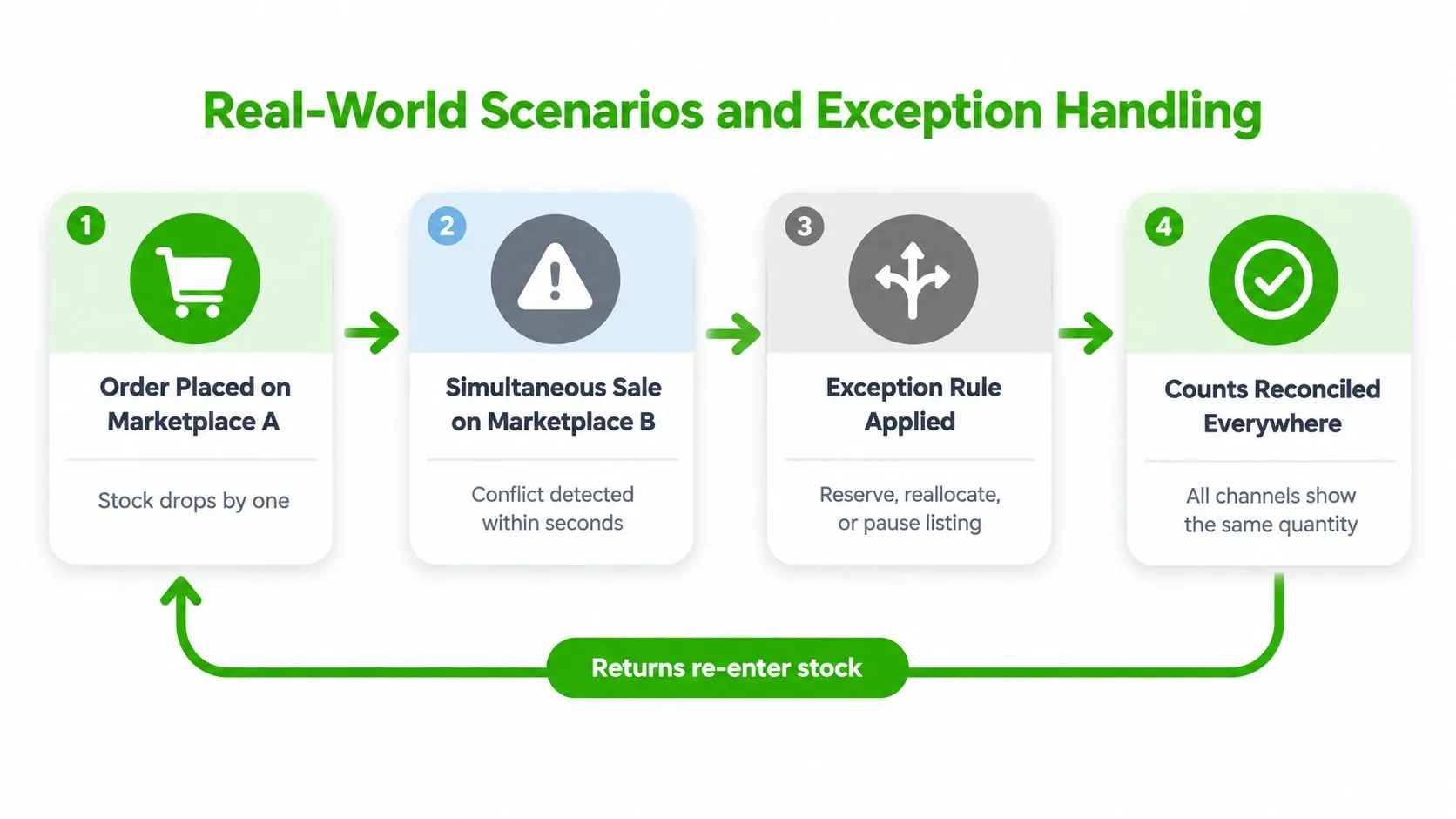
A unique item exposes weak architecture immediately. Suppose a vintage jacket is listed on a local marketplace and a global platform. A buyer purchases it locally while another buyer sends an offer on the global channel.
A basic quantity system deducts one from the item and attempts to update both listings. A stronger system records the local order, places the item into a committed state, pauses or removes the other listing, and routes the offer for a decision. If the second transaction arrived before the first event propagated, the reservation rule determines whether the platform rejects, holds, or reallocates the order.
Treat every exception as a state change
Returns need inspection before they become available again. A buyer may return the wrong accessory, expose a new defect, or send an item that needs cleaning. The stock record should preserve the return event while keeping the item unavailable until someone approves its condition.
Damaged goods need a separate status, not a negative quantity adjustment that hides the reason. Staff should be able to record the defect, update the condition description, change the price, and decide whether to relist, repair, liquidate, or discard the item.
Bundles require component-level logic. If one bundle contains items with different conditions or locations, selling the bundle should reserve the components and prevent those same components from remaining independently available. A platform that only deducts a finished-product quantity will leave the underlying catalog exposed.
Create rules for messy decisions
Use explicit rules rather than relying on memory:
- Simultaneous sale: Reserve the item immediately, freeze competing listings, and send the conflict to a named operator.
- Offer received after sale: Keep the offer record, mark the item unavailable, and avoid accepting an offer against committed stock.
- Return in transit: Keep the original sale history and block relisting until inspection is complete.
- Condition changed: Require updated photos, description, and price before restoring sellable status.
- Failed delist: Alert the team and place the listing in a reconciliation queue instead of assuming the channel accepted the change.
Ruit’s guide to stock synchronization for WooCommerce provides relevant context for connecting a store with other selling channels, but the same control principle applies to marketplaces: every channel must reflect the item’s actual operational state.
Strategic Migration and Implementation Guidance
Moving from spreadsheets to centralized inventory sync software should be treated as an operational migration, not a quick import. The first job is to establish which record represents the true item. If the same jacket appears under different titles and SKUs on several marketplaces, importing every listing as a separate product only preserves the original problem.
Start with a data audit. Identify duplicate listings, missing identifiers, incorrect quantities, old prices, inactive channels, returns awaiting review, and stock that cannot be located. Then define the master fields that every channel must inherit, including condition, cost, price, location, status, photographs, and marketplace mapping.
Use a staged decision matrix
| Current operating problem | Recommended priority |
|---|---|
| One item sells twice | Reservation logic, fast delisting, and conflict alerts |
| Staff edits several spreadsheets | Central item records and controlled permissions |
| Returns reappear as sellable stock | Inspection states and approval-based relisting |
| Prices drift across channels | Central price rules and change history |
| Failed updates go unnoticed | Reconciliation queues and owner notifications |
| Managers can’t see labor impact | Channel margin and profit-per-hour reporting |
| Existing listings are difficult to rebuild | Import and merge tools with mapping review |
Import a representative sample before migrating everything. Include a mix of unique goods, variations, bundles, returned items, and listings with incomplete data. Confirm that the platform merges records correctly, preserves marketplace relationships, and doesn’t create duplicate sellable units.
Protect continuity during the cutover
Run the migration with clear ownership. Decide who approves mappings, who resolves duplicate records, who validates quantities, and who handles failed channel updates. Configure team permissions before the full launch so casual edits can’t overwrite controlled product data.
Set baseline measures for labor hours, oversells, stale listings, cancellations, time to listing, and contribution margin by channel. Review them after the system has operated through normal sales, returns, price changes, and reconciliation events. A successful migration should produce fewer manual corrections and stronger profit per hour, not merely a cleaner dashboard.
The long-term advantage comes from connected data. Once sourcing, inventory, listings, orders, and sales performance share a consistent item identity, your team can identify profitable categories, compare channel outcomes, and use AI-assisted workflows without feeding them fragmented records.
Ruit centralizes sourcing, inventory, multichannel publishing, prices, messaging, orders, accounting, and analytics for professional second-hand businesses. If fragmented tools are consuming your team’s time or causing oversells, visit Ruit to evaluate a full-cycle workflow built around more profit per hour worked.
Frequently Asked Questions
What should inventory sync software do beyond pushing stock updates?
It should identify each unique item, model its state, resolve conflicts, and expose failures. A central record needs to tell sellable, reserved, in-process, unavailable, and returned items apart, or the software only automates distribution instead of controlling inventory.
How fast should inventory sync be?
Independent implementation guidance recommends updates below 60 seconds in normal operation and below 10 seconds for unique items during peak sales. Measure p50, p95, and p99 latency from the sale or adjustment to the corrected quantity on every channel, not only the average.
When is a basic crosslister enough?
A point solution still makes sense when your catalog is stable, product states are simple, and one person can resolve exceptions without switching between systems. It becomes a poor fit when your team spends more time proving stock than preparing items for sale.
Which metrics show that inventory sync is working?
Track oversell rate, stale-listing rate, failed-update count, and time to resolution. Add profit per labor hour and exception minutes to see whether automation is reducing the work needed to prove that stock is accurate.
How should you migrate to new inventory sync software?
Start with a data audit of duplicate listings, missing identifiers, incorrect quantities, and returns awaiting review. Define the master fields every channel inherits, import a representative sample first, and assign owners for mappings, duplicates, and failed updates before the full cutover.