Price History Checker: Find Profitable Stock Faster


Table of Contents
- Table of Contents
- The Reseller Who Bought at the Wrong Time
- What a Price History Checker Measures
- How to Read Historical Price Signals
- Why Lowest Price Is Not Always the Best Buy
- Building a Sourcing Workflow Around Price Intelligence
- Why Resellers Who Ignore History Lose Margin
- Turning Price History Into Profitable Action
- Frequently Asked Questions
You spot a vintage Pentax camera on a European marketplace at a price that looks impossible to ignore. The photos are decent, the model is familiar, and the seller wants a quick sale. You buy it immediately, then discover that similar examples are appearing at a much lower price, with more complete accessories and better condition. Your “bargain” is now tied-up cash, a thinner margin, and a listing that may sit for weeks.
That mistake is familiar to anyone who sources second-hand stock seriously. A displayed price is only a moment. A price history checker adds context by recording how an item’s price changes over time, across marketplaces and availability states. For a professional reseller, that context protects more than the purchase price. It protects working capital, storage space, selling time, and the margin needed to make the business worthwhile.
Table of Contents
- The Reseller Who Bought at the Wrong Time
- What a Price History Checker Measures
- How to Read Historical Price Signals
- Why Lowest Price Is Not Always the Best Buy
- Building a Sourcing Workflow Around Price Intelligence
- Why Resellers Who Ignore History Lose Margin
- Turning Price History Into Profitable Action
- Frequently Asked Questions
The Reseller Who Bought at the Wrong Time
The camera looked like a bargain until I compared its condition, accessories, and likely resale cost with earlier listings. Its displayed price was not necessarily excessive in isolation. It was excessive for that moment and that condition. A temporary shortage can push a similar model upward, while a cheaper example may have a faulty light meter, a missing lens cap, or other costs hidden outside the headline price.
I have made this mistake with cameras, watches, audio equipment, and collectible household goods. A listing drops, urgency takes over, and the current number starts to feel like proof of value. Two weeks later, a better-supplied example appears for less, leaving cash tied up in stock that needs more work before it can be sold.

A single listing hides the decision
A history record changes the questions to ask before buying:
- Is the drop genuine? A lower displayed price may be cancelled out by delivery charges, missing parts, repair needs, or a weaker condition grade.
- Is the item moving? A low price can remain unsold because buyers recognise a problem that the listing headline does not show.
- Is the market declining? A short-lived dip supports a different decision from a steady fall in comparable prices.
- Can the stock be resold? The purchase price matters only after fees, shipping, testing, repairs, handling time, and realistic demand are included.
The European Commission found that 74% of EU consumers had used a comparison tool. That finding, reported in the European Commission study of comparison tools, helps explain why structured price information affects buying decisions. For a reseller, the same information needs a stricter test: whether the recorded price reflects a real, comparable transaction and a cost base that leaves room for profit.
The lowest historical price is often the wrong benchmark. I compare the full landed cost with equivalent items, then ask whether the expected resale price still covers marketplace fees, preparation, and the time the stock may occupy. That shift turns price history from a tempting chart into evidence for a sourcing decision.
What a Price History Checker Measures
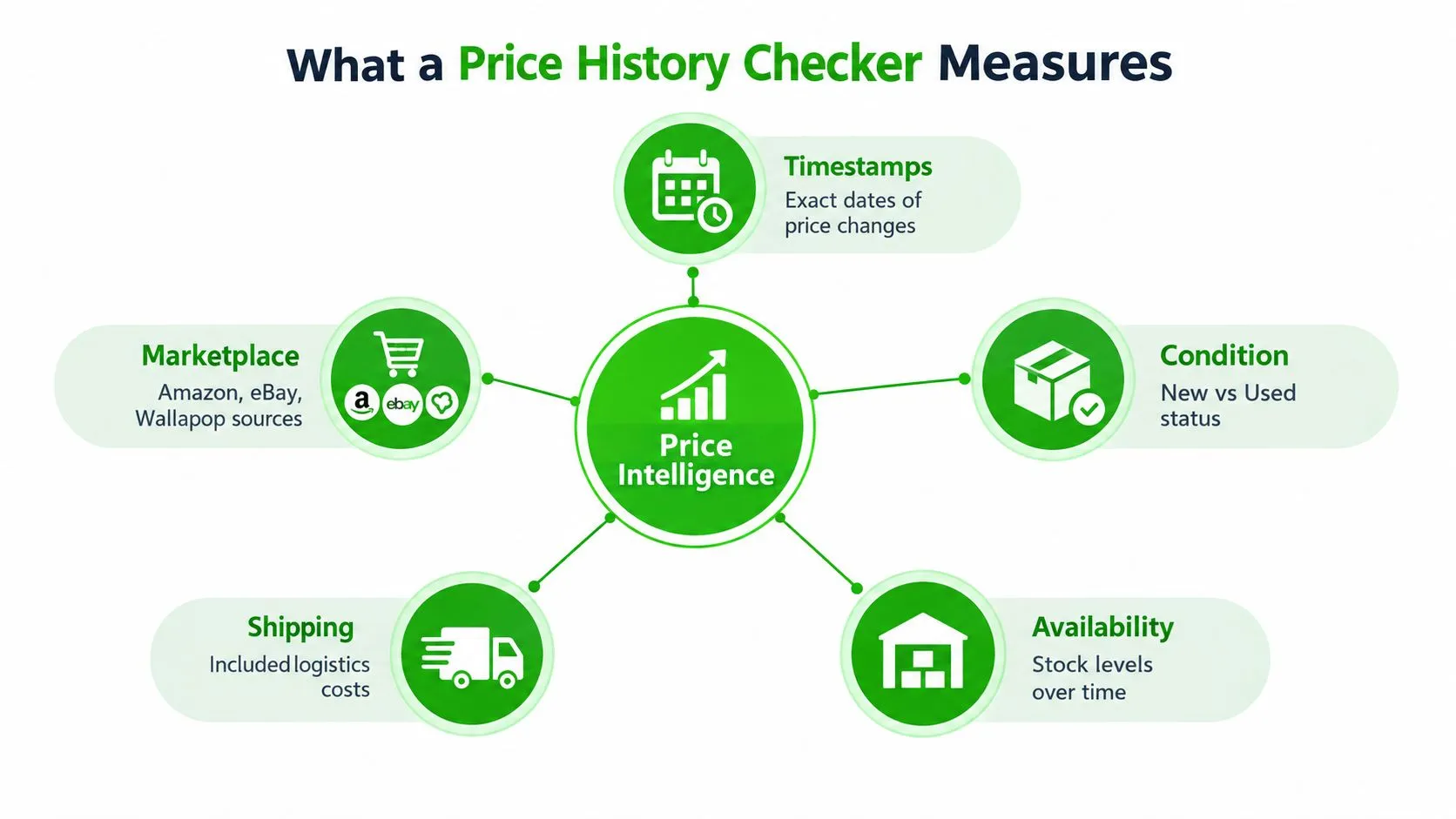
A useful checker records more than a line moving up and down. It preserves the conditions behind each observation, because a headline price without context can turn an expensive purchase into a false bargain.
The minimum useful record includes:
- Timestamp: when the price was observed or changed.
- Marketplace: where the listing appeared, such as eBay, Wallapop, or another regional platform.
- Condition: new, used, refurbished, incomplete, damaged, or otherwise qualified.
- Shipping: whether delivery was included, separate, or unavailable.
- Availability: listed, out of stock, removed, or sold where that status can be established.
Reliability matters more than volume
Research on comparison tools found that 65% of surveyed consumers had experienced a problem. Product unavailability accounted for 54% of reported problems, while incorrect prices accounted for 21%. A history built from stale or inaccurate observations can therefore give a reseller confidence without providing dependable evidence.
A serious tool should distinguish at least four price concepts:
- Displayed price, the number visible on the listing.
- Transaction price, the amount a buyer paid when that information is available.
- Promotion-adjusted price, including coupons, loyalty reductions, or payment incentives.
- Landed price, including delivery, marketplace charges, taxes, and other acquisition costs.
For second-hand stock, comparable-sales bands are more useful than a single “lowest price” marker. A camera with its original lens, tested shutter, clean optics, and working meter belongs in a different comparison group from an untested body. The displayed number may look attractive, yet delivery, fees, testing, repairs, or missing accessories can make its real acquisition cost higher than a less dramatic listing.
Wine requires the same discipline. Vintage, provenance, storage history, bottle condition, and case completeness can change value. A specialist reference such as Wine Labs cellar pricer shows why category-specific context matters when a simple product label is insufficient.
A price history checker becomes a sourcing instrument only when it preserves these distinctions. Otherwise, it is a polished record of numbers that may never have described the same product, condition, or landed cost.
How to Read Historical Price Signals
A reseller can buy into a rising chart and still lose money. The problem usually appears after purchase, when delivery, fees, taxes, testing, or repairs widen the gap between the displayed price and the actual landed cost. Historical signals help only when they are read alongside the conditions that created them.
Start by asking what the direction represents. A rising vintage-watch price may reflect stronger demand, reduced availability, or better examples entering the market. Waiting may therefore carry a cost. A falling line could indicate seasonal weakness, oversupply, declining interest, or a run of inferior listings. The line identifies movement, not its cause.
Read the pattern in a fixed order
First, inspect the range. Online market research found substantial variation between sellers offering identical products. Earlier work cited in a Columbia Business School study reported average differences of 33% for books and 25% for CDs, as described in the online market price dispersion research. Use that spread as a warning. The highest and lowest observations may describe different selling conditions, not interchangeable opportunities.
Next, separate recurring dips from isolated events. A seasonal reduction can create a useful buying window. A single sharp drop may instead reflect damage, missing parts, an incomplete listing, or a seller liquidating stock quickly. Compare equivalent items, check whether they moved at the same time, and see whether the lower price lasted long enough to represent normal trading.
Then, examine time at price. A number that appears repeatedly but rarely produces a sale may be aspirational. A slightly higher listing that disappears quickly can sit closer to the clearing price. For resale, ask where comparable items leave the market, then test whether that level still leaves room after landed costs.
Practical rule: Treat each price observation as a clue until condition, availability, and selling behavior support it.
Search behavior adds another blind spot. The same price-dispersion research found that shoppers generally checked only a few competing sites in a given month, leaving buyers and sellers with an incomplete view of the market. It also associated a 17% narrowing of online price dispersion following a 10% increase in search intensity. For auction sourcing, historical context can help you set smarter bids at auction, rather than bidding against one visible listing.
Save the item, compare its history, and record your expected buy price, landed cost, and realistic resale band. Tools for eBay price tracking can reduce reliance on memory. They cannot verify condition or protect a margin built on the wrong benchmark.
Why Lowest Price Is Not Always the Best Buy
The lowest recorded price is often a poor benchmark because second-hand listings are rarely identical. A €50 item with expensive delivery, missing accessories, uncertain functionality, and high selling fees may be worse stock than an €80 item that is complete, tested, and easy to resell.
Cross-border sourcing makes the comparison even less reliable. A European study of 600 used plug-in hybrid vehicles across six countries found average prices ranging from €25,721 in Italy to €36,690 in France, while mileage also differed substantially between the samples, as reported in the BEUC used vehicle market study. The lesson extends beyond vehicles. Country, condition, mileage, shipping, taxes, and seller quality can all change what looks like the same product.
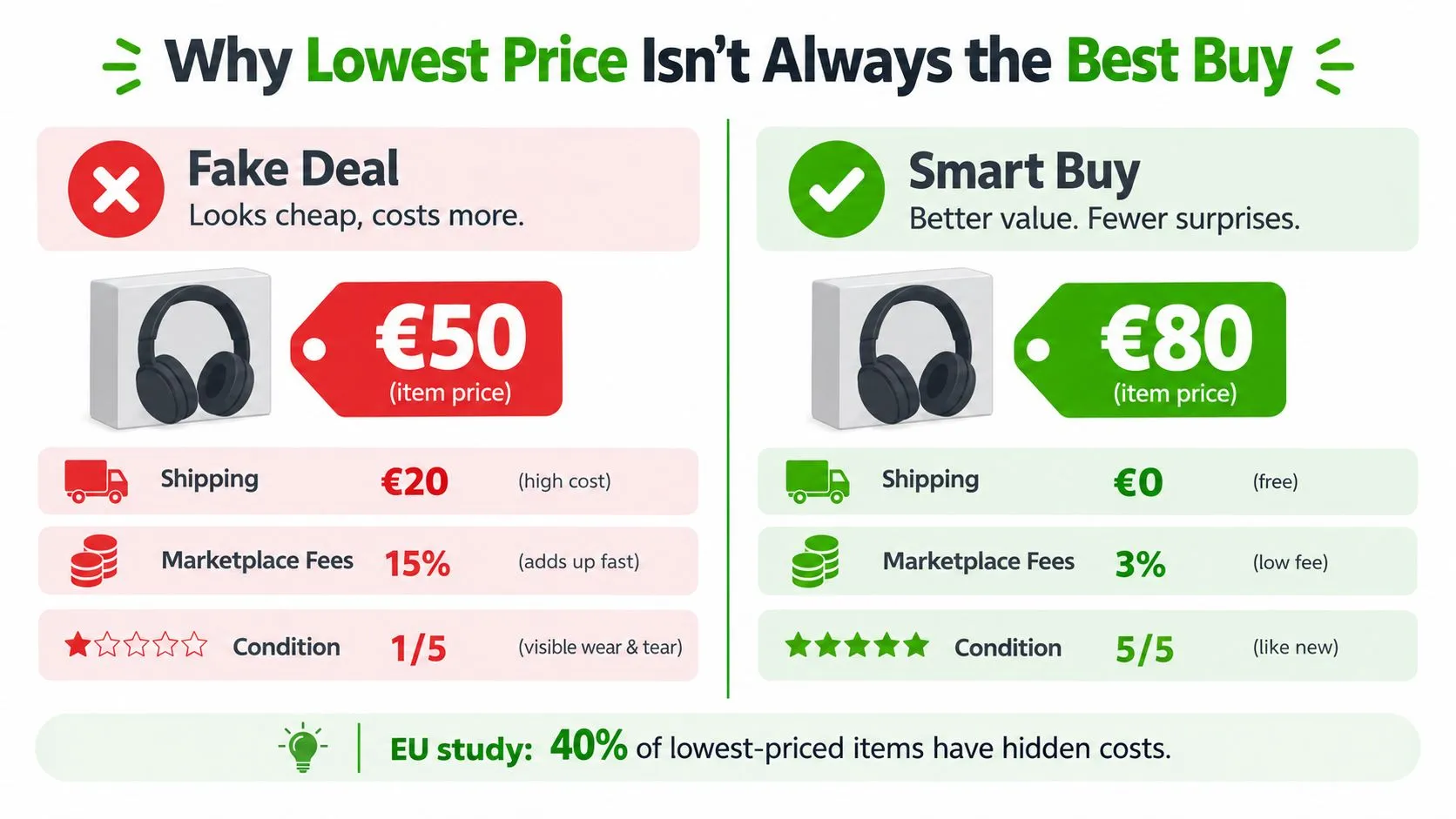
Replace headline price with landed economics
Before committing, normalize each candidate around the number that affects your business:
| Factor | Question to ask |
|---|---|
| Item price | What does the seller actually charge? |
| Delivery | What will it cost to bring the item to you? |
| Fees and taxes | Which acquisition and resale charges apply? |
| Condition | Is the item equivalent to the comparison set? |
| Completeness | Are key accessories, packaging, or documentation missing? |
| Liquidity | Can you resell this version without excessive waiting? |
The right benchmark is the lowest price for an equivalent item, not the lowest price ever observed. A worn lens with fungus may be historically cheap and commercially useless. A slightly more expensive lens with clean optics may produce a better return because buyers trust the description and accept the asking price.
Use the used-item pricing framework to keep acquisition and resale decisions connected. If the expected margin disappears after delivery, marketplace fees, testing, cleaning, and listing time, the historical low is irrelevant. You didn’t find cheap stock. You found a cheap-looking obligation.
Building a Sourcing Workflow Around Price Intelligence
Historical data only creates value when it changes what you do. A practical workflow turns observations into a buying rule that can be repeated across categories, sellers, and marketplaces.
Start with a defined buy zone
Choose the product families you understand well, then write down the conditions you’ll accept. A vintage camera workflow might separate tested bodies, untested bodies, complete kits, and body-only listings. Each group needs its own comparable history because combining them creates an artificial average.
Set your buy zone from expected resale value, not from a seller’s discount language. Include delivery, taxes, platform charges, testing, repairs, packaging, and the time required to publish and answer messages. The alert should fire when the estimated margin works, not merely when the displayed price falls.
Use four checkpoints before payment
- Target selection: Define the category, acceptable condition, and minimum margin.
- Alert trigger: Watch for prices entering the relevant historical band.
- Analysis: Verify the listing, condition, completeness, landed cost, and likely demand.
- Acquisition: Buy quickly only after the evidence supports the decision, then review the realized margin.
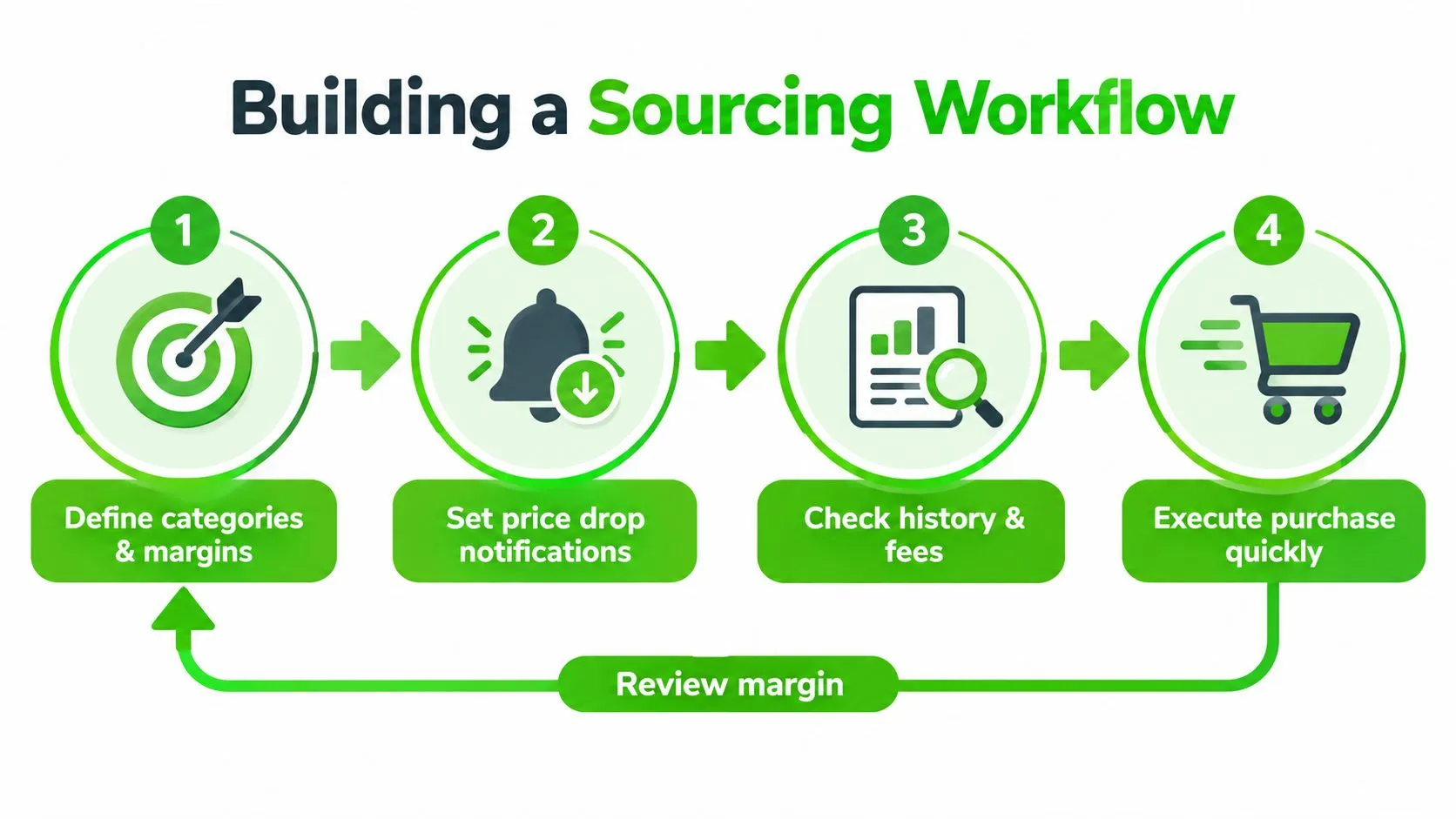
The feedback loop is essential. If a purchase looked profitable but required extensive cleaning, attracted weak demand, or sold only after a large reduction, update your category rules. A workflow that never learns from completed sales will keep repeating the same optimistic assumptions.
Some businesses also need to decide where inventory will sell. A specialist item may perform on eBay, while a locally desirable piece may be better suited to selling on a local marketplace. The channel affects delivery, buyer expectations, fees, and the time needed to complete the sale.
Ruit can sit within this kind of workflow by combining marketplace sourcing, price comparison, price history, inventory, multichannel publishing, and operational records in one system. Its value here is not a chart in isolation. It is the connection between the purchase decision, the stock record, the eventual listing, and the resulting margin. A competitive pricing intelligence workflow is useful only when the insight reaches the person deciding what to buy.
Why Resellers Who Ignore History Lose Margin
A reseller can buy an item at a price that looks low and still lose money. Professional sourcing starts by checking whether the product has a dependable resale range, whether its condition matches comparable sales, and whether the purchase leaves room for preparation, fees, delivery, and slow demand.
Ignoring history means accepting incomplete information. A buyer who checks one marketplace can miss a cheaper equivalent elsewhere. A seller pricing from memory may anchor on an unusually high listing and hold stock above what buyers accept. Research on online market research describes how limited searching can leave shoppers unaware of better offers. For resellers, the same gap can distort both acquisition cost and expected recovery.
Margin disappears in ordinary ways
Losses usually come from several small assumptions rather than one dramatic mistake:
- A temporary discount looks normal: You buy after a price drop without checking whether comparable items show the same movement.
- A damaged listing sets the benchmark: You compare a tested, complete item with an untested one because both carry the same model number.
- The resale price reflects wishful thinking: You rely on the highest visible asking price instead of a realistic market-clearing range.
- Slow stock stays outside the calculation: Storage, messages, relisting, and capital tied up reduce the outcome even when the headline spread looks attractive.
A professional buyer does not need perfect information. They need enough historical context to reject bad comparisons quickly.
The lowest recorded price can also be a poor sourcing target. It may belong to a damaged unit, a short promotion, a local pickup, or an offer whose delivery cost destroys the apparent saving. Compare the complete landed cost and likely resale condition before treating that figure as a buying benchmark.
Over time, purchase records show which categories reward patience, which sellers omit faults, and which price changes precede worthwhile opportunities. A price history checker gives smaller resellers a guardrail. Every purchase made without context moves more risk onto the cash balance.
Turning Price History Into Profitable Action
A useful price history checker should help you decide, not just display attractive charts. The decision combines comparable condition, total landed cost, expected resale value, liquidity, and the effort required to turn stock into cash.
Begin with five target items in one category. Track their price changes, marketplace, condition, availability, delivery terms, and eventual selling behavior over a defined observation period. Don’t mix a tested camera with an untested one, or a complete wine case with loose bottles. The cleaner the comparison set, the more useful the resulting buy zone.
Then create alerts around outcomes:
- Margin alert: Notify me when expected profit remains acceptable after costs.
- Comparable-price alert: Notify me when a complete, equivalent item enters its historical buying band.
- Cross-market alert: Notify me when another marketplace offers a lower landed cost.
- Risk alert: Flag listings with missing condition, unclear shipping, or incomplete promotion details.
This approach answers the question that headline discounts avoid: What will I ultimately pay, and what can I realistically recover? It also keeps the checker connected to the rest of the operation. Once you buy, the item needs inventory control, accurate listings, synchronized availability, buyer communication, and sales analysis. Fragmented tools create gaps between those steps.
Ruit provides a unified operating environment for professional second-hand businesses, including sourcing, price history, inventory, multichannel publishing, messaging, orders, accounting, and analytics. Used properly, it turns historical price information into an operating habit rather than an occasional research task.
The target isn’t to buy every item at its lowest recorded price. It’s to buy the right version, at a defensible landed cost, with enough evidence that the expected margin justifies the risk. That is how price history becomes profitable action.
Ruit brings marketplace sourcing, price-history checks, inventory, multichannel publishing, and margin-focused operations into one workflow for professional second-hand sellers. Visit Ruit to see how you can replace impulse buying with decisions grounded in comparable prices and total cost.
Frequently Asked Questions
What does a price history checker show?
It records how an item’s price changes over time, across marketplaces and availability states. A useful record keeps the timestamp, marketplace, condition, shipping terms, and availability behind each observation, so a headline price is never read without its context.
Is the lowest historical price the best time to buy?
Not always. The right benchmark is the lowest price for an equivalent item, not the lowest price ever observed. Delivery, fees, testing, repairs, or missing accessories can make a cheap listing a worse buy than a complete, tested one.
How do you read price history before buying stock?
Read it in a fixed order. Inspect the range first, then separate recurring dips from isolated events, then examine time at price to see where comparable items actually leave the market.
What is the landed price of an item?
It is the price including delivery, marketplace charges, taxes, and other acquisition costs. Comparing landed prices for equivalent items is what turns price history into evidence for a sourcing decision.
Which price alerts should a reseller set?
Set alerts around outcomes: a margin alert when expected profit stays acceptable after costs, a comparable-price alert when an equivalent item enters its historical buying band, a cross-market alert for a lower landed cost elsewhere, and a risk alert for listings with missing condition or shipping details.