Price Used Clothing for Profit: UK Resellers' Fees and Kilo Costs


Table of Contents
- Marketplace fees and the net price you actually receive
- How to price used clothing: comps, condition grading and timing
- Wholesale and buying by the kilo: expected price ranges and how to convert to per-item cost
- Worked margin examples: step-by-step calculations from buy price to net profit
- Tax and trading essentials sellers must know
- How multi-listing and inventory sync change pricing decisions
- Volume or selectivity: a practitioner’s view
- Why Ruit can help you price and sell smarter
- FAQ
- Sources
- Recommended
Pricing used clothing comes down to three things: condition, brand demand and what the marketplace fees leave you with after the sale. Before listing anything, check sold comps for similar items and run one margin calculation on your actual numbers. Most hobbyist resellers can make a reasonable return if they account for fees and postage; wholesale buyers need volume and accurate grading to make the same maths work.
TL;DR:
- UK private sellers pay no final value fee on eBay, while for business sellers eBay fees plus VAT take roughly 15.8 percent of a £45 sale; Vinted charges buyer protection fees instead of taking a cut from sellers.
- Using sold listings to set prices and applying a simple grading system helps sellers accurately value used clothing based on condition.
- Testing prices across multiple platforms with auto-relisting and inventory sync can improve sales efficiency and yield better pricing insights.
- Keep detailed records of purchase, sale, and postage costs and understand UK tax rules to stay compliant when reselling clothing commercially.
Marketplace fees and the net price you actually receive
The price you list is never the price you keep. Since 1 October 2024, UK private sellers pay no final value fee on eBay, but business sellers do. On a £40 clothing item sold with £5 postage, a business seller pays the 11.9% final value fee and the 0.35% regulatory operating fee on the £45 total plus a £0.40 per-order fee, and with 20% VAT on those fees for sellers who aren’t VAT-registered that comes to about £7.10, or roughly 15.8% of the gross amount, according to eBay’s fees for business sellers. Vinted charges buyers a separate buyer protection fee rather than taking a cut from the seller’s sale price, which changes how you should think about underpricing to compete; understanding this is important for secure pricing on resale platforms as explained in what buyer protection means for luxury fashion shoppers.
Two quick examples show the gap between listed price and take-home pay:
- A £25 sale on eBay with £3.50 postage can lose several pounds to combined fees as a business seller, once VAT and the per-order charge are included.
- A £40 sale with £5 postage loses roughly 15.8% to eBay fees and VAT as a business seller, before you account for packaging under the UK Extended Producer Responsibility scheme, which adds a small per-item cost for packaging compliance.
| Cost component | eBay UK (business seller) | Vinted |
|---|---|---|
| Final value fee | 11.9% of total sale amount (clothing) | No seller-side selling fee |
| Regulatory operating fee | 0.35% of total sale amount | None |
| Per-order fee | £0.30 up to £10, £0.40 above | None |
| VAT on fees | Applied to the fee total | Not applicable to seller |
| Buyer-side fee | None | Buyer protection fee charged separately |
How to price used clothing: comps, condition grading and timing
The fastest route to an accurate price is searching sold listings for the closest match in brand, size and condition, then using the median of those sold prices as your starting point rather than active asking prices, which are often optimistic. A simple grading system keeps this consistent across a wardrobe of items.
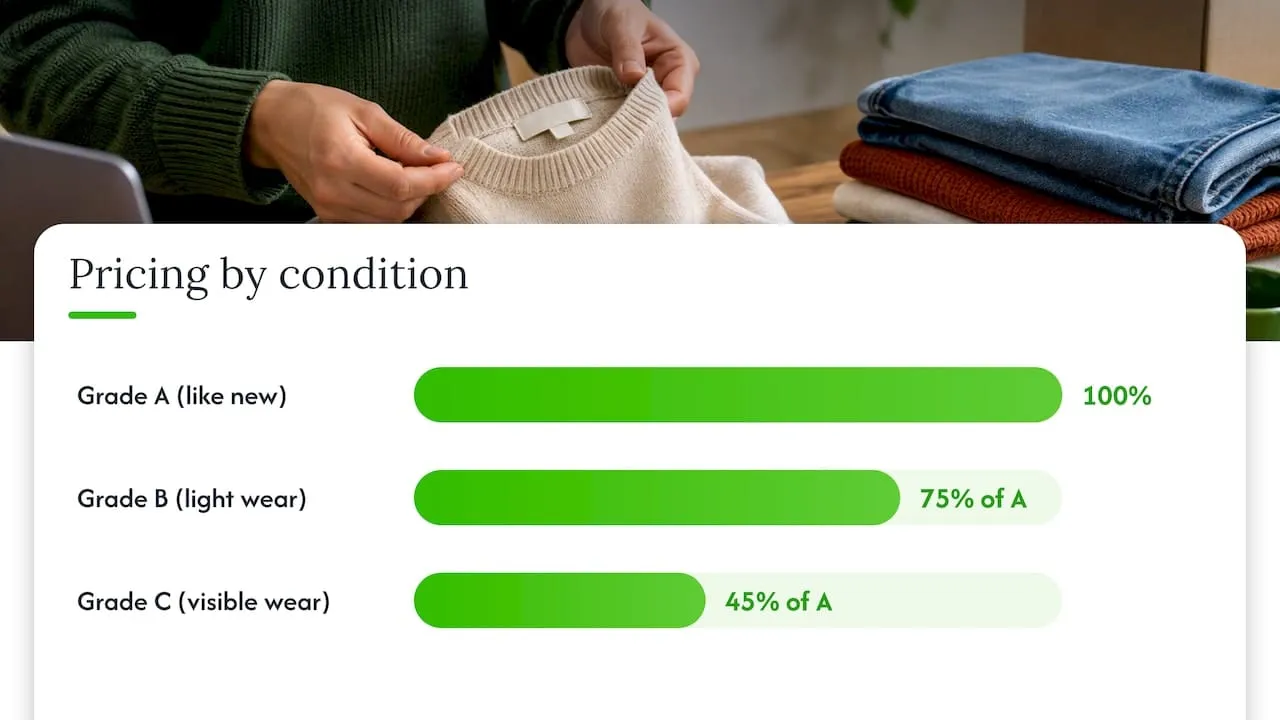
- Grade A (like new, no flaws): price at or slightly above your comp median.
- Grade B (light wear, minor marks): price at roughly 70 to 80% of the Grade A comp.
- Grade C (visible wear, missing parts): price at 40 to 50% of the Grade A comp, or bundle it.
Underpricing makes sense when you need cash flow or shelf space, or when an item is a slow-moving basic with plenty of competing listings. Holding for a premium makes more sense with recognisable vintage labels, limited runs or designer pieces where patient buyers will pay for rarity. Our guide to finding the right selling price from comps and fees walks through this comparison step by step, and checking how to view sold items on eBay is the fastest way to build your comp set.
Pro Tip: Save five sold comps per item type in a spreadsheet; the median moves less than you’d expect, and it saves you re-researching the same brand every week.
Wholesale and buying by the kilo: expected price ranges and how to convert to per-item cost
Buying in bulk changes the pricing problem from “what will this sell for” to “what’s my cost per piece before I even touch it.” Wholesale clothing lots are sold by grade, and prices vary enormously depending on quality and mix, with some bulk listings showing per-piece costs as low as around £0.33 depending on the lot, according to wholesale listings on Merkandi. Mixed bales cost less than sorted Grade A stock because you’re paying someone else to not do the sorting work for you.
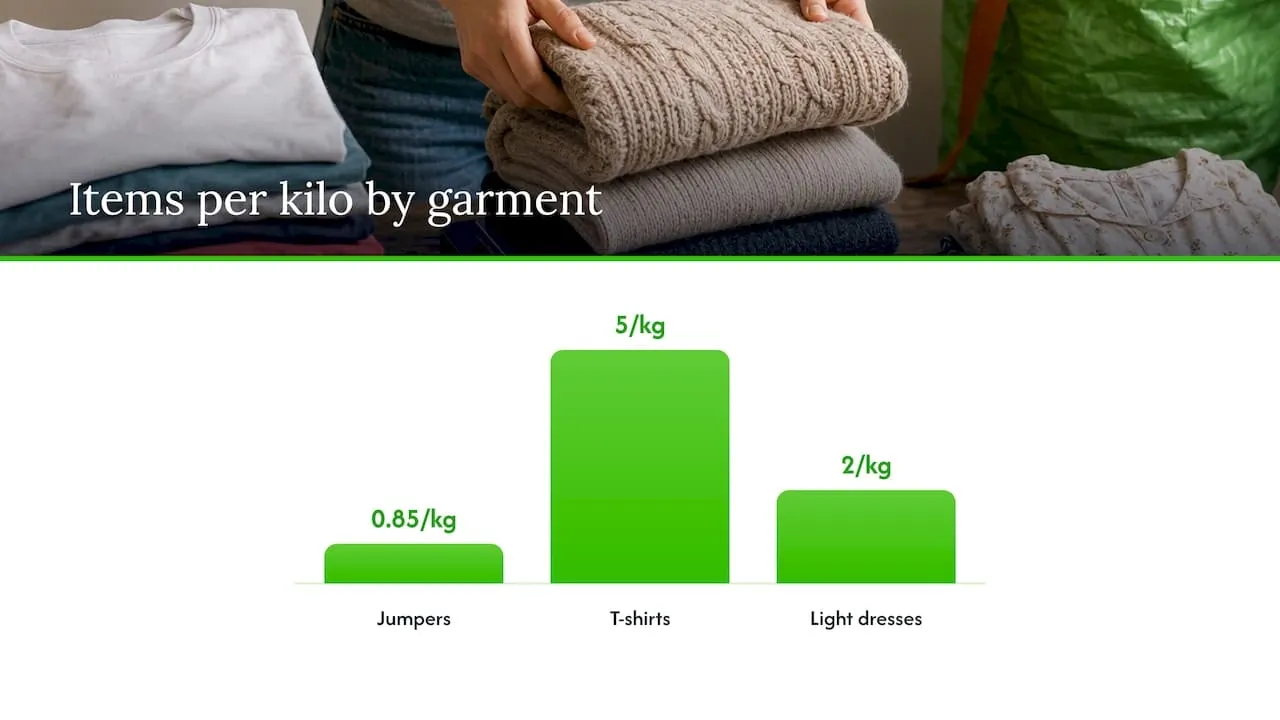
Converting a per-kilo price into a per-item cost means estimating how many garments fit in a kilo by type:
- Jumpers and heavier knitwear vary widely in weight, so weigh a few from the lot before converting the per-kilo price.
- T-shirts and lightweight tops run roughly 4 to 6 items per kilo.
- Lightweight dresses run roughly 1.5 to 2.5 items per kilo.
Before committing to a full bale, inspect a sample for mildew, strong odours, missing buttons or zips, and check the mix ratio of saleable to unsaleable stock.
- Ask the supplier for photos of a typical bale, not just the best pieces.
- Buy the smallest trial lot available before scaling up.
Worked margin examples: step-by-step calculations from buy price to net profit
The full cost of selling an item includes more than the price tag you paid. Add buy price, cleaning or repair time, photography, the marketplace’s listing and final value fees, postage, EPR packaging cost and VAT where it applies, then compare that total against your sale price.
- Single-item flip: buy a jumper for £7, sell for £25 with £3.50 postage charged to the buyer.
- As a UK private seller you pay no final value fee, so you keep £18 after the £7 buy cost; as a business seller, the 11.9% final value fee, the 0.35% regulatory operating fee, the £0.40 per-order fee and VAT on those fees come to about £4.67 on the £28.50 total, leaving about £13.33 once the £3.50 postage and the £7 buy cost are paid.
- Ten-item charity-shop batch: add up buy prices, then factor in fuel and the hour spent sourcing and photographing the batch.
A sourcing trip that nets £60 profit across ten items in two hours works out to around £30 an hour before tax, once fuel and packaging are deducted. That figure only holds if every item actually sells, so factor in a realistic sell-through rate when you calculate it. Our piece on items worth reselling for a profitable side business has more worked examples across different categories.
Tax and trading essentials sellers must know
Selling your own unwanted clothes isn’t a new tax and generally isn’t trading. Buying items specifically to resell them is a different matter: intent is what HMRC looks at when deciding whether your activity counts as trading, according to HMRC’s guidance for people buying or making things to sell.
- Platforms must report seller data to HMRC when a seller has sold at least 30 items or earned roughly £1,700 (equivalent to €2,000) in a year, under rules confirmed on GOV.UK.
- Reporting data to HMRC doesn’t automatically create a tax bill; it simply means your activity may get a closer look.
- The £1,000 trading allowance is the threshold at which trading income typically needs declaring through Self Assessment, a point restated in HMRC’s December 2024 guidance for online sellers.
- Keep buy receipts, sale records and postage costs in a separate log from day one, since mixing personal and trading sales in one account makes it hard to prove what’s taxable later.
How multi-listing and inventory sync change pricing decisions
Listing an item once across several marketplaces lets you see which channel actually wants it, rather than guessing and relisting manually on each one. A single listing publishes to multiple marketplaces, and when it sells on one channel, stock updates and the listing disappears from the rest.
- You stop needing to discount early just to avoid a double sale across platforms.
- Auto-relist keeps a listing visible without you repeating the work.
- A single inbox for messages, plus AI-drafted titles and descriptions, cuts the time spent per listing, which gives you room to hold out for a better price instead of rushing a sale.
Volume or selectivity: a practitioner’s view
Start with one trial lot, not a full bale, no matter how good the per-kilo price looks. If you can’t tell whether a sample sells through at your target price, scaling it ten times over only scales the mistake. Beginners should chase fewer, better items; sellers scaling up should chase consistent grading over flashy one-off finds.
- Luis
Why Ruit can help you price and sell smarter
Testing a price properly means seeing it in front of buyers on more than one marketplace at once, and that’s exactly what cross-listing does: one listing reaches multiple platforms together, and stock stays in sync so a sale on one channel pulls the listing from the rest automatically.
Auto-relist keeps items visible without manual repeats, a shared inbox keeps buyer questions in one place, and AI-drafted titles and descriptions cut the setup time per item. That matters most if you’re already selling across more than one marketplace and want to test a price quickly rather than committing to it blind. Our plans and pricing page has the details if you’re ready to compare options, or see the full feature overview first.
FAQ
Who pays the highest for used clothes?
There’s no single buyer who pays the most for every item; the best price depends on brand, condition and where you sell. Designer and vintage pieces tend to earn more through marketplaces with active sold comps, while fast fashion and basics often return more through cash-for-clothes depots or kilo-based buyers when speed matters more than margin.
How to determine resale value of clothing?
Search recently sold listings for the closest match in brand, size and condition, then use the median of those sold prices rather than active asking prices. Adjust that figure down for wear using a simple A, B, C condition grade.
Where can I sell used clothes for cash in the UK?
Local cash-for-clothes depots and collection points buy by weight and pay on the spot, which suits sellers who want an immediate payout rather than a longer listing process, as shown by typical cash-for-clothes depot listings. Online marketplaces like Vinted and eBay typically pay more per item but take longer to sell.
How can I get the most money for my used clothes?
Photograph items well, write an accurate condition description and price against real sold comps rather than guesswork. Holding higher-demand vintage or designer pieces for the right buyer, rather than discounting for a fast sale, usually protects margin better than racing to sell everything at once.
Sources
- Buying or making things to sell and online selling: tax rules - Tax Help for Hustles
- Gov
- eBay UK Fees 2026: Real Seller Cost Breakdown Guide · FeeHelper
- Fees for business sellers, eBay UK